
How Much Horsepower Does a 2006 Toyota Camry 4-cylinder Have

The 2006 Toyota Camry with the 4-cylinder engine produces 158 horsepower and 161 lb-ft of torque. This power comes from the proven 2.4-liter 2AR-FE engine, paired with a smooth 5-speed automatic or 5-speed manual transmission. It’s celebrated for its exceptional reliability, solid fuel economy (up to 24 MPG city/33 MPG highway), and balanced, comfortable ride. While not a sports car, its adequate power makes it a dependable and efficient family sedan that has stood the test of time.
So, you’re looking at a 2006 Toyota Camry. Maybe it’s your first car, a reliable workhorse for the family, or a sensible used sedan purchase. One of the first questions that likely comes to mind, especially if you’re comparing it to other cars like a Honda Civic or a larger vehicle, is about the muscle under the hood. Just how much horsepower does that 4-cylinder engine actually put down? It’s a simple question with a straightforward answer, but understanding what that number *means* for your daily drive is the real key. Let’s pop the hood and dive into the heart of the 2006 Camry 4-cylinder.
Key Takeaways
- Exact Horsepower: The 2006 Camry 4-cylinder (2.4L 2AR-FE engine) is rated at 158 horsepower at 5,700 RPM and 161 lb-ft of torque at 4,000 RPM.
- Engine Technology: It features Toyota’s VVT-i (Variable Valve Timing with intelligence) on the intake cam, improving efficiency and power across the rev range.
- Transmission Options: Buyers could choose between a 5-speed automatic transmission (most common) or a 5-speed manual transmission (rare, in the base CE trim).
- Real-World Performance: 0-60 mph takes approximately 8.5-9.5 seconds. It’s designed for smooth, stress-free commuting, not aggressive acceleration.
- Fuel Economy Champion: EPA ratings are 24 MPG city / 33 MPG highway for the automatic, making it very efficient for its class and era. For specific maintenance details like oil capacity, consult your manual.
- Benchmark for Reliability: This engine and transmission package is famous for its longevity, often surpassing 250,000 miles with proper care, a key reason for the Camry’s high resale value.
- Generational Context: This was the first year of the XV40 generation Camry. The 4-cylinder offered a significant power increase (15 more hp) over the previous 2005 model’s 2.4L engine.
[FEATURED_IMAGE_PLACEHOLDER]
📑 Table of Contents
The Heart of the Beast: The 2AR-FE Engine Specs
For the 2006 model year, Toyota introduced the all-new XV40 generation Camry. With it came a brand new engine for the 4-cylinder models: the 2.4-liter 2AR-FE. This wasn’t just a minor refresh; it was a ground-up redesign focused on power, efficiency, and smoothness. The “2AR” code tells engineers a story: the “2” means it’s in the 2-liter family, “A” denotes the engine family, “R” is for the specific variant, and “FE” stands for “Fuel Economy.” That last part is crucial—this engine was built from the start to be efficient, not just powerful.
Unpacking the Numbers: 158 HP and 161 lb-ft
So, what’s the official output? The 2006 Toyota Camry 4-cylinder produces 158 horsepower at 5,700 revolutions per minute (RPM) and 161 pound-feet of torque at 4,000 RPM. Let’s translate that into plain English. Horsepower is a measure of the engine’s total power output, useful for understanding its top speed and sustained performance. Torque, measured in lb-ft, is the twisting force that gets the car moving from a stop and helps with passing and hill climbing. The fact that peak torque arrives at a relatively low 4,000 RPM is great news. It means you get strong, usable pulling power right in the heart of your daily driving range, without needing to rev the engine high. You’ll feel confident merging onto the highway or climbing a steep on-ramp.
Key Engine Technology: VVT-i
How did this new engine make more power than its predecessor while being more fuel-efficient? The star of the show is VVT-i, or Variable Valve Timing with intelligence. On this engine, it’s applied to the intake camshaft. valves control the flow of air and fuel into the engine and the exhaust gases out. By continuously adjusting the timing of when those intake valves open and close based on engine speed and load, the 2AR-FE can optimize for either maximum power (at higher RPMs) or maximum efficiency (at lower, cruising RPMs). This clever system is a big reason the 2006 Camry feels smoother and more responsive than the 2005 model, despite being in the same displacement class. It’s a mature technology Toyota has perfected, and it’s a major factor in the engine’s legendary reliability.
What Does 158 Horsepower Actually Feel Like?
Numbers on a spec sheet are one thing. How does that power translate when you’re behind the wheel? In a word: adequate. In two words: comfortable and confident. The 2006 Camry 4-cylinder is not a sports sedan. It will not pin you back in your seat like a turbocharged hot hatch. Instead, it offers a smooth, linear power delivery. The sound is a quiet, refined hum rather than a raucous roar. The acceleration is best described as “unhurried.”
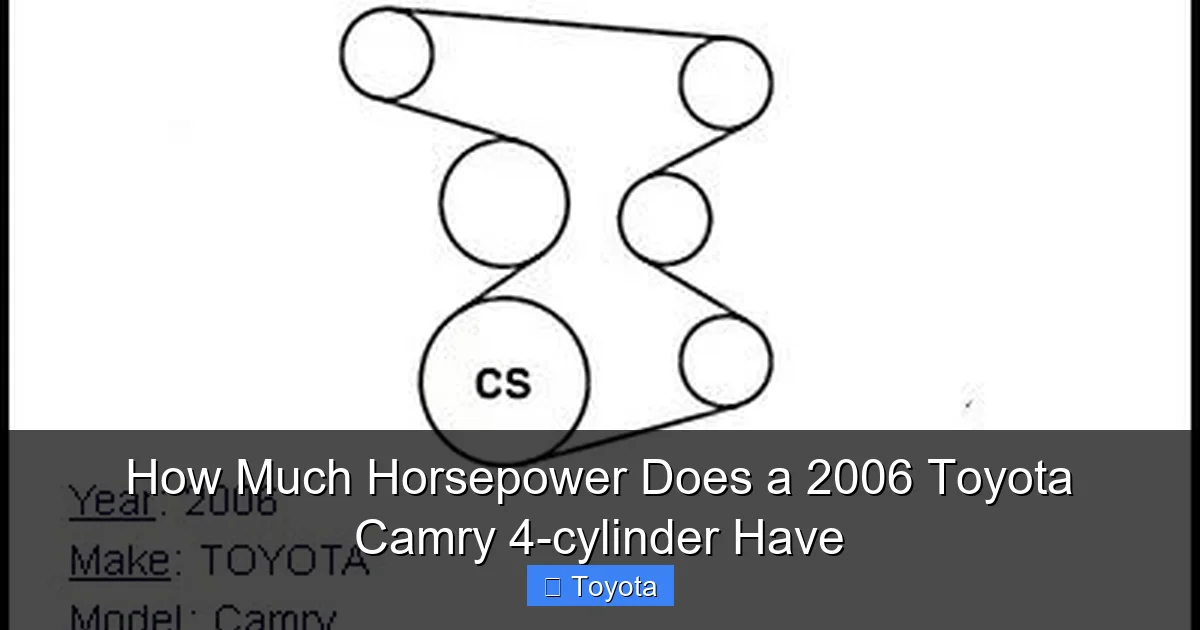
Visual guide about How Much Horsepower Does a 2006 Toyota Camry 4-cylinder Have
Image source: serpentinebeltdiagram.com
Real-World Performance Metrics
In independent tests, a well-maintained 2006 Camry 4-cylinder automatic will typically go from 0 to 60 miles per hour in about 8.5 to 9.5 seconds. That’s perfectly acceptable for a family sedan. For comparison, a base 2006 Honda Civic LX coupe with its 1.8L engine (140 hp) would take about 9.5-10.5 seconds. A V6-powered 2006 Camry, by contrast, would sprint to 60 in around 6.5-7 seconds. The 4-cylinder’s power is more than enough for daily commuting, highway cruising, and passing maneuvers when you downshift the (excellent) 5-speed automatic. The manual transmission, while rare, makes the car feel slightly more engaged and can shave a few tenths off the 0-60 time with a skilled driver.
Where the Camry truly shines is in its refinement and quietness. The engine and transmission work in seamless harmony. You won’t feel harsh shifts or hear excessive engine noise, even when accelerating onto a busy interstate. This “effortless” quality is a hallmark of the Camry and a huge part of its appeal. It’s a car that doesn’t tire you out; it soothes you.
The All-Important Fuel Economy: Where the 2AR-FE Excels
This is where the 2AR-FE engine, and the Camry as a whole, truly justifies its existence. The EPA ratings for the 2006 Camry 4-cylinder with the automatic transmission are 24 miles per gallon in the city and 33 miles per gallon on the highway. The manual transmission model was even slightly more efficient. In real-world driving, many owners report seeing 26-28 MPG combined, with highway trips easily hitting the mid-30s. This was class-leading for a midsize sedan at the time and remains very respectable today.
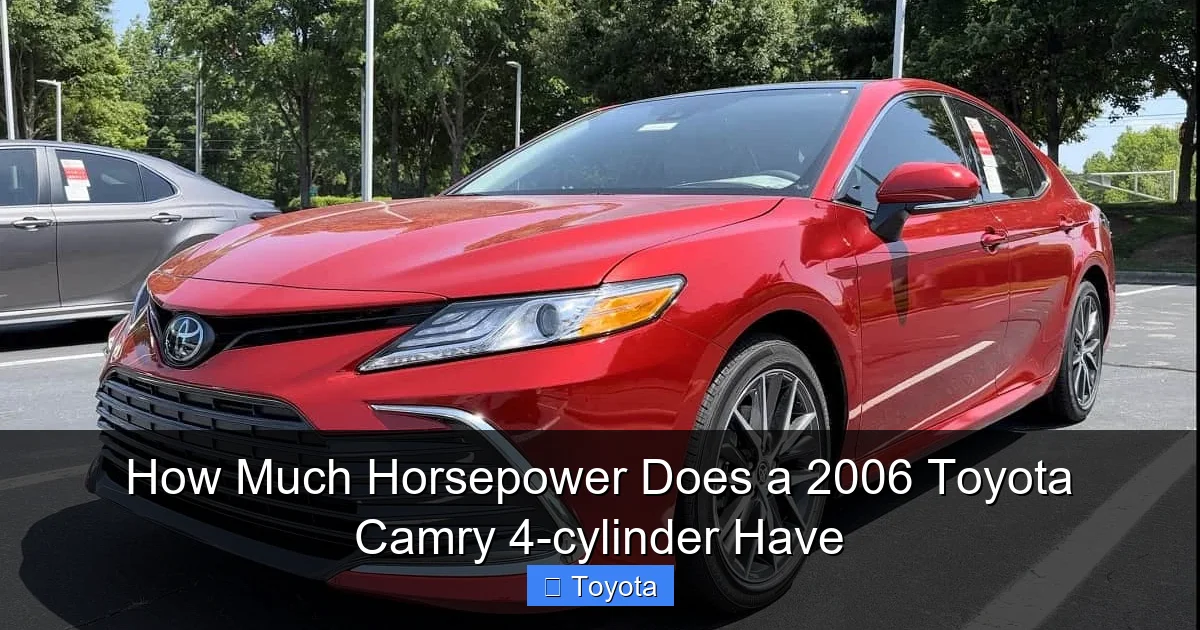
Visual guide about How Much Horsepower Does a 2006 Toyota Camry 4-cylinder Have
Image source: torquenews.com
Why It’s So Efficient
The efficiency comes from a combination of factors. The VVT-i system we discussed is the primary one, ensuring the engine breathes optimally at all times. The engine also features electronic throttle control (drive-by-wire), which provides precise fuel metering. The 5-speed automatic transmission has tall enough gearing to keep the engine revs low during highway cruising, which is where you get that 33 MPG number. The car’s aerodynamic shape also plays a role. For drivers maximizing efficiency, understanding the fuel tank capacity helps plan long trips without stops.
This combination of adequate power and excellent fuel economy is the sweet spot for the vast majority of car buyers. You get enough get-up-and-go without constantly visiting the gas station. It’s a pragmatic, no-nonsense engineering achievement.
Reliability and Longevity: The Legend Continues
You cannot discuss the 2006 Camry 4-cylinder without talking about its reputation for bulletproof reliability. The 2AR-FE engine, coupled with the Aisin-built 5-speed automatic transmission, is considered one of the most durable powertrain combinations Toyota ever produced. There are no major, widespread mechanical failures associated with this engine. Common maintenance items are exactly what you’d expect: oil changes, spark plugs, timing belt (yes, this engine has a timing belt that must be replaced every 60,000-90,000 miles), and filters.
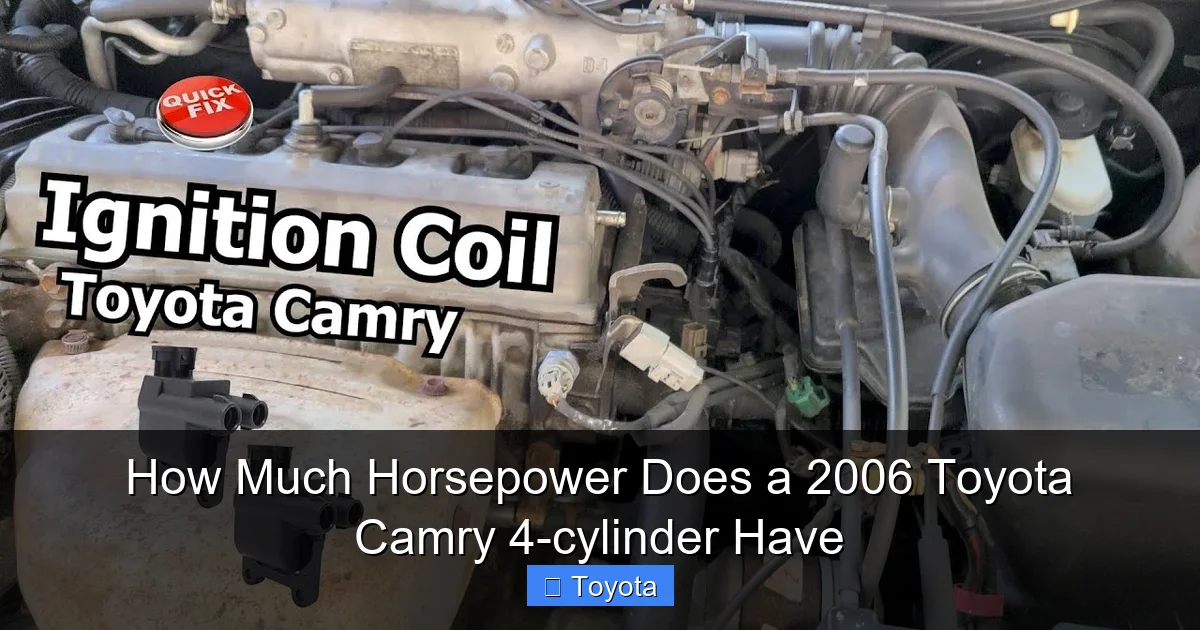
Visual guide about How Much Horsepower Does a 2006 Toyota Camry 4-cylinder Have
Image source: i.ytimg.com
What to Look For When Buying Used
When shopping for a used 2006 Camry, the engine itself is rarely the problem. Your focus should be on the overall condition of the vehicle. A full service history is golden. Has the timing belt been replaced on schedule? Have the transmission fluid and coolant been serviced? These are the critical items. Listen for smooth shifts from the automatic. There should be no harsh clunks, slips, or delayed engagement. Check for any oil leaks around the valve cover gasket (a common and inexpensive fix). The rest of the car—the interior, electronics, suspension components—will tell the real story of how well it’s been cared for. A well-maintained 2006 Camry with this engine can easily provide another 150,000-200,000 miles of dependable service. For those considering modifications, understanding the cost to wrap a Toyota Camry can be part of personalizing a reliable platform.
The takeaway is this: the 158 hp figure isn’t exciting, but the engineering behind it is. It’s a design philosophy centered on low stress, high efficiency, and maximum longevity. You’re not buying a thrill ride; you’re buying a tool that will start every morning, get you where you need to go, and ask for very little in return.
Putting It in Context: How Does It Compare?
To fully appreciate the 2006 Camry 4-cylinder’s output, it’s helpful to look at its peers from 2006 and its own evolution. In the fiercely competitive midsize sedan segment, horsepower wars were heating up.
Vs. The Competition (2006 Models)
- Honda Accord (4-cylinder): The Accord’s 2.4L i-VTEC engine made 160 hp and 161 lb-ft of torque—nearly identical to the Camry. The driving experience was slightly more engaging, but the Camry was quieter and smoother.
- Nissan Altima (4-cylinder): Used a 2.5L engine making 175 hp and 180 lb-ft. It felt notably quicker and more responsive, but often at a slight cost to observed fuel economy and long-term refinement perception.
- Ford Fusion (4-cylinder): The base 2.3L engine made 160 hp, while the optional 3.0L V6 made 221 hp. The Fusion was a strong contender but didn’t have the Camry’s reputation for bulletproof reliability at the time.
The Camry’s 158 hp put it right in the middle of the pack—competitive but not leading. Its advantage was the holistic package: the seamless transmission, the quiet cabin, the Toyota badge, and the unbeatable reliability forecast.
Evolution Within the Camry Line
For the Camry itself, this was a major leap. The 2005 Camry 4-cylinder (2.4L 2AZ-FE) made only 144 hp. The jump to 158 hp for 2006 was a 9.7% increase, which owners definitely felt in real-world driving. This 2AR-FE engine would soldier on, with minor tweaks, through the 2011 model year. For the 2012 redesign (XV50), the 4-cylinder grew to 2.5L (2AR-FE, same basic design) and was tuned to 178 hp, showing the continuous refinement of this engine architecture.
So, while 158 hp might seem modest today, in 2006 it was the perfect number for Toyota’s target audience: enough to be competitive, delivered in the smoothest possible way, and engineered to last forever.
Ownership Experience: The Practical Reality
Let’s bring it all home. What does owning and driving a 2006 Camry 4-cylinder with 158 horsepower mean for you today?
The Daily Grind
It means a car that is utterly predictable and unintimidating. The light steering, the comfortable seats, the quiet cabin—it all combines to make traffic jams and long highway drives less stressful. The power is there when you need it. You press the pedal, the transmission downshifts, and the car accelerates with a quiet, steady surge. It won’t win drag races, but it will never leave you feeling vulnerable or underpowered in normal driving situations. This predictability is a huge safety benefit; you always know what the car is going to do.
The Long-Term Outlook
This is the Camry’s superpower. An engine with 158 horsepower that is not being stressed to its limits every day is an engine that will last. The 2AR-FE is a workhorse, not a racehorse. It’s designed to run at low-to-medium RPMs for hundreds of thousands of miles. As long as you follow the maintenance schedule—especially the critical timing belt replacement—the powertrain is likely the last part of the car you’ll need to worry about. The rest of the car (suspension, electronics, interior wear) will age, but the core mission of getting you from Point A to Point B is fulfilled with near-total reliability. For a used car buyer, this peace of mind is worth more than any extra 20 horsepower.
In conclusion, the answer to “how much horsepower” is a specific, documented 158. But the real answer is a philosophy. It’s 158 horsepower delivered with Toyota’s signature refinement, wrapped in a package of unmatched dependability and fuel efficiency. It’s not about the peak number; it’s about the entire, stress-free experience that number enables. That’s why, nearly two decades later, the 2006 Camry 4-cylinder remains one of the smartest, most rational used car choices on the road.
Frequently Asked Questions
Is 158 horsepower enough for a 2006 Toyota Camry?
Yes, absolutely. For a midsize family sedan of its era, 158 hp provided adequate acceleration and confident highway merging. It was designed for smooth, comfortable, and efficient commuting rather than sporty performance, and it excels in that role.
Does the 2006 Camry 4-cylinder have enough power to tow?
While the owner’s manual may list a very light towing capacity (around 1,000 lbs for a trailer with brakes), this engine and vehicle are not designed for regular towing. Its power and cooling systems are optimized for the car’s weight alone. Attempting to tow significant weight will strain the engine and transmission and is not recommended.
Can I increase the horsepower of my 2006 Camry 4-cylinder?
Significant horsepower gains on this naturally aspirated engine are costly and complex. Simple, effective modifications include a cold air intake and a performance exhaust, which may add 5-10 hp by improving airflow. For substantial gains, a forced-induction (turbocharger or supercharger) kit is required, but it’s expensive, impacts reliability, and requires extensive supporting modifications.
What is the difference between the 2005 and 2006 Camry 4-cylinder horsepower?
The 2005 Camry 4-cylinder (2AZ-FE engine) produced 144 horsepower. For the 2006 model year’s redesign, the new 2AR-FE engine increased output to 158 horsepower—a gain of 14 hp—thanks to the new VVT-i system and other refinements.
Is the 2006 Camry 4-cylinder faster than the V6 model?
No. The 2006 Camry V6 (3.5L 2GR-FE) produced 268 horsepower. It is significantly quicker, with a 0-60 mph time around 6.5 seconds compared to the 4-cylinder’s 8.5-9.5 seconds. The V6 is for those prioritizing performance, while the 4-cylinder prioritizes fuel economy and lower cost.
How does the horsepower compare to a modern Camry 4-cylinder?
Modern Camry 4-cylinders are much more powerful. The current 2.5L 4-cylinder produces 203-206 hp. This increase comes from advanced direct fuel injection, higher compression ratios, and more sophisticated engine management, while maintaining similar or better fuel economy.
