
Can I Drive with a Maintenance Required Light on in a Toyota

The maintenance required light in your Toyota is a service reminder, not an immediate danger signal. While you can typically drive 500-1,000 miles, ignoring it risks engine damage and costly repairs. Always check your oil and schedule service promptly—never just reset the light without addressing the underlying maintenance.
Key Takeaways
- It’s a mileage/time-based reminder: The light illuminates based on preset intervals to signal scheduled maintenance is due, primarily an oil change.
- It’s not an emergency, but don’t ignore it: Unlike a check engine light, it doesn’t indicate immediate failure, but prolonged neglect causes engine wear.
- Driving with it on is possible short-term: Most Toyotas can safely go 500-1,000 miles after the light comes on, but conditions matter.
- Always check your oil first: When the light illuminates, immediately verify oil level and quality; low oil is a separate, critical issue.
- Resetting without service is a bad idea: Simply turning off the light without performing maintenance is unethical, harmful to the engine, and may void warranty.
- Consult your owner’s manual: Your specific Toyota model and year has exact maintenance intervals and reset procedures outlined by the manufacturer.
- Ignoring it hurts resale value: A persistent maintenance light can deter buyers and lower your car’s trade-in value.
📑 Table of Contents
- So, That Little Light Is On… Now What?
- Understanding Your Toyota’s Maintenance Required Light
- The Real Risks of Ignoring That Little Wrench
- How Long Can You Actually Drive With It On?
- What to Do the Moment That Light Comes On
- Resetting the Light – A Temporary Fix, Not a Solution
- Proactive Maintenance: The Secret to a 300,000-Mile Toyota
- Conclusion: A Friendly Reminder, Not a Threat
So, That Little Light Is On… Now What?
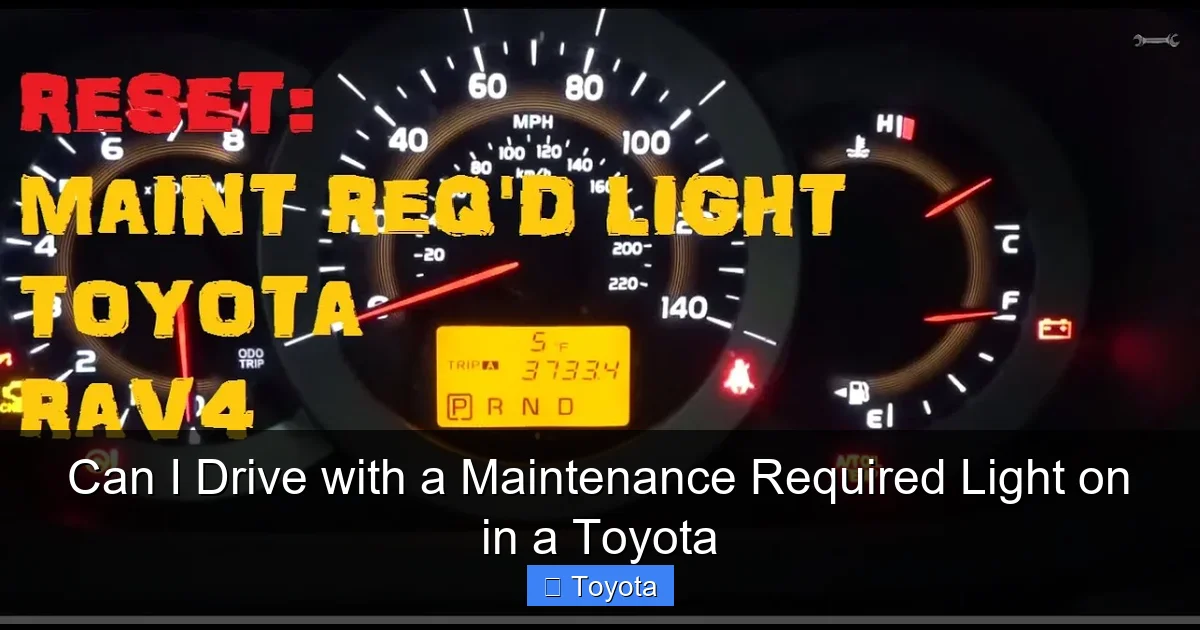
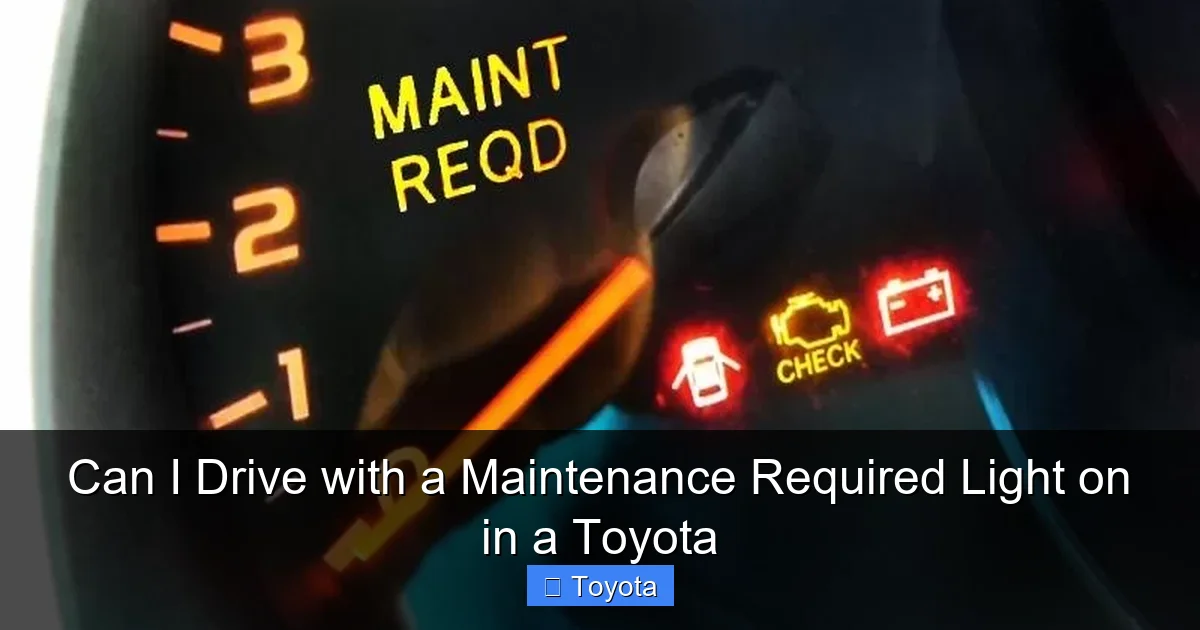
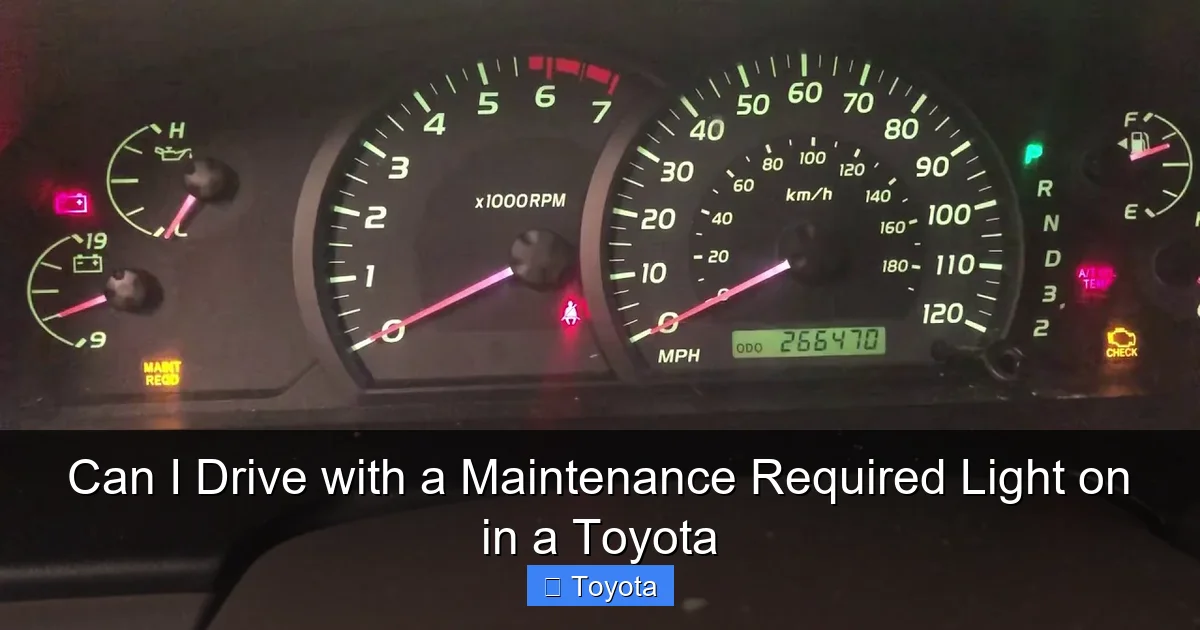
You’re cruising down the highway, the sun is shining, your favorite playlist is on, and then—you see it. That little amber wrench or “MAINT REQD” symbol glowing on your Toyota’s dashboard. Your immediate thought might be a pang of anxiety: “Can I still drive this? Am I about to break down?” Take a deep breath. That maintenance required light is one of the least intimidating warnings your car can give you, but it is a crucial nudge from your vehicle. It’s your Toyota’s polite but firm way of saying, “Hey, it’s time for our scheduled check-up.” Unlike the ominous, blinking check engine light that screams “STOP NOW,” the maintenance required light is a reminder, not a reprimand. In this guide, we’ll break down exactly what this light means, the real risks of ignoring it, how far you can safely drive, and the exact steps you should take. Think of this as your friendly, no-nonsense playbook for handling one of the most common dashboard alerts in your Toyota.
Understanding Your Toyota’s Maintenance Required Light
To make smart decisions, you need to understand what you’re dealing with. The maintenance required light is part of your Toyota’s onboard computer system, specifically the Maintenance Required Reminder (MRR) system. It’s not a sensor that detects a problem in real-time. Instead, it’s a simple mileage and time-based timer. Think of it like the calendar alert on your phone for a dentist appointment. The car doesn’t know if your oil is dirty; it just knows it’s been 5,000 miles or six months since the last time you (or a technician) reset the timer. This system is designed to prompt you for the regularly scheduled maintenance outlined in your owner’s manual, which typically includes oil and filter changes, tire rotations, and comprehensive inspections of key components like brakes, fluids, and belts.
Visual guide about Can I Drive with a Maintenance Required Light on in a Toyota
Image source: i.ytimg.com
How the System Works: The Simple Math
The system is elegantly simple. After you have your oil changed (or perform the maintenance yourself), the technician—or you—must reset the maintenance required light. This resets the internal counter to zero. From that point, the computer begins counting down the miles and tracking time. The preset interval varies by model year and engine type, but for most modern Toyotas (pre-2020 models), it’s set to illuminate every 5,000 miles. Newer models with synthetic oil or specific driving conditions might have intervals of 7,500 or even 10,000 miles. Once you reach that predetermined mileage threshold, the light comes on steadily. It will remain on until you manually reset it after the maintenance is performed. There is no “sensor” checking your oil’s actual condition; it’s purely a distance/time tracker.
What Triggers the Light? It’s Usually the Oil Change
While the light is a general service reminder, its primary trigger is the engine oil change interval. Your engine oil is its lifeblood, and it degrades over time and use. The manufacturer’s recommended interval balances optimal engine protection with convenience. When the light comes on, it’s screaming, “My oil has served its recommended lifespan! Please replace it.” However, the reminder also encompasses other time/mileage-based services. For example, at 30,000 miles, the light might remind you of a major service that includes air filter replacement, cabin filter replacement, and a thorough multi-point inspection. The key takeaway: the light means “scheduled maintenance is overdue,” with the oil change being the most common and urgent component of that schedule.
The Real Risks of Ignoring That Little Wrench
“It’s just a reminder,” you might think. “I’ll get to it next week.” This mindset is where trouble begins. While the maintenance required light doesn’t signal an imminent catastrophic failure like a red oil pressure light, ignoring it is like ignoring your body’s thirst for water during a marathon. The consequences are slow, cumulative, and expensive. The primary risk stems from aged, degraded engine oil. Fresh oil is a viscous, slippery liquid that lubricates the thousands of metal parts moving at high speeds inside your engine, reducing friction and heat. As it ages, it breaks down, becomes contaminated with fuel byproducts and microscopic metal particles, and loses its viscosity. This turns it into a sludge-like substance that fails to lubricate properly.
Visual guide about Can I Drive with a Maintenance Required Light on in a Toyota
Image source: towingless.com
The Domino Effect of Skipped Oil Changes
Driving with old oil sets off a chain reaction. First, increased friction causes components like piston rings, cylinder walls, and camshafts to wear prematurely. This wear is microscopic at first but adds up, leading to decreased compression and reduced engine efficiency. You might notice a drop in fuel economy—your engine is working harder. Second, the sludge can clog small oil passages, preventing oil from reaching critical areas like the valve train. This can cause noisy lifters and, in extreme cases, valve train wear. Third, the oil’s ability to neutralize acids and suspend contaminants diminishes, allowing corrosive substances to attack internal metal parts. The most severe outcome is engine seizure, where parts weld together from extreme heat and friction due to a lack of lubrication. Repairing or replacing an engine is one of the most costly repairs you can face, often running into thousands of dollars. A $50 oil change is a tiny fraction of that cost.
Other Services You’re Missing
The maintenance required light isn’t just about oil. It’s a flag for the entire service schedule. By ignoring it, you’re also postponing:
- Tire Rotations: Uneven tire wear, leading to premature tire replacement and poor handling.
- Brake Inspections: Worn brake pads or contaminated brake fluid can compromise stopping power.
- Fluid Checks: Coolant, transmission fluid, brake fluid, and power steering fluid degrade. Low or old coolant can lead to overheating; old transmission fluid causes harsh shifting and eventual transmission failure.
- Air & Cabin Filters: A clogged engine air filter starves your engine of clean air, reducing power and fuel economy. A dirty cabin filter hurts your AC performance and air quality.
Each neglected item adds wear and tear, shortening the overall lifespan of your reliable Toyota.
How Long Can You Actually Drive With It On?
This is the million-dollar question. The short, practical answer is: you can typically drive 500 to 1,000 miles after the light comes on before risking significant damage. However, this is not a license to procrastinate. Think of it as a grace period, not an invitation. The exact safe distance depends heavily on several critical factors. Your driving style and conditions are the biggest variables. If you’re doing mostly highway miles at steady speeds, your engine is under less stress, and you might be on the higher end of that range. If you’re in stop-and-go city traffic, constantly towing a trailer, or driving in extreme heat or cold, the engine works harder, the oil degrades faster, and you should aim for the lower end—closer to 300-500 miles.
Visual guide about Can I Drive with a Maintenance Required Light on in a Toyota
Image source: i.ytimg.com
Oil Type Matters: Conventional vs. Synthetic
The type of oil in your engine dramatically affects this timeline. If your Toyota uses conventional motor oil (common in older models), its lifespan is shorter, and the 5,000-mile interval is firm. Driving beyond 1,000 miles past the light with conventional oil is pushing your luck. If your vehicle uses full synthetic oil (required for many newer models and turbocharged engines), the oil is more resilient. Synthetic oil maintains its protective properties longer and can often safely extend the interval. In this case, driving 1,000-1,500 miles might be less risky, but it’s still not recommended. Always default to the interval in your owner’s manual. For a concrete example of how different warning lights have different “ranges,” consider the fuel gauge. Many drivers wonder how many miles they can drive when the gas light comes on in a Toyota Camry. The answer for fuel is usually 30-50 miles, a much shorter buffer because running out of gas causes an immediate, complete shutdown. The maintenance light’s buffer is longer because engine wear is a slower, cumulative process.
The Bottom Line on Driving Distance
Treat the illuminated maintenance required light as a firm deadline to schedule service within the next week or two. Do not plan a cross-country road trip with it on. Use the 500-1,000 mile guideline as an absolute maximum under ideal conditions. The safest and most cost-effective practice is to schedule your oil change and service as soon as the light comes on. This habit protects your engine, maintains your fuel economy, and ensures all other systems are inspected and serviced on time. Procrastination is the true enemy here, not the light itself.
What to Do the Moment That Light Comes On
So, the light is on. Don’t panic. Don’t immediately floor it to the nearest shop. Instead, follow these logical, calm steps.
Step 1: Check Your Engine Oil Level IMMEDIATELY. This is non-negotiable. Pop the hood, locate the dipstick, pull it out, wipe it clean, reinsert it fully, and pull it out again. Check that the oil level is between the “MIN” and “MAX” or “L” and “F” marks. If it’s low, add the correct type of oil (check your owner’s manual for viscosity, like 0W-20) to bring it to the proper level. A low oil level is a separate, critical emergency that requires immediate attention and could be the reason the light came on (though the MRR system itself doesn’t monitor level). If the oil looks extremely dark, gritty, or smells burnt, that’s a sign of severe degradation and you should limit driving and get serviced urgently.
Step 2: Assess Your Driving Needs. Do you need to drive to work tomorrow? Can you carpool or use another vehicle for a few days? If possible, minimize driving until you can get service. If you must drive, avoid hard acceleration, high RPMs, and severe traffic. Keep your trips short and efficient.
Step 3: Schedule Your Service. Call your trusted Toyota dealer or independent mechanic. Explain that your maintenance required light is on and you’d like to schedule the recommended service for your mileage. They will look up the exact service bulletin for your model year and VIN. This is typically a standard oil and filter change, tire rotation, and multi-point inspection. Book the appointment.
Step 4: Do NOT Reset the Light Yet. Resist the urge to look up how to reset it and turn it off before the work is done. Resetting is the final step after the maintenance is complete. Turning it off prematurely is like erasing a to-do list item without doing the task—it creates a false sense of security and causes you to forget the real need.
Resetting the Light – A Temporary Fix, Not a Solution
Once the recommended maintenance is performed—the oil is changed, the filters are replaced, the tires are rotated—the technician will reset the maintenance required light. This is a simple procedure that tells the car’s computer, “The service is complete. Start the countdown over.” For many DIY-inclined Toyota owners, resetting the light is a straightforward process involving the odometer button and ignition. However, it’s vital to understand that resetting the light is not a maintenance procedure. It is merely the administrative act of clearing the reminder. If you reset the light without actually performing the oil change or other services, you are actively harming your engine and deceiving yourself. You’ve turned off the alarm but left the fire smoldering. The reset procedure can vary slightly between models. For a general walkthrough that covers most Toyota vehicles, you can refer to our detailed guide on how to reset the maintenance required light on a Toyota. Remember: reset only after the work is done.
Proactive Maintenance: The Secret to a 300,000-Mile Toyota
The maintenance required light is your car’s built-in scheduling tool. The best way to deal with it is to never let it catch you off guard. Proactive ownership is the hallmark of Toyota owners who enjoy legendary reliability and high resale values. Here’s how to stay ahead of the curve.
Follow the Schedule, Not the Light.
Don’t wait for the light to come on. Your owner’s manual provides a detailed maintenance schedule based on “normal” or “severe” driving conditions. Most drivers fall into the “severe” category (short trips, cold weather, dusty roads, heavy loads). Adopt the severe schedule for maximum protection. This means oil changes every 5,000 miles with conventional oil or 7,500-10,000 with synthetic, regardless of when the light comes on. By being proactive, you’ll often change your oil before the light ever illuminates, keeping your engine in pristine condition.
Keep Meticulous Records.
Save every receipt for oil changes, tire rotations, and major services. Create a digital or physical log with dates, mileage, and what was done. This documentation is gold for two reasons: first, it proves you’ve maintained the car according to schedule, which is crucial for warranty claims. Second, it significantly boosts your car’s resale value when you sell it, as a well-documented service history is a top selling point for used Toyotas.
Use the Right Parts and Fluids.
Always use the oil viscosity and specification (e.g., Toyota Genuine Motor Oil or API-certified) recommended in your manual. For filters, use a high-quality filter from a reputable brand. When other parts need replacement (wipers, batteries, brakes), OEM (Original Equipment Manufacturer) or equivalent quality parts ensure compatibility and longevity. Skimping on oil or filters to save $5 is a false economy that costs you big time in engine wear.
Conclusion: A Friendly Reminder, Not a Threat
That maintenance required light in your Toyota is not a harbinger of doom. It’s a helpful, predictable tool designed to keep your car running smoothly for the long haul. The answer to “Can I drive with it on?” is yes, for a limited and reasonable distance—typically up to 1,000 miles under ideal conditions. But the wise answer is to treat it as an urgent to-do item. The moment it illuminates, check your oil, assess your schedule, and book a service appointment. Never, ever reset the light without performing the underlying maintenance. By respecting this simple reminder, you protect your engine’s health, maintain your vehicle’s legendary reliability, save money on expensive repairs, and ensure your Toyota continues to be a source of pride and trouble-free transportation for years to come. Listen to what your car is telling you; it’s one of the smartest conversations you’ll have as a vehicle owner.
Frequently Asked Questions
Is it safe to drive my Toyota with the maintenance required light on?
Yes, it is generally safe to drive for a limited distance (typically 500-1,000 miles). The light is a service reminder, not an indicator of immediate danger like a red oil pressure light. However, you should schedule maintenance promptly to avoid engine wear from old oil.
How many miles can I drive after the maintenance required light comes on?
Most Toyota models allow for 500 to 1,000 miles of driving after the light illuminates. The exact safe distance depends on your driving conditions (severe vs. normal) and oil type. Always check your oil level and quality immediately and aim to get service within a week or two.
What does the maintenance required light actually mean?
It means your Toyota has reached a preset mileage or time interval for scheduled maintenance, as outlined in your owner’s manual. It primarily signals that an oil and filter change is due, but it can also remind you of other services like tire rotations and multi-point inspections.
Can I reset the maintenance light without getting service?
Technically yes, you can reset it via a button sequence, but you should never do this without performing the required maintenance. Resetting without service deceives you into thinking the car is maintained, leading to engine damage from old oil and potentially voiding your warranty.
Will my Toyota pass a state inspection with the maintenance required light on?
No, in most states, a vehicle will fail a safety or emissions inspection if the maintenance required light is illuminated. The light indicates overdue factory-scheduled maintenance, which inspectors will note as a failure to meet safety standards. Always address the light before your inspection.
What should I do if the maintenance required light is flashing?
A steadily illuminated maintenance required light is normal. However, if it is flashing or blinking, this is not standard for the MRR system and may indicate a different, more serious issue. In this case, treat it like a check engine light, stop driving as soon as it is safe, and have your vehicle diagnosed by a professional immediately.
