
How to Reset Check Engine Light on 2013 Toyota Highlander

Resetting the check engine light on a 2013 Toyota Highlander is a straightforward process, but it requires careful attention. The light is a warning indicator, not a problem itself, so you must diagnose and fix the underlying issue first. You can reset it using an OBD2 scanner, by disconnecting the battery, or by completing a successful drive cycle after repairs. Never ignore a persistent check engine light, as it signals a problem that could worsen over time.
Key Takeaways
- Diagnosis Before Reset: Always read and address the stored trouble codes with an OBD2 scanner before clearing the light. Resetting without repair is temporary and misleading.
- Method Matters: Using an OBD2 scanner is the fastest, most reliable method. Disconnecting the battery is a manual alternative but may reset other vehicle systems.
- The Drive Cycle is Key: After clearing codes, the vehicle must complete a specific drive cycle for the light to stay off, proving the issue is resolved.
- Light Behavior Tells a Story: A steady light indicates a non-emergency issue. A flashing light means severe engine misfire—stop driving immediately and seek professional help.
- Professional Help is Sometimes Necessary: For complex codes, intermittent problems, or if the light returns quickly, consult a certified mechanic for proper diagnosis and repair.
📑 Table of Contents
- Understanding Your 2013 Toyota Highlander’s Check Engine Light
- Before You Reset: The Essential Diagnostic Step
- Method 1: Resetting with an OBD2 Scanner (The Recommended Way)
- Method 2: The Battery Disconnect Method (A Manual Reset)
- Method 3: The Drive Cycle (Letting the Computer Verify the Fix)
- When to Seek Professional Help
- Proactive Maintenance to Avoid Future Lights
- Conclusion: Knowledge is Power Under the Hood
Understanding Your 2013 Toyota Highlander’s Check Engine Light
That little amber or yellow light on your dashboard, shaped like an engine, is one of the most misunderstood features in your 2013 Toyota Highlander. Officially called the Malfunction Indicator Lamp (MIL), it’s part of your vehicle’s On-Board Diagnostics (OBD-II) system. Its primary job is to tell you that the engine computer, or powertrain control module (PCM), has detected a problem it can’t correct on its own. It’s not a “service engine” reminder like the maintenance required light; it’s a cry for help from your car’s brain. When it illuminates, it means a sensor or system is operating outside its normal parameters, and a specific trouble code has been stored in the computer’s memory.
Many people’s first instinct is to find out how to reset the check engine light immediately. But this is the wrong first step. Resetting the light erases the diagnostic trouble codes (DTCs) from the computer’s memory without fixing the underlying problem. It’s like turning off a smoke alarm without putting out the fire. The light will likely return, often within a few drive cycles, because the fault still exists. The correct sequence is always: Diagnose, Repair, then Reset. This guide will walk you through that entire process for your 2013 Highlander, ensuring you not only turn off the light but also keep it off for good.
What Triggers the Light? Common Culprits in a Highlander
Your 2013 Highlander’s 3.5L V6 or 2.7L I4 engine is a complex system. The check engine light can be triggered by anything from a loose gas cap to a failing catalytic converter. Some of the most common reasons include:
- Loose or Faulty Gas Cap: A cap that doesn’t seal properly allows fuel vapors to escape, causing evaporative (EVAP) system codes like P0455 (large leak) or P0440 (system malfunction).
- Oxygen Sensor Failure: The O2 sensors monitor exhaust gases. A failing upstream sensor (before the catalytic converter) hurts fuel economy and performance. A downstream sensor (after the cat) monitors catalyst efficiency. Codes like P0130-P0135 are common.
- Catalytic Converter Issues: This expensive component reduces emissions. If it fails or becomes inefficient, you’ll see codes like P0420 (cat system efficiency below threshold).
- Mass Air Flow (MAF) Sensor Problems: This sensor measures incoming air. Contamination or failure causes rough running, poor acceleration, and codes like P0100-P0103.
- Ign System Misfires: Worn spark plugs, bad ignition coils, or faulty spark plug wires can cause misfires (codes P0300-P0306). A flashing check engine light indicates a severe misfire that can damage the catalytic converter.
- Evaporative Emission (EVAP) System Leaks: Leaks in the fuel tank, vapor lines, or purge valve cause codes in the P0440-P0457 range.
These are just a few examples. There are hundreds of possible codes. This is why reading the specific code is the non-negotiable first step.
Before You Reset: The Essential Diagnostic Step
You cannot responsibly reset the check engine light without knowing why it came on. This step saves you money, prevents damage, and ensures your Highlander is safe and compliant with emissions tests. Here’s exactly what you need to do.

Visual guide about How to Reset Check Engine Light on 2013 Toyota Highlander
Image source: dodgecheckenginelight.com
Reading the Trouble Codes: Your Roadmap to the Problem
To read the codes, you need an OBD-II scanner. This is a simple electronic tool that plugs into the Data Link Connector (DLC) under your dashboard, left of the steering column. Any scanner purchased after 1996 will work with your 2013 Highlander.
- Basic Code Readers ($20-$50): These simply read and clear generic and some manufacturer-specific codes. They are sufficient for most DIYers. Popular brands include Autel, Ancel, and Innova.
- Advanced Scanners/Apps ($50+): Tools like the Autel MaxiCOM or BlueDriver app with a Bluetooth adapter provide live data, code definitions, and repair suggestions. Highly recommended.
- Free Services: Many auto parts stores (AutoZone, Advance Auto, O’Reilly) will scan your codes for free. This is a great option if you don’t own a tool.
How to Scan: Turn the ignition to “ON” (do not start the engine). Plug the scanner into the DLC. Follow the scanner’s menu to “Read Codes.” It will display one or more alphanumeric codes (e.g., P0171, P0302). Write these down. Do not clear them yet! Use the scanner’s code lookup feature or a reliable online database to understand what each code means. This diagnosis tells you which system or component needs attention.
When to Absolutely NOT Reset the Light
There are critical situations where resetting the light is dangerous and irresponsible:
- Flashing MIL: A flashing check engine light indicates a severe engine misfire. Unburned fuel is flooding the exhaust and can overheat and destroy your catalytic converter in minutes. You must stop driving safely and have the vehicle towed.
- Along with Other Warning Lights: If the check engine light is accompanied by the red oil pressure warning light, battery light, or temperature gauge in the red, your car has a critical, immediate safety issue. Pull over and shut off the engine.
- After a Major Repair: If you just replaced a component like the catalytic converter, you must reset the codes to see if the repair was successful and to clear the readiness monitors for a smog test.
- If You Have No Idea What the Code Means: If you’ve read a code but don’t understand it or how to fix it, take it to a professional. Guessing can lead to expensive, unnecessary part replacements.
Remember, the check engine light is your car’s way of communicating a fault. Resetting it is like hanging up on a important phone call—you’ll miss the crucial information.
Method 1: Resetting with an OBD2 Scanner (The Recommended Way)
Once you’ve diagnosed the problem, replaced the faulty part, or made the necessary repair, it’s time to clear the codes. Using an OBD2 scanner is the cleanest, most controlled method. It directly communicates with the PCM to erase the stored DTCs and reset the MIL.
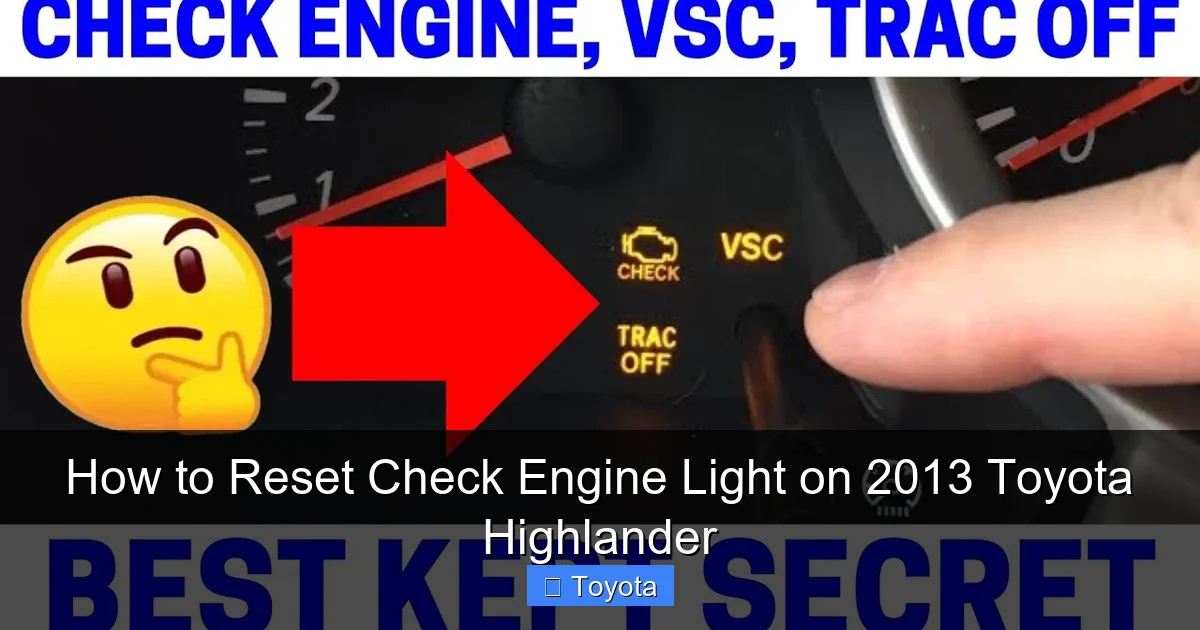
Visual guide about How to Reset Check Engine Light on 2013 Toyota Highlander
Image source: i.ytimg.com
Step-by-Step Scanner Reset Procedure
This process is identical for nearly all OBD2 scanners, from basic to advanced.
- Ensure the Repair is Complete: Double-check that the issue causing the code is fully resolved. For example, if you replaced an O2 sensor, ensure the wiring is intact and the connector is secure.
- Prepare the Vehicle: Turn off all accessories (radio, A/C, lights). Place the key in the ignition but do not start the engine. For keyless entry, press the “Start/Stop” button twice without touching the brake pedal to put the system in “ON” mode.
- Connect the Scanner: Plug the scanner’s cable firmly into the DLC under the dashboard. You should hear a click.
- Power On: Turn the scanner on if it has a separate power button.
- Navigate to “Erase Codes” or “Clear DTCs”: Use the scanner’s menu. This option is often under “Codes,” “Diagnostics,” or “Tools.” WARNING: Some scanners have a separate “Reset Emissions” or “Readiness Monitors” function. Clearing codes does not always reset the monitors. You may need to do this separately if preparing for an emissions test.
- Confirm and Execute: The scanner will ask for confirmation. Select “Yes” or “OK.” The process takes a few seconds. You may hear a beep or see a message like “Codes Cleared” or ” MIL Off.”
- Verify: The check engine light on your Highlander’s dash should go out immediately. Start the engine. The light should remain off. If it comes back on immediately, the problem was not fixed correctly, or a new fault has occurred.
What About Readiness Monitors?
This is a crucial concept for emissions testing (smog check). After you clear codes, your Highlander’s computer must run a series of self-tests, called “readiness monitors,” to verify all emission systems are working. These include tests for the EVAP system, oxygen sensors, and catalytic converter. You cannot pass an emissions test if these monitors are not “Complete” or “Ready.” Simply clearing codes sets all monitors to “Not Complete.” They will only reset after you drive the vehicle under specific conditions (the drive cycle). This is why the light may stay off, but you could still fail a smog test if you haven’t completed the drive cycle. Your advanced scanner can check monitor status.
Method 2: The Battery Disconnect Method (A Manual Reset)
This old-school method works on many vehicles, including your 2013 Highlander, by temporarily cutting power to the PCM. However, it’s a blunt instrument with significant downsides. Use this only if you have no scanner and have already made a repair.

Visual guide about How to Reset Check Engine Light on 2013 Toyota Highlander
Image source: cararac.com
How to Perform a Battery Reset on a 2013 Highlander
This method will clear codes but also reset all your vehicle’s memory settings.
- Safety First: Park safely, engage the parking brake, and turn off the engine. Ensure all electrical accessories are off.
- Locate the Battery: Open the hood. The battery is in the engine bay, typically on the driver’s side near the firewall.
- Identify Terminals: The negative (-) terminal is connected to a black cable with a minus (-) symbol. The positive (+) terminal has a red cable and a plus (+) symbol.
- Disconnect the NEGATIVE Terminal FIRST: Using a 10mm socket or wrench (common size for Toyota), loosen the nut on the negative terminal clamp. Carefully lift the clamp and cable off the battery post. Tuck it away so it cannot accidentally touch the post.
- Wait: This is the most important part. You must wait at least 10-15 minutes. This allows all residual electrical charge to drain from the PCM and modules. Simply disconnecting for 30 seconds is often not enough for a full reset on modern vehicles.
- Reconnect: Reattach the negative cable to the battery post and tighten the nut securely. Do not overtighten.
- Start the Vehicle: You may notice some transient issues—the idle may be rough, the transmission may shift oddly, the clock and radio presets will be lost. This is normal. The PCM is in a “relearn” mode. Drive the car normally for 15-20 minutes. The PCM will gather new data from all sensors and the idle should smooth out.
- Check the Light: The check engine light should be off. If it comes back on, the original fault persists or a new one has appeared.
Major Drawbacks of the Battery Method
- Resets Everything: You will lose radio presets, clock settings, seat memory (if equipped), and any learned transmission shift points. The vehicle will drive differently for a short time.
- May Not Work on All Systems: Some modules have backup memory that retains codes even with battery disconnected.
- Risk of Radio/System Lockout: On some vehicles, disconnecting the battery can trigger an anti-theft system lockout requiring a code. While rare on 2013 Highlanders, it’s a risk.
- Doesn’t Reset Readiness Monitors Intentionally: While it clears codes, the subsequent drive may not follow the precise sequence needed to set all monitors to “Ready,” potentially causing a failed smog test.
For these reasons, the OBD2 scanner method is always superior. If you do use the battery method, be prepared to reset your clock and radio. You might also find helpful guides for other Toyota models, like how to reset the maintenance light on a 2013 Toyota Highlander, which involves a different, simpler procedure.
Method 3: The Drive Cycle (Letting the Computer Verify the Fix)
Here’s the part many DIYers miss. Resetting the light is only half the battle. For the light to stay off, the PCM must successfully complete its internal self-tests, the readiness monitors. If a monitor fails, the PCM will turn the MIL back on, often with the same code. The only way to satisfy these monitors is to drive your Highlander under a specific set of conditions called a “drive cycle.”
General Toyota Highlander Drive Cycle Guidelines
Exact drive cycles vary by model year and engine. The following is a general guide that works for most 2013 Highlanders to set the primary monitors (Catalyst, EVAP, Oxygen Sensors). A more precise cycle can be found in a factory service manual.
- Cold Start: Start the engine when it’s completely cold (overnight). Let it idle for 2-3 minutes. Do not rev the engine.
- Low-Speed Steady Cruise: Drive at a steady 40-50 mph on a flat highway for 8-10 minutes. Do not use cruise control for the entire time; vary your speed slightly.
- Decelerate: Slow down gently by lifting off the throttle (do not brake) to about 20 mph. Coast for 30 seconds.
- Accelerate: Gently accelerate back up to 50-55 mph. Hold for 2-3 minutes.
- Stop and Idle: Come to a complete stop at a stop sign or light. Put the transmission in “Park” or “Neutral” and let the engine idle for 2 minutes.
- Final Step: Turn the ignition off. Wait 30 seconds. Restart the engine. The drive cycle is complete.
After this cycle, the monitors should be set. You can verify this with your OBD2 scanner under “Readiness Monitors” or “I/M Status.” All or most should show “Complete” or “Ready.” Important: Do not attempt this drive cycle if your check engine light is still on. Fix the problem first, clear the codes, then perform the drive cycle.
Why Your Light Might Come Back On After a Reset
If you’ve reset the light and it returns within a few days, here’s what likely happened:
- Incomplete or Incorrect Repair: The part you replaced was not the root cause, or it was installed incorrectly. For example, you replaced an O2 sensor but the exhaust leak near it is still causing a lean condition.
- Faulty New Part: The replacement part itself is defective.
- Related System Issue: Fixing one code revealed another. For instance, fixing a misfire (P0302) might cause the EVAP monitor to fail if a leak was previously masked.
- Drive Cycle Not Completed: The PCM detected the fault again during its self-tests after the reset.
- Intermittent Problem: The fault is not constant (e.g., a wiring harness that shorts only when turning the steering wheel). This is tricky to diagnose and often requires a professional with a lab scope.
If the light returns, you must re-scan for codes. The same code means the repair failed. A different code means a new or secondary problem was found.
When to Seek Professional Help
While resetting the light is simple, proper diagnosis and repair are not always. Here are clear signs it’s time to call a certified mechanic, preferably one familiar with Toyotas.
Complex or Multiple Codes
If your scan shows multiple codes from different systems (e.g., an oxygen sensor code and a misfire code), the problems may be related or there may be a master fault. A professional has the training to trace wiring diagrams and perform advanced diagnostics like live data streaming, voltage tests, and smoke machine tests for EVAP leaks. They can determine if, for example, a misfire is causing the O2 sensor code or vice versa.
Flashing Check Engine Light
As stated before, this is an emergency. A flashing MIL indicates a severe, active misfire that is dumping raw fuel into the exhaust. This can overheat and melt the catalytic converter in a very short distance, leading to a $2,000+ repair. Do not drive the vehicle. Have it towed.
Intermittent Issues and “No Codes” Stored
Sometimes the light comes on, you scan it, and there are no codes stored. Or the light comes and goes randomly. This points to a very intermittent electrical problem—a loose connector, a wire with a break in the insulation, or a failing PCM. Diagnosing these requires patience, experience, and tools like a digital multimeter and oscilloscope that go beyond a basic code reader.
Failed Emissions Test (Smog Check)
If your Highlander fails an emissions test due to a check engine light being on or monitors not ready, you need a professional. They have proprietary Toyota scan tools that can perform more detailed tests and force monitor operations. They can also ensure the repair is done to state standards. The process for preparing for a smog test is similar to the drive cycle but more stringent. You can learn more about Toyota-specific maintenance by reading guides like how to reset the maintenance light on a 2017 Toyota Highlander, which is a separate, simpler procedure.
Proactive Maintenance to Avoid Future Lights
The best way to deal with a check engine light is to prevent it from coming on in the first place. Following your Highlander’s maintenance schedule is key.
Stick to the Factory Maintenance Schedule
Your owner’s manual outlines critical services at specific mileage intervals. For a 2013 Highlander with the 3.5L V6, this typically includes:
- Every 5,000-7,500 miles: Oil and filter change, tire rotation. This is the most important basic maintenance.
- Every 30,000 miles: Inspect and replace engine air filter. Inspect cabin air filter. Inspect spark plugs (replace if needed, usually around 60k-100k miles on platinum/iridium plugs).
- Every 60,000 miles: Replace spark plugs (if not done earlier). Inspect and possibly replace drive belts. Inspect and service the EVAP system (purge valve, etc.).
- Every 100,000 miles: Major service including timing belt/water pump inspection (if equipped with a belt—the 3.5L V6 in the 2013 Highlander uses a timing chain, which is generally “lifetime” but still requires inspection), coolant replacement, and differential fluid service (for AWD models).
Using high-quality parts and oil that meets Toyota specifications (like 0W-20 synthetic) is crucial for the longevity of sensors and emissions systems.
Address Small Problems Immediately
That rough idle, the slight hesitation on acceleration, or the faint smell of fuel are clues. Get them checked before they trigger a check engine light and cause secondary damage. A $50 oxygen sensor connector replacement now is better than a $300 sensor and a failed catalytic converter later. Also, always ensure your gas cap is tightened until it clicks. A missing or damaged gas cap is a top cause of EVAP codes.
Use Quality Fuel
Buy gasoline from reputable stations. Poor-quality fuel with contaminants can foul injectors, damage sensors, and cause carbon buildup, leading to misfires and efficiency codes. Consider using a Toyota-approved fuel system cleaner occasionally if you primarily drive short trips.
Conclusion: Knowledge is Power Under the Hood
Resetting the check engine light on your 2013 Toyota Highlander is the final, ceremonial step in a repair process—not the solution itself. By following the proper sequence of diagnose with an OBD2 scanner, repair the identified fault, and then clear the codes, you empower yourself as a vehicle owner. You save money on unnecessary repairs, prevent small issues from becoming catastrophic failures, and ensure your Highlander passes emissions tests. Remember the battery disconnect method is a last resort, and the drive cycle is your proof of a successful fix. If at any point the problem seems beyond your comfort zone—especially with a flashing light or complex codes—do not hesitate to seek a professional’s expertise. Your Highlander is a reliable SUV, and with informed care, it will continue to serve you well for many miles to come. For other common Toyota service lights, such as the maintenance required indicator, the process is much simpler and often done without tools—you can find specific instructions for your model year through dedicated guides.
Frequently Asked Questions
Will disconnecting the battery reset the check engine light on a 2013 Toyota Highlander?
Yes, disconnecting the negative battery terminal for 10-15 minutes will usually reset the check engine light by cutting power to the PCM. However, it also resets all other vehicle memory (radio, clock, transmission adaptations) and is less reliable than using an OBD2 scanner. It should only be used after making a repair.
Can I pass a smog test if I just reset my check engine light?
No. Simply resetting the light will not make your car pass a smog test. The vehicle must complete its drive cycle to set all emissions-related readiness monitors to “Ready.” If the light is on or monitors are not ready, you will automatically fail. The light must be off due to a successful repair, not just a reset.
How long does it take for the check engine light to come back on after a reset if the problem isn’t fixed?
It varies. The PCM typically runs its self-tests during normal driving. If the underlying fault persists, the light will usually return within 10-50 miles of driving, often after a cold start or specific driving conditions. This is a clear sign the repair was incomplete.
Is it safe to drive my Highlander with the check engine light on?
It depends. A steady check engine light means a non-emergency issue (like a loose gas cap or failing sensor). You can drive cautiously but should get it diagnosed soon. A flashing check engine light indicates a severe engine misfire. Stop driving immediately and have the vehicle towed to prevent catastrophic damage to the catalytic converter.
How much does it cost to have a shop reset my check engine light?
Many shops will reset the light for free or a small fee ($20-$50) if you have already performed the repair yourself. However, if you need them to diagnose the problem, expect to pay a diagnostic fee (typically $80-$150) which includes the scan and identification of the faulty component. The reset is part of that service.
My check engine light is on, but the car runs fine. What could it be?
A common scenario. The most frequent cause is a loose or faulty gas cap, which triggers an EVAP system leak code. Other possibilities include a failing oxygen sensor that hasn’t yet affected performance, a minor evaporative leak, or a non-critical sensor issue. You must scan for codes to know for sure. Do not ignore it, as a small problem can lead to reduced fuel economy and eventually more serious damage.
