
How Do You Reset the Check Engine Light on a 2009 Toyota Corolla?

The proper way to reset the check engine light on a 2009 Toyota Corolla is by using an OBD-II scanner, which clears the stored trouble codes after the underlying issue has been repaired. Simply disconnecting the battery is not recommended, as it may not clear all codes and can cause other systems to reset. Always diagnose and fix the original problem first to ensure the light stays off and your vehicle remains safe and reliable.
How Do You Reset the Check Engine Light on a 2009 Toyota Corolla?
That little, glowing orange orb on your dashboard. The one that looks suspiciously like an engine. For any 2009 Toyota Corolla owner, the moment it illuminates, a wave of dread and a million questions flood your mind. “What’s wrong?” “How much is this going to cost?” “Can I just… make it go away?” I’ve been there, trust me. The urge to simply reset the check engine light on a 2009 Toyota Corolla is strong, but before we dive into the “how,” we absolutely must talk about the “why.” Resetting the light without addressing the core issue is like taking a painkiller for a broken bone—it masks the problem while the damage gets worse. This guide is your complete companion, walking you through the responsible steps to diagnose, understand, and finally, if appropriate, reset that pesky light. Think of me as your gearhead friend who’s been under the hood of a Corolla or two.
The 2009 Corolla, a paragon of reliability, uses the universal OBD-II (On-Board Diagnostics) system. When its computer, the ECM (Engine Control Module), detects something outside normal parameters—say, a loose gas cap or a faulty oxygen sensor—it stores a Diagnostic Trouble Code (DTC) and turns on the Malfunction Indicator Lamp (MIL), which we all call the check engine light. Our goal is to read that code, solve the problem, and then clear the code to extinguish the light. Let’s get started.
Key Takeaways
- Diagnose first: Never reset the light without identifying the triggering problem.
- Use an OBD2 scanner: Connect to your Corolla’s port for the simplest, most reliable reset.
- Disconnect the battery: Remove the negative terminal for several minutes as a manual reset method.
- Complete a drive cycle: Drive under varied conditions to confirm the repair and light stays off.
- Address root causes: Resetting only clears the symptom; fix the actual mechanical or electrical issue.
- Seek professional help: For complex or persistent codes, a mechanic’s diagnostic is essential.
- Don’t ignore warnings: A reset light may mask serious safety or emissions problems needing attention.
📑 Table of Contents
- 1. Understanding Your Check Engine Light: It’s Not Always an Emergency
- 2. The Golden Rule: Diagnose Before You Reset
- 3. Method 1: The Professional Way – Using an OBD-II Scanner to Reset
- 4. Method 2: The “Disconnect the Battery” Trick (A Last Resort)
- 5. What If the Light Won’t Reset? Interpreting Persistent Codes
- 6. Beyond the Reset: Holistic 2009 Corolla Care and Related Lights
- Conclusion: Empowerment Through Understanding
1. Understanding Your Check Engine Light: It’s Not Always an Emergency
First, let’s take a deep breath. A lit check engine light doesn’t automatically mean your engine is about to explode. It’s a messenger. The color and behavior matter. A steady, amber light generally indicates a non-emergency issue that should be diagnosed soon. A flashing light, however, is your car’s panicked scream—it signals a severe misfire that can damage the catalytic converter and requires immediate, gentle pull-over and a tow. For our 2009 Corolla, we’re most often dealing with the steady variety.
Common Culprits in a 2009 Toyota Corolla
While the light can mean hundreds of things, some issues are famously common for this model year and era of Corolla. Knowing these can save you time and money.
- Loose or Faulty Gas Cap: The #1 cause. A cap that doesn’t seal properly allows fuel vapors to escape, tripping the EVAP system code. It’s the easiest fix.
- Oxygen Sensor (O2 Sensor) Failure: These sensors monitor exhaust gases. They wear out, and a Corolla’s front (pre-cat) sensor is a frequent culprit, hurting fuel economy and performance.
- Mass Air Flow (MAF) Sensor Issues: This sensor measures incoming air. A dirty or failing MAF can cause rough idling, hesitation, and poor fuel economy.
- Catalytic Converter Efficiency: Less common on a well-maintained 2009, but codes like P0420 can appear if the cat is failing or if oxygen sensors are lying to the computer.
- Evaporative Emission System (EVAP) Leaks: Small leaks in hoses or the charcoal canister can trigger codes like P0440, P0441, or P0442.
The Diagnostic Trouble Code (DTC) is Your Clue
Every code is a starting point, not a diagnosis. A P0171 (System Too Lean) could mean a vacuum leak, a bad fuel pump, or dirty injectors. You must use the code as a map, not the destination. This is why blindly resetting the light without checking the code is a recipe for a repeat illumination and potentially a bigger repair bill.
Here is a small table of common codes you might find on a 2009 Corolla and their general meaning:
| Code | Description | Common Likely Cause in a 2009 Corolla |
|---|---|---|
| P0455 | Evaporative Emission System Leak Detected (Gross) | Loose gas cap, cracked canister, or hose leak. |
| P0420 | Catalyst System Efficiency Below Threshold | Failing catalytic converter, bad rear O2 sensor, or exhaust leak. |
| P0171 | System Too Lean (Bank 1) | Vacuum leak, weak fuel pump, or dirty MAF sensor. |
| P0300-P0304 | Random/Multiple Cylinder Misfire or Specific Cylinder Misfire | Spark plugs, ignition coils, or fuel injector issues. |
| P0135 | O2 Sensor Heater Circuit (Bank 1, Sensor 1) | Faulty front oxygen sensor or its wiring. |
2. The Golden Rule: Diagnose Before You Reset
I cannot say this enough: Do not reset the check engine light until you’ve retrieved and addressed the trouble code. Resetting clears the code from memory, but it does not fix the mechanical or electrical problem. The light will simply return, often within a few drive cycles, and you’ll be right back where you started, having wasted time and possibly erased valuable diagnostic data.
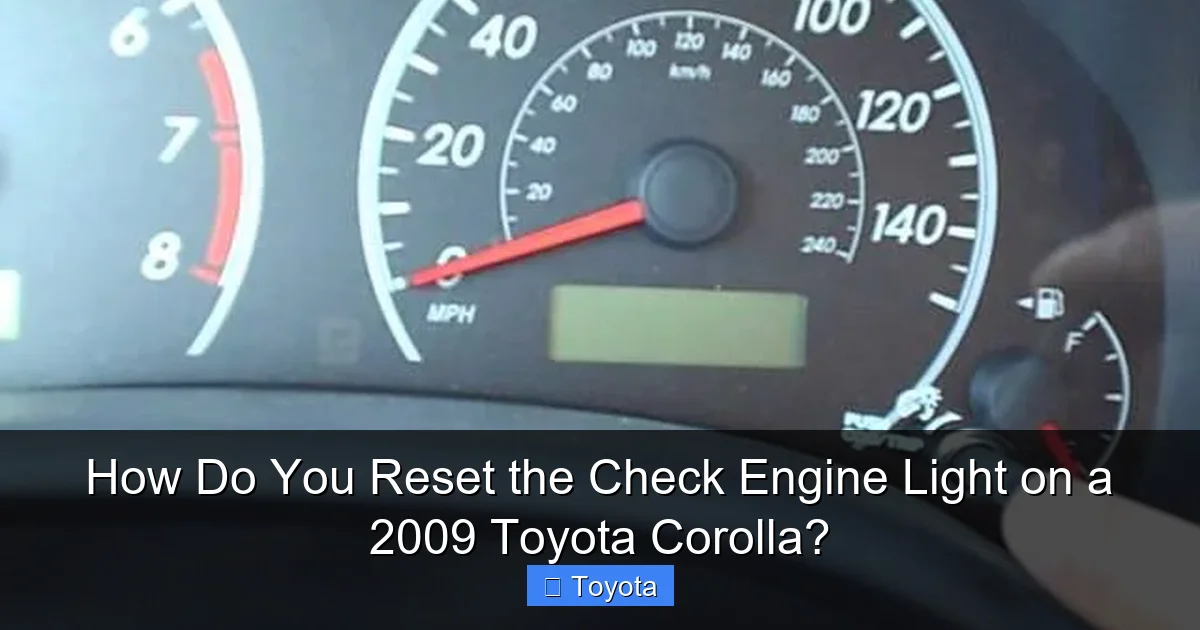
Visual guide about How Do You Reset the Check Engine Light on a 2009 Toyota Corolla?
Image source: i.ytimg.com
Your Essential Tool: The OBD-II Scanner
To read codes, you need an OBD-II scanner. This is non-negotiable for a proper job. You have options:
- Basic Code Readers ($20-$50): These are perfect for our purpose. They plug into the OBD-II port (under your Corolla’s dashboard, left of the steering column), turn on, and read/clear generic P-codes. They won’t access manufacturer-specific codes or advanced data, but for a 2009, they’re usually sufficient.
- Advanced Scanners/Apps ($50+): Tools like Autel, Launch, or Bluetooth adapters paired with your phone (like the OBDLink or Torque app) offer more data, live sensor readings, and better code definitions. A great investment if you plan to DIY more.
- Visit a Professional: Many auto parts stores (AutoZone, Advance Auto, O’Reilly) offer free code reading services. This is a fantastic, zero-cost option if you just want to know the code.
How to Retrieve the Code: A Simple Walkthrough
- Locate the OBD-II Port: In your 2009 Corolla, it’s a 16-pin trapezoidal connector located under the dashboard, to the left of the steering wheel. You might need to remove a small plastic cover.
- Connect the Scanner: With the ignition OFF, plug in your scanner.
- Turn Ignition to “ON” (Not Start): Turn the key to the position where the dash lights come on, but don’t crank the engine.
- Follow Scanner Prompts: Usually, you’ll navigate to a “Read Codes” or “Trouble Codes” menu. The scanner will communicate with the car and display any stored codes, like “P0455.”
- Write It Down: This is crucial. Write the exact code(s) down. You can then look them up online for a more detailed explanation of what the code means for your specific vehicle.
3. Method 1: The Professional Way – Using an OBD-II Scanner to Reset
Once you’ve diagnosed the problem, made the repair (or verified a loose gas cap), and are confident the issue is resolved, you can clear the code. This is the cleanest, most reliable method. If you’ve already used a scanner to read the code, you’re halfway there.
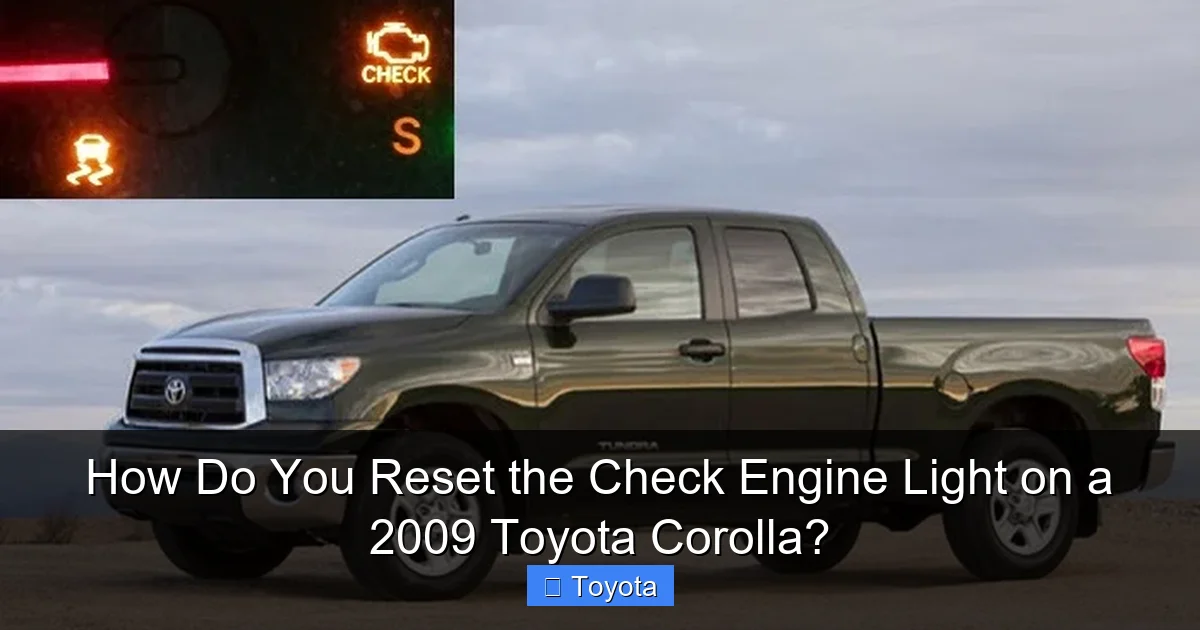
Visual guide about How Do You Reset the Check Engine Light on a 2009 Toyota Corolla?
Image source: cararac.com
Step-by-Step Clearing Process
- Ensure the ignition is still in the “ON” position (key in run, engine off).
- On your scanner, navigate to the “Erase Codes,” “Clear DTCs,” or “Reset MIL” function. The wording varies.
- Select the option. The scanner will send a command to the Corolla’s ECM to wipe the stored fault code(s) from its memory.
- You should see a confirmation message like “Codes Cleared” or “DTCs Erased.”
- The check engine light on your dash should immediately extinguish.
Important Post-Clear Steps
After clearing, don’t just drive off. You need to perform a “drive cycle” to ensure the repair is holding and that the light stays off. The ECM needs to see that the faulty condition is gone under various driving conditions.
- Start the engine and let it idle for about 2-3 minutes.
- Drive at moderate speeds (around 45-55 mph) for 5-10 minutes.
- Include a couple of gentle acceleration/deceleration cycles.
- Turn the engine off, wait 30 seconds, and restart. The light should remain off.
- If it comes back on within a day or two, the problem wasn’t fully fixed, or a new one has developed. Re-scan for codes.
4. Method 2: The “Disconnect the Battery” Trick (A Last Resort)
This old-school method will indeed reset the check engine light on a 2009 Toyota Corolla because it cuts power to the ECM, wiping its memory. However, it comes with significant downsides and should only be used if you have no access to a scanner and have already fixed a simple issue (like a gas cap) and want to see if the light returns.
The Procedure & Major Caveats
- Safety First: Ensure the car is parked, engine off, keys out of the ignition.
- Disconnect the Negative Terminal: Open the hood and locate the battery. Using a 10mm wrench (typical size), loosen and remove the NEGATIVE (black, marked with “-”) battery cable from the terminal post. Tuck it away so it can’t accidentally touch the post.
- Wait: Wait at least 10-15 minutes. This allows any residual electrical charge to dissipate and the ECM to fully power down. Some sources suggest longer, up to 30 minutes.
- Reconnect: Reattach the negative cable and tighten it securely.
- Start the Car: The light should be off. However…
What You Lose By This Method:
- All radio presets and clock settings will be lost.
- Some models may require a “re-learn” process for the idle speed and throttle position. Your Corolla might idle a bit rough or high for the first 10-15 minutes of driving until the ECM re-calibrates. This is usually normal.
- You erase all stored, non-check-engine related data the computer uses for optimal performance, which may slightly affect fuel economy until it re-learns.
- Most importantly, this method does not tell you what the original problem was. You are flying blind. If the underlying issue persists, the light will simply come back on after the ECM re-detectes the fault during its self-tests.
Because of these drawbacks, the battery disconnect method is generally not recommended by professionals when a simple code reader is available. It’s a blunt instrument for a job that requires precision.
5. What If the Light Won’t Reset? Interpreting Persistent Codes
You’ve fixed what you thought was the problem, cleared the code, but the light returns. Or you clear it and it comes back with a *different* code. This is your car telling you to dig deeper. A persistent code means the repair was incomplete, the wrong part was replaced, or the problem is more complex.
Potential Scenarios and Next Steps
- The Same Code Returns Immediately: The repair was ineffective. A “loose gas cap” code (P0455) returning after you replaced the cap might mean the cap is still faulty, or there’s an actual leak in the EVAP system hoses or charcoal canister.
- New, Different Codes Appear: Your repair may have inadvertently caused another issue, or you have multiple, separate problems. For example, fixing an exhaust leak might cause an O2 sensor code to appear because the sensor’s readings are now out of spec.
- Multiple Codes from One System: Several codes related to the oxygen sensors (e.g., P0130, P0135, P0141) often point to a wiring harness issue or a bad ground, not necessarily all sensors being bad.
- “Incomplete” or “Pending” Codes: Some scanners show pending codes. This means the ECM has detected an issue once but it hasn’t yet met the criteria to fully illuminate the MIL. Monitor these. If they become active, you have a growing problem.
When to Wave the White Flag and See a Pro
It’s time to call a trusted mechanic if:
- The code points to an internal engine issue (e.g., multiple cylinder misfires with no obvious spark plug/coil problem).
- Codes involve the catalytic converter (P0420/P0430). Replacing a cat is expensive, and you need to be sure it’s the real culprit, not a sensor lying to the computer.
- You’ve attempted repairs based on the code, but the light returns. You need advanced diagnostics, like live data stream analysis, smoke tests for EVAP leaks, or in-depth electrical diagnostics.
- The check engine light is flashing. Stop driving and get it towed.
6. Beyond the Reset: Holistic 2009 Corolla Care and Related Lights
Resetting the check engine light is just one piece of your Corolla’s maintenance puzzle. The same OBD-II system that monitors engine and emissions also watches other systems. You might encounter other warning lights that require their own specific reset procedures after repair.
The Maintenance Required Light vs. Check Engine Light
This is a critical distinction! Your 2009 Corolla has a separate MAINT REQD light. This is an oil change/maintenance reminder based on mileage and driving conditions. It is not an emissions or engine fault indicator. The procedure to reset it is completely different and usually involves your odometer/trip meter button, not an OBD-II scanner. If you see “MAINT REQD,” you need an oil change and a simple reset procedure.
Other Common Toyota Warning Lights
Your dashboard is a communication center. A battery light (often shaped like a battery) usually indicates an alternator charging issue, not a bad battery itself. A tire pressure light (exclamation point in a tire) requires inflating tires and often a reset button or drive cycle. Always consult your owner’s manual for the specific meaning and recommended action for every warning light. For instance, if you’re dealing with a persistent battery warning, you’d follow a different path than a check engine light reset, as detailed in guides for resetting the battery light on a Toyota Corolla.
Furthermore, understanding your car’s limits is key. Ever wonder how many miles you can drive after the gas light comes on in a Toyota Corolla? It’s usually around 30-50 miles, but it’s best not to push it, as running the fuel pump dry can cause damage. These bits of knowledge, combined with proper check engine light diagnosis, make you a truly informed Corolla owner.
Conclusion: Empowerment Through Understanding
So, how do you reset the check engine light on a 2009 Toyota Corolla? The short answer is: with an OBD-II scanner, after you’ve fixed the problem. The long answer is what we’ve covered—a journey from initial anxiety, through careful diagnosis with the right tools, to a responsible reset and verification. Your 2009 Corolla is a fantastic, durable car, but like any machine, it needs attention. That check engine light is its way of asking for that attention.
Resist the temptation for a quick, blind reset. Embrace the diagnostic process. Retrieve the code. Research it. Make a logical, informed repair. Then, and only then, use your scanner to clear the code and celebrate the return of a clear dashboard. This approach saves you money, prevents small problems from becoming catastrophic ones, and gives you peace of mind. You’re not just silencing a light; you’re ensuring your reliable Corolla stays that way for many more miles to come. Now, go pop the hood, grab that scanner, and show your car who’s boss—responsibly.
Frequently Asked Questions
What is How Do You Reset the Check Engine Light on a 2009 Toyota Corolla??
How Do You Reset the Check Engine Light on a 2009 Toyota Corolla? is an important topic with many practical applications and benefits.
How can How Do You Reset the Check Engine Light on a 2009 Toyota Corolla? help me?
Understanding How Do You Reset the Check Engine Light on a 2009 Toyota Corolla? can improve your knowledge and provide practical solutions.
