
How Much Does It Cost to Replace Brakes on a Toyota 4runner?

Replacing the brakes on a Toyota 4Runner typically costs between $300 and $900 per axle, depending heavily on your model year, whether you need pads only or pads and rotors, and if you choose OEM or aftermarket parts. Front brakes are generally more expensive than rear. While a DIY job can save you $200-$400 in labor, professional installation is strongly recommended for safety and proper bedding. Ignoring brake wear is never an option—it compromises safety and leads to more expensive damage to other components like calipers and rotors.
Let’s be real. When you hear a high-pitched squeal or feel a concerning vibration through your steering wheel in your Toyota 4Runner, your heart sinks a little. It’s not just an annoyance—it’s your brakes talking to you. And the next logical, and often dreaded, question is: “How much is this going to cost?” The Toyota 4Runner, a beloved and rugged SUV, is a workhorse. Its brakes take a beating, especially if you tow, off-road, or just use it as the family hauler in stop-and-go traffic. The cost to replace its brakes isn’t a single number you can just Google and take to the bank. It’s a range shaped by your specific 4Runner’s year, trim, what exactly needs replacing, and where you get the work done. This guide will walk you through every factor, break down real-world costs for different model years, and help you make a smart, safe decision for your wallet and your 4Runner.
Key Takeaways
- Average Cost Range: Expect to pay $300-$900 per axle for a complete brake job (pads and rotors), with front axles costing more than rear. Basic pad-only replacements can start around $150-$250 per axle.
- Model Year Matters: Newer 4Runners (2014+) with larger brakes and advanced systems like brake hold will have higher parts costs than older models (2003-2009).
- Parts vs. Labor: Parts (pads, rotors, hardware) make up 40-60% of the total cost. Labor is typically $80-$130 per hour, with the job taking 1-2 hours per axle at a shop.
- DIY Can Save Money: If you have the tools and skill, you can save $200-$400 in labor. However, improper installation risks safety and can void warranties on parts.
- Don’t Ignore the Warning Signs: Squealing, grinding, pulsation in the pedal, or a dashboard brake warning light mean it’s time for an inspection. Delaying leads to rotor damage and higher costs.
- Quality Parts Are an Investment: Cheap pads can wear quickly, damage rotors, and create dust. Mid-range to premium OEM or name-brand aftermarket parts offer better performance, longevity, and quieter operation.
- Complete the Job: Always replace pads and rotors in pairs (both front or both rear) and use new hardware (shims, clips). This ensures even braking and prevents premature wear.
📑 Table of Contents
- The Core Factors That Drive Your 4Runner Brake Bill
- Real-World Cost Breakdowns by 4Runner Model Year
- Should You DIY Your 4Runner’s Brakes? A Practical Guide
- Maintenance Tips to Maximize Your Brake Investment
- The Big Picture: Brakes vs. Other 4Runner Maintenance Costs
- Conclusion: Prioritize Safety, Shop Smart
The Core Factors That Drive Your 4Runner Brake Bill
Before we dive into specific numbers, you need to understand the key variables. Think of it like building a sandwich—the base cost is the bread and meat (pads and rotors), but the extras (labor, premium ingredients, where you buy it) change the final price.
1. Front vs. Rear Axle: The Biggest Price Difference
This is the first and most significant split. On virtually all Toyota 4Runners, the front brakes do 60-70% of the braking work due to weight transfer during deceleration. Consequently, they are larger, more complex, and more expensive to replace than the rear brakes.
- Front Brakes: Larger rotors, bigger calipers, and more robust hardware. A complete front axle job (pads + rotors) is the most common and costly brake service.
- Rear Brakes: Smaller components. On many 4Runner models, the rear brakes are drum brakes (especially on base models pre-2014) which are significantly cheaper to replace than disc brakes. If your 4Runner has rear disc brakes (common on Limited and TRD trims), the cost will be closer to the front but still typically 15-25% less.
Real-World Example: For a 2019 4Runner Limited with rear disc brakes, a front brake job might cost $700-$900, while the rear might be $500-$700. A 2010 4Runner SR5 with rear drums might have a rear brake job cost only $200-$350.
2. The Parts Puzzle: OEM vs. Aftermarket vs. Pad-Only
What you buy is half the equation.
- OEM (Original Equipment Manufacturer): These are the exact parts Toyota used when your 4Runner rolled off the line. They offer guaranteed fit, reliability, and often come with a warranty. They are usually the most expensive option.
- Premium Aftermarket (e.g., Akebono, Bosch, PowerStop): High-quality brands that often outperform OEM in terms of dust, noise, and braking power. They are a popular middle-ground, typically costing 10-30% less than OEM.
- Standard Aftermarket/Economy: The cheapest option at parts stores. They will work, but they may wear faster, produce more brake dust, and can be noisier. We generally advise caution here for a vehicle like a 4Runner that’s often used for towing or adventure.
- Pad-Only vs. Complete Kit: You can sometimes just replace the pads if your rotors are thick, smooth, and undamaged. This is the cheapest route ($150-$300 per axle for good pads). However, mechanics almost always recommend replacing rotors at the same time. Rotors develop grooves, heat spots, and a minimum thickness. Reusing a worn rotor with new pads leads to poor performance, noise, and rapid pad wear. The cost difference between good pads alone and a complete pad+rotor kit is often just $50-$100 more for the rotors—a wise investment.
3. Your 4Runner’s Generation and Trim Level
A 2003 4Runner is not a 2023 4Runner when it comes to brakes. Here’s a general breakdown by generation:
- Third Generation (2003-2009): Base models often had rear drum brakes. Front brakes were moderately sized. Parts are plentiful and relatively inexpensive. This is the most affordable era for brake repairs.
- Fourth Generation (2010-2013): Transitional years. Most models switched to 4-wheel disc brakes. Components are larger than the previous gen, so costs increased slightly. TRD Off-Road and Limited packages often had larger front brakes.
- Fifth Generation (2014-Present): All models have 4-wheel disc brakes. The 2014-2020 models have a standard front brake size. The 2020+ models (especially TRD Pro) often have larger, upgraded brakes from the factory (like the 18-inch front brakes on the TRD Pro). These larger brakes cost more for rotors and pads. Additionally, features like Brake Hold (on automatics) and trailer brake controllers add complexity but don’t drastically change the basic pad/rotor replacement cost.
4. Labor Rates: Where Geography and Dealerships Rule
This is the wild card. Labor is billed by the hour. The national average for brake labor is $80-$130 per hour. A standard pad and rotor replacement on one axle takes a competent mechanic 1 to 1.5 hours. So labor alone is $80-$195.
- Dealerships: Charge the highest labor rates ($120-$150/hr) but use OEM parts and have technicians specifically trained on your 4Runner. They are the most expensive option but offer factory warranties on parts and labor.
- Independent Shops / Chain Stores (Midas, Meineke, etc.): Typically have lower labor rates ($90-$120/hr). They often use a mix of OEM and aftermarket parts. You can usually negotiate on parts brands.
- DIY: Labor cost = $0. But you need tools (jack, stands, socket set, C-clamp, brake cleaner) and knowledge. We’ll cover this more later.
Real-World Cost Breakdowns by 4Runner Model Year
Enough theory. Let’s talk concrete numbers. These are estimated total costs (parts + labor) for a complete pad and rotor replacement on one axle at a typical independent shop using mid-range aftermarket parts. Dealership prices will be 20-40% higher.
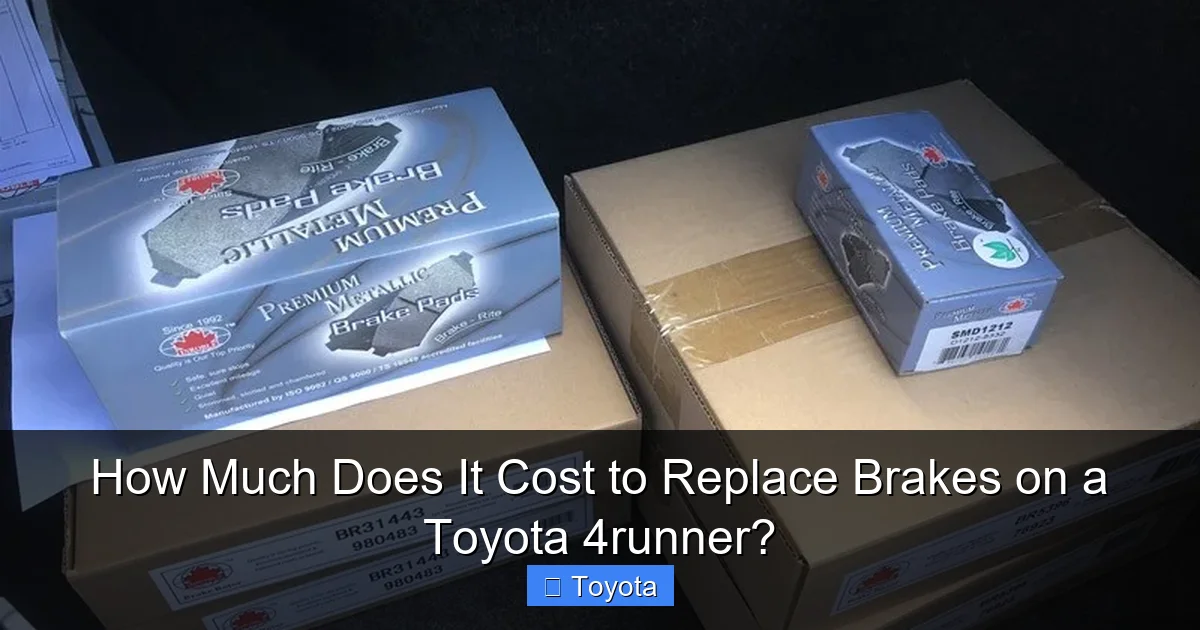
Visual guide about How Much Does It Cost to Replace Brakes on a Toyota 4runner?
Image source: allrotors.com
Third Generation (2003-2009) 4Runner
The budget-friendly era. Base SR5 models with rear drums are the cheapest to maintain.
- Front Disc Brakes (All Trims): $350 – $550 per axle
- Rear Disc Brakes (Limited/ Sport trim): $300 – $450 per axle
- Rear Drum Brakes (SR5 trim): $200 – $350 per axle (includes new shoes, hardware, and wheel cylinder inspection)
Example: A 2006 4Runner SR5 with rear drums. A front brake job might be $400. A rear drum job might be $280. The entire truck (all four corners) could be done for under $700.
Fourth Generation (2010-2013) 4Runner
All models now had 4-wheel discs. Slightly larger components mean a modest price jump.
- Front Brakes: $400 – $650 per axle
- Rear Brakes: $350 – $550 per axle
Example: A 2012 4Runner Trail Edition. A complete four-wheel brake job using quality aftermarket parts might run $1,600 – $2,200 at an independent shop.
Fifth Generation (2014-Present) 4Runner
The current generation. Standard 4-wheel discs. Costs are stable but on the higher end due to larger, heavier vehicle mass and often larger brakes on higher trims.
- Front Brakes (SR5, Limited, TRD Off-Road): $450 – $750 per axle
- Front Brakes (TRD Pro – larger 18″ brakes): $550 – $900+ per axle
- Rear Brakes (All Disc): $380 – $650 per axle
Example: A 2021 4Runner TRD Off-Road. A front brake job with premium aftermarket pads and rotors might be $650. A rear job might be $500. Total for all four: $2,700 – $3,000 at a dealership using OEM parts would be even higher.
Pro Tip: Always get a detailed, itemized quote. It should list the exact part numbers for pads and rotors (so you can check prices) and the estimated labor hours. This prevents surprise charges.
Should You DIY Your 4Runner’s Brakes? A Practical Guide
The siren song of saving $300-$600 in labor is strong. For many mechanically-inclined 4Runner owners, a brake job is a perfect weekend project. But it’s not for everyone.
Visual guide about How Much Does It Cost to Replace Brakes on a Toyota 4runner?
Image source: mobileabode.net
The DIY Cost: Parts-Only + Your Time
Buying parts from an online retailer (like RockAuto) or a warehouse club can be 30-50% cheaper than a shop’s markup. A complete pad and rotor kit for a 2018 4Runner might cost $250-$400 per axle for good aftermarket parts. Add $20 for brake fluid and $10 for brake lube. Your total parts cost for all four corners could be $600-$1,000.
The Tools You’ll Need
- A safe, level workspace and quality jack stands (NEVER rely on the jack alone).
- Lug wrench, socket set (usually 17mm or 19mm for lug nuts), breaker bar.
- C-clamp or pry bar to compress the caliper piston.
- Brake cleaner, brake lube (for slides and pins), wire brush.
- Torque wrench (CRITICAL for proper lug nut torque).
- Bleeder wrench and clear tubing if you need to flush fluid (often not needed for a simple pad/rotor change on a system without ABS activation).
The Risks and Rewards
Rewards: Significant savings, deep satisfaction, complete control over part quality, and you learn your vehicle intimately.
Risks:
- Safety: Improper installation can lead to brake failure. Caliper bolts must be torqued to spec. Piston must be fully compressed. Slide pins must be clean and lubricated.
- Damage: You can scratch rims, strip lug nuts, or damage the ABS sensor wire if you’re not careful.
- Bedding Procedure: New pads and rotors require a specific “bedding-in” process to transfer a thin layer of pad material to the rotor for optimal performance. Skipping this can cause glazing, noise, and poor braking until it’s done.
- No Warranty on Labor: If you mess up, you have no recourse. Shop warranties cover their work.
Verdict: If you are comfortable with basic automotive repairs, have good tools, and watch a few model-specific YouTube tutorials (search “Toyota 4Runner [your year] brake replacement”), DIY is a viable and rewarding option. If you have any doubt, pay the professional. Your brakes are non-negotiable for safety.
Maintenance Tips to Maximize Your Brake Investment
Brakes are a wear item. But how you drive and maintain your 4Runner directly impacts how often you’ll face this bill.
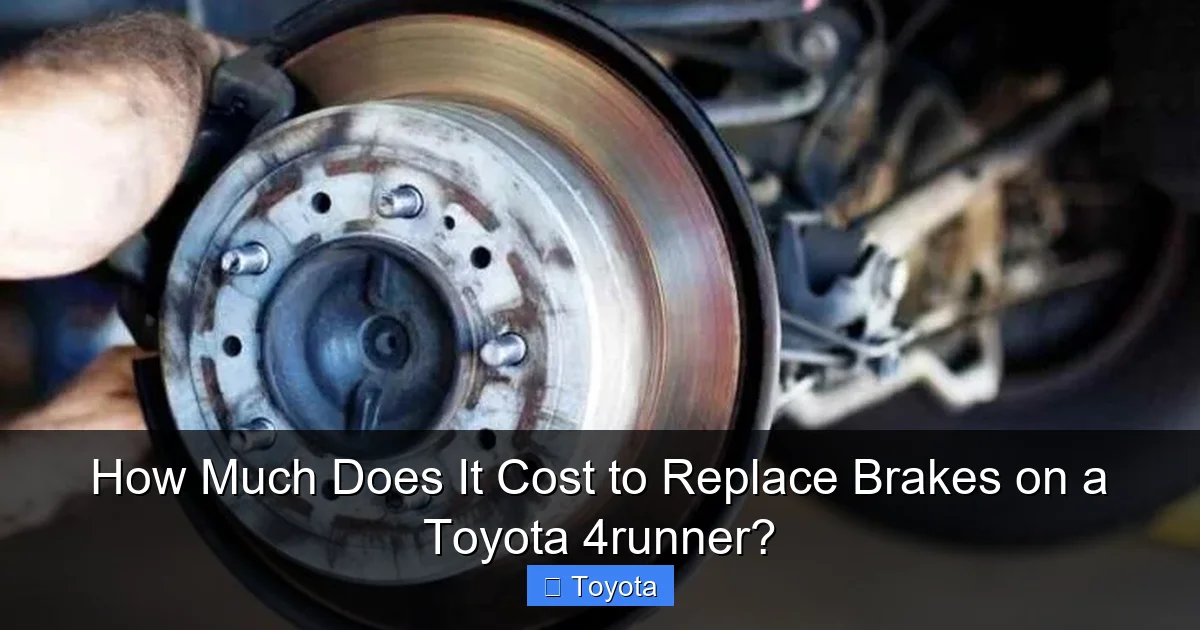
Visual guide about How Much Does It Cost to Replace Brakes on a Toyota 4runner?
Image source: trucksauthority.com
Drive Smoothly, Not Aggressively
Hard, late braking generates extreme heat and wears pads and rotors dramatically faster. Anticipate traffic, leave more following distance, and brake earlier and more gently. This is the single biggest thing you can do to extend brake life, especially if you do a lot of city driving.
Mind the Weight and Towing
Your 4Runner is a heavy vehicle. Adding a roof rack, heavy aftermarket bumpers, or towing a trailer increases unsprung weight and braking effort. Be aware that loaded, the brakes work harder and will wear sooner. If you tow regularly, consider upgrading to a higher-grade pad designed for sustained heat.
Regular Inspections Are Free (Usually)
During an oil change, ask the tech to quickly check your brake pad thickness (they can often see it through the wheel). Many shops will do a basic inspection for free if you’re a customer. Knowing you have 5mm of pad left vs. 2mm gives you months to plan and budget for the repair instead of facing a sudden, urgent (and more expensive) failure.
Don’t Forget the Brake Fluid
Brake fluid is hygroscopic—it absorbs water from the air over time. Water lowers the boiling point of the fluid, which can lead to brake fade or even internal corrosion in the brake system. Toyota recommends flushing the brake fluid every 2-3 years. This is a relatively inexpensive service ($80-$150) that protects your entire brake system’s longevity and performance. It’s a great thing to combine with a pad/rotor job, as the system is already open.
Consider a Premium Pad for Your Lifestyle
If your 4Runner is a daily driver that occasionally sees dirt roads, a good ceramic pad is an excellent choice—low dust, quiet, good performance. If you tow a boat or camper, or do serious off-roading, look into a “semi-metallic” or even a dedicated “towing” pad from brands like Hawk or PowerStop. They handle heat better but may be noisier and dustier. Spending a little more upfront on the right pad for your use case saves money and hassle in the long run.
The Big Picture: Brakes vs. Other 4Runner Maintenance Costs
It’s helpful to put the brake cost in the context of other common 4Runner expenses. This helps you budget for long-term ownership.
- Major Service (Oil Change, Filter, Inspection): $60 – $120
- Spark Plugs (V6 models): $250 – $400 (parts are pricey, labor is moderate)
- Timing Belt/Water Pump (4-cylinder models, 2003-2009): $800 – $1,200 (critical preventive maintenance)
- Struts/Shocks: $900 – $1,600 for all four (a common wear item around 100k miles)
- Tires (Set of 4 All-Terrain): $800 – $1,400+
- Windshield Replacement: $400 – $800 (a single unexpected event)
As you can see, a full brake job ($1,200-$2,500 for all four corners) is a significant but not catastrophic expense. It’s part of the predictable cycle of maintaining a reliable, capable SUV like the 4Runner. Budgeting $500-$1,000 per year for “wear and tear” items on a high-mileage 4Runner is a smart strategy.
When considering overall vehicle upkeep, costs can add up. For instance, cosmetic maintenance like a Toyota Camry wrap or Toyota Tacoma paint job are entirely different categories of expense—more about aesthetics than safety-critical systems. However, the principle of getting multiple quotes and understanding parts vs. labor holds true across all automotive services.
Conclusion: Prioritize Safety, Shop Smart
The cost to replace brakes on your Toyota 4Runner is an investment in safety. It’s not an optional service. The final number you write a check for depends on a clear checklist: your model year and trim (front/rear, disc/drum), the quality of parts you choose, and who turns the wrenches.
For most owners, budgeting $400-$800 per axle for a complete, quality pad and rotor job at a reputable independent shop is a safe estimate. If you have a newer TRD Pro, lean toward the higher end. If you have an older base model with rear drums, the rear will be much cheaper.
Get at least three detailed, itemized quotes. Don’t be afraid to ask about part brands and warranties. If you’re handy, the DIY path offers real savings but demands respect for the procedure. And remember, the cheapest quote isn’t always the best if it means subpar parts or rushed labor. Your 4Runner’s brakes are what stop you, your family, and your gear. Treat them accordingly, and your SUV will continue to be the reliable, adventure-ready companion it was built to be for years to come.
Frequently Asked Questions
What are the first signs that my Toyota 4Runner’s brakes need replacing?
The most common sign is a high-pitched squeal or squeak when you brake, which is the wear indicator on the pad. A grinding or growling noise means the pad is completely worn and metal is contacting the rotor—this is an urgent, expensive problem. You might also feel a pulsation or vibration in the brake pedal or steering wheel, indicating a warped rotor. A dashboard brake warning light can indicate worn pads or a system issue.
How often do brakes need to be replaced on a 4Runner?
There’s no set mileage. It depends entirely on driving style, environment (city vs. highway, mountainous areas), and vehicle load. On average, front pads on a 4Runner last 30,000-50,000 miles, and rear pads/drums last 40,000-70,000 miles. If you do a lot of towing or off-roading, expect them to wear faster. Always have them inspected regularly rather than relying on a mileage guess.
Is it okay to just replace the brake pads and not the rotors?
It’s possible only if your rotors are still above the minimum thickness specification, are perfectly smooth (no grooves or scoring), and are not warped. However, rotors are relatively inexpensive and have a finite lifespan. Installing new pads on old, grooved rotors will cause the new pads to wear unevenly and prematurely, often creating noise. For a long-term, trouble-free repair, replacing pads and rotors together as a set is the recommended and most cost-effective practice over time.
Why is my 4Runner’s brake pedal soft or spongy after a brake job?
A soft or spongy pedal usually indicates air in the brake lines. This can happen if the caliper piston was not properly compressed during the job, or if the brake fluid was not bled correctly afterward. A proper brake job on a 4Runner should include bleeding the system to remove any air. If you did the job yourself, you may need to perform a thorough brake fluid flush and bleed. If a shop did it, take it back—this is a safety issue they must correct.
Can I use any brake pads on my 4Runner, or do I need specific ones?
You must use pads and rotors specifically listed for your exact year, model, engine, and trim. A 2020 4Runner TRD Pro has different (larger) front brakes than a 2020 SR5. Using the wrong parts is dangerous and won’t fit. Always double-check fitment using your VIN or by consulting a parts professional. Reputable online retailers and parts stores have catalog systems to ensure compatibility.
My 4Runner has a “Brake Hold” feature. Does this affect the replacement process?
The Brake Hold system (available on automatic transmission models) uses the existing brake hardware; it doesn’t require special parts for a standard pad and rotor replacement. However, the system has its own control module and sensors. The replacement process for the physical brakes is the same. The only caveat is that after any brake work, the system may need to be reset or recalibrated via the vehicle’s menu or with a scan tool to function properly. A professional shop will handle this; if you DIY, consult your owner’s manual for the reset procedure.
