
How Many Miles Can a Toyota Tundra Go on a Full Tank of Gas?

The Toyota Tundra’s range on a full tank typically falls between 350 to 500 miles, but this number is highly variable. Factors like engine choice (gas vs. hybrid), cab size, driving conditions, and towing significantly impact the final figure. The standard gas tank holds 22-27.5 gallons, while the hybrid i-FORCE MAX system offers slightly better efficiency. Understanding your specific Tundra’s MPG and tank capacity is key to accurate range calculation.
Key Takeaways
- Range is not a single number: A Tundra’s miles-per-tank varies widely based on model year, engine, configuration, and individual driving style.
- Tank size matters: Full-size Tundras have a 22-gallon tank, while the hybrid and some trims use a larger 27.5-gallon tank, directly affecting maximum range.
- Engine choice is critical: The twin-turbo V6 is efficient for a truck, but the hybrid i-FORCE MAX system provides the best combined MPG, extending range between fill-ups.
- Real-world MPG differs from EPA: Towing, off-roading, highway speed, and city traffic can reduce actual fuel economy by 20-30% from EPA estimates.
- The gas light warning is your reserve: Like most Toyotas, the Tundra’s low fuel light typically illuminates with 2-3 gallons remaining, giving you an extra 40-70 miles.
- Calculate your own range: For the most accurate estimate, divide your personal average MPG by your specific tank’s capacity (22 or 27.5 gallons).
- Maintenance impacts efficiency: Proper tire inflation, regular oil changes, and a clean air filter are simple ways to protect and potentially improve your Tundra’s fuel range.
[FEATURED_IMAGE_PLACEHOLDER]
📑 Table of Contents
- Introduction: The Big Question for Big Trucks
- The Core Variables: What Actually Determines Your Range?
- Breaking Down the Numbers: Estimated Ranges by Model
- Real-World Scenarios: How Driving Habits Change Everything
- Maximizing Your Miles Per Tank: Practical Tips
- Understanding Your Fuel Gauge and Reserve
- Conclusion: Know Your Truck, Plan Your Trip
Introduction: The Big Question for Big Trucks
If you own a Toyota Tundra or are thinking about buying one, one of the most practical—and sometimes anxiety-inducing—questions is: “How far can I really go on a single tank?” It’s not just about avoiding a gas station; it’s about planning road trips, managing work commutes, and understanding your truck’s true capability. For a full-size truck known for its power and presence, the answer isn’t as straightforward as a single number on a window sticker.
The Toyota Tundra, especially in its recent generations, is a sophisticated machine. It offers multiple powertrains, cab configurations, and package levels, all of which influence that final “miles to empty” readout. While marketing materials provide EPA estimates, real-world driving tells a different story. This article will dive deep into the variables that determine your Tundra’s fuel range, break down the numbers by model, and give you actionable tips to get the most miles possible from every drop of gasoline.
The Core Variables: What Actually Determines Your Range?
Before we look at specific numbers, it’s crucial to understand the two fundamental components of the “miles per tank” equation: Fuel Tank Capacity and Fuel Efficiency (MPG). Your maximum theoretical range is simply: Tank Capacity (gallons) x Miles Per Gallon = Total Miles. However, both of those components are dynamic.

Visual guide about How Many Miles Can a Toyota Tundra Go on a Full Tank of Gas?
Image source: autozonic.com
1. Fuel Tank Capacity: It’s Not Always the Same
The size of your Tundra’s gas tank depends primarily on the model year and drivetrain configuration.
- 2022-Present (Third Generation): The standard gas tank for most rear-wheel-drive and 4×4 models is 22.0 gallons. However, the revolutionary i-FORCE MAX hybrid powertrain comes standard with a larger 27.5-gallon tank. This is a key reason the hybrid often achieves a longer total range despite having similar or only slightly better combined MPG.
- 2014-2021 (Second Generation): Most models featured a 22.0-gallon tank. Some specific trims or earlier years might have slight variations, but 22 gallons was the standard.
- 2007-2013 (First Generation): These models also predominantly used a 22-gallon tank.
Pro Tip: You can always find your exact tank capacity in your owner’s manual under “Specifications” or “Fuel” or by checking the fuel filler door for a label (some models).
2. Fuel Efficiency (MPG): The Biggest Variable
This is where things get interesting. Your Tundra’s MPG is a moving target. The EPA provides estimates, but your real-world number is influenced by:
- Powertrain: The twin-turbo 3.5L V6 (V35A-FTS) is the standard engine. The i-FORCE MAX hybrid pairs this V6 with an electric motor for improved efficiency, especially in city driving and during acceleration.
- Drivetrain: 4×2 (rear-wheel-drive) models are almost always more fuel-efficient than 4×4 (four-wheel-drive) models due to the added weight and mechanical drag of the transfer case and front drivetrain components.
- Cab and Bed Size: A Double Cab with a 5.5-foot bed is lighter and more aerodynamic than a CrewMax with a 5.5-foot bed. The larger, heavier the truck, the more fuel it consumes.
- Driving Style & Conditions: This is the most significant personal factor. Aggressive acceleration, high highway speeds (above 70 mph), heavy loads, towing, and constant stop-and-go traffic can slash your MPG. Conversely, gentle, steady highway driving can sometimes exceed EPA estimates.
- Accessories: Large off-road tires, roof racks, and heavy steel bumpers add drag and weight, reducing efficiency.
For context, understanding how other Toyota vehicles handle fuel reserves can be helpful. For instance, the distance you can drive after the gas light comes on in a Toyota Camry is often cited as 30-50 miles, which is a common benchmark for many Toyotas, including the Tundra. You can learn more about that specific warning system here.
Breaking Down the Numbers: Estimated Ranges by Model
Let’s translate those variables into estimated ranges. Remember, these are estimates. Your results will vary. We’ll use the EPA combined MPG estimates as a baseline for calculation, but we’ll also discuss realistic real-world expectations.
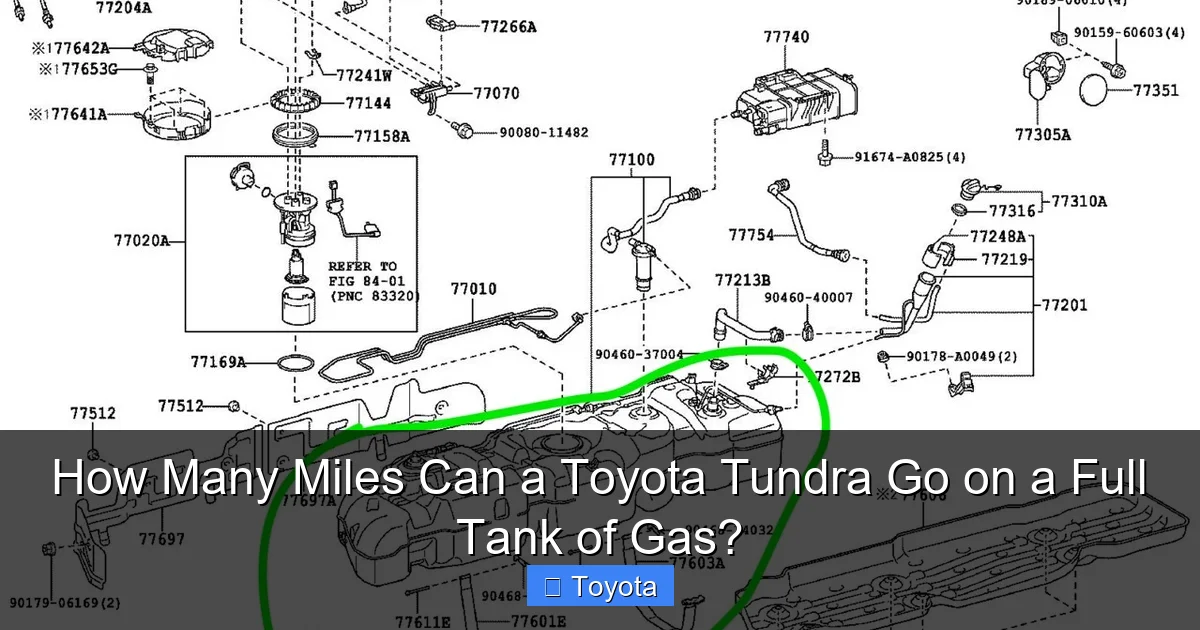
Visual guide about How Many Miles Can a Toyota Tundra Go on a Full Tank of Gas?
Image source: tundras.com
Current Generation (2022-Present) with Standard V6 Engine
Tank Size: 22.0 gallons (most models).
- EPA Combined MPG (4×2): ~20 MPG. Estimated Max Range: 22 gal x 20 MPG = 440 miles.
- EPA Combined MPG (4×4): ~19 MPG. Estimated Max Range: 22 gal x 19 MPG = 418 miles.
Real-World Expectation: For many owners driving a mixed commute without towing, seeing 17-18 MPG combined is common. That translates to a real-world range of 374-396 miles on a full tank. If you’re doing a lot of highway cruising at 65 mph, you might eke out 20+ MPG and hit 440+ miles. If you’re towing a large trailer, your MPG could drop to 10-12, slashing your range to 220-264 miles.
Current Generation (2022-Present) with i-FORCE MAX Hybrid
Tank Size: 27.5 gallons (standard on hybrid).
- EPA Combined MPG: ~22 MPG. Estimated Max Range: 27.5 gal x 22 MPG = 605 miles.
Real-World Expectation: This is the range champion. The hybrid system excels in city driving and during acceleration from a stop. Real-world combined MPG for many owners hovers around 20-21 MPG. That gives a practical range of 550-578 miles. The larger tank is the game-changer here. For long road trips or those who dislike frequent gas stations, the hybrid Tundra offers a significantly longer stretch between fill-ups. It’s worth comparing this to other vehicles; for example, the Toyota Sienna minivan, which also uses a hybrid system, is known for exceptional range, details of which you can find here.
Previous Generation (2014-2021) with 5.7L V8
Tank Size: 22.0 gallons.
- EPA Combined MPG (4×2): ~15 MPG. Estimated Max Range: 22 gal x 15 MPG = 330 miles.
- EPA Combined MPG (4×4): ~14 MPG. Estimated Max Range: 22 gal x 14 MPG = 308 miles.
Real-World Expectation: The older V8 is a thirsty engine, especially under load. Many owners report 12-13 MPG combined in daily driving, leading to a range of 264-286 miles. Highway-only driving could reach 16-17 MPG, pushing the range to 352-374 miles.
Real-World Scenarios: How Driving Habits Change Everything
The numbers above assume a “best-case” average. Let’s look at how specific scenarios dramatically alter your fuel range.

Visual guide about How Many Miles Can a Toyota Tundra Go on a Full Tank of Gas?
Image source: motorbiscuit.com
The Daily Commuter (City/Highway Mix)
This is the most common use case. A 30-mile round trip with some city streets and highway miles. Expect your Tundra to land in the lower to middle of its real-world MPG range (16-18 MPG for V6, 20-21 for hybrid). Your range will be reliable but not staggering. Plan for a fill-up every 350-450 miles (V6) or 500-600 miles (hybrid).
The Highway Cruiser
A long, steady-state road trip at 65-70 mph with no traffic and a light load is where the Tundra shines aerodynamically. You can often achieve or exceed the EPA highway rating. A V6 model could hit 21-23 MPG, giving it a potential range of 462-506 miles on that 22-gallon tank. The hybrid could approach 24 MPG, pushing its range toward 660 miles. This is when the larger hybrid tank truly pays off.
The Workhorse: Towing and Hauling
This is the scenario that hurts range the most. Towing a 7,000+ lb trailer can cut your fuel economy in half. A V6 Tundra that normally gets 18 MPG might drop to 9-10 MPG while towing. On a 22-gallon tank, that’s a brutal 198-220 mile range. The hybrid’s advantage is less pronounced under extreme load, as the electric motor assist works hardest during acceleration, not steady-state cruising. You must plan fuel stops meticulously when towing. Always assume the worst-case range and fill up whenever possible. For those who frequently tow, understanding your specific vehicle’s performance under load is more important than any published number.
Off-Road and Adverse Conditions
Driving in deep sand, mud, or snow requires low-range gearing and high engine RPMs, consuming fuel rapidly. Additionally, using 4WD on dry pavement adds drag. Cold weather thickens oil and increases engine warm-up time, reducing MPG. In these conditions, subtract 2-4 MPG from your normal average and recalculate your expected range.
Maximizing Your Miles Per Tank: Practical Tips
You can’t change your truck’s fundamental engineering, but you can adopt habits and maintenance routines to protect and slightly improve your real-world fuel range.
Driving Habits That Save Fuel
- Drive Smoothly: Avoid jackrabbit starts and hard braking. Accelerate gradually and anticipate traffic flow. This is the #1 way to improve MPG.
- Observe Speed Limits: Aerodynamic drag increases exponentially with speed. Driving 65 mph instead of 75 mph can save 1-2 MPG.
- Use Cruise Control on Flat Highways: It maintains a constant speed and is often more efficient than manual throttle control.
- Reduce Idling: Modern engines don’t need long warm-ups. 30 seconds is sufficient. If stopped for more than 60 seconds, consider turning the engine off (if safe and practical).
- Travel Light: Remove unnecessary cargo from the bed and cabin. Every 100 lbs of extra weight reduces MPG by about 1-2%.
Essential Maintenance for Efficiency
- Keep Tires Properly Inflated: Under-inflated tires create more rolling resistance. Check pressure monthly and when the outside temperature changes drastically. Use the PSI rating on the driver’s door jamb sticker, not the tire sidewall.
- Use the Recommended Motor Oil: Using the correct viscosity (e.g., 0W-20 for newer Tundras) reduces internal engine friction.
- Replace Air Filters Regularly: A clogged air filter forces the engine to work harder, burning more fuel.
- Address Check Engine Lights Immediately: A faulty oxygen sensor or spark plug can decrease MPG by 20% or more.
Smart Trip Planning
Combine errands into one trip. A warm engine is more efficient than a cold one. Use navigation apps that show real-time traffic to avoid idling in congestion. For long trips, use apps or websites to find the cheapest gas along your route, but don’t drive miles out of your way—the fuel spent getting there can outweigh the savings.
Understanding Your Fuel Gauge and Reserve
That little low-fuel warning light isn’t just a suggestion; it’s your truck’s final call to action. How far can you go after it comes on?
For the Toyota Tundra, the general consensus from owner forums and testing is that when the low fuel light illuminates, you have approximately 2 to 3 gallons of fuel remaining. This is a common reserve across many Toyota vehicles. Using a conservative estimate of 15 MPG (for a heavily loaded or older truck), that gives you a reserve of 30 to 45 miles. Using a more optimistic 20 MPG, it’s 40 to 60 miles.
Important: This is a reserve for emergency only. Consistently driving on “empty” can:
- Overheat the fuel pump (which is cooled by gasoline).
- Draw sediment from the bottom of the tank into the fuel system.
- Cause catalytic converter damage from running lean.
Your best practice is to treat the low fuel light as a reminder to find a station within the next 20-30 miles. For a deeper dive into how different Toyotas handle this warning, you can read about the Corolla’s specifics here.
Conclusion: Know Your Truck, Plan Your Trip
So, how many miles can a Toyota Tundra go on a full tank of gas? The honest answer is: it depends. A brand-new hybrid Tundra on a steady highway cruise might effortlessly cover 600 miles. A fully loaded, towing 2015 V8 model in stop-and-go traffic might struggle to hit 200 miles. The range is a spectrum, not a fixed point.
The power of knowing this lies in empowerment. By understanding your specific Tundra’s tank size, tracking your real-world MPG over several fill-ups, and acknowledging how your driving habits and loads affect consumption, you can calculate a remarkably accurate personal range. Use that knowledge to plan trips with confidence, avoid stressful low-fuel situations, and truly appreciate the capability of your truck. Remember, the goal isn’t just to see how far you can stretch a tank; it’s to operate your Tundra efficiently and reliably for years to come. For those interested in the long-term durability of Toyota powertrains, exploring how many miles a Toyota Avalon can last provides great insight into Toyota’s engineering philosophy, which you can read about here.
Frequently Asked Questions
What is the typical gas tank size on a Toyota Tundra?
For the 2022 and newer models, most Tundras have a 22-gallon tank. The i-FORCE MAX hybrid model comes standard with a larger 27.5-gallon tank. Previous generation models (2014-2021) also primarily used a 22-gallon tank.
How many miles can I drive after the Tundra’s gas light comes on?
When the low fuel warning light illuminates, you typically have 2-3 gallons of fuel remaining. This provides an approximate reserve of 30-60 miles, depending on your current fuel efficiency. It’s best to find a gas station within 20-30 miles of the light coming on.
Does the Toyota Tundra hybrid have a longer range than the gas model?
Yes, almost always. While the hybrid and gas V6 have similar combined MPG ratings, the hybrid comes with a larger 27.5-gallon tank compared to the standard 22-gallon tank. This extra capacity gives the hybrid a significantly longer maximum range, often exceeding 500 miles on a single tank.
How much does towing affect my Tundra’s fuel range?
Towing has a dramatic impact. Fuel economy can drop by 30-50% or more depending on trailer weight and aerodynamics. A Tundra that normally gets 18 MPG might only achieve 9-12 MPG while towing, cutting its range in half. Always plan fuel stops conservatively when towing.
What is the best way to calculate my Tundra’s actual miles per tank?
The most accurate method is to track your driving. When you fill up, reset your trip odometer. Drive normally until you refill again. Note the number of gallons it takes to fill the tank. Then divide the miles driven by the gallons added. This gives you your true average MPG. Multiply that by your tank’s capacity (22 or 27.5 gallons) for your personal range.
Are there any common issues that suddenly reduce Tundra fuel economy?
Yes. A failing oxygen sensor, clogged air filter, dirty fuel injectors, or under-inflated tires can cause a sudden drop in MPG. A Check Engine Light is a clear indicator. Also, using the wrong motor oil viscosity or adding heavy, permanent accessories like large steel bumpers or roof racks can reduce efficiency.
