
How Much Does a Toyota Tundra Weigh Compared to a Tacoma?

The Toyota Tundra is significantly heavier than the Tacoma, typically weighing 1,500 to 2,000 pounds more depending on configuration. This weight gap stems from the Tundra’s full-size, heavy-duty truck design versus the Tacoma’s mid-size, efficiency-focused build. Understanding this difference is crucial for towing capacity, fuel economy, and overall vehicle handling. Your choice ultimately depends on whether you need maximum payload and power (Tundra) or agility and fuel efficiency (Tacoma).
Key Takeaways
- Massive Weight Disparity: A base Tundra weighs about 5,000 lbs, while a base Tacoma is around 4,000 lbs. The gap widens with higher trims and packages.
- Design Philosophy Drives Weight: The Tundra is built as a full-size, heavy-duty truck for maximum towing/payload. The Tacoma is a mid-size truck optimized for versatility and efficiency.
- Configuration Matters: Both trucks’ weights vary greatly with cab size (Access Cab vs. Double Cab), bed length, engine choice, and drivetrain (2WD vs. 4WD).
- Weight Directly Impacts Capability: The Tundra’s extra mass contributes to its higher towing (up to 11,175 lbs) and payload (up to 1,940 lbs) ratings versus the Tacoma.
- Fuel Economy Trade-Off: The heavier Tundra consistently gets lower MPG than the lighter Tacoma, a direct result of needing more energy to move more mass.
- Handling and Maneuverability: The Tacoma’s lighter weight makes it more nimble and easier to drive in cities and on winding roads. The Tundra feels more planted but less agile.
- Maintenance and Wear: Heavier vehicles like the Tundra often experience faster brake and tire wear due to greater mass and kinetic energy. For specific maintenance needs, check our guide on how much oil a Toyota Tacoma takes.
[FEATURED_IMAGE_PLACEHOLDER]
📑 Table of Contents
- Understanding Curb Weight: What It Really Means
- The Toyota Tundra: A Weighty Workhorse
- The Toyota Tacoma: Agile and Efficient
- Head-to-Head: Tundra vs. Tacoma Weight Comparison
- What Makes the Weight Difference? Engineering and Design
- Real-World Implications: Why Weight Matters in Your Daily Drive
- Conclusion: Choosing Your Truck Based on Weight and Purpose
Understanding Curb Weight: What It Really Means
Before we dive into the numbers, let’s get clear on what “curb weight” actually means. Curb weight is the total weight of a vehicle with all standard equipment, a full tank of fuel, and all necessary fluids (like oil and coolant), but without any passengers or cargo. It’s the “ready-to-drive-off-the-lot” weight. This is the most common and useful figure for comparing vehicles because it’s a consistent baseline. You’ll also see “Gross Vehicle Weight Rating” (GVWR), which is the maximum safe total weight including passengers, cargo, and fuel. The difference between curb weight and GVWR tells you your potential payload capacity.
Why does this number matter so much? Weight is the single biggest factor in a vehicle’s performance, efficiency, and feel. A heavier truck needs a more powerful engine to accelerate, stronger brakes to stop, and more fuel to cover the same distance. It also handles differently, feeling more stable at high speeds but less responsive in tight turns. When comparing the Toyota Tundra and Tacoma, we’re essentially comparing two different classes of vehicles designed for different primary jobs, and weight is the most fundamental expression of that design difference.
The Full-Size vs. Mid-Size Truck Divide
The automotive industry categorizes trucks by “size class.” The Toyota Tacoma is a mid-size pickup, competing with the Ford Ranger, Chevy Colorado, and Jeep Gladiator. It’s designed to be a versatile, do-it-all vehicle that’s manageable in size for daily driving and parking, yet still capable for light work and adventure. The Toyota Tundra is a full-size pickup, competing with the Ford F-150, Chevy Silverado, and Ram 1500. Its primary mission is serious work: hauling heavy loads, towing large trailers, and serving as a rugged utility vehicle. This fundamental difference in purpose is the root cause of the weight disparity.
The Toyota Tundra: A Weighty Workhorse
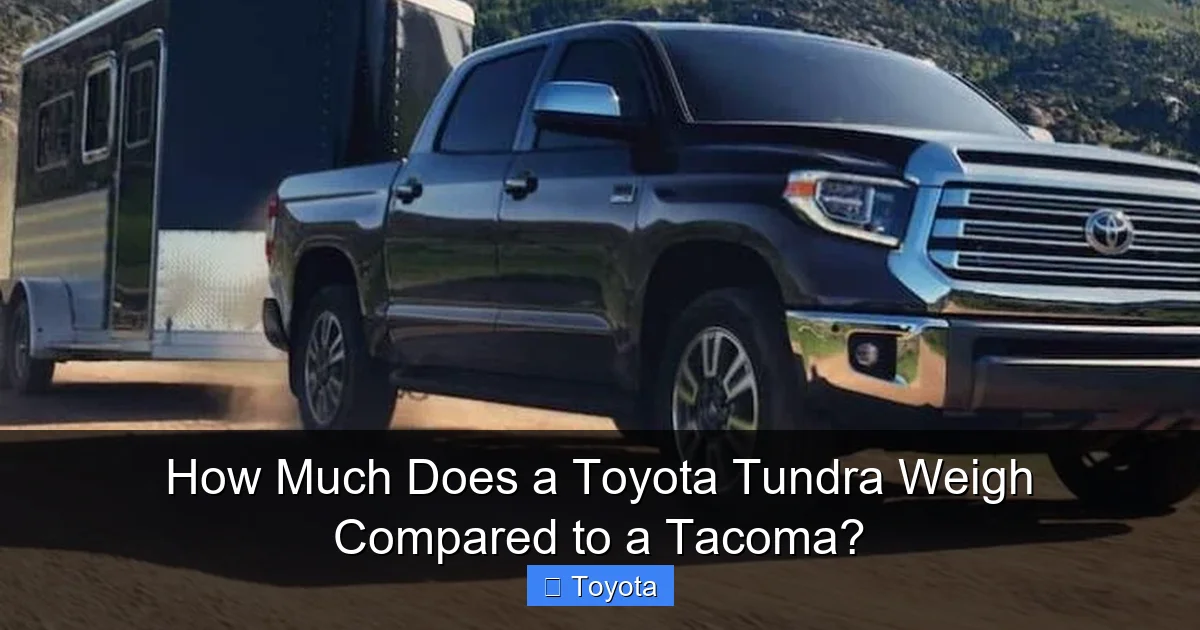
The Toyota Tundra is a beast of a truck, and its weight reflects that. For the 2024 model year, the Tundra is entirely redesigned, shedding some weight from the previous generation while gaining strength and capability through its new frame and powertrain. The current lineup is powered exclusively by a twin-turbo 3.5L V6 engine (the i-FORCE MAX hybrid variant adds an electric motor), a significant departure from the old V8. This new engine is lighter than the V8 it replaced, helping curb weight despite the truck’s robust build.
Visual guide about How Much Does a Toyota Tundra Weigh Compared to a Tacoma?
Image source: trucksauthority.com
Tundra Curb Weight by Configuration
Let’s look at the specific numbers. The lightest Tundra you can buy is the SR 2WD with the 5.5-foot bed. This configuration has a curb weight starting around 5,085 lbs. As you add options, the weight climbs. A 4×4 system adds roughly 100-150 lbs. The longer 6.5-foot bed adds about 50-75 lbs. The larger Double Cab (vs. the standard Access Cab) adds another 50-100 lbs. Top-tier trims like the Limited, Platinum, and Capstone bring significant weight with more luxury features, larger wheels, and upgraded suspension. A fully loaded Tundra Capstone 4×4 can easily tip the scales at 5,700 lbs or more.
It’s also worth noting the hybrid i-FORCE MAX model. While the hybrid system adds the weight of the electric motor and battery pack, it replaces the traditional alternator and starter, leading to a net weight gain of only about 50-100 lbs over the standard twin-turbo V6. This means the heaviest Tundra hybrids can approach 5,800 lbs. For a deep dive into all Tundra weights and specifications, you can explore our detailed analysis on how much a Toyota Tundra weighs.
The Toyota Tacoma: Agile and Efficient
The Toyota Tacoma has been the best-selling mid-size truck in America for years, and its weight is a big part of its appeal. For 2024, the Tacoma is all-new, riding on the TNGA-F platform shared with the Tundra and 4Runner. This new platform uses more high-strength steel and aluminum to improve rigidity while managing weight. The Tacoma offers two powerful but efficient engine choices: a 2.4L 4-cylinder and a hybrid 2.4L i-FORCE MAX system. The standard 4-cylinder is surprisingly light for its power output.

Visual guide about How Much Does a Toyota Tundra Weigh Compared to a Tacoma?
Image source: trucksauthority.com
Tacoma Curb Weight by Configuration
The lightest Tacoma is the SR 2WD with the 5-foot bed. This configuration starts at a curb weight of approximately 3,915 lbs. That’s a full 1,170 lbs lighter than the lightest Tundra! Moving to 4WD adds about 100 lbs. The longer 6-foot bed adds about 75 lbs. The Double Cab (the only cab option for 2024) is standard. The TRD PreRunner and TRD Off-Road trims add skid plates, off-road tires, and suspension components, adding 50-150 lbs. The top-spec TRD Pro, with its lifted suspension, all-terrain tires, and heavy-duty steel bumpers, is the heaviest, weighing in around 4,500 – 4,600 lbs.
The hybrid i-FORCE MAX Tacoma adds the weight of its hybrid components, making it about 150-200 lbs heavier than the equivalent non-hybrid model. This means a TRD Pro Hybrid can reach about 4,750 lbs. Even at its heaviest, the Tacoma remains over 1,000 lbs lighter than a base Tundra. If you’re considering a Tacoma and want to understand its maintenance needs relative to its size, knowing its exact weight and oil capacity is a good start, which you can find in our article on how much oil a Toyota Tacoma takes.
Head-to-Head: Tundra vs. Tacoma Weight Comparison
Now, let’s put the numbers side-by-side to see the full picture. The weight difference isn’t just a number; it’s a canyon separating two very different vehicles. We’ll compare common, similarly equipped configurations to highlight the gap.
Visual guide about How Much Does a Toyota Tundra Weigh Compared to a Tacoma?
Image source: trucksauthority.com
Comparing Popular Configurations
Consider a well-equipped, everyday driver’s truck:
- Tundra Limited 4×4, Double Cab, 6.5′ bed: Approx. 5,450 – 5,550 lbs
- Tacoma Limited 4×4, Double Cab, 6′ bed: Approx. 4,400 – 4,500 lbs
That’s a difference of about 1,050 to 1,050 lbs. For a more off-road focused comparison:
- Tundra TRD Pro 4×4: Approx. 5,600 – 5,700 lbs
- Tacoma TRD Pro 4×4: Approx. 4,700 – 4,800 lbs
The off-road TRD Pro models show a similar gap of roughly 900 to 1,000 lbs. The Tundra is consistently, massively heavier across the board. This isn’t a slight variation; it’s the difference between a compact SUV and a large SUV. The Tundra’s weight is in the same league as full-size SUVs like the Toyota Sequoia, while the Tacoma’s weight is closer to a 4Runner or a Honda Pilot.
Visualizing the Gap
To visualize 1,000 lbs, think of it this way: it’s equivalent to carrying about 500 gallons of water, or a small grand piano, or ten average-sized adults. That’s the constant extra mass the Tundra’s engine and drivetrain must move every time you accelerate, climb a hill, or brake. This explains the dramatically different driving experiences and capabilities. The Tundra’s extra weight is its “toolbox” for heavy-duty work, providing the structural rigidity and momentum needed for towing and hauling. The Tacoma’s lighter weight is its “toolbox” for efficiency and agility, making it a more playful and economical driver.
What Makes the Weight Difference? Engineering and Design
Why is there such a chasm? It’s not just about size. It’s about every component being scaled up for a different purpose. The Tundra is built on a full-size ladder frame, while the Tacoma uses a more modern, body-on-frame design optimized for mid-size proportions. The Tundra’s frame rails are thicker, wider, and heavier to handle immense twisting forces from towing. Its body panels are larger and often use more steel. The drivetrain components—axles, transmission, transfer case—are all heavier-duty and more robust in the Tundra to manage its higher torque and payload.
Engines and Drivetrains
Even though the Tundra and Tacoma now share similar engine families (twin-turbo V6 vs. turbo 4-cylinder, both with hybrid options), the Tundra’s versions are built bigger and stronger. The Tundra’s 3.5L V6 block and heads are larger and use more material. Its transmission is a heavier-duty 10-speed unit versus the Tacoma’s 8-speed. The Tundra’s rear axle is a full-floating design capable of handling much higher loads, while the Tacoma uses a semi-floating design suitable for its lower capacity. Every single component in the drivetrain and suspension is scaled for the Tundra’s higher GVWR, adding pounds.
Interior, Features, and Safety
Interior size and materials play a role too. The Tundra’s cab is larger, requiring more structural metal, more glass, and more sound-deadening material. Heavier luxury features like ventilated seats, a massive panoramic sunroof, and premium audio systems add up. Safety is a huge factor. Both trucks have advanced safety suites, but the Tundra’s larger size requires more extensive high-strength steel in the frame and body to meet crash test standards for a heavier vehicle. The sheer volume of material needed to create a safe, full-size truck cabin is substantially greater than for a mid-size truck.
Real-World Implications: Why Weight Matters in Your Daily Drive
So, you know the numbers. But what does that 1,000+ lb difference actually mean for you when you’re behind the wheel, filling up at the pump, or hooking up a trailer? Let’s break down the practical consequences.
Fuel Economy and Efficiency
This is the most obvious and constant impact. The EPA fuel economy ratings reflect the weight difference starkly. A 2024 Tundra 2WD might get an estimated 18 MPG combined, while a similarly powered Tacoma 2WD might get 23 MPG combined. That’s a 5 MPG gap, or about a 28% difference in efficiency. In real-world driving, that translates to needing to stop for gas much more frequently with the Tundra. Over 15,000 miles, at $3.50/gallon, that 5 MPG difference could cost you an extra $400-$600 annually. The Tundra’s heavier mass means its engine must work harder and consume more fuel to overcome inertia and maintain speed.
Towing and Payload Capacity
Here, the Tundra’s weight becomes an advantage. A heavier vehicle generally has a higher Gross Combined Weight Rating (GCWR)—the max weight of the truck plus trailer and cargo. The Tundra’s robust frame and heavy-duty components give it a maximum towing capacity of up to 11,175 lbs (with the i-FORCE MAX hybrid). The Tacoma’s max is 6,400 lbs. For payload (what you can put in the bed and cab), the Tundra can handle up to 1,940 lbs, while the Tacoma maxes out at 1,709 lbs. If you regularly tow a large boat, horse trailer, or heavy RV, the Tundra’s extra weight and engineering are non-negotiable. For lighter loads—a jet ski, small utility trailer, or dirt bikes—the Tacoma is more than capable and much more fuel-efficient doing it.
Handling, Braking, and Ride Quality
Weight influences driving dynamics in nuanced ways. The Tundra’s mass gives it a feeling of solidity and stability, especially at highway speeds. It feels “planted.” However, this comes at the cost of slower, heavier steering and more body roll in corners. Braking distances are longer; all that momentum must be dissipated. The Tacoma, being lighter, feels more responsive and playful. Steering is quicker, and it changes direction with less effort. Its braking feel is more immediate. However, the lighter Tacoma can feel more “nervous” in strong crosswinds or when passed by large semis. The Tacoma’s suspension is also tuned for more off-road articulation, which can compromise on-road comfort compared to the Tundra’s generally smoother, more controlled ride.
Off-Road Performance
This is a fascinating trade-off. On one hand, the Tundra’s extra weight can be an advantage in some off-road scenarios. Its momentum can help it power through deep sand or loose dirt where a lighter vehicle might get stuck. Its heavy-duty axles and frame are less likely to flex under load. On the other hand, the Tacoma’s lighter weight is a massive advantage in technical rock crawling. Less weight means less pressure on the tires and ground, reducing the chance of breaking traction or getting high-centered. It’s also easier on the vehicle’s components. For most recreational off-roading—forest service roads, rocky trails, moderate sand—the Tacoma’s weight is perfectly adequate and its smaller size often makes it more capable on narrow, twisty trails.
Practical Ownership: Parking, Storage, and Daily Use
Don’t underestimate the daily impact of size and weight. The Tundra is a large vehicle. Its length (over 22 feet for the Double Cab long bed) makes parking in tight city spots a genuine challenge. Its width requires more room in your garage and on the road. The Tacoma, while still a truck, is significantly more compact and easier to live with in an urban environment. Its lighter weight also means less wear and tear on your driveway or garage floor. When loading cargo, the Tacoma’s lower bed height (due to smaller tires and suspension) can make lifting heavy items easier than heaving them into the taller Tundra bed.
Ultimately, the weight difference tells the story of two iconic Toyotas. The Tundra is a purpose-built tool for those who need maximum, uncompromising capability and are willing to pay for it in fuel and size. The Tacoma is the brilliant all-rounder, offering impressive capability in a more efficient, agile, and manageable package. Your choice depends entirely on which set of trade-offs aligns with your real-life needs.
Conclusion: Choosing Your Truck Based on Weight and Purpose
We’ve traveled through the numbers, the engineering, and the real-world consequences. The answer to “how much does a Toyota Tundra weigh compared to a Tacoma?” is clear: the Tundra is consistently 1,000 to 2,000 pounds heavier, depending on the specific models you compare. This isn’t a minor discrepancy; it’s the defining characteristic that separates a mid-size adventurer from a full-size workhorse.
Let this weight difference guide your decision. If your life involves serious towing—a large boat, a full-size camper, a heavy equipment trailer—the Tundra’s heft is its greatest asset. Its frame, axles, and brakes are engineered to manage that mass and the added strain of a heavy trailer. If your priorities lean toward daily driver usability, weekend adventures, light-to-moderate hauling, and the best possible fuel economy, the Tacoma’s lighter weight is its superpower. It’s the truck that’s easier to live with every single day while still being remarkably capable.
Both are exceptional, reliable trucks that hold their value incredibly well. The “better” truck isn’t a universal truth; it’s the one whose weight—and all the capabilities and compromises that come with it—best matches your specific needs. Think about your most common tasks. Imagine parking your truck. Picture your last few fill-ups. The weight difference between the Tundra and Tacoma isn’t just a spec sheet number; it’s a daily reality that will shape your ownership experience from the first drive to the last.
Frequently Asked Questions
Does the 4×4 system add the same amount of weight to both trucks?
No. While both gain weight from 4×4 components (transfer case, front axle, driveshafts), the Tundra’s 4×4 system is heavier-duty and thus adds more absolute weight—typically 100-150 lbs. The Tacoma’s 4×4 system adds about 80-120 lbs. The percentage increase relative to the base vehicle weight is similar.
How much does the hybrid system add to the weight?
The hybrid i-FORCE MAX system adds weight to both trucks, but differently. In the Tundra, it replaces the traditional starter and alternator, resulting in a net gain of about 50-100 lbs over the standard twin-turbo V6. In the Tacoma, the hybrid adds a more substantial 150-200 lbs because it integrates with a different 4-cylinder engine architecture. Even with hybrids, the Tundra remains far heavier.
Can the lighter Tacoma tow as much as a heavier Tundra?
No. Towing capacity is not directly about the truck’s own weight, but about the strength of its frame, engine, transmission, axles, and cooling systems. The Tundra’s heavier, more robust components are designed for much higher loads. Its maximum towing capacity is nearly double that of the Tacoma’s. The Tacoma is rated for lighter trailers, typically up to 6,400 lbs.
Does a heavier truck like the Tundra get worse fuel economy?
Yes, significantly. Physics dictates that moving more mass requires more energy. The Tundra’s 1,000+ lb weight advantage means its engine must work harder to accelerate and maintain speed, burning more fuel. This is the primary reason its EPA MPG ratings are 4-6 MPG lower across the board compared to the Tacoma, even when they have similar horsepower.
Is the heavier Tundra safer in a crash?
In a collision with a smaller vehicle, the heavier Tundra would likely transfer less force to its occupants due to physics (Newton’s Third Law). However, modern crash safety is about engineered crumple zones and occupant cell integrity, not just mass. Both trucks earn top safety ratings (IIHS Top Safety Pick+). The Tundra’s extra weight allows for more robust structural materials, but the Tacoma’s excellent ratings prove its design is also highly effective at protecting occupants.
How does weight affect tire wear?
More weight means more force on the tires, leading to faster tread wear. The Tundra’s heavier front axle, in particular, will wear out front tires quicker than the Tacoma’s. Additionally, the Tundra often requires heavier-duty, higher-load-index tires, which can have different wear characteristics. Owners of heavier trucks should expect to rotate tires more frequently and potentially replace them sooner.
