
How Much Does It Cost to Replace a Toyota Catalytic Converter

Replacing a Toyota catalytic converter is one of the most expensive common repairs. Total costs typically range from $1,200 to over $3,500, depending heavily on your model year, engine type, and whether you use OEM or aftermarket parts. Labor is a significant factor, as the converter is often welded into the exhaust system. Understanding these variables is crucial before getting quotes, as is exploring potential warranty coverage or aftermarket alternatives to manage the high expense.
Key Takeaways
- Extreme Cost Variability: The total replacement cost for a Toyota catalytic converter can range from $1,200 for a basic, older model to upwards of $3,500 for a newer, high-performance, or hybrid vehicle with multiple converters.
- Parts Are the Primary Cost: The catalytic converter itself is the expensive component, with OEM (Original Equipment Manufacturer) parts costing between $800 and $2,500+. Aftermarket options can be 30-50% cheaper but vary in quality and compliance.
- Labor is Complex and Time-Consuming: Installation often involves cutting out the old, welded converter and welding in the new one, requiring 2-5 hours of skilled labor at $75-$150 per hour, adding $150-$750+ to the bill.
- Your Specific Toyota Model is Everything: A 2005 Camry 2.4L has a single, relatively simple converter. A 2022 RAV4 Hybrid has two complex converters (one for engine, one for battery) that are far more expensive. Always get model-specific quotes.
- DIY is Rarely Feasible or Legal: While possible on very old models, welding skills and tools are mandatory. Improper installation can cause exhaust leaks, failed emissions tests, and trigger check engine lights. In many states, non-compliant aftermarket converters are illegal for vehicles over a certain age.
- Diagnosis is Critical Before Replacement: A failing converter often has a root cause (like misfiring sparks plugs or oil burning). Replacing the converter without fixing the underlying issue will lead to a repeat failure. Always diagnose the full system first.
- Consider Long-Term Value & Maintenance: On an older, high-mileage Toyota, a $3,000 repair may not make financial sense. Explore the vehicle’s overall value. For cosmetic upkeep alongside mechanical repairs, owners sometimes consider options like a cost to wrap a Toyota Camry to refresh its appearance without a full repaint.
📑 Table of Contents
- Understanding the Heart of Your Exhaust: What is a Catalytic Converter?
- The Big Question: How Much Does It Actually Cost?
- What Factors Change the Price for YOUR Toyota?
- Recognizing the Signs: Do You Really Need a New Converter?
- DIY vs. Professional: Should You Attempt This Yourself?
- Saving Money: Smart Strategies for a Costly Repair
- Conclusion: A Necessary Evil for Your Toyota
Understanding the Heart of Your Exhaust: What is a Catalytic Converter?
Before we dive into the shock of the price tag, let’s talk about what this mysterious part actually does. Your Toyota’s catalytic converter is a metal canister, typically located in the exhaust system between the engine and the muffler. Inside, it’s packed with a honeycomb structure coated with precious metals like platinum, palladium, and rhodium. Its job is absolutely critical for the environment and your car’s legality: it uses a chemical reaction to convert harmful exhaust gases—carbon monoxide, hydrocarbons, and nitrogen oxides—into less harmful carbon dioxide, nitrogen, and water vapor. Without it, your car would spew toxic smog, and it would fail every emissions test. It’s not a wear-and-tear part like brakes or oil filters; it’s designed to last the life of the vehicle. So when it fails, it’s a big deal, both for your car’s health and your wallet.
The “Why” Behind the High Price
The staggering cost stems from the raw materials. Those precious metals we mentioned? They are, well, precious. Rhodium, in particular, has seen wild price swings, often trading for thousands of dollars per ounce. The converter is essentially a small, precisely engineered vault of these metals. Combine that with complex manufacturing and stringent emissions regulations that mandate highly efficient designs, and you have a component that is inherently expensive to produce. When you buy one, you’re paying for that material content and the technology that goes into it.
The Big Question: How Much Does It Actually Cost?
Now for the number you’ve been waiting for. There is no single answer, but we can provide clear ranges. The total cost at a repair shop includes two main things: the part itself and the labor to install it. Let’s break it down.
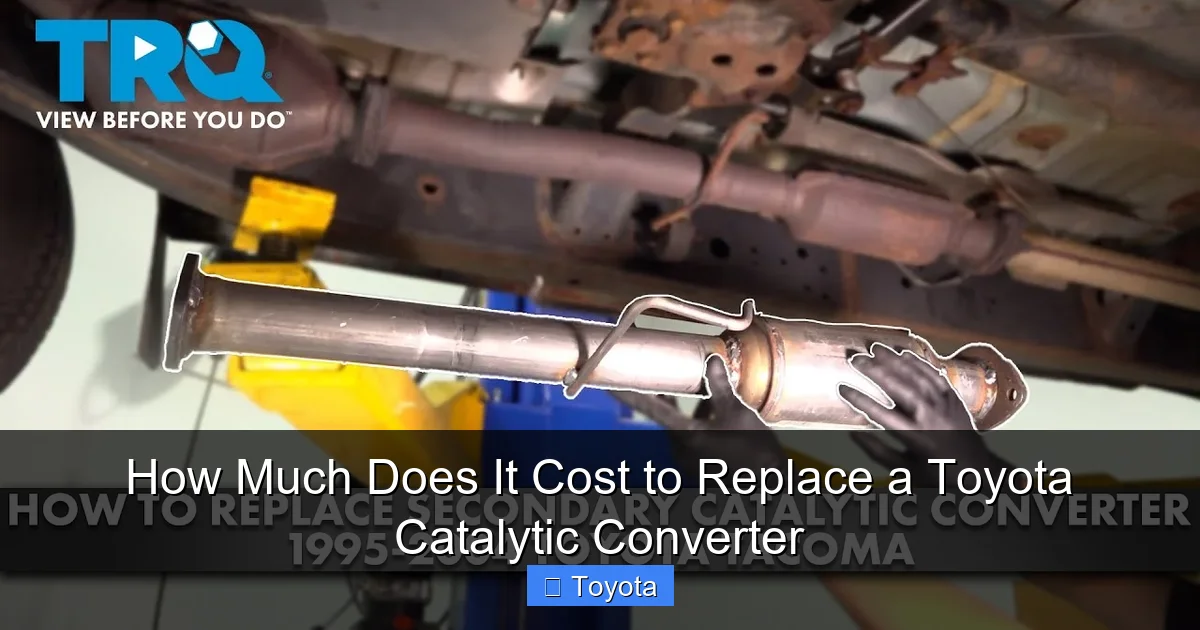
Visual guide about How Much Does It Cost to Replace a Toyota Catalytic Converter
Image source: i.ytimg.com
Parts Cost: The Major Variable
This is where the biggest swing happens. You generally have three choices:
- OEM (Dealer) Parts: These are made by Toyota or their direct suppliers to exact original specifications. They are guaranteed to fit perfectly and meet all emissions standards. Cost: $800 – $2,500+ for the part alone. For a late-model Toyota with a direct OEM-fit converter, this is the most common and reliable path.
- Aftermarket/Performance Parts: Companies like MagnaFlow, Bosal, or Eastern Catalytic make converters. Quality varies wildly. Some are excellent, using sufficient precious metals to pass emissions. Others are “cheap cats” with minimal catalyst material that may fail inspections quickly. Cost: $400 – $1,200. This is the risk/reward option.
- Used/ Salvage Parts: Pulling a converter from a donor vehicle at a junkyard. This is a gamble. You have no idea of its history or remaining life. It could be near failure already. Cost: $100 – $400, but with high risk and often illegal in states with strict used-part laws for emissions components.
Labor Cost: The Hidden Time Sink
This isn’t a simple bolt-off, bolt-on job for most modern Toyotas. Rust, heat, and design often mean the converter is welded directly to the exhaust pipe or is part of a complex front pipe assembly. Mechanics must cut it out (often with a sawzall), which takes time and skill, then weld the new unit in perfectly to prevent exhaust leaks. Labor rates vary by region and shop, but expect $75 to $150 per hour. The time required can be:
- Simple Bolt-On (rare on newer models): 1-2 hours.
- Cut & Weld (most common): 2-4 hours.
- Extremely Complex (e.g., some hybrids, V6 models with dual exhaust): 4-6+ hours.
Quick Math Example: A 2018 Toyota Camry SE 2.5L might have an OEM converter for ~$1,100. Labor at 3 hours @ $120/hr = $360. Total: ~$1,460. Add taxes and shop supplies, and you’re easily at $1,600-$1,800.
What Factors Change the Price for YOUR Toyota?
Your specific vehicle is the single biggest determinant. Let’s look at the key factors that will push your quote up or down.
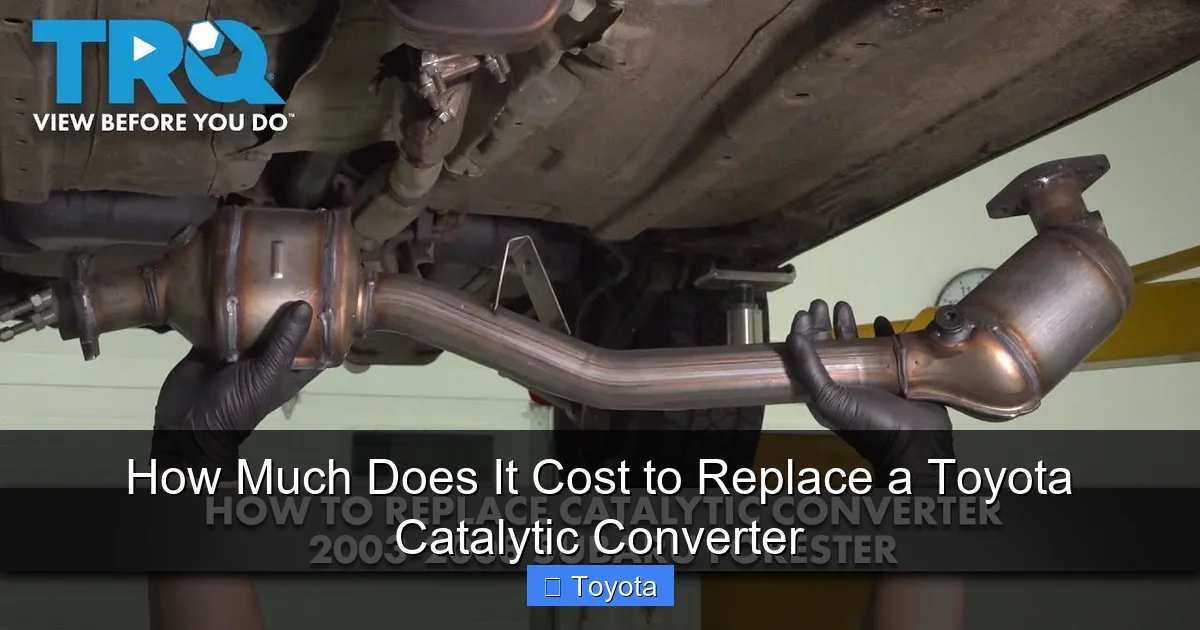
Visual guide about How Much Does It Cost to Replace a Toyota Catalytic Converter
Image source: i.ytimg.com
Model Year and Engine Size
Generally, newer cars are more expensive. Emissions standards tightened dramatically in the 2000s and 2010s, requiring more sophisticated (and expensive) converter designs. A 1999 Toyota Corolla converter might be a simple, cheap bolt-on unit. A 2021 Toyota Tacoma with a 3.5L V6 has a much larger, more complex converter. Also, engines with more cylinders (V6, V8) often have more exhaust flow, requiring larger or multiple converters.
Vehicle Type: Sedan vs. SUV vs. Truck vs. Hybrid
This is huge. A standard gasoline sedan like a Camry or Corolla usually has one primary converter. A large SUV like a Highlander or 4Runner, especially with a V6, will have a larger, more expensive single unit. A pickup like the Tundra has a massive converter. But the king of high costs is the hybrid. Models like the RAV4 Hybrid, Prius, and Highlander Hybrid have two catalytic converters: a traditional one for the gasoline engine and a second, often very expensive one for the battery cooling system (the “auxiliary” or “battery” converter). Replacing both can easily double the cost.
Your Geographic Location
Labor rates differ wildly. A shop in Manhattan or San Francisco will charge $150+/hr. A shop in a small Midwest town might be $85/hr. Additionally, states with strict emissions testing (California, New York, etc.) may require a very specific, CARB-compliant converter, which is almost always OEM or a premium aftermarket part, eliminating the cheap options.
OEM vs. Aftermarket: The Great Debate
This is a personal decision with trade-offs. OEM guarantees a perfect fit and 100% compliance, but at a premium. A reputable aftermarket brand (like the ones mentioned) can offer a great product at a 30-50% discount, but you must verify it’s CARB or EPA certified for your state and vehicle. For a car you plan to keep long-term, OEM is often the safer peace-of-mind bet. For an older car you might sell in a few years, a quality aftermarket part can make financial sense. Never choose a no-name, ultra-cheap converter; it will likely fail and you’ll be doing the job twice.
Recognizing the Signs: Do You Really Need a New Converter?
Catalytic converters don’t usually fail spontaneously. They degrade due to an underlying issue. Throwing a new converter at a car with an unresolved problem is like putting a new tire on a car with a bent wheel—it will just destroy the new part. Here are the classic symptoms of a failing converter:
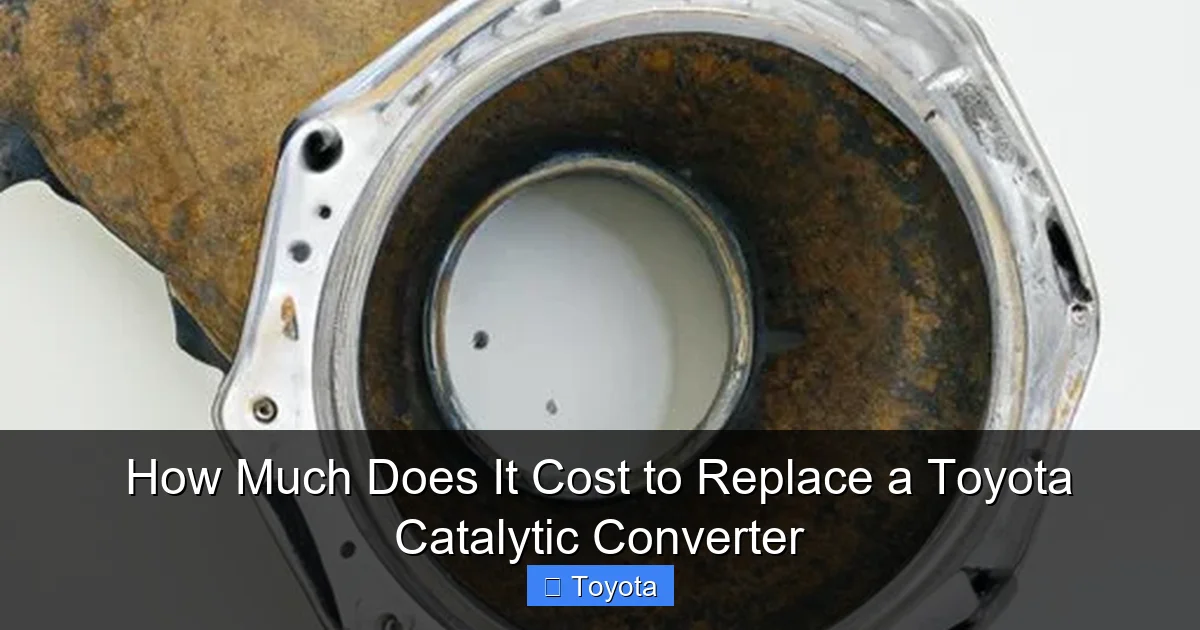
Visual guide about How Much Does It Cost to Replace a Toyota Catalytic Converter
Image source: tffn.net
- Failed Emissions Test: This is the most common discovery. Your car won’t pass its annual smog check.
- Check Engine Light (CEL): A specific OBD-II trouble code will store. Common codes are P0420 (Catalyst System Efficiency Below Threshold) or P0430. A mechanic will read this and may perform further tests (like an exhaust gas analysis) to confirm converter failure versus a faulty oxygen sensor.
- Poor Performance & Fuel Economy: A clogged converter creates backpressure. You might notice sluggish acceleration, difficulty reaching high speeds, or a significant drop in MPG.
- Rotten Egg Smell: A failing converter can’t process sulfur properly, leading to a distinct hydrogen sulfide (rotten egg) odor from the exhaust.
- Loud Exhaust Noise: If the converter’s internal honeycomb structure breaks apart (from overheating or impact), it can rattle loudly inside the canister. You might hear this as a metallic clatter, especially when idling or revving.
The Crucial Step: Diagnosing the Root Cause
Before any reputable shop quotes you for a converter, they must diagnose why it failed. The #1 cause is unburned fuel entering the exhaust. This happens from:
- Misfiring spark plugs or ignition coils.
- Faulty fuel injectors leaking fuel.
- Bad engine compression (worn rings, valves).
- Oil burning from worn seals or rings (blue smoke).
These issues dump raw fuel into the exhaust, which then burns inside the super-hot converter, melting the catalyst substrate. If your shop doesn’t check for these first, find a new one. Fixing the misfire is often a few hundred dollars. Replacing the converter without fixing it will destroy the new one in weeks or months.
DIY vs. Professional: Should You Attempt This Yourself?
The honest answer for 99% of Toyota owners is a firm no. Here’s why.
The Skills and Tools Required
You need more than just a socket wrench. You need:
- Advanced welding skills (MIG or TIG) and a welder. The new converter must be welded seamlessly to the existing exhaust pipe.
- Reciprocating saw (Sawzall) with metal-cutting blades to cut out the old, rusted converter.
- Exhaust pipe benders, clamps, and sealant for certain applications.
- Jack stands, a safe way to lift the vehicle, and knowledge of exhaust system routing.
Poor welding leads to exhaust leaks, which are dangerous (carbon monoxide enters the cabin), cause noise, and will trigger the Check Engine Light again due to oxygen sensor readings.
Legal and Emissions Compliance
In many states, it is illegal to install a non-CARB-compliant aftermarket converter on a vehicle that originally came with a catalytic converter (which is all post-1975 cars). You could be fined, and your car will fail its next emissions test. Even if you use a compliant part, improper installation can cause a failure. Professional shops guarantee their work and the part’s compliance.
When DIY *Might* Be Considered
Only if you have a very old Toyota (pre-1996, OBD-I) with a simple, bolt-on converter, excellent welding skills, and you live in a state with no emissions testing. Even then, sourcing the correct, legal part is a challenge. For any modern Toyota, this is a professional job.
Saving Money: Smart Strategies for a Costly Repair
Don’t just accept the first quote. Be a savvy consumer.
Get Multiple, Detailed Quotes
Contact at least 3-4 reputable repair shops. An independent shop is often cheaper than a dealership. Give them your exact VIN. Ask for a breakdown: part number/price, labor hours, hourly rate, and shop supplies fee. Compare the total. Be wary of a quote that seems too good to be true—they may be using a cheap, non-compliant converter or planning to cut corners on the weld.
Ask About Aftermarket Options with Proof
Say to the shop: “I’m concerned about cost. Do you have a high-quality aftermarket converter that is CARB/EPA certified for my specific VIN? Can you show me the certification number?” A good shop will have relationships with brands like MagnaFlow or AP Exhaust and can provide the documentation. This can save you $500-$1,000.
Check for Warranty Coverage
This is a long shot, but worth a call:
- Extended Warranty: If you purchased an extended service contract (not the factory warranty, which is usually expired), check if catalytic converter failure is a covered item. Many are not, or have high deductibles.
- Recall: Extremely rare, but check the NHTSA website for your Toyota’s VIN. Some older models had recalls for defective converters.
Consider the Vehicle’s Value
Do the math. If your 2005 Camry with 250,000 miles needs a $1,800 repair and its total value is $2,500, it’s a tough call. You might be better off putting that money toward a different vehicle. On a 2019 RAV4 worth $25,000, a $2,200 repair is a no-brainer to keep it running reliably. For cosmetic fixes on a car you’re keeping, like a minor dent or aging paint, some owners opt for a full wrap. You can research the cost to wrap a Toyota Camry as an alternative to a costly paint job, which is a separate consideration from this critical mechanical repair.
Conclusion: A Necessary Evil for Your Toyota
Replacing a catalytic converter on a Toyota is never a pleasant experience due to the high cost. It’s a repair born of a failed emissions component, often triggered by another neglected issue. The key takeaway is knowledge. Understand that the price is driven by precious metal costs and complex labor. Get a proper diagnosis to ensure you’re not fixing the wrong problem. Shop around, ask about certified aftermarket parts, and always use a reputable shop with welding expertise. While the bill will be steep, a properly functioning catalytic converter is non-negotiable for a legal, environmentally sound, and smoothly running Toyota. Treat this repair as a reminder to stay on top of general maintenance—addressing small problems like misfires immediately is the best way to avoid facing this giant expense down the road. Your Toyota’s longevity and your wallet will thank you.
Frequently Asked Questions
Can I drive my Toyota with a bad catalytic converter?
You can drive it for a short distance to a repair shop, but it’s not advisable for long. A severely clogged converter can cause engine overheating, stalling, or complete engine failure due to excessive backpressure. It will also continuously trigger the check engine light and cause your vehicle to fail emissions tests.
How long does a catalytic converter replacement take?
For most modern Toyotas, expect the job to take between 2 and 5 hours. Simple, bolt-on units on older models might be done in under two hours. Complex units on hybrids or trucks with welded connections can take 4-6 hours. The time is almost entirely labor, as the part itself is simply installed once the old one is removed.
Are aftermarket catalytic converters any good for a Toyota?
They can be, but you must be selective. Reputable brands (MagnaFlow, Flowmaster, etc.) make excellent, CARB/EPA-compliant converters that perform well and are significantly cheaper than OEM. Always verify the specific part is certified for your exact Toyota model, year, and engine. Avoid the cheapest options on generic websites, as they often lack sufficient catalyst material and will fail quickly or be illegal.
Will a Toyota dealer install an aftermarket converter I buy myself?
Most dealerships will not. They typically require using their OEM parts and have policies against customer-supplied parts for emissions-related repairs due to liability and warranty concerns. Independent shops are much more likely to install a quality aftermarket converter you source, but always ask first and get their approval in writing.
What happens if I ignore a failing catalytic converter?
Initially, you’ll have a check engine light and failed emissions test. As it worsens, you’ll experience poor performance and fuel economy. Eventually, a clogged converter can cause the engine to overheat, lose power severely, or stall. Complete blockage can lead to catastrophic engine damage. You will also be polluting at much higher levels, which is illegal.
Is there any way to clean a catalytic converter instead of replacing it?
There are fuel additives and “catalytic converter cleaners” marketed for this. Their effectiveness is highly questionable and debated. They might help with minor carbon buildup from rich fuel mixtures, but they cannot repair a physically damaged, melted, or severely clogged converter substrate. If a professional diagnosis confirms a failed converter, replacement is the only permanent fix.
