
How Long Does a Timing Chain Last on a Toyota Highlander?

A well-maintained timing chain in a Toyota Highlander is designed to last the life of the engine, often exceeding 200,000 miles. Unlike timing belts, it’s a lubricated, metal system that rarely needs scheduled replacement. However, factors like poor oil maintenance, extreme driving conditions, and specific model year issues can lead to premature wear. Proactive oil changes with the correct oil and listening for early warning noises are the best defenses against costly engine damage.
If you own a Toyota Highlander or are considering buying one, understanding its heart—the engine—is crucial. One of the most critical, yet often misunderstood, components inside that engine is the timing chain. It’s the silent guardian that synchronizes the entire mechanical ballet of your engine. So, the big question on every Highlander owner’s mind is: how long does a timing chain last on a Toyota Highlander? The simple, reassuring answer is that it’s designed to last the lifetime of the engine. But, as with most things in life, the reality is a bit more nuanced. Let’s pop the hood and take a detailed look at what you really need to know.
Key Takeaways
- Designed for Longevity: The Toyota Highlander’s timing chain is a “lifetime” component meant to last the engine’s life, typically over 200,000 miles with proper care.
- Oil is Critical: Clean, correct-viscosity oil is the #1 factor for timing chain life, as it lubricates and cools the chain and tensioners.
- Listen for Warning Signs: A persistent rattling or tapping noise from the front of the engine, especially on cold starts, is the most common early symptom of a failing chain.
- Neglect is the Main Enemy: Skipping oil changes, using the wrong oil, or ignoring low oil levels causes accelerated wear and is the primary cause of failure.
- Replacement is Major Surgery: If the chain fails, it will likely destroy the engine, requiring a full replacement or rebuild, which is extremely expensive.
- Model Year Matters: Some early 2000s Highlander models (with the 2.4L 2AZ-FE engine) have documented issues with timing chain guides and tensioners.
[FEATURED_IMAGE_PLACEHOLDER]
📑 Table of Contents
- Timing Chain vs. Timing Belt: The Fundamental Difference
- The Official Answer: Expected Lifespan in a Highlander
- What Can Shorten a Timing Chain’s Life? The Real Threats
- How to Spot a Problem: The Warning Signs
- Maintenance Best Practices to Maximize Chain Life
- What Happens If It Fails? The Cost of Catastrophe
- Comparing Generations and Models: Is There a Difference?
- The Bottom Line: Your Action Plan
Timing Chain vs. Timing Belt: The Fundamental Difference
First, we need to clarify a common point of confusion. Many people hear “timing chain” and “timing belt” and think they’re the same thing with different names. They are not. This distinction is the foundation for understanding longevity.
What is a Timing Chain?
A timing chain is, as the name suggests, a heavy-duty metal chain, very similar to what you’d find on a high-performance bicycle or motorcycle, but much stronger. It runs inside the engine, lubricated by engine oil, and connects the crankshaft to the camshaft(s). Its job is to ensure the intake and exhaust valves open and close at precisely the right moment in sync with the pistons. Because it’s made of metal and runs in a bath of oil, it’s incredibly durable. In a Toyota Highlander, the timing chain is the standard for most models across its production run.
What is a Timing Belt?
A timing belt, conversely, is made of a reinforced rubber composite with teeth. It performs the same synchronization job but is not lubricated by engine oil. It runs outside the engine, protected by a cover, and is subject to dry wear, heat, and age. This is the component that has a strict replacement interval, typically every 60,000 to 100,000 miles, depending on the manufacturer. Failure of a timing belt usually means catastrophic engine damage in an interference engine. The Highlander has almost exclusively used timing chains, which is a major point in its favor for long-term reliability. You can think of the chain as the heavy-duty, “set it and forget it” option, while the belt is the scheduled-maintenance option.
The Official Answer: Expected Lifespan in a Highlander
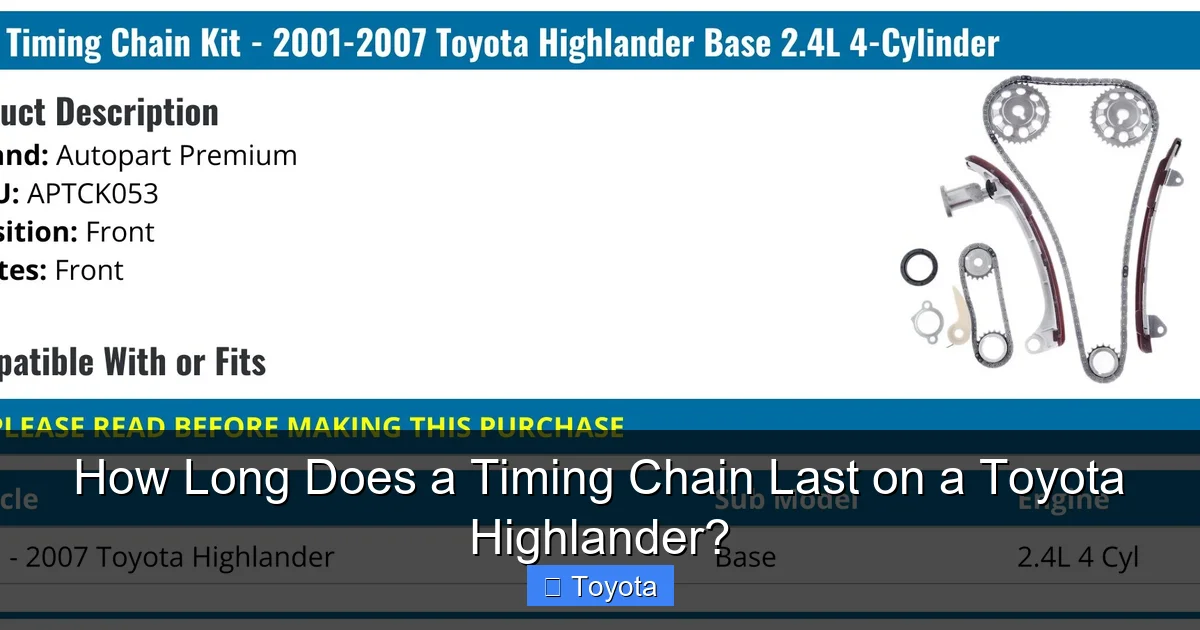
Toyota’s official stance for most Highlander models equipped with a timing chain is that it is a “lifetime” part. In automotive engineering terms, “lifetime” doesn’t mean “forever”; it means the designed service life of the engine itself—often considered to be 150,000 to 200,000 miles or more under normal operating conditions. This is a bold claim, and for the vast majority of Highlanders on the road, it holds true. These engines, particularly the popular 3.5L V6 (2GR-FE and its variants), are known for their robust construction and the exceptional durability of their timing chain systems.
Visual guide about How Long Does a Timing Chain Last on a Toyota Highlander?
Image source: partsgeek.com
So, you should not plan on replacing your Highlander’s timing chain as part of a regular maintenance schedule like you would a serpentine belt or spark plugs. There is no mileage-based “service interval” printed in your owner’s manual for the chain itself. The system is designed to be maintenance-free. However, “lifetime” is conditional. It assumes you follow all other maintenance schedules rigorously, especially oil changes. The health of the timing chain is inextricably linked to the health of your engine oil. If the oil degrades, becomes sludgy, or runs low, the chain and its associated components (tensioners, guides) will suffer accelerated wear. This is why you might hear stories of a timing chain failing at 120,000 miles in one car while another with 300,000 miles is still going strong. The difference almost always comes down to oil maintenance history.
What Can Shorten a Timing Chain’s Life? The Real Threats
Understanding what can go wrong is just as important as knowing the ideal scenario. Several factors can prematurely age and eventually fail a timing chain system.
Visual guide about How Long Does a Timing Chain Last on a Toyota Highlander?
Image source: i.redd.it
1. Oil Neglect: The Primary Culprit
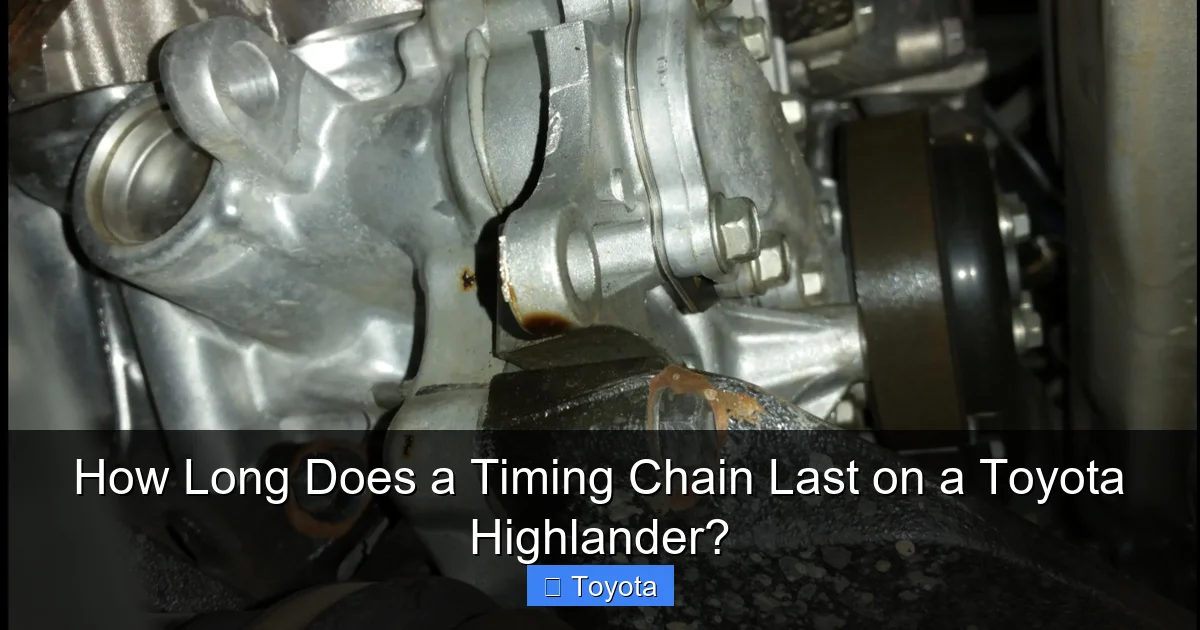
The timing chain and its hydraulic tensioners are bathed in engine oil. This oil provides crucial lubrication and also acts as a hydraulic fluid to keep the tensioner applying the correct pressure. If oil is not changed regularly, it breaks down. It loses its viscosity, becomes contaminated with fuel, water, and metal particles, and can form sludge. Sludge can clog the tiny oil passages that feed the tensioner, causing it to fail and the chain to go slack, leading to noise and potential跳齿 (jumping teeth). Low oil level means the chain isn’t getting enough lubrication, causing rapid metal-on-metal wear. Simply put, consistent, timely oil changes with the oil viscosity specified by Toyota are the single most important thing you can do for your timing chain’s health. Neglecting this is like running a marathon in sandals—it might work for a while, but destruction is inevitable.
2. Faulty or Worn Tensioners and Guides
The chain isn’t just loose; it’s kept under precise tension by a hydraulic tensioner and guided by plastic or nylon composite guides. These guides have a finite lifespan. Over hundreds of thousands of cycles, the plastic can wear, crack, or become brittle. A worn guide allows the chain to slap against it, creating the characteristic rattling noise. The hydraulic tensioner’s seals can also wear out, causing it to lose pressure. If either of these components fails, the chain can become excessively loose or jump a tooth, leading to engine misalignment and potential valve/piston collision. Some specific Highlander engine codes have had documented issues with premature guide or tensioner failure. For example, certain early 2AZ-FE engines (found in some 2001-2006 models with the 2.4L 4-cylinder) are known for timing chain guide failures. This is a key reason to research your specific VIN or engine code if you have a high-mileage early-model Highlander.
3. Severe Driving Conditions and Lack of Warm-Up
“Severe” driving, as defined by Toyota, isn’t just racing. It includes frequent short trips (where the oil doesn’t fully warm up and circulate), driving in extremely cold or hot climates, extensive idling, towing, and driving in dusty conditions. These conditions put extra stress on all engine components. A cold engine has thicker oil that doesn’t lubricate the chain as effectively until it warms up. If you constantly start and shut off the engine before it reaches full operating temperature, you’re subjecting the chain to more cold-start wear. While the chain is robust, years of this treatment can contribute to wear.
4. Manufacturing Defects (Rare)
While Toyota has an excellent reputation, no mass-produced component is immune to the rare manufacturing defect. A flawed link, a tensioner with a microscopic casting flaw, or a guide made from substandard material could fail prematurely. This is statistically very rare but is a possibility in any mechanical system. This is often what warranties are for, which is why checking if your Highlander had any extended warranty coverage for timing chain components could be worthwhile.
How to Spot a Problem: The Warning Signs
Because there’s no scheduled replacement, your ears and awareness become your primary diagnostic tools. Catching a problem early can save you from an engine that needs to be replaced. The most common and earliest symptom is noise.
Visual guide about How Long Does a Timing Chain Last on a Toyota Highlander?
Image source: i.ytimg.com
The Classic “Cold Start Rattle”
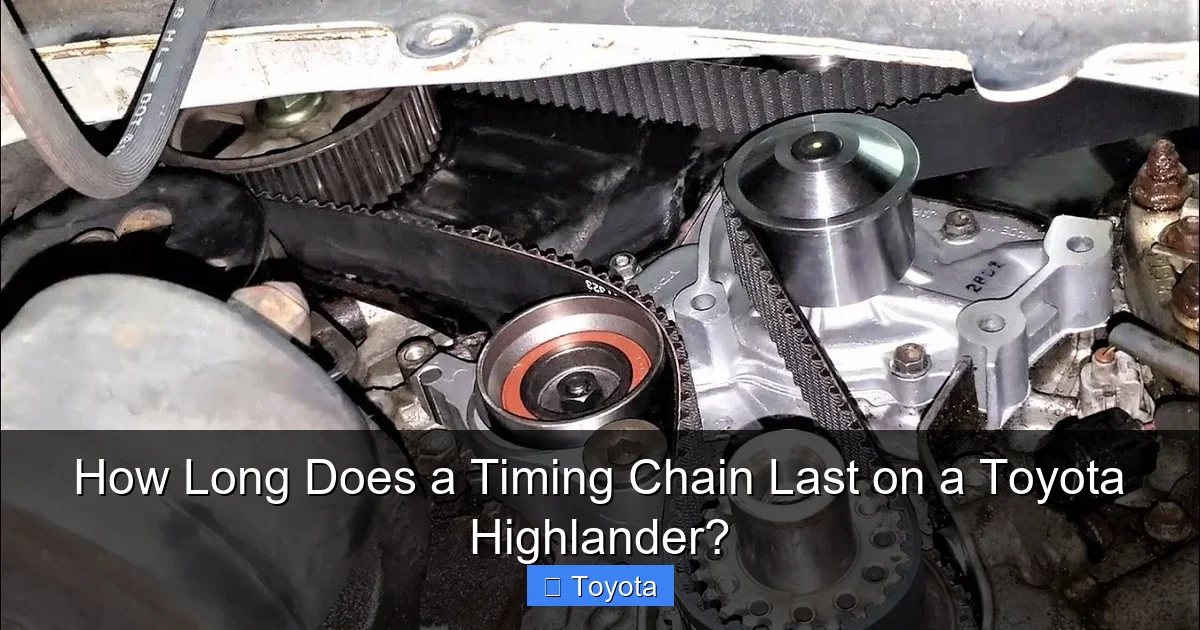
The #1 red flag is a distinct rattling, tapping, or slapping noise coming from the front top of the engine (the timing cover area). This noise is most pronounced and loudest on cold starts, especially after the car has been sitting overnight. It may last for a few seconds to a minute as the engine warms up and oil pressure builds to fully tension the chain. As the oil warms and thins, the noise often diminishes or disappears. This is the sound of a loose chain slapping against a worn guide or a tensioner that isn’t applying enough pressure immediately. If you hear this, do not ignore it. Get it diagnosed by a qualified mechanic immediately. They will often listen with a mechanic’s stethoscope to confirm the source.
Performance Issues and Check Engine Lights
As the problem progresses, you might notice other symptoms. A stretched chain that jumps a tooth will throw off the engine’s timing. This can cause:
- Rough Running: The engine may idle poorly, shake, or misfire.
- Loss of Power: You might feel a lack of acceleration or a general “sluggish” feel.
- Poor Fuel Economy: The engine is no longer operating efficiently.
- Check Engine Light (CEL): The engine control unit (ECU) will detect misfires or cam/crank sensor correlation errors and illuminate the CEL. Codes like P0010, P0011, P0012 (relating to camshaft position) are common indicators.
At this stage, the problem is serious and has likely moved beyond just a noisy chain to one that is out of alignment. Continuing to drive risks bending valves and destroying pistons.
Visual Inspection and Oil Condition
While you can’t see the chain without removing the timing cover, you can check for related signs. Look under the valve cover (if your model has an accessible one) for excessive metal shavings in the oil—a sign of accelerated wear. More importantly, regularly check your oil level and condition. Is it low between changes? Is it dark, gritty, or sludgy? These are indirect but strong indicators that your engine’s lubrication system is under stress, which directly impacts the timing chain.
Maintenance Best Practices to Maximize Chain Life
You hold the keys to your Highlander’s timing chain longevity in your hand—the gas pump and your maintenance records. Here is your actionable plan.
1. Oil Changes: Non-Negotiable and Precise
This cannot be stressed enough. Follow Toyota’s recommended oil change interval religiously. For most modern Highlanders, this is every 5,000 to 10,000 miles depending on driving conditions. But the interval is just a maximum. If you do a lot of short trips, towing, or drive in very dusty or extreme temperatures, change it more often. Always use the oil viscosity specified in your owner’s manual. For most Highlanders, that’s 0W-20 synthetic oil. Using a heavier oil (like 5W-30) “to be safe” can actually be harmful, as it may not circulate quickly enough to lubricate the chain on cold starts. The “0W” part is critical for cold-start flow. Also, always use a high-quality oil filter. A cheap filter can allow contaminants into the system or have poor anti-drain back valves, leading to dry starts.
2. Warm It Up (Briefly)
After a cold start, especially in very cold weather, let the engine idle for 20-30 seconds. This allows oil to circulate and build pressure before you put the car under load. You don’t need to let it idle until it’s fully warm—just a brief moment. Then drive gently for the first few minutes until the engine reaches normal operating temperature. Avoid high RPMs and hard acceleration when cold.
3. Keep Oil at the Correct Level
Check your oil level at least once a month or before long trips. The dipstick should show the level between the MIN and MAX marks, ideally closer to MAX. Running the engine low on oil is a guaranteed way to starve the timing chain of lubrication. If you find you’re losing oil between changes (more than a quart every 1,000 miles), you have a problem that needs diagnosis—it could be a leak or engine burning oil, both of which threaten the chain’s life.
4. Address Other Engine Issues Promptly
Problems like a faulty PCV valve can cause crankcase pressure issues and oil vapors to contaminate the oil faster. A malfunctioning cooling system can cause the engine to run too hot, thinning the oil. Keep your entire engine system in good working order. This holistic approach protects all components, including the timing chain.
What Happens If It Fails? The Cost of Catastrophe
This is the sobering part. A timing chain does not just “break” like a rubber belt and leave you stranded. In most modern interference engines, which the Highlander’s V6 is, a timing chain failure is almost always a total disaster. When the chain skips a tooth or snaps, the carefully synchronized relationship between the pistons and valves is lost. The pistons, moving up and down, will collide with the valves that are supposed to be out of the way. This results in bent valves, broken valve stems, damaged pistons, and potentially a ruined cylinder head or block.
The repair is not a simple “replace the chain.” It is an engine rebuild or replacement. The labor alone is enormous—it requires removing the entire front of the engine, the cylinder heads, and often the oil pan. Parts costs for a new or remanufactured engine, plus the 15-25+ hours of labor, can easily reach $5,000 to $10,000 or more. At that point, the car’s value rarely justifies the repair. This is why proactive listening and oil maintenance are not just good advice—they are financially essential. For context on other major component costs, you can read about how long a Toyota alternator lasts and its replacement cost, which is a fraction of an engine job.
Comparing Generations and Models: Is There a Difference?
While the principle is the same, there are slight variations across the Highlander’s generations and engine options. Knowing your specific engine can give you more precise information.
- First Generation (2001-2007): This generation offered the 2.4L 4-cylinder (2AZ-FE) and the 3.0L V6 (1MZ-FE). The 2.4L has the aforementioned known issues with timing chain guides and tensioners. It’s the most likely candidate for premature failure among Highlanders. The 3.0L V6 is generally robust but still requires impeccable oil maintenance.
- Second Generation (2008-2013): Primarily used the excellent 3.5L V6 (2GR-FE). This engine is renowned for its durability and timing chain system. Failures are very rare and almost always linked to severe neglect or a one-off defect. This is the engine that solidified the Highlander’s reputation for reliability.
- Third Generation (2014-2019): Continued with the 2GR-FE 3.5L V6 and added a hybrid system. The hybrid uses a different, but similarly robust, timing chain system for the gasoline engine portion. The core principles of oil maintenance remain absolutely critical.
- Fourth Generation (2020-Present): Now offers a turbocharged 2.4L 4-cylinder (T24A-FTS) in non-hybrid models and the hybrid system. The turbo engine is new but built to modern standards with a timing chain. Its long-term track record is still being established, but Toyota’s engineering suggests it is designed for longevity. The hybrid system’s complexity adds other components but the core gasoline engine timing chain remains a “lifetime” design.
The overarching theme is that the V6-powered Highlanders, especially from 2008 onward, have an excellent timing chain track record. The main concern lies with the early 4-cylinder models. A Toyota 4.7 V8, found in other models like the Tundra and Sequoia, also uses a timing chain with a similar “lifetime” design philosophy and comparable maintenance needs.
The Bottom Line: Your Action Plan
So, how long does a timing chain last on a Toyota Highlander? The engineering answer is “the life of the engine.” The practical answer is: “As long as you are religious about your oil changes and use the correct oil.” For a well-cared-for Highlander with a 3.5L V6, expecting the timing chain to last 250,000, 300,000, or even more miles is completely reasonable. For the early 2.4L 4-cylinder, be extra vigilant for the cold-start rattle and consider having a mechanic inspect the timing cover area during major services if the mileage is very high.
Your takeaway should be confidence, not fear. The timing chain is one of the reasons the Highlander has such a strong reputation for reliability. It is not a wear item you need to budget for. Instead, invest your maintenance dollars in the one thing that protects it: immaculate oil service. Listen to your engine. If it develops a new noise, especially a cold-start rattle, have it checked immediately. This small act of attention can prevent a multi-thousand-dollar disaster and keep your Highlander running for the long haul. Remember, longevity in a Toyota isn’t magic; it’s the result of consistent, correct maintenance. This philosophy extends to other components too, like understanding how long struts last on a Toyota or how long brakes last on a Toyota Highlander, which are scheduled wear items with clear replacement intervals.
Frequently Asked Questions
Can I prevent timing chain failure in my Highlander?
Yes, absolutely. The primary prevention method is adhering strictly to Toyota’s recommended oil change intervals using the correct 0W-20 synthetic oil and a quality filter. This ensures the chain and tensioners are always properly lubricated and cooled.
Is a timing chain replacement a scheduled service?
No. Unlike a timing belt, the timing chain in a Highlander is not on a scheduled replacement interval. It is considered a “lifetime” component. You only replace it if it shows signs of failure (like noise) or during an engine rebuild after a failure.
What does a bad timing chain sound like?
The most common sound is a distinct rattling or slapping noise from the front top of the engine. It’s loudest on cold starts and may fade as the engine warms up and oil pressure builds. It’s often described as a “diesel-like” rattle for a few seconds.
Can I still drive with a noisy timing chain?
You should not. A rattling noise indicates excessive play, which could mean a worn guide or weak tensioner. If the chain jumps a tooth or breaks while driving, it will cause severe internal engine damage. Have the vehicle towed to a mechanic for diagnosis immediately.
Does the 2020+ Highlander with the turbo engine have a timing chain?
Yes. The new turbocharged 2.4L 4-cylinder engine (T24A-FTS) uses a timing chain system, not a belt. It is designed with the same “lifetime” intent as the previous V6 engines, meaning its longevity still depends heavily on proper oil maintenance.
Is a timing chain failure covered by warranty?
It may be if your vehicle is still under the original powertrain warranty (typically 5 years/60,000 miles). Some extended warranties or goodwill warranties from Toyota for specific known issues (like on early 2AZ engines) might also cover it. Once out of warranty, the cost is the owner’s responsibility.
