
What Is the Class Action Lawsuit Against the Toyota Grand Highlander?

A class action lawsuit has been filed against Toyota alleging that the fuel pump in certain Grand Highlander models is defectively designed, leading to sudden engine stalling and a loss of power. The lawsuit claims the issue affects model years 2020 through 2023, posing serious safety risks and costly repairs for owners. Toyota has not issued a recall for this specific issue yet, and the litigation is in its early stages, meaning affected owners should stay informed about their legal rights and potential remedies.
Imagine you’re merging onto a busy highway, or cautiously navigating a slippery intersection, when your three-row family SUV—your trusted Toyota Grand Highlander—suddenly and without warning loses all power. The engine dies. You’re coasting, powerless, in a stream of traffic. For many Grand Highlander owners, this terrifying scenario isn’t just a nightmare; it’s a recurring reality they attribute to a hidden defect. This is the heart of the emerging class action lawsuit against Toyota, a legal battle that strikes at the core of vehicle reliability and safety for one of the brand’s most popular family haulers.
If you own or are considering a Toyota Grand Highlander, the phrase “class action lawsuit” likely raises immediate red flags. What does it mean? Who is involved? And most importantly, could it affect you? This article unpacks the intricate details of this litigation. We’ll move beyond the legal headlines to explain the alleged technical problem, identify the specific vehicles involved, outline the real-world risks for drivers, and provide clear, actionable steps for current owners. Our goal is to give you a complete, easy-to-understand picture of this developing situation, helping you protect your investment and your family’s safety.
Key Takeaways
- The lawsuit targets a specific fuel pump component: Plaintiffs allege the suction port design of the low-pressure fuel pump is prone to cracking, leading to fuel starvation and engine stall.
- Affected model years are primarily 2020-2023 Grand Highlanders: The complaint focuses on vehicles equipped with the 2.4-liter turbocharged 4-cylinder engine (T24A-FTS).
- Sudden, unexplained engine stalling is the core symptom: Owners report vehicles shutting off while driving, often at low speeds or when idling, with no warning lights.
- The lawsuit seeks compensation for repairs and damages: Claims include costs for towing, repairs, diminished vehicle value, and potentially injunctive relief forcing a recall.
- Toyota has not acknowledged the defect in court: The company typically denies allegations in initial filings and may argue the issue is isolated or not safety-critical.
- Owners should document all incidents and repairs: Detailed records of stalling events, dealership communications, and repair invoices are crucial evidence.
- Joining the lawsuit is not the only option: Owners can also file complaints with NHTSA and monitor for a potential future safety recall.
📑 Table of Contents
- Understanding the Landscape: What Exactly Is a Class Action Lawsuit?
- The Heart of the Matter: Allegations in the Grand Highlander Lawsuit
- Who Is Affected? Identifying the Model Years and Vehicles
- The Real-World Impact: Safety Risks and Financial Burden
- Navigating the Legal Process: Where Does the Lawsuit Stand?
- What Should Grand Highlander Owners Do Right Now?
- Toyota’s Stance and the Road Ahead
- Conclusion: Knowledge is Your Best Defense
Understanding the Landscape: What Exactly Is a Class Action Lawsuit?
Before diving into the Grand Highlander specifics, it’s essential to understand the legal vehicle being used: a class action lawsuit. In simple terms, it’s a single lawsuit filed by one or a few people (the “class representatives”) on behalf of a large group of others who have suffered the same or similar harm from the same defendant—in this case, Toyota.
The “Class” and Why It Matters
The power of a class action is in its efficiency. Instead of hundreds or thousands of individual car owners each filing separate lawsuits over the same alleged defect, a class action consolidates them into one case. This makes economic sense for plaintiffs with relatively small individual damages (like a costly repair) who couldn’t otherwise afford to sue a giant corporation. For the court system, it prevents identical claims from clogging the dockets. To become a certified class, the lawsuit must meet specific legal criteria, including numerosity (many people), commonality (common questions of law or fact), typicality (the representatives’ claims are typical of the class), and adequacy (the representatives will adequately protect the class’s interests).
What a Class Action Is NOT
It’s crucial to dispel a common myth: a class action is not a guaranteed payday for every member. It is a legal proceeding to seek a remedy for an alleged wrong. The outcome could be a settlement (where Toyota agrees to pay money or provide repairs without admitting fault), a court judgment in favor of the class, or the lawsuit could be dismissed. If a settlement is reached or a judgment is won, class members are typically given a period to file a claim to receive their portion of the award. Being part of the “class” does not mean you are automatically suing; it means you are included in the group that will be bound by the final outcome and eligible for any relief.
The Heart of the Matter: Allegations in the Grand Highlander Lawsuit
The complaint, filed in a federal court, lays out a specific and technical allegation against Toyota. It’s not about infotainment glitches or minor rattles; it’s about a core component of the vehicle’s fuel system that, if it fails, can cause a total loss of motive power.
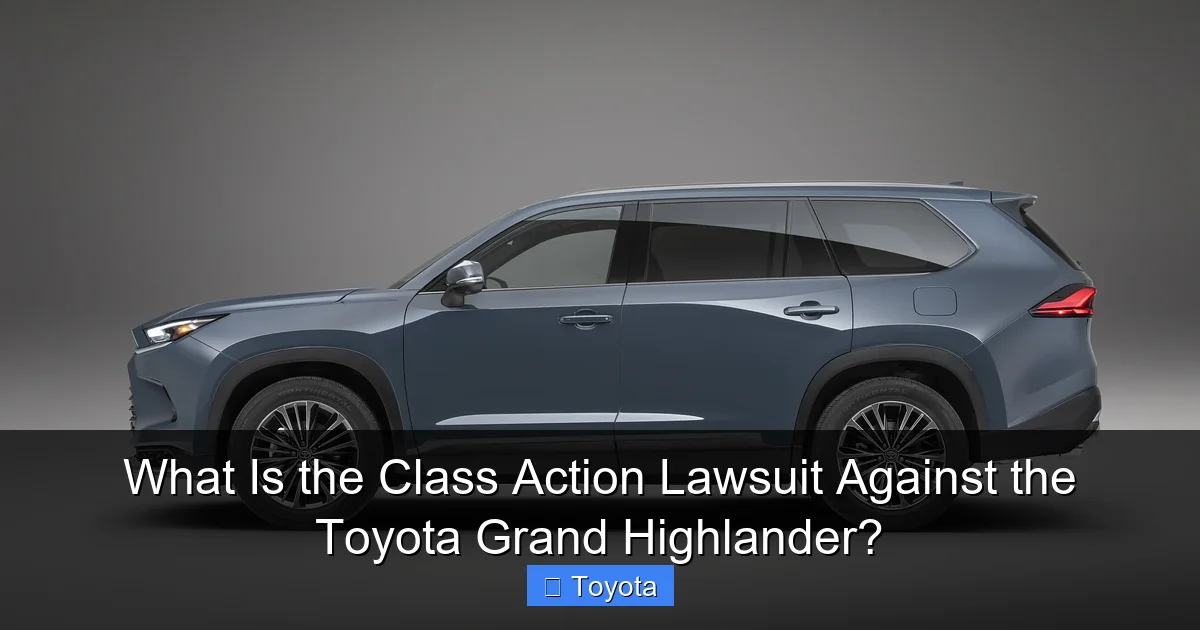
Visual guide about What Is the Class Action Lawsuit Against the Toyota Grand Highlander?
Image source: images.caricos.com
The Alleged Defect: A Fuel Pump Failure
At the center of the lawsuit is the low-pressure fuel pump, specifically its “suction port” design. According to the plaintiffs, this component, manufactured by a supplier (often Denso in Toyota’s supply chain), is made from a plastic material that is inherently prone to developing cracks. These cracks can allow air to enter the fuel system or cause a leak, which starves the engine of fuel. The result is a sudden, unpredictable engine stall. The lawsuit alleges Toyota knew or should have known about this defect based on pre-production testing, early owner complaints to dealerships and the National Highway Traffic Safety Administration (NHTSA), and its own internal data.
This isn’t a vague complaint. The legal filing points to a pattern where the failure often occurs without prior warning signs like a check engine light. The engine simply shuts off. This aligns with numerous owner descriptions posted on forums and complaint websites, where they describe the vehicle dying at stoplights, while idling in traffic, or during steady highway cruising. The alleged design flaw is particularly insidious because it provides no advance notice to the driver, creating a classic “sudden acceleration” type of hazard, but in reverse—a sudden *loss* of power.
The Engine in Question: The T24A-FTS
The lawsuit is narrowly focused on Grand Highlanders equipped with the 2.4-liter turbocharged 4-cylinder engine, internal code T24A-FTS. This is a critical detail. The Grand Highlander is also available with a older, naturally aspirated 3.5-liter V6 (2GR-FKS) in earlier model years. The class action complaint specifies that the defect is tied to the fuel system architecture of the newer turbo engine. This means not every Grand Highlander is potentially affected. Owners must confirm their vehicle’s engine specification, which is found on a sticker under the hood or in the owner’s manual. If you have the V6, this particular lawsuit likely does not apply to your vehicle, though other issues could exist.
Who Is Affected? Identifying the Model Years and Vehicles
Pinpointing the exact population of affected vehicles is key. The lawsuit defines the proposed class with some specificity, but it’s important to understand the boundaries.
Visual guide about What Is the Class Action Lawsuit Against the Toyota Grand Highlander?
Image source: classaction.org
The Proposed Class Definition
While the final class must be certified by a judge, the initial complaint typically proposes a definition. In this case, it generally includes: “All owners and lessees of model year 2020 through 2023 Toyota Grand Highlander vehicles equipped with the 2.4-liter turbocharged engine (T24A-FTS) that were sold or leased in the United States and its territories.” This timeframe covers the Grand Highlander’s entire first generation (2020-2023), as the vehicle was all-new for the 2020 model year. The 2024 model year introduced a mild refresh, and it’s currently unclear if the fuel pump design was altered. The lawsuit’s focus on the 2020-2023 window suggests the plaintiffs believe the defective part was used consistently throughout that production run.
How to Check Your Vehicle
If you own a Grand Highlander from this period, here is your immediate checklist:
- Confirm Your Engine: Look for the engine displacement badge on the rear of the vehicle (it will say “2.4T” or “2.4 Turbo”). The safest method is to find the Vehicle Identification Number (VIN) on your dashboard or insurance card and use Toyota’s official website or a free VIN decoder service online to see the exact engine code. It must be the T24A-FTS.
- Note Your Model Year: The lawsuit covers 2020, 2021, 2022, and 2023 models. A 2024 or newer model is not included at this time.
- Document Any Issues: If your vehicle has stalled, even once, document the date, conditions (weather, speed, road type), any warning lights, and the dealership or repair shop visit report. This is vital evidence.
It’s also worth noting that while the lawsuit defines a class, you do not need to “join” to be potentially covered if a class is certified. However, to claim any benefit from a settlement or judgment, you would need to file a claim form. Staying informed through official court notices is essential.
The Real-World Impact: Safety Risks and Financial Burden
An engine stall at speed is more than a mere inconvenience; it’s a direct safety hazard. The lawsuit’s allegations paint a picture of a dangerous driving experience compounded by a frustrating and expensive repair journey.
Visual guide about What Is the Class Action Lawsuit Against the Toyota Grand Highlander?
Image source: singletonschreiber.com
The Safety Equation: Loss of Power Assist
When an engine dies in a modern vehicle like the Grand Highlander, several critical systems lose their power assistance almost immediately. Power steering becomes extremely heavy, making it difficult or impossible to steer the vehicle, especially at higher speeds or during a turn. Power brakes also lose their assist, requiring immense pedal pressure to stop the car. This combination in traffic is a recipe for disaster. Drivers describe the terrifying experience of trying to steer and brake a dead 4,500-pound SUV while lanes of traffic whiz by. The risk is magnified on highways, bridges, or in congested urban areas. Even if the vehicle coasts to a stop, the sudden loss of control can cause a collision with other vehicles or roadside objects.
The Financial Toll: Repairs and Diminished Value
Beyond safety, owners face significant financial strain. Replacing a fuel pump is not a simple, cheap service. On a turbocharged engine, it is often a complex, labor-intensive job that may require dropping the fuel tank or other major disassembly. Dealership repair quotes can range from $1,200 to over $2,500 for parts and labor. The lawsuit alleges that this is a latent defect present from the time of sale, meaning owners are paying to fix a manufacturing flaw that Toyota should have covered under warranty.
Furthermore, a vehicle with a known history of sudden stalling—even if repaired—suffers from diminished resale value. Future buyers will be wary, and vehicle history reports may eventually note the repair. The lawsuit seeks compensation for this “diminution in value,” arguing that the defect permanently taints the vehicle’s worth in the marketplace. There are also incidental costs: towing fees after a stall, rental car expenses while the vehicle is in the shop, and lost time dealing with dealerships and repair facilities.
Legal proceedings move at a deliberate pace. Understanding the current stage helps set realistic expectations for owners wondering when—or if—a resolution will come.
The Early Stages: Complaint and Motion to Dismiss
The lawsuit you’re reading about is likely in its very beginning. The plaintiffs have filed a Complaint, which is the initial document outlining their allegations. Toyota’s next step is to file an Answer, which will deny the allegations and present its defenses. Toyota will almost certainly file a Motion to Dismiss, arguing that even if all the plaintiffs’ facts are true, they haven’t stated a valid legal claim. The judge will hear arguments on this motion. If the case survives dismissal, it moves into the discovery phase, where both sides exchange evidence, take depositions (sworn testimony), and request documents. This is where internal Toyota documents and engineer testimony could become public, potentially strengthening the plaintiffs’ case.
The Long Road to Certification and Settlement
A major hurdle for the plaintiffs is achieving class certification. The judge must agree that the case meets the criteria for a class action. Toyota will fiercely oppose this, arguing that individual issues—like the specific condition of each fuel pump or driving habits—predominate over common ones. If certification is granted, the case gains immense leverage. The vast majority of class actions are settled after certification, as the potential damages for thousands of vehicles become a powerful incentive for the defendant to negotiate. Settlements can take years. If no settlement is reached, the case proceeds to trial. Throughout this process, there is always the possibility that NHTSA could open its own investigation, which could pressure Toyota to issue a recall independent of the lawsuit.
What Should Grand Highlander Owners Do Right Now?
Feeling anxious is understandable. But panic is not productive. Here is a clear, step-by-step action plan for any Grand Highlander owner, especially those with the turbo engine.
1. Gather and Organize Your Documentation
This is your most important task. Locate your:
- Purchase/Lease Agreement and all warranty documents.
- Service Records from every oil change, tire rotation, and repair.
- Repair Invoices for any fuel system, stalling, or no-start issues.
- Communication Logs: Notes from calls or visits to the dealership about the problem, including the service advisor’s name and date.
- Photos/Videos: If you can safely capture the dashboard when a stall occurs (showing no warning lights) or the vehicle being towed.
Create a single digital folder (PDFs, photos) for your vehicle’s VIN. This organized record is your best evidence if you need to make a warranty claim, file a complaint, or participate in litigation.
2. Report the Issue to NHTSA
The National Highway Traffic Safety Administration is the federal agency responsible for vehicle safety. Each consumer complaint filed on their website (www.nhtsa.gov/recalls) contributes to their data. If they see a pattern of identical failures in the same make/model/year, they can open a formal investigation, which often leads to a manufacturer-ordered recall. When you file, be factual, include your VIN, describe the stalling event in detail (no warning lights, conditions), and mention you believe it is related to a fuel pump failure. This is a free, crucial step that adds your voice to the official record.
3. Contact Your Dealership (Again) and Toyota Customer Service
If you’ve experienced a stall, take the vehicle to a Toyota dealership. Demand a full diagnostic and a written report of their findings. Even if they cannot replicate the problem, get a statement that no fault was found. Call Toyota’s corporate customer service (1-800-331-4331) and open a formal case. Reference your NHTSA complaint number. Escalate politely but firmly. Document every interaction. While a warranty repair may be denied if no code is stored, creating a paper trail is essential.
4. Consult with an Attorney (No Obligation)
Many law firms handling class actions offer free, confidential consultations. You can speak with a lemon law or consumer protection attorney to understand your individual rights. They can review your documentation and advise if you have a strong individual claim beyond the class action, such as under your state’s lemon law (which may have shorter timeframes/mileage limits). This consultation does not obligate you to join the lawsuit but provides expert perspective.
5. Stay Informed, But Ignore the Noise
Bookmark the Toyota Convenience Package article on our site to understand the features your vehicle may have, as this can sometimes relate to owner satisfaction and perceived value. Follow the lawsuit’s docket on PACER (Public Access to Court Electronic Records) or through reputable legal news sites. Be wary of fear-mongering on social media forums; stick to documented facts from official sources.
Toyota’s Stance and the Road Ahead
What is Toyota saying about all this? So far, the company’s public response has been limited, as is standard legal strategy in the early stages of litigation.
Expected Corporate Defense
In its eventual Answer, Toyota will likely argue several points: that the issue is not widespread or safety-critical; that any failures are due to owner maintenance, environmental factors, or unusual driving conditions; that the fuel pump design is sound and meets all industry standards; and that the lawsuit’s class definition is improper because not all vehicles in the proposed class have experienced the problem. They may also point to their comprehensive warranty program as adequate recourse. Toyota has a long history of high reliability ratings and has faced previous class actions over various components (e.g., certain engine sludge issues in the 2000s), some of which resulted in extended warranty programs but no full recalls.
The Potential Outcomes: From Settlement to Trial
The spectrum of possible resolutions is wide:
- No Certification/Dismissal: If the judge grants Toyota’s motion to dismiss or denies class certification, the lawsuit ends. Individual owners would have to sue on their own, which is rarely feasible.
- Settlement: This is the most common outcome. Toyota could agree to a fund that reimburses owners for past repairs (with receipts), provides extended warranties for the fuel pump (covering future failures), or even offers a buyback or trade-in assistance for severely affected vehicles. A settlement must be approved by the judge as “fair, reasonable, and adequate.”
- Trial and Judgment: If it goes to trial and the plaintiffs win, the court could order similar remedies as a settlement, or potentially more. Toyota would appeal, extending the process for years.
- Parallel NHTSA Recall: A government recall could happen at any time, independent of the lawsuit. A recall would mandate free repairs for all affected vehicles, regardless of whether they’ve failed yet. This is often the best outcome for owners.
For now, the most prudent course is vigilant monitoring. Check your mail for official court notices if a class is certified. Watch NHTSA’s recall database for your VIN. And keep your maintenance and repair records pristine.
Conclusion: Knowledge is Your Best Defense
The class action lawsuit against the Toyota Grand Highlander shines a light on a serious alleged defect that transforms a family-oriented SUV into a potential hazard. While the legal wheels turn slowly, the situation underscores a fundamental truth for all vehicle owners: your awareness and documentation are your first and best lines of defense. The alleged fuel pump failure is not a trivial matter; it’s a claim of a design flaw that compromises a core safety function—the ability to move and stop predictably.
For owners of the 2020-2023 Grand Highlander with the 2.4T engine, the path forward is clear: verify your eligibility, document everything, report to NHTSA, and engage with your dealership. Do not accept a “no problem found” diagnosis passively; insist on a written record. While we await the lawsuit’s fate, remember that Toyota’s brand reputation is built on reliability, and pressure from a class action and regulatory scrutiny often leads to resolutions that favor consumers, even without an official admission of fault. Stay informed through trusted sources like this one, and don’t hesitate to seek professional legal advice to understand your unique position. Your safety on the road, and the financial health of your investment, depend on it.
Frequently Asked Questions
What model years of the Toyota Grand Highlander are part of this lawsuit?
The proposed class action lawsuit targets model years 2020 through 2023. It is specifically for vehicles equipped with the 2.4-liter turbocharged 4-cylinder engine (T24A-FTS). The older 3.5-liter V6 engine is not included in this particular litigation.
If my Grand Highlander hasn’t stalled yet, am I still in the class?
Yes, if you own or lease a qualifying vehicle (2020-2023 with the 2.4T engine), you are part of the proposed class definition. The lawsuit alleges a latent defect exists in all these vehicles, meaning they are all at risk of future failure, not just those that have already stalled.
Will Toyota fix my fuel pump for free under warranty?
Currently, there is no official recall or special service campaign from Toyota for this specific fuel pump issue. If your vehicle is still under its original 5-year/60,000-mile powertrain warranty and you experience a stall, the dealership *may* cover the repair if they can diagnose a failed fuel pump as the cause. However, many owners report being denied coverage, citing lack of a stored diagnostic trouble code or attributing the failure to “wear and tear.” This denial is a primary driver of the lawsuit.
How do I join the class action lawsuit?
You do not need to take any action to “join” the class at this early stage. If the court certifies the class, you will automatically be included. Later, if a settlement is reached, the settlement administrator will mail a notice and claim form to all potential class members. You would then have a deadline to submit a claim to receive any compensation or benefits.
Is it safe to keep driving my Grand Highlander if it hasn’t stalled?
The lawsuit alleges the defect is present from the start and can fail at any time without warning. While many vehicles may never experience a stall, the risk exists. The safest course is to be hyper-aware of your driving conditions. If you frequently drive in heavy traffic or on highways, the potential consequences of a sudden stall are high. Some owners choose to limit driving or have a roadside assistance plan as a precaution until the legal or regulatory situation clarifies.
What is the difference between this lawsuit and a recall?
A recall is an order from the National Highway Traffic Safety Administration (NHTSA) that mandates the manufacturer fix a safety-related defect at no cost to the owner, for all affected vehicles. A class action lawsuit is a private legal action brought by consumers seeking damages and remedies. A lawsuit can result in a settlement that mimics a recall (e.g., extended warranty), but it is not government-mandated. A recall can happen independently of, or in conjunction with, a class action. The ultimate goal for many owners is a NHTSA-ordered recall, as it applies universally and immediately.
