
Why Won’t My Traction Control Light Turn Off on Toyota Corolla

A persistent traction control (TC/TRAC) light on your Toyota Corolla is a critical warning that your vehicle’s stability system is disabled or malfunctioning. This is almost always triggered by a fault in the wheel speed sensors, ABS module, or related wiring, not a simple issue you can ignore. Driving without functional traction control is dangerous, especially on wet or icy roads, as the system cannot prevent wheel spin or loss of control. The light will not turn off on its own; you must diagnose and repair the underlying fault, often requiring a professional scan tool to read the specific trouble code stored in the car’s computer.
You start your Toyota Corolla, and there it is—that little car with squiggly lines icon, the traction control (TC) or vehicle stability control (VSC) light, glowing steadily on your dashboard. It wasn’t there yesterday. You might even press the TC off button on the dash or steering wheel, but the light refuses to go out. What gives? Why won’t your traction control light turn off on your Toyota Corolla? This isn’t just an annoying bulb; it’s your car’s way of screaming that one of its most important safety systems is offline. Let’s break down exactly what’s happening, why it matters, and what you need to do about it, in plain English.
First, a quick refresher. Traction Control System (TCS) and Vehicle Stability Control (VSC) are electronic systems that use the same hardware—your Anti-lock Braking System (ABS) wheel speed sensors—to monitor each wheel. If the computer detects one wheel spinning much faster than the others (like on ice), it automatically applies brake pressure to that wheel and/or reduces engine power to help you maintain control. The light is the system’s “check engine” signal. When it stays on solid, it means the system has detected a fault and has shut down to prevent incorrect or dangerous interventions. The system is now disabled until the problem is fixed.
So, why won’t it turn off? Because the underlying problem that set the fault code hasn’t been resolved. The car’s computer, the Engine Control Unit (ECU) or ABS module, has stored a “Diagnostic Trouble Code” (DTC) related to the traction control system. As long as that code is present and the faulty component or circuit is still there, the light will remain illuminated. The key is to find out what that code is. To understand why your Toyota Corolla’s traction control light won’t turn off, we need to explore the most common culprits, from the incredibly simple to the more complex.
Key Takeaways
- It’s a Safety System Failure: The light means your traction control and often your ABS are offline, drastically increasing stopping distances and the risk of skidding in poor conditions.
- The Problem is Electronic, Not Manual: You cannot simply “turn off” the light by pressing a button; it stays illuminated until the fault is repaired and the code is cleared by a scan tool.
- Wheel Speed Sensors are the Prime Suspect: These sensors, located at each wheel, are the most common failure point due to damage, corrosion, or wiring issues.
- A Loose Gas Cap Can Trigger It: A very common and overlooked cause is a loose or faulty fuel cap, which can set a code that disables the system. Always check this first.
- Professional Diagnosis is Key: While you can check simple things, reading the specific Diagnostic Trouble Code (DTC) from the car’s ECU is essential for an accurate fix. This often requires a mechanic or an advanced OBD2 scanner.
- Driving with it On is Risky: You can technically drive the car, but you lose a major safety net. Avoid aggressive acceleration and be extra cautious in rain, snow, or on gravel until it’s fixed.
📑 Table of Contents
The Most Common Reasons Your TC Light is Stuck On
While there are dozens of possible fault codes, about 80% of persistent TC/TRAC light issues on Corollas (and most modern cars) boil down to a handful of very typical problems. Let’s walk through them, starting with the easiest and cheapest to check.
1. The “Oops, I Forgot” Culprit: A Loose or Faulty Fuel Cap
Yes, really. Your gas cap is part of the vehicle’s evaporative emission (EVAP) system. If it’s not tightened properly, or if the seal is cracked, it can cause a large EVAP leak. The ECU often sets a code for this (like P0455, P0456, or P0440). In many Toyota models, a severe EVAP code can trigger the traction control light to come on as a related warning. This is the first thing you should check! Turn the cap until it clicks at least three times. If the seal is damaged, replace the cap—it’s a $15 part. Clear the code (by disconnecting the battery for a few minutes or using a scan tool) and see if the light returns after a drive cycle. This is the simplest fix for a traction control light that won’t turn off.
2. The Usual Suspect: Faulty Wheel Speed Sensors
This is, by far, the number one cause. Your Corolla has a wheel speed sensor at each of the four wheels. These magnetic or Hall-effect sensors read the rotation speed of each wheel and send that data to the ABS/TCS module. If one sensor fails, sends an erratic signal, or its wiring is damaged (by road debris, heat, or chafing), the module gets confused. It knows one wheel’s data is wrong, so it disables the entire system for safety. A failing sensor might cause intermittent light activation, especially when turning, or a solid light after driving for a bit. Symptoms can include a pulsating brake pedal during light braking (ABS activating erratically) or the light flashing during hard acceleration before staying on. Replacing a wheel speed sensor is a common mechanical repair.
3. The Dirty Secret: Damaged or Corroded Sensor Rings (Tone Rings)
Behind the wheel speed sensor is a toothed ring, called a tone ring, that spins with the wheel. The sensor reads the teeth passing by. If this ring gets bent, cracked, or coated in thick road grime and brake dust, it can’t be read properly. This is especially common on the rear wheels of front-wheel-drive cars like the Corolla, which can accumulate more brake dust. Sometimes, a simple, careful cleaning of the ring and sensor face with a brake cleaner and wire brush resolves the issue. If the ring is physically damaged, it must be replaced, which can be more involved.
4. The Electrical Gremlins: Wiring Harness and Connector Issues
The wires running from each wheel speed sensor to the ABS module are vulnerable. They run through the wheel well and along the suspension, subject to constant movement, water, salt, and debris. Over time, the insulation can crack, wires can fray, or connectors can corrode. A short circuit, open circuit, or high resistance in any of these wires will set a code for that specific wheel sensor circuit (e.g., C0200, C0201, etc.). Inspect the wiring near each wheel, especially the front ones, for any visible damage. This is a fix that requires splicing and soldering or connector replacement.
5. The Module Itself: A Failing ABS or ECU
Less common, but possible, is a failure inside the ABS hydraulic control unit or the main computer. These modules are expensive and complex. Before blaming the module, all sensors and wiring must be confirmed good. Sometimes, a bad ground connection or a voltage supply issue to the module can cause it to malfunction. Diagnosing a module fault requires advanced diagnostic tools to communicate directly with it.
Diagnosing the Problem: A Step-by-Step Guide
So you’ve tightened the gas cap. The light is still on. Now what? You need to find the code. Here’s the logical progression for diagnosing why your Toyota Corolla’s traction control light won’t turn off.
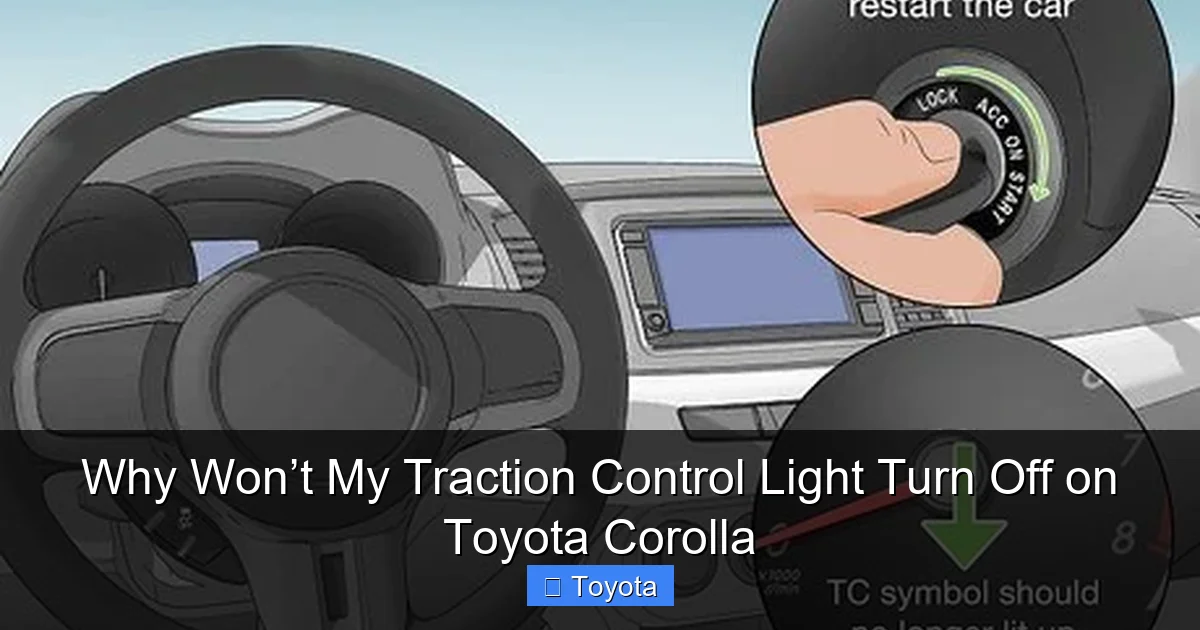
Visual guide about Why Won’t My Traction Control Light Turn Off on Toyota Corolla
Image source: wikihow.com
Step 1: The Free and Easy Check
Before you go anywhere, ensure the TC system isn’t simply turned off. Locate the button, often labeled “VSC OFF” or with a car squiggling icon. Press it. The light should turn off, and a separate “VSC OFF” indicator (usually a small icon with “OFF” underneath) should illuminate on the dash. If pressing the button does nothing at all, or the main TC light stays on, that indicates an electronic fault, not a manually disabled system. Also, check your owner’s manual for any specific Corolla model-year procedures.
Step 2: Read the Trouble Codes
This is non-negotiable. You need the code. You have three main options:
- Auto Parts Store Scan: Many auto parts stores (like AutoZone, Advance Auto) will scan your car’s OBD2 port for free. Tell them you have a TC/TRAC light on and need the ABS/TCS codes, not just the engine codes. They may have a basic scanner that only reads engine codes, so call ahead. Look for codes starting with “C” (chassis) like C0200-C0205, C1225, C1235, etc., or P codes related to wheel speed sensors.
- Buy a Scanner: For $50-$150, you can buy a decent OBD2 scanner that reads ABS codes. Look for models like the Autel, Launch, or Innova that specifically state they read “ABS/SRS” codes. This is a great investment for a Toyota owner.
- Visit a Mechanic: A professional will have the most advanced scanners (like the Toyota Techstream) that can read all module data, perform active tests (like spinning each wheel sensor to see its signal live), and provide the most accurate diagnosis. This is often the most efficient path.
Step 3: Interpret the Code and Inspect
Once you have a code, you can narrow it down. A code for “Wheel Speed Sensor #2 Circuit” (e.g., C0201) points you to the passenger front wheel. A code for “ABS Pump Motor Circuit” is a bigger problem. Use the code as your guide. Visually inspect the indicated wheel’s sensor, wiring, and connector. Look for:
- Damaged, chewed, or burnt wires.
- Corroded or loose electrical connectors.
- Excessive metal shavings or debris on the sensor tip.
- A bent or damaged tone ring (you may need to remove the wheel to see it).
- Severe rust on the sensor itself, which can sometimes be cleaned.
Step 4: Test the Sensor (If Equipped)
With a multimeter, you can do basic tests on a magnetic wheel speed sensor. With the sensor unplugged, check resistance between the two terminals (usually 800-2000 ohms). Check for continuity to ground (should be infinite ohms). These tests have limits but can identify a dead short or open circuit. A Hall-effect sensor requires voltage to test and is harder to check without a scan tool’s live data.
Toyota Corolla Specific Considerations and Quirks
While the general causes are universal, some Toyota Corolla models and years have known patterns.
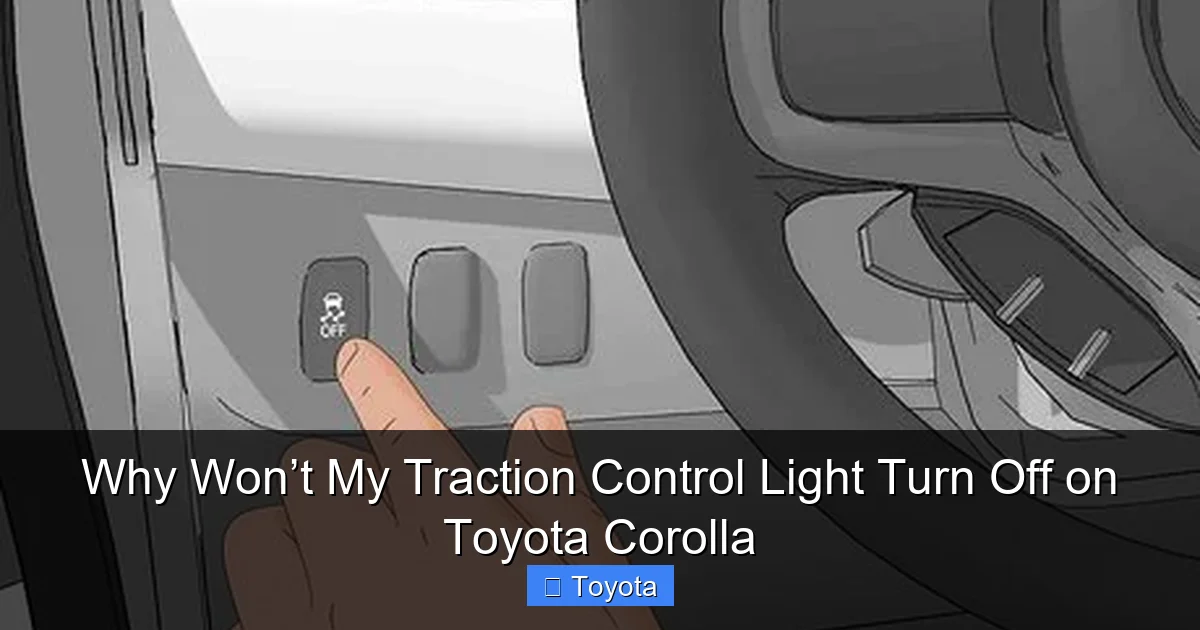
Visual guide about Why Won’t My Traction Control Light Turn Off on Toyota Corolla
Image source: wikihow.com
Model Year Variations
Later model Corollas (2014+) with more advanced safety suites might have additional sensors (like a yaw rate sensor or steering angle sensor) that can also trigger VSC/TRAC lights. However, wheel speed sensors remain the dominant failure point across all generations from the early 2000s to the current model. The location and design of the sensors vary slightly; some are integrated into the wheel bearing hub assembly, meaning if the sensor fails, you replace the entire wheel bearing, which is a more expensive job.
The “Intermittent” Light Problem
Does your light come on only when it’s cold, or only when turning? Intermittent faults are the most frustrating. They often point to:
- Wiring that’s fraying inside a loom: The wire breaks only when the suspension moves in a certain way.
- A connector that’s slightly loose: Vibration causes a temporary loss of contact.
- A sensor that’s failing but not completely dead: Its output voltage drops below spec under certain conditions.
Diagnosing this requires reproducing the fault while monitoring live sensor data with a scan tool, which is a professional’s domain.
Aftermarket Parts and “Bad” Repairs
If the problem recurred shortly after a brake job, tire rotation, or suspension work, the repair shop may have damaged a sensor or its wire. Poor-quality aftermarket wheel speed sensors can also fail prematurely. Always use OEM or high-quality OEM-spec sensors for replacement.
How to Fix It and Reset the Light
Once you’ve identified the faulty component, the fix is straightforward in principle.
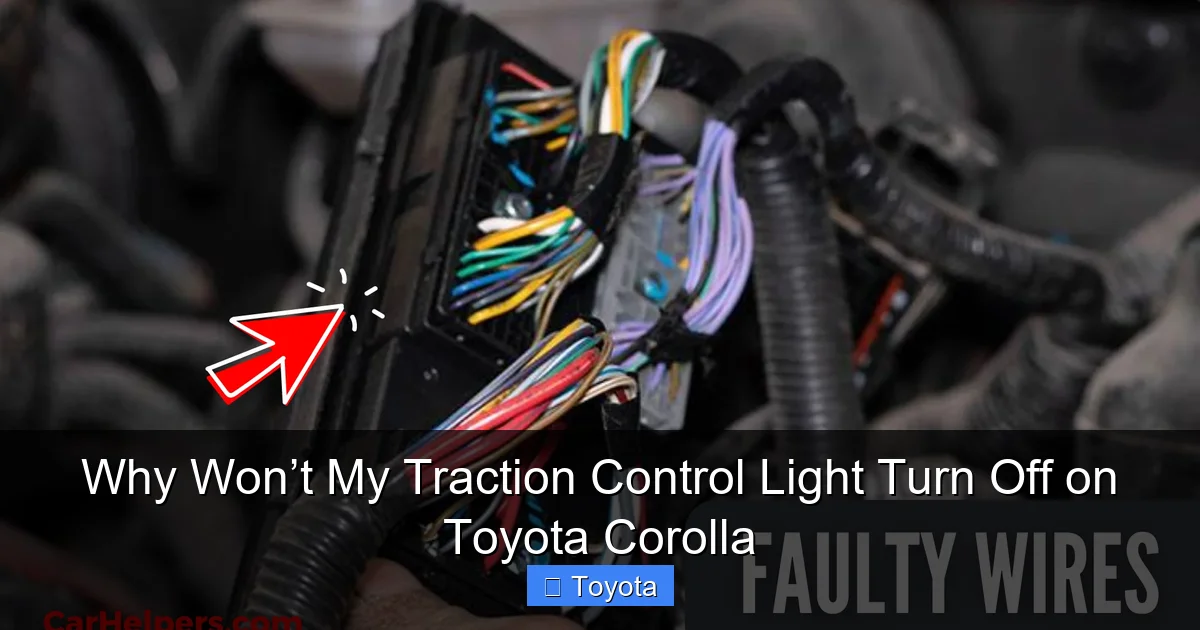
Visual guide about Why Won’t My Traction Control Light Turn Off on Toyota Corolla
Image source: carhelpers.com
Replacing a Wheel Speed Sensor
This is a common DIY job for those with basic mechanical skill. You’ll need to:
- Lift and secure the car, remove the wheel.
- Locate the sensor (usually held by one or two bolts, with a wiring connector).
- Unplug the connector (be gentle, use a plastic trim tool if needed).
- Unbolt the sensor and carefully pull it out. It may be stuck due to corrosion; penetrating oil and gentle prying can help.
- Clean the mounting surface and hole. Install the new sensor with a new bolt if provided (they are often torque-to-yield). Tighten to the manufacturer’s specification (find this in a service manual or online).
- Reconnect the electrical plug firmly.
- Reinstall the wheel, lower the car.
For sensors integrated into the wheel bearing hub, the job involves removing the brake caliper, rotor, and hub, which is more advanced and often requires a special tool to press out the old bearing. Most people opt for professional installation here.
Repairing Wiring or Connectors
This is a delicate job. You must identify the exact break or short. Splice in new wire using heat-shrink butt connectors for a weatherproof seal. Replace corroded connectors. Ensure all wiring is routed away from hot exhaust parts or sharp suspension edges. Use dielectric grease in connectors to prevent future corrosion.
Resetting the Traction Control Light
You cannot reset the light until the fault is physically repaired. Once the bad sensor is replaced or the wire is fixed, the system may clear itself after a few drive cycles (starting the car, driving at various speeds). However, to be certain, you must clear the Diagnostic Trouble Code from the computer’s memory using an OBD2 scan tool. Simply disconnecting the battery may clear some codes but not all, especially in the ABS module. After clearing the code, take the car for a drive. Accelerate moderately, make some turns, and brake gently. The light should stay off. If it comes back, the repair was not successful or there is a second, hidden problem.
Safety Implications: Why You Should Not Ignore It
Let’s be very clear: driving with your traction control light on is not the same as driving with a burnt-out dome light. You are operating a critical safety system in a degraded state.
Loss of Traction and Stability Control
The primary function is gone. On wet pavement, ice, or even loose gravel, your wheels can spin freely during acceleration. During hard cornering, the car has no electronic aid to apply brake pressure to individual wheels to keep you pointed where you steer. You are relying entirely on your own skill and the car’s mechanical grip (tires). This significantly increases the likelihood of a spin or fishtail.
Potential ABS Compromise
Traction control and ABS share the same sensors and often the same control module. A fault that disables TC frequently disables ABS as well. You may see a separate ABS light illuminate. Without ABS, in a panic stop on a slippery surface, you must manually “pump” the brakes to avoid locking the wheels, a technique most modern drivers are not practiced in. Locked wheels mean zero steering control and much longer stopping distances.
When is it *Marginally* Okay to Drive?
If you must move the car a very short distance (like out of a parking spot) to get it to a safe location or repair shop, you can do so with extreme caution. Avoid any hard acceleration. Allow much larger following distances. Drive slowly and smoothly. But this is an emergency measure only, not a long-term solution. The system is there for your protection, and it’s offline.
When to Call a Professional: Beyond DIY
You should seek professional help if:
- You cannot retrieve any codes or the codes are confusing (e.g., multiple sensor codes, module communication errors).
- The wiring damage is extensive or inside a sealed harness.
- You have codes pointing to the ABS pump, hydraulic unit, or steering angle sensor.
- You’ve replaced a sensor and the light returns immediately.
- You are uncomfortable working with brake system components.
A reputable independent mechanic or a Toyota dealership has the specialized knowledge and diagnostic software (like Techstream) to perform deep system checks, calibrate sensors after replacement (some require this!), and ensure all safety systems are fully restored. For complex issues related to your Corolla’s stability systems, professional calibration is often required after a sensor replacement to ensure the light stays off. This is a step many DIYers miss, leading to the light coming back on.
In summary, your Toyota Corolla’s traction control light won’t turn off because the car’s computer has detected a fault in the wheel speed sensor circuit, wiring, or related component, and it’s storing a code to remind you. The fix is not a reset; it’s a repair. Start with the simple stuff—tighten that gas cap! Then, get the codes read. Address the specific fault, clear the code, and drive safely knowing your vital electronic stability net is back online. Ignoring it means choosing to drive without a key safety feature, a risk not worth taking.
Frequently Asked Questions
Can I just pull the fuse for the traction control system to turn off the light?
No. Pulling a fuse will disable the system, but the light will typically stay on because the ECU detects the circuit as “open” or failed, storing a new fault code. This creates a different problem and leaves you without the system for no reason. The light indicates a fault, not just that the system is off.
My traction control light came on after I got my tires rotated. Is that normal?
It can be. During a rotation, a mechanic might accidentally damage a wheel speed sensor wire or connector, or a sensor might get knocked loose. It’s also possible the rotation was coincidental and the existing problem just manifested. You should have the codes checked immediately to see if it’s related to the rotation work.
Is it safe to drive in the snow with the traction control light on?
It is significantly less safe. Traction control is invaluable on snow and ice, helping prevent wheel spin when starting or climbing and aiding in controlled stops. Without it, your car is much more likely to spin its tires and slide. You must drive with extreme caution, gentle inputs, and consider installing winter tires, which provide the most critical safety benefit.
How much does it typically cost to fix a persistent traction control light on a Corolla?
Costs vary wildly by the cause. A new gas cap is $15. A single wheel speed sensor part can range from $50 (aftermarket) to $200+ (OEM). Labor adds 0.5-1.5 hours. So, a simple sensor fix might be $150-$400. If it’s a wiring harness repair or a module replacement, costs can climb to $800-$1500+. Getting an accurate diagnosis via the trouble code is the only way to get a real quote.
Will an oil change or tire pressure fix the traction control light?
No. Traction control is an electronic brake/engine management system. It is completely separate from oil pressure or tire pressure monitoring systems (TPMS). However, a severely low tire pressure *can* sometimes indirectly affect wheel speed readings, but this is rare. The TPMS light would come on separately. Focus on the TC system itself.
My check engine light is also on along with the traction control light. Is that related?
Very often, yes. Many engine-related faults, especially severe ones like a bad mass airflow sensor, misfires, or the aforementioned large EVAP leak (loose gas cap), can cause the ECU to disable traction control as a precaution. You must diagnose and fix the check engine light issue first. Addressing a persistent check engine light is often the first step in resolving a related traction control light on a Toyota Corolla. Scan for all codes and start with the highest-priority engine codes.
