
Is Toyota Still the World’s Top-selling Automaker in 2024?

Toyota maintains its global sales lead in 2024, but faces growing pressure from EV-focused rivals. Its hybrid strategy and regional strengths keep it ahead, though delays in full EVs could threaten long-term dominance. This analysis examines the data, challenges, and future outlook.
Key Takeaways
- Toyota remains the global sales leader in 2024, but its margin over Volkswagen and Hyundai is narrowing. The company’s consistent performance across multiple regions provides a stable foundation.
- Its hybrid-electric vehicle (HEV) strategy is a double-edged sword. HEVs drive current sales and profits, but a slower rollout of battery-electric vehicles (BEVs) risks future market share.
- Regional market dominance is key to its success. Strong performance in North America (trucks/SUVs) and Asia (sedans/keicars) offsets softer sales in Europe.
- Intense competition is closing the gap. Volkswagen’s EV push and Hyundai-Kia’s aggressive pricing and model rollout present the most immediate threats.
- Supply chain stability and regulatory pressures are major headwinds. Chip shortages and evolving global emissions rules impact production and strategy.
- The next 3-5 years are critical. Toyota’s upcoming BEV platforms and models will determine if it can defend its title in an electrifying world.
📑 Table of Contents
- The Crown Still Fits: Toyota’s 2024 Sales Position
- Head-to-Head: The 2024 Sales Battlefield
- The Regional Pillars of Toyota’s Empire
- Hybrid King, EV Contender? The Heart of Toyota’s Strategy
- The Competition: Who’s Chasing and How?
- Challenges on the Horizon: More Than Just EVs
- The Road Ahead: Can Toyota Stay on Top?
The Crown Still Fits: Toyota’s 2024 Sales Position
For over a decade, the title of “World’s Top-Selling Automaker” has been Toyota’s to lose. The Japanese giant, with its reputation for reliability and a vast global footprint, has consistently outpaced rivals like Volkswagen Group and the Hyundai-Kia conglomerate. But as we move through 2024, the automotive landscape is shifting beneath its feet. The relentless rise of electric vehicles (EVs), changing consumer preferences, and aggressive strategies from competitors mean Toyota’s reign is no longer a foregone conclusion. So, is Toyota still the world’s top-selling automaker in 2024? The answer, for now, is a qualified yes—but the story behind that answer is full of tension, strategy, and high-stakes bets on the future.
This isn’t just about counting cars. It’s about understanding the pillars of Toyota’s empire, the cracks that are appearing, and the monumental task of transitioning from a hybrid king to an EV contender. We’ll dive into the latest sales figures, break down performance by critical regions, and examine the philosophical divide between Toyota’s cautious electrification path and the all-in EV strategies of its rivals. Whether you’re a car buyer, an investor, or just an industry observer, understanding this dynamic is key to seeing where the auto world is headed.
Understanding the “Top-Seller” Metric
First, a quick note on what “top-selling” means. Industry analysts typically use two key metrics: global vehicle sales volume (units sold) and sometimes global production volume. Sales are the more common and telling figure, as they reflect actual consumer demand. For 2024, we are looking at full-year projections and first-half data from major automotive reporting firms like JATO Dynamics and company financial reports. The race is incredibly tight, often decided by a few hundred thousand vehicles across an industry that sells over 80 million units annually.
Head-to-Head: The 2024 Sales Battlefield
Let’s look at the numbers that define the current battle. Based on first-half 2024 data and full-year projections:
Visual guide about Is Toyota Still the World’s Top-selling Automaker in 2024?
Image source: bsmedia.business-standard.com
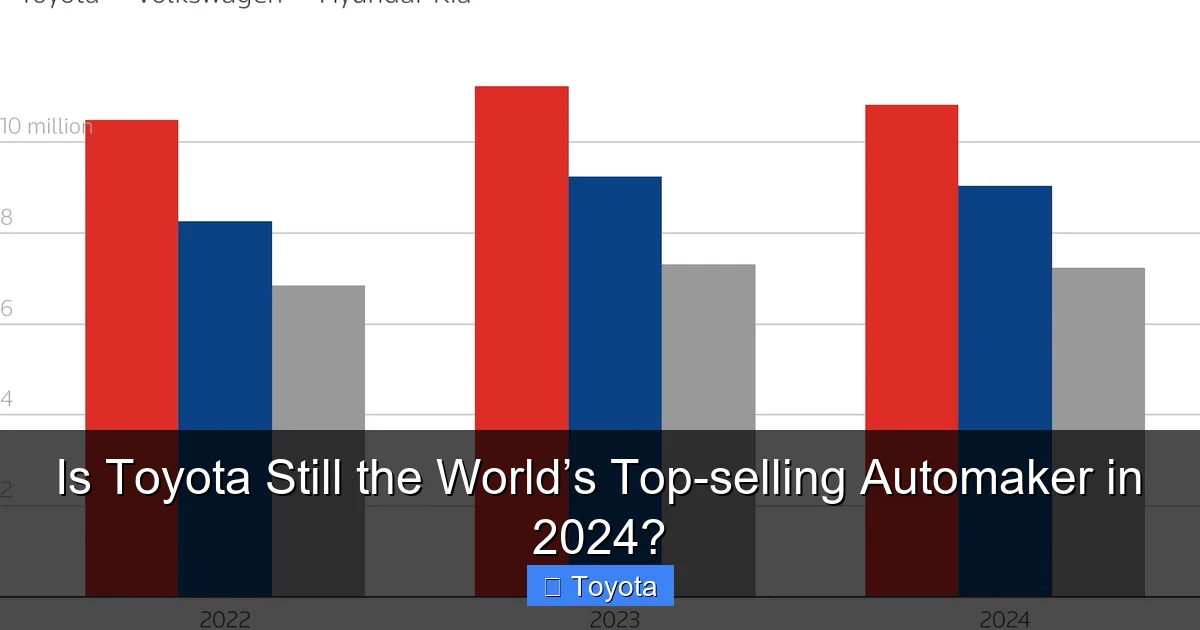
- Toyota Group (including Lexus, Daihatsu, Hino): Projected to sell approximately 10.5 – 10.8 million vehicles globally in 2024. This includes strong sales from its core Toyota brand and luxury Lexus division.
- Volkswagen Group (VW, Audi, Porsche, Skoda, etc.): Projected to be very close, around 10.3 – 10.6 million units. Their performance is heavily influenced by Europe and China.
- Hyundai Motor Group (Hyundai, Kia, Genesis): The rising challenger, projected to reach a combined 8.5 – 9.0 million units, with impressive growth in key markets like North America and Europe.
Toyota holds a lead, but it is slimmer than in years past. The gap is no longer a comfortable cushion; it’s a razor-thin margin that can be erased by a single strong quarter from a competitor or a misstep in Toyota’s own production or model rollout. The competition is no longer just about building good cars; it’s about winning the technology transition.
Why Volume Isn’t Everything: The Profitability Picture
It’s worth noting that while Toyota leads in volume, its rival Volkswagen Group often leads in revenue and profit. This is due to VW’s premium brands (Audi, Porsche, Bentley) which have much higher profit margins per vehicle. Toyota’s profit, while enormous, is more reliant on high-volume, mid-market models and its lucrative hybrid technology. This difference in portfolio mix is a strategic choice with long-term implications for both companies’ financial resilience.
The Regional Pillars of Toyota’s Empire
Toyota’s global dominance is built on a “fortress” strategy—it is exceptionally strong in multiple, distinct regions. Losing its top spot would likely require a simultaneous stumble in more than one of these key markets.
Visual guide about Is Toyota Still the World’s Top-selling Automaker in 2024?
Image source: reuters.com
North America: Trucks, SUVs, and Hybrids Rule
The United States is Toyota’s largest single market and the absolute bedrock of its volume success. Here, the formula is simple and effective: trucks and SUVs. The Toyota Tacoma and Tundra pickup trucks, along with the RAV4 and Highlander SUVs, are perennial best-sellers. Their combination of reputation for reliability, strong resale value, and (in the case of hybrids) excellent fuel economy makes them immune to much of the market volatility seen in sedan segments. The popularity of these models is so profound that a whole ecosystem of accessories has grown around them. For owners looking to maximize their truck’s utility, researching the bed size of a Toyota Tacoma is a critical first step before purchasing tonneau covers, campers, or other gear. This deep model-specific demand insulates Toyota from trends affecting other segments.
Lexus also performs well in the luxury segment, though it faces stiffer competition from German rivals. Importantly, Toyota’s North American manufacturing footprint is vast, with major plants in Kentucky, Texas, Alabama, and Mississippi. This local production shields it from some currency fluctuations and trade policy risks. For example, the iconic Toyota 4Runner is built in the United States, a point of pride and logistical efficiency. You can learn more about where the Toyota 4Runner is built to understand the scale of this localized production strategy.
Japan & Asia: Home Market and Emerging Growth
In Japan, Toyota is the undisputed king, benefiting from a unique market with a strong preference for kei cars (tiny, tax-advantaged vehicles) and minivans. Its sales in other Asian markets, including Southeast Asia, are robust, driven by models like the Yaris Cross and Veloz. In markets like the Philippines, the Toyota Veloz is a massive hit, and understanding its price point in the local context reveals how Toyota tailors its product and pricing strategy for regional affordability and demand. This regional nuance is a key advantage over European rivals who often have a less granular approach.
Europe: The Hybrid Stronghold, EV Laggard
Europe is Toyota’s most challenging major market. It is the region with the most aggressive CO2 regulations and the fastest adoption of BEVs. Here, Toyota’s strategy is almost entirely centered on its hybrid technology. Models like the Yaris Hybrid and Corolla Hybrid are top sellers, perfectly aligning with Europe’s historical focus on reducing urban emissions without requiring charging infrastructure. However, Toyota’s pure BEV lineup, led by the bZ4X, has gotten off to a slow start compared to the Volkswagen ID. series and models from Hyundai/Kia. The company is playing catch-up in a region that is rapidly electrifying, and this is a significant drag on its overall growth potential against VW, which is headquartered and deeply entrenched in Europe.
The Rest of the World: A Mixed Bag
In other regions like South America, the Middle East, and Africa, Toyota’s reputation for durability gives it a strong foothold, often competing directly with brands like Chevrolet and Hyundai. Its commercial vehicle division, which includes vans like the Proace (a collaboration with Stellantis), is particularly important in Europe. The availability of such models varies drastically by region; for instance, the Proace is not sold in the United States, where Toyota focuses on the larger Sienna minivan and Tacoma for commercial duties. This highlights a key point: Is the Toyota Proace available in the USA? The answer is no, demonstrating how Toyota’s model strategy is meticulously tailored to regional needs and regulatory environments.
Hybrid King, EV Contender? The Heart of Toyota’s Strategy
This is the core of the “Is Toyota still top?” question. Toyota’s bet on hybrids as a long-term,甚至 *the* solution, while competitors bet everything on batteries, defines its current position and future risk.
Visual guide about Is Toyota Still the World’s Top-selling Automaker in 2024?
Image source: i.pinimg.com
The Hybrid Fortress: Profitable and Popular
Toyota didn’t just dabble in hybrids; it built an empire with them. The Prius launched the mainstream hybrid revolution, and today, Toyota’s Hybrid Synergy Drive system is found across its lineup, from the compact Corolla to the full-size Grand Highlander. This strategy has paid off brilliantly:
- Massive Sales Volume: Over 20 million Toyota hybrids have been sold worldwide. They are a core part of the company’s identity and a major driver of its sales numbers.
- High Profit Margins: Mature hybrid technology is now relatively inexpensive to produce, and Toyota has optimized its supply chain for it, leading to strong profits.
- Regulatory Compliance: Hybrids significantly reduce fleet-wide CO2 emissions, helping Toyota meet stringent global regulations without the infrastructure challenges of BEVs.
- Consumer Trust: For millions of buyers wary of EV range anxiety or charging logistics, a Toyota hybrid offers a familiar, worry-free path to better fuel economy.
The Electric Vehicle Crossroads: Catching Up
However, the world is moving decisively toward battery power. Major markets like Europe, China, and California have set targets to phase out internal combustion engine (ICE) vehicles. Here, Toyota’s strategy has been criticized as slow and cautious. Its first global BEV, the bZ4X, arrived later than rivals and faced an early recall due to wheel bolt issues, damaging its initial momentum. The company’s philosophy, often summarized by the phrase “multi-pathway” (offering hybrids, plug-in hybrids, BEVs, and hydrogen), is seen by some as a lack of commitment.
Toyota is now accelerating. It has announced a flood of new BEV models under its “bZ” sub-brand and is investing billions in battery technology and dedicated EV platforms. The upcoming Toyota 3-row SUV and a sports car concept promise more compelling designs. The critical question is whether this acceleration is fast enough to win over consumers who are increasingly viewing BEVs as the only true “electric” future, and to compete with the vast model lineups and aggressive pricing of Tesla, VW, and Hyundai-Kia. Toyota’s future as top seller may depend on convincing hybrid loyalists to make the jump to its own EVs when the time comes.
The Competition: Who’s Chasing and How?
Toyota’s lead is not being challenged by one company, but by a combination of forces with different strengths.
Volkswagen Group: The European Titan
VW is Toyota’s closest rival and the most likely to overtake it in the near future if Toyota falters. VW’s “Accelerate” strategy is a full-throttle commitment to EVs. Its MEB platform underpins a wide range of vehicles from the mass-market ID.3 and ID.4 to premium models from Audi and Porsche. In Europe, VW is already the sales leader and its EV market share is significant. Its biggest challenge is executing this transition profitably while managing its vast ICE business. In North America, VW’s EV sales are growing but still lag behind Toyota’s hybrid/ICE volume. The battle for global supremacy will be won or lost on the streets of China and the dealerships of the USA.
Hyundai-Kia: The Agile Disruptor
Don’t overlook Hyundai-Kia. This group has been the quiet phenomenon of the 2020s. They have combined aggressive, attractive EV designs (Ioniq 5, EV6) with competitive pricing and excellent warranty terms to gain massive market share, especially in North America and Europe. Their transition is arguably the most successful among traditional automakers. They lack Toyota’s sheer scale in emerging markets, but their momentum in developed regions is formidable. They are proof that a traditional automaker can successfully pivot to EVs and win customers.
Tesla and New Entrants: The Wild Cards
While Tesla’s global sales volume (~1.8 million in 2023) is still far below Toyota’s, its growth rate, brand power, and profitability are unmatched in the EV space. More importantly, Tesla sets the benchmark for software, user experience, and direct sales. Chinese EV makers like BYD are also rising fast, though their global expansion beyond Asia and Europe is in early stages. For Toyota, the threat isn’t necessarily that BYD or Tesla will sell 10 million cars tomorrow, but that they will continue to chip away at the premium and early-adopter segments that fund R&D for the next generation of vehicles.
Challenges on the Horizon: More Than Just EVs
Even if Toyota perfectly executes its EV plan, other significant threats could disrupt its top position.
Supply Chain Volatility
The automotive industry is still reeling from the chip shortage and geopolitical tensions. Toyota’s famed “just-in-time” supply chain, once its greatest efficiency advantage, proved vulnerable. As EVs require different and often more semiconductors, securing a stable supply of advanced chips will be a constant battle. Any major disruption could halt production at its plants worldwide, directly impacting sales volume.
Regulatory Whiplash
Emissions regulations are becoming more complex and region-specific. The U.S. EPA rules, EU’s 2035 ICE ban, and China’s NEV mandates all pull in slightly different directions. Navigating this labyrinth while developing compliant vehicles for each major market is a colossal engineering and financial challenge. A misstep, like being caught with a non-compliant fleet in a key region, could lead to massive fines and lost sales.
The Shifting Consumer Mindset
Car buyers, especially in urban and affluent areas, are increasingly viewing EVs not just as an alternative but as a superior product—cheaper to run, quieter, and packed with tech. The “Tesla effect” has changed expectations. If Toyota’s BEVs are perceived as lagging in performance, range, or tech, it could suffer a lasting brand hit among the next generation of car buyers, even if its hybrids remain popular with today’s pragmatic shoppers.
The Road Ahead: Can Toyota Stay on Top?
So, will Toyota be the world’s top-selling automaker at the end of 2024? Almost certainly yes. Its first-half lead is likely too large to overcome in a single year, barring a catastrophic event. But the more important question is: Will it still be number one in 2027 or 2030?
The answer hinges on execution. Toyota is unleashing a torrent of new BEVs. Its first dedicated EV platform, the Toyota 3-Zero, promises better range, faster charging, and lower costs. Success here is non-negotiable. It must also continue to evolve its hybrid and plug-in hybrid offerings to stay competitive as those segments also face increased efficiency demands.
Furthermore, Toyota must leverage its strengths: its enormous global manufacturing scale, its legendary quality reputation, and its deep relationships with suppliers. It needs to translate its hybrid customer loyalty into EV loyalty. A Toyota RAV4 Hybrid owner today should see a compelling, trustworthy Toyota EV as their natural upgrade path in five years.
Finally, Toyota cannot ignore the software-defined vehicle revolution. Its vehicles are often praised for mechanical reliability but criticized for infotainment systems. Partnering with tech companies or dramatically upgrading its in-house software capabilities is essential to compete with Tesla and the new generation of “software-first” cars.
What This Means for You, the Car Buyer
If you’re in the market for a car, Toyota’s position is relevant to you. Its current dominance means:
- Unmatched Choice and Availability: You’ll find a Toyota or Lexus model at almost any dealership, in any configuration you want.
- Strong Resale Value: Historically, Toyotas hold their value exceptionally well, a direct result of perceived reliability and high demand.
- Hybrid Maturity: If you want a hybrid, Toyota’s offerings are the most proven and extensive.
- EV Caution: If you want a pure electric vehicle, Toyota’s current selection is limited and less proven than its Korean or American rivals. You should test drive a bZ4X against a Hyundai Ioniq 5 or Tesla Model Y.
- Future Uncertainty: The cars Toyota sells today will be on the road for 10-15 years. Consider how the brand’s strategy might affect long-term support, software updates, and parts availability for EVs versus hybrids.
Practical Tip: When evaluating a Toyota, especially a new model like an EV or PHEV, research its specific platform and technology. Don’t assume its hybrid success automatically translates to its electric vehicles. Read expert and owner reviews focused on the new powertrain’s real-world performance and reliability.
Frequently Asked Questions
Will Toyota lose its top-selling title soon?
Toyota is unlikely to lose the title in 2024. However, its lead is shrinking fast. If Volkswagen’s EV sales continue to surge in Europe and China, and if Hyundai-Kia maintains its strong growth, Toyota could be overtaken by 2026-2027 if its own EV rollout stumbles.
How can Toyota be number one in sales but not in EVs?
Sales volume includes all vehicles: gasoline, hybrid, plug-in hybrid, and electric. Toyota sells millions of highly profitable hybrids and gasoline cars that dominate regions like the US and Southeast Asia. Its pure EV sales are currently small compared to Tesla or Hyundai, but the sheer volume of its other models keeps its total sales at the top.
What is Toyota’s plan to catch up in electric vehicles?
Toyota is accelerating its plans. It aims to launch 30 battery-electric models globally by 2030 and has promised a next-generation EV platform (“3-Zero”) with longer range and lower cost. It is also investing heavily in solid-state battery technology, which could be a game-changer, though mass production is likely years away.
Is Toyota’s hybrid strategy a good long-term bet?
It has been an excellent medium-term bet. Hybrids provide significant fuel savings with no range anxiety and are cheaper than BEVs. However, as more regions announce future bans on new ICE vehicles (which often include hybrids), the long-term viability of hybrids alone is limited. They are a crucial bridge technology but not the final destination for most major markets.
What are Toyota’s biggest vulnerabilities right now?
Its biggest vulnerability is the perception that it is “behind” in battery-electric technology. This affects investor confidence and early adopter buyers. Secondary vulnerabilities include supply chain fragility (especially for semiconductors and batteries) and the immense cost of transitioning a company of its size from one core technology (hybrids/ICE) to another (BEVs).
Should I buy a Toyota EV now or wait?
That depends on your needs. If you want a proven, reliable electric vehicle with a great warranty and are not focused on cutting-edge infotainment or maximum range, the bZ4X/Suzuki e Vitara (its sibling) is a competent, if unspectacular, choice. If you want the best EV experience today, models from Hyundai, Kia, Tesla, and Ford offer more range, faster charging, and better tech. Waiting 1-2 years will likely yield a much wider and more competitive selection of Toyota EVs based on their new platform.
