
How Many Miles Are Left When the Gas Light Comes on in a 2003 Toyota Corolla?

When the gas light illuminates in a 2003 Toyota Corolla, you typically have between 30 to 50 miles remaining before the tank is empty. This estimate is based on a 13.2-gallon fuel tank and EPA mileage ratings, but real-world range can vary significantly. Factors like driving habits, terrain, and vehicle condition play a major role. It’s always safest to refuel as soon as the light comes on to prevent damage and avoid being stranded.
Key Takeaways
- The gas light is a warning, not an exact gauge: It signals you have a limited, but variable, reserve of fuel left.
- Typical range is 30-50 miles: For a 2003 Corolla with a 13.2-gallon tank, this is a common estimate under normal conditions.
- Your actual mileage may vary: Highway cruising can stretch the range, while city traffic and heavy loads will shrink it quickly.
- Running on empty causes damage: Draining the tank can harm the fuel pump and clog the fuel filter with sediment from the tank bottom.
- Refuel immediately when the light comes on: This is the safest practice to protect your fuel system and ensure you never run out.
- Reserve fuel amount is not user-adjustable: The trigger point for the warning light is set by the manufacturer’s sensor calibration.
- Monitor your own fuel efficiency: Knowing your car’s average miles per gallon (MPG) gives you the best personal estimate for your remaining range.
📑 Table of Contents
- Understanding Your Gas Gauge and Warning Light
- The 2003 Toyota Corolla: Tank Size and Expected Range
- Factors That Dramatically Affect Your “Miles to Empty”
- The Real Risks of Driving on “Fumes”
- Best Practices: What To Do When the Light Comes On
- Comparing to Other Corolla Years and Models
- Conclusion: Knowledge is Power (and Savings)
Understanding Your Gas Gauge and Warning Light
That little amber light flickering on your dashboard—the one shaped like a gas pump—is one of the most universally recognized warning signals in your car. But what does it really mean, especially in a reliable workhorse like a 2003 Toyota Corolla? It’s not a precise measurement tool. Think of it less like a fuel gauge and more like a friendly, urgent nudge. Its job is to get your attention before you truly run out of gasoline.
The system that controls this light is surprisingly simple. Inside your fuel tank is a float attached to a variable resistor, similar to the mechanism in a toilet tank. As the fuel level drops, the float sinks, changing the resistance in the circuit. The car’s computer interprets this resistance and, at a predetermined threshold (usually when you have about 1-2 gallons left), it flips on that warning light. For the 2003 Corolla, this threshold is designed to give you a reasonable buffer to find a gas station without causing damage. However, that buffer is a estimate, not a guarantee.
The Difference Between a Gauge and a Light
Your fuel gauge needle sweeps from “F” (Full) to “E” (Empty). This gives you a continuous, relative idea of fuel level. The gas light, however, is a binary switch—it’s either OFF or ON. There is no “half-lit” or “dimly glowing” stage. Once the electrical circuit hits that specific resistance value, the light is on. This means there’s a sudden jump from “you have fuel” to “you are now in the reserve zone.” The needle might still be pointing to “E” or just above it when the light comes on, which is perfectly normal.
Why Toyota Sets the Threshold Where It Does
Toyota engineers have to balance two competing goals: giving you enough range to reach a gas station and preventing you from running the tank completely dry. Running a fuel pump dry is a primary cause of premature failure, as the pump relies on gasoline for both lubrication and cooling. By setting the light to come on with 1-2 gallons left, Toyota provides a safety margin. For the 2003 Corolla, with its fuel-efficient 1.8L 4-cylinder engine, that 1.5-gallon reserve can theoretically take you a decent distance, hence the common 30-50 mile estimate.
The 2003 Toyota Corolla: Tank Size and Expected Range
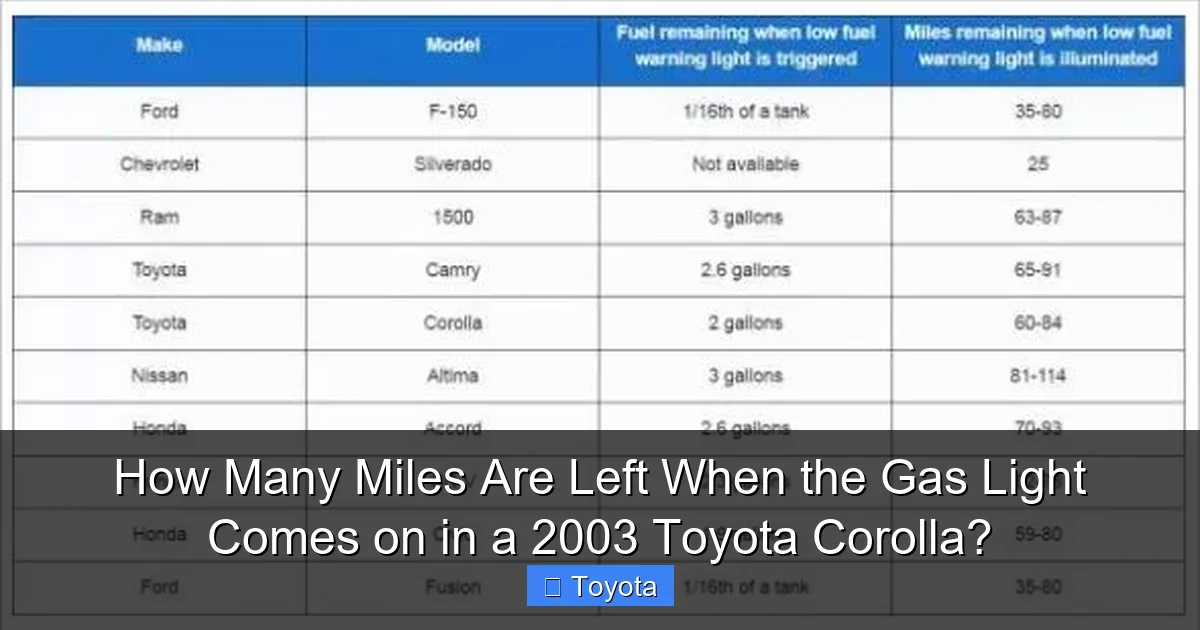
To calculate a baseline, we need two key numbers: the fuel tank capacity and the car’s fuel economy. For the 2003 Toyota Corolla (with the 1ZZ-FE 1.8L engine and automatic transmission, the most common configuration), the rated fuel tank capacity is 13.2 gallons. The EPA estimated fuel economy for that year and model was 26 MPG city / 34 MPG highway / 29 MPG combined.
Visual guide about How Many Miles Are Left When the Gas Light Comes on in a 2003 Toyota Corolla?
Image source: automotivian.com
Doing the Math: A Theoretical Estimate
Let’s use the conservative combined rating of 29 MPG. If the gas light comes on with, say, 1.5 gallons remaining (a reasonable average reserve), the math is simple: 1.5 gallons x 29 MPG = 43.5 miles. If you’re on a pure highway drive and can achieve 34 MPG, that same 1.5 gallons gives you 51 miles. In stop-and-go city traffic at 26 MPG, it drops to 39 miles. This is where the often-cited 30-50 mile range comes from. It’s a practical, real-world ballpark figure based on the car’s specifications.
Why Your Personal Results Will Differ
That 29 MPG combined rating is a laboratory estimate. Your actual MPG depends on dozens of variables. A lead-footed driver will see that range evaporate quickly. A hypermiler who drafts trucks and uses cruise control religiously might squeeze out an extra 10 miles. The condition of the car is huge: worn spark plugs, a clogged air filter, or low tire pressure all decrease efficiency, meaning you burn through your reserve faster. The age of the car itself matters; a 2003 model with 200,000+ miles might not be as tight or efficient as a well-maintained one with 100,000 miles.
Practical Example: Imagine two drivers with identical 2003 Corollas. Driver A has a 30-minute highway commute at 65 mph. The gas light comes on. They maintain speed, and their light indicates 1.6 gallons. At 32 MPG, they have ~51 miles left. They find a station 45 miles down the road with no problem. Driver B is in heavy city traffic, constantly accelerating and braking. Their light comes on with the same 1.6 gallons, but they are only getting 24 MPG. Their 51 theoretical miles are now just 38. If the next station is 45 miles away, they are in serious trouble. This shows why the range is a guess, not a promise.
Factors That Dramatically Affect Your “Miles to Empty”
So you know the ballpark. Now let’s dive into what pushes that number up or down. Understanding these factors helps you make smarter decisions when the light comes on.
Visual guide about How Many Miles Are Left When the Gas Light Comes on in a 2003 Toyota Corolla?
Image source: i.redd.it
Driving Style and Conditions
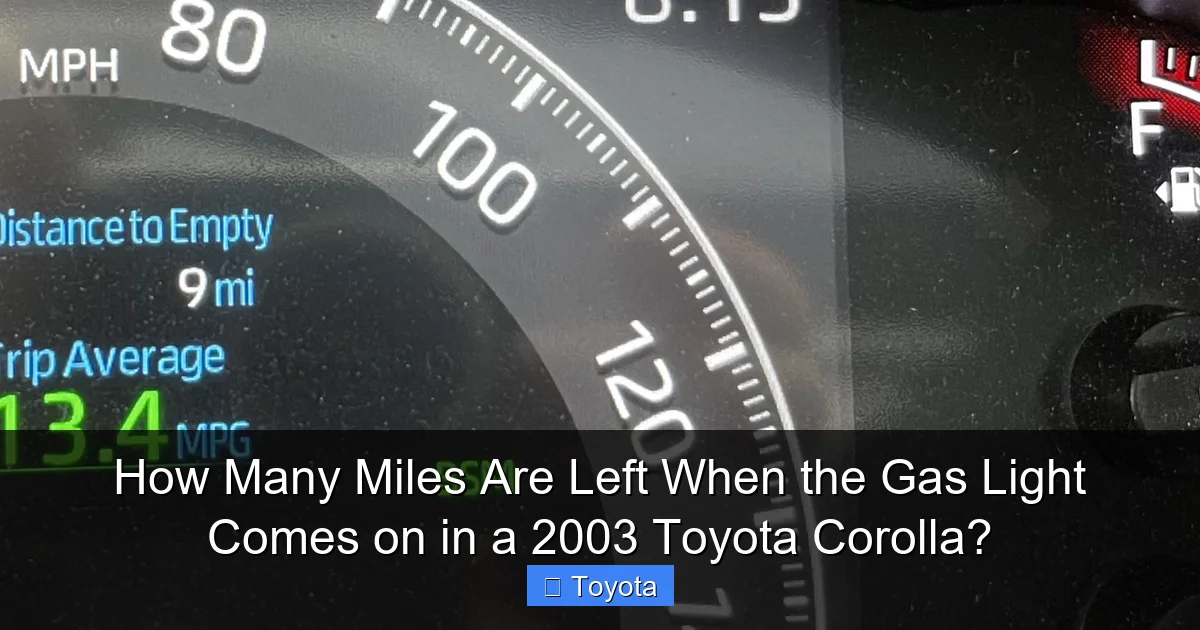
This is the biggest variable. Aggressive acceleration and braking can reduce fuel economy by up to 30% in city driving. Using the air conditioning, especially in the hot summer when the Corolla’s A/C system works hard, puts an extra load on the engine. Driving with the windows down at high speeds creates aerodynamic drag. Conversely, gentle acceleration, using cruise control on flat highways, and minimizing accessory use can maximize your precious remaining miles. Terrain is critical: climbing a steep hill with the gas light on burns fuel at a dramatically higher rate than cruising on flat ground.
Vehicle Health and Maintenance
A poorly maintained car is a thirsty car. Here are key items that, if neglected, will shave miles off your reserve range:
- Tire Pressure: Under-inflated tires increase rolling resistance. A drop of just 5 PSI below the recommended pressure (found on the driver’s door jamb sticker) can lower MPG by 3% or more.
- Engine Tune-Up: Worn spark plugs, a dirty oxygen sensor, or a clogged fuel injector disrupt the precise air-fuel mixture, leading to incomplete combustion and wasted fuel.
- Oil Quality & Level: Old, thick oil creates more internal engine friction. Using the correct oil grade and changing it on schedule is crucial for efficiency.
- Air Filter: A clogged air filter starves the engine of air, forcing it to work harder and burn more fuel.
Environmental Factors
Cold weather is a double whammy. Engines run less efficiently until warmed up, and cold air is denser, creating more aerodynamic drag. You also might idle the car more to warm it up. Fuel itself is less energy-dense in cold temperatures (though this is a minor factor). Strong headwinds or driving into a crosswind increases resistance. Carrying extra weight—roof racks, cargo in the trunk, or several passengers—increases the mass the engine must move, lowering MPG.
The Real Risks of Driving on “Fumes”
You might be thinking, “My Corolla is tough. A few extra miles won’t hurt.” This mindset can lead to expensive and dangerous consequences. The gas light is a warning to refuel soon, not a challenge to see how far you can go.
Visual guide about How Many Miles Are Left When the Gas Light Comes on in a 2003 Toyota Corolla?
Image source: koala.sh
Damage to the Fuel Pump
This is the most common and costly issue. The electric fuel pump is located inside the fuel tank. It is cooled and lubricated by the gasoline surrounding it. When the tank is very low, the pump can overheat because it’s no longer submerged. It also can suck in air, causing it to work harder and wear out prematurely. A failed fuel pump means you won’t be going anywhere, and replacing it often requires dropping the fuel tank—a labor-intensive and expensive repair. For a 20-year-old car like a 2003 Corolla, this is a failure you absolutely want to avoid.
Sediment and Debris in Your Tank
Over years of use, tiny particles of rust, dirt, and debris can accumulate at the bottom of your fuel tank. These particles are normally settled and undisturbed. When you run the tank extremely low, the fuel pickup at the bottom of the tank starts sucking up this sediment. This debris can clog the fuel filter, jam the fuel injectors, or even damage the fuel pump itself. A clogged fuel filter will starve the engine of fuel, causing sputtering, loss of power, and eventually a stall. Cleaning or replacing fuel system components because you habitually ran the tank dry is a avoidable expense.
Stranded and Unsafe
The most immediate risk is simply running out of gas. This can happen in a dangerous location—on a busy highway, on a railroad crossing, or in a poorly lit area. It puts you and others at risk. It also causes inconvenience, potential towing bills, and the stress of being stranded. For a car known for its reliability, this is an unnecessary blemish on its record.
Best Practices: What To Do When the Light Comes On
So, the amber pump icon is glowing. What’s your playbook? Here’s a step-by-step guide to handling this situation safely and intelligently.
1. Don’t Panic, But Don’t Ignore It
The light is your cue to start planning your next fuel stop. It’s not a five-minute warning; it’s a “you should refuel at the next convenient opportunity” signal. Continue driving calmly, but avoid making unnecessary detours or seeking out the absolute cheapest station if it means adding extra miles. Your goal is to find fuel with a reasonable margin of safety.
2. Assess Your Situation and Drive Efficiently
If you have a good idea of where the next gas station is (via a GPS or mental map), note its distance. If you’re on a long highway stretch with few exits, you may need to drive a bit further, but compensate by driving more efficiently. Turn off the A/C if you can tolerate it, roll up windows at high speed, use cruise control on flat terrain, and accelerate gently. Every tenth of a mile per gallon you save extends your range.
3. Refuel at a Quarter Tank, Not on Empty
This is the golden rule. Make it a habit to refuel when your gauge shows about 1/4 tank remaining. This gives you a massive buffer. It means you’ll rarely, if ever, see the gas light come on in normal driving. It also keeps your fuel tank fuller, which helps reduce condensation inside the tank and keeps the fuel pump properly cooled and lubricated. For a 13.2-gallon tank, 1/4 is about 3.3 gallons, giving you a huge safety net over that 1.5-gallon reserve.
4. When You Fill Up, Do It Right
When you get to the pump, fill the tank until the nozzle automatically clicks off. Don’t try to “top it off” by squeezing in extra fuel past the click. Modern cars have evaporative emission systems that need space in the tank. Overfilling can damage the charcoal canister and cause check engine lights. A related but useful skill is knowing how to open the gas door on your 2003 Corolla—it’s a simple lever by the driver’s seat, but it’s good to know for anyone driving the car.
Comparing to Other Corolla Years and Models
You might wonder if the 2003 Corolla’s range is typical. The answer is yes, with minor variations. Later Corolla models (like the 2010s) have slightly larger or similar tanks (around 13.2-13.8 gallons) and much better EPA ratings (often 30+ MPG combined). This means their theoretical reserve range when the light comes on could be similar or even slightly longer due to better efficiency. However, the fundamental principle remains: the light indicates a small, fixed reserve, not an exact mileage count.
It’s also interesting to compare within the Toyota family. A larger vehicle like a Toyota Camry has a bigger tank (often 15.8+ gallons) but lower MPG. The final “miles left” number can end up being surprisingly similar to a Corolla’s. The key takeaway is that every model’s light is calibrated for its specific tank size and intended use. Never assume the range from one car applies to another, even within the same brand.
Conclusion: Knowledge is Power (and Savings)
So, how many miles are left when the gas light comes on in your 2003 Toyota Corolla? The responsible, practical answer is: not enough to risk it. While the engineering suggests a buffer of roughly 30 to 50 miles, that number is a moving target influenced by your driving, your car’s health, and the world around you. Treating the gas light as a firm “refuel within 30 miles” deadline is a safe habit. Treating it as a “see how far I can go” challenge is a gamble with your fuel pump, your fuel system, and your peace of mind.
The 2003 Toyota Corolla’s reputation for reliability is built on proper maintenance and sensible operation. Part of that sensible operation is respecting its warning systems. By refueling at a quarter tank, you protect your investment, avoid costly repairs, and ensure your Corolla remains the dependable companion it was designed to be. That little light isn’t just telling you to get gas; it’s giving you the chance to take care of your car. Heed that advice, and your Corolla will thank you with many more years of trouble-free miles.
Frequently Asked Questions
Is 30 miles after the gas light comes on a safe guarantee for my 2003 Corolla?
No. It is a general estimate based on the tank size and EPA ratings. Your actual safe range can be less due to city driving, traffic, or poor vehicle maintenance. The only safe guarantee is to refuel immediately.
Can I reset the gas light myself after I add fuel?
No action is needed. The gas light is controlled by the fuel level sensor. Once you add sufficient fuel and the float rises past the trigger point, the light will automatically turn off. You do not need to reset it like a check engine light.
Does the 2003 Corolla have a special “reserve” tank like some older cars?
No. The 2003 Corolla does not have a separate reserve tank. The “reserve” is simply the last 1-2 gallons of fuel in the main tank that the warning light circuit is designed to alert you about.
How can I find out my exact remaining range when the light comes on?
The most accurate method is to note your odometer the moment the light comes on, drive to a station, fill the tank, and note how many gallons it took to fill. Subtract the gallons added from 13.2 (your tank size) to estimate your reserve. Do this a few times to get a personal average for your driving habits.
Is it worse for an older Corolla like a 2003 model to run low on fuel compared to a newer one?
Yes, potentially. Older fuel tanks can have more internal rust and sediment buildup. Running the tank extremely low increases the chance of sucking this debris into the fuel system, which can clog filters or damage the older fuel pump more easily.
What’s the number one thing I should do to maximize my fuel range in general?
Maintain proper tire pressure. Under-inflated tires are one of the most common and easily fixable causes of reduced fuel economy. Check your tires monthly and inflate them to the PSI listed on the driver’s door jamb sticker.
