
What Type of Gas Does a Nissan Altima Use?

Your Nissan Altima is designed to run efficiently on regular unleaded gasoline with an octane rating of 87. While premium fuel isn’t required, using higher-octane gas occasionally may offer minor performance benefits under specific driving conditions.
Key Takeaways
- Recommended Fuel: Nissan officially recommends using regular unleaded gasoline with an octane rating of 87 for all Altima models.
- Premium Gas Not Required: Unlike some performance vehicles, the Altima does not require premium fuel, even in turbocharged or high-efficiency variants.
- Octane and Engine Performance: Using fuel with a lower octane than recommended can cause engine knocking, especially under heavy load or high temperatures.
- Fuel Additives and Cleaners: Top-tier detergent gasoline helps keep fuel injectors and intake valves clean, improving long-term engine health.
- Flex-Fuel Compatibility: Some newer Altima models (2020 and later) are E85-compatible, allowing the use of ethanol-blended fuel where available.
- Driving Conditions Matter: Frequent towing, high-speed highway driving, or extreme heat may benefit from mid-grade or premium fuel to prevent knocking.
- Cost vs. Benefit: Regular gas saves money at the pump with no significant performance loss for everyday driving.
📑 Table of Contents
- What Type of Gas Does a Nissan Altima Use?
- Understanding Octane Ratings and Why They Matter
- Official Nissan Recommendations for Altima Fuel
- Can You Use Premium Gas in a Nissan Altima?
- Flex-Fuel and Ethanol Blends: What You Need to Know
- Fuel Quality and Additives: Protecting Your Engine
- Driving Habits and Environmental Factors
- Cost-Benefit Analysis: Regular vs. Premium Gas
- Conclusion: Fueling Your Altima the Right Way
What Type of Gas Does a Nissan Altima Use?
If you’re a proud owner of a Nissan Altima—or considering buying one—you’ve probably asked yourself: “What type of gas does a Nissan Altima use?” It’s a smart question. Fuel isn’t just about filling up the tank; it’s about protecting your engine, maximizing fuel efficiency, and ensuring your car runs smoothly for years to come. The good news? The answer is simpler than you might think.
The Nissan Altima, one of the most popular midsize sedans on the road today, is engineered to run efficiently on regular unleaded gasoline. That means you don’t need to spend extra on premium fuel unless you’re driving under specific conditions or own a model with certain features. Whether you’re commuting to work, taking a road trip, or just running errands around town, understanding your Altima’s fuel needs helps you make smarter, more cost-effective decisions.
But there’s more to the story. While regular gas is the standard recommendation, factors like engine type, driving habits, climate, and even fuel quality can influence what’s best for your vehicle. In this guide, we’ll break down everything you need to know about fueling your Nissan Altima—from octane ratings and fuel additives to flex-fuel options and long-term maintenance tips. By the end, you’ll feel confident every time you pull up to the pump.
Understanding Octane Ratings and Why They Matter
Visual guide about What Type of Gas Does a Nissan Altima Use?
Image source: homeygears.com
Before diving into the specifics of what gas your Altima needs, it helps to understand what octane ratings actually mean. You’ve probably seen numbers like 87, 89, and 91 at the gas station—these are octane ratings, and they measure a fuel’s ability to resist “knocking” or “pinging” during combustion.
Knocking happens when fuel ignites prematurely in the engine cylinder, causing a knocking sound and potentially damaging engine components over time. Higher octane fuels are more resistant to this premature ignition, which is why high-performance or turbocharged engines often require premium gas.
But here’s the key point: your Nissan Altima is not a high-performance sports car. It’s a practical, fuel-efficient sedan designed for everyday driving. As such, Nissan engineers have calibrated the engine to run optimally on regular unleaded gasoline with an octane rating of 87. This is the standard fuel available at most gas stations and is perfectly safe and effective for your Altima.
Using a higher octane fuel—like 89 or 91—won’t harm your engine, but it also won’t provide any meaningful performance or efficiency gains under normal driving conditions. Your car’s engine control unit (ECU) is programmed to adjust timing and fuel delivery based on the fuel it detects. If you use premium gas, the ECU may make minor adjustments, but the difference in power or mileage will be negligible for most drivers.
That said, there are exceptions. If you frequently drive in hot climates, tow heavy loads, or push your Altima hard on mountain roads, you might experience occasional knocking with regular gas. In those cases, switching to mid-grade (89 octane) or premium (91+ octane) fuel can help prevent engine knock and protect your engine. But for the average driver, regular gas is more than sufficient.
Official Nissan Recommendations for Altima Fuel
Visual guide about What Type of Gas Does a Nissan Altima Use?
Image source: bryansgarage.com
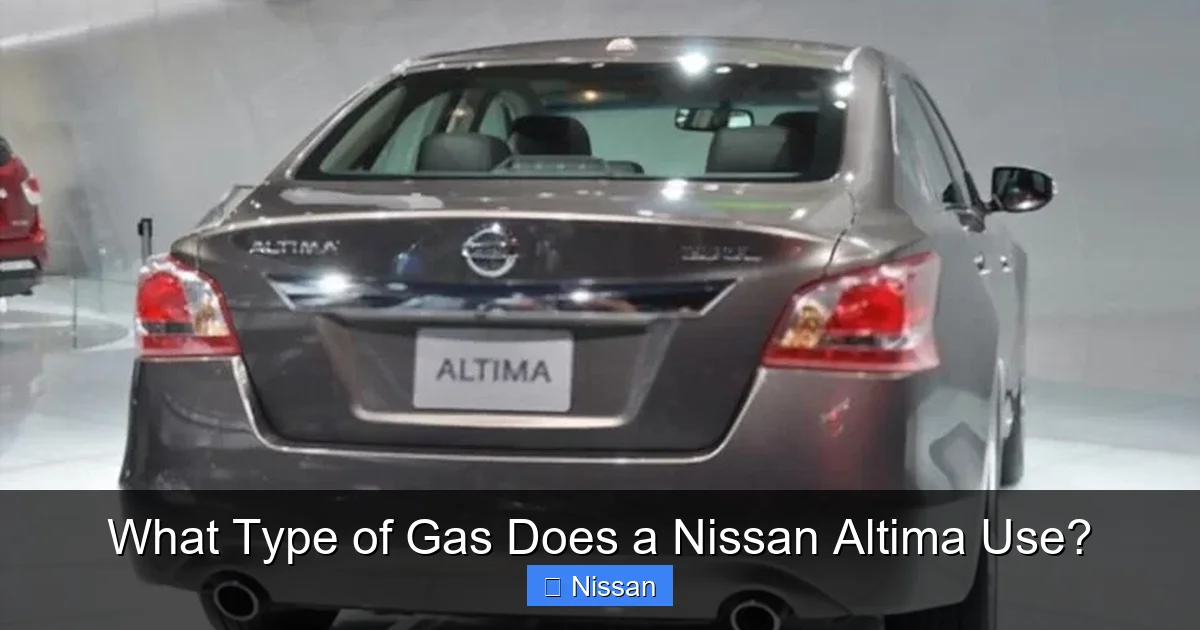
Nissan is very clear about the fuel requirements for the Altima. In the owner’s manual for every model year—from the early 2000s to the latest 2024 versions—the manufacturer consistently recommends using regular unleaded gasoline with an octane rating of 87.
This recommendation applies across the board, whether you drive a base-model Altima with a 2.5L four-cylinder engine or a more powerful 3.5L V6 (found in older models). Even the newer turbocharged variants, such as the Altima SR with its 2.0L VC-Turbo engine, are designed to run on regular gas. Nissan engineers have built in advanced technologies—like variable compression ratios and knock sensors—that allow the engine to adapt to different fuel types without sacrificing performance.
It’s also worth noting that Nissan advises against using gasoline with more than 10% ethanol (E10) unless your specific model is labeled as flex-fuel compatible. Most Altimas are not E85-compatible, so using high-ethanol blends can damage fuel lines, seals, and the fuel injection system over time.
Another important point: always use Top Tier detergent gasoline when available. Top Tier is a voluntary standard adopted by major fuel retailers that requires higher levels of detergent additives. These additives help prevent carbon buildup on intake valves and fuel injectors, which can lead to reduced performance, rough idling, and lower fuel economy. Brands like Shell, Chevron, Exxon, and Costco typically offer Top Tier gas, so look for the logo at the pump.
Can You Use Premium Gas in a Nissan Altima?
Visual guide about What Type of Gas Does a Nissan Altima Use?
Image source: bryansgarage.com
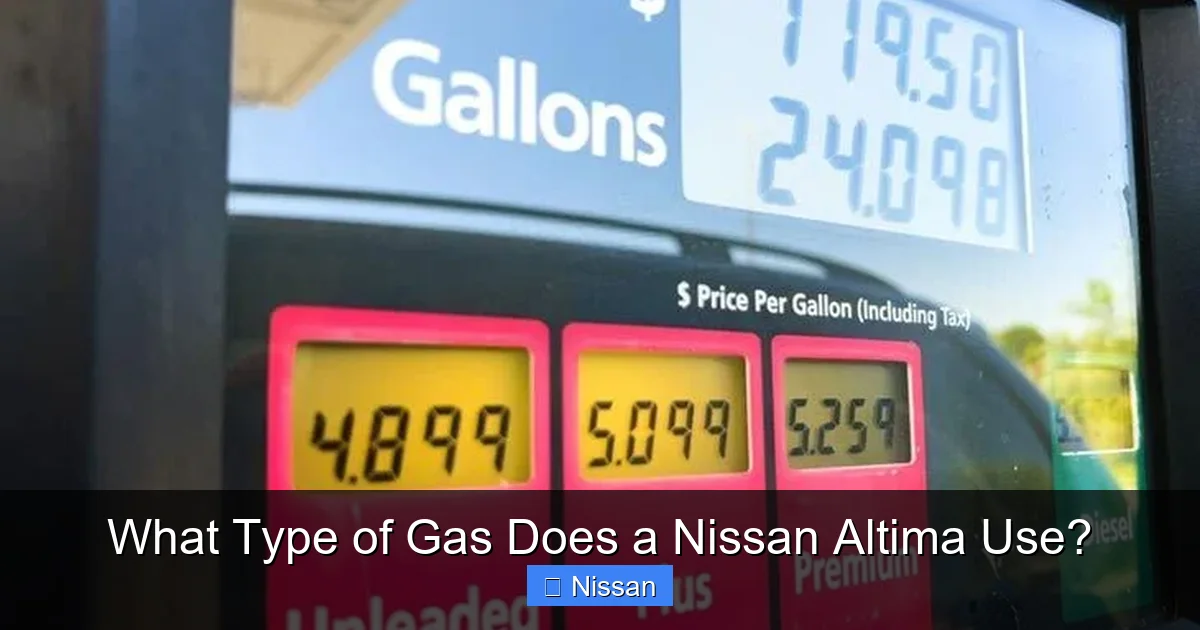
Now for a common question: “Can I use premium gas in my Nissan Altima?” The short answer is yes—but it’s not necessary.
As mentioned earlier, premium gasoline (91–93 octane) is formulated for high-compression or turbocharged engines that are more prone to knocking. Since the Altima’s engine is designed to run on 87 octane, using premium fuel won’t unlock hidden power or dramatically improve fuel economy.
However, there are a few scenarios where premium gas might be beneficial:
– **High-altitude driving:** At elevations above 5,000 feet, the air is thinner, which can affect combustion. Some drivers report smoother performance with higher-octane fuel in these conditions.
– **Extreme heat:** In very hot climates, engine temperatures rise, increasing the risk of knocking. Premium gas can offer added protection during summer months or long highway drives.
– **Heavy loads:** If you frequently carry heavy cargo or drive with multiple passengers, the extra load can stress the engine. Premium fuel may help prevent knocking under these conditions.
– **Towing (if applicable):** While the Altima isn’t designed for towing, some owners use it for light trailer hauling. In such cases, premium gas can provide peace of mind.
That said, these benefits are situational and often minimal. For most drivers, the extra cost of premium gas—typically $0.20 to $0.50 more per gallon—isn’t justified by the marginal gains. Over time, that difference adds up. If you drive 15,000 miles a year and your Altima gets 30 mpg, you’ll spend an extra $150–$375 annually just on higher-octane fuel.
If you’re curious, you can try a tank of premium gas and see if you notice any difference in performance or engine smoothness. But unless you’re experiencing knocking or driving under extreme conditions, regular gas is the smarter, more economical choice.
Flex-Fuel and Ethanol Blends: What You Need to Know
In recent years, Nissan has introduced flex-fuel capability in some Altima models, particularly those sold in the U.S. market. Flex-fuel vehicles (FFVs) can run on gasoline, E85 (a blend of 85% ethanol and 15% gasoline), or any mixture of the two.
As of 2020, certain Altima trims—especially those with the 2.5L engine—are labeled as E85-compatible. You can identify an FFV Altima by checking the fuel door or gas cap, which will usually have a yellow label or sticker indicating “E85” or “Flex-Fuel.” The owner’s manual will also confirm compatibility.
Using E85 in a flex-fuel Altima is legal and safe, but there are trade-offs:
– **Lower fuel economy:** Ethanol contains less energy than gasoline, so you’ll get fewer miles per gallon when running on E85. Expect a 15–30% drop in fuel efficiency.
– **Cold weather performance:** E85 can be harder to ignite in cold temperatures, leading to longer cranking times and reduced performance in winter.
– **Availability:** E85 is not widely available in all regions. It’s more common in the Midwest and less so on the coasts.
If your Altima is not flex-fuel compatible, do not use E85. The high ethanol content can damage rubber seals, fuel lines, and sensors not designed to handle it. Stick to gasoline with no more than 10% ethanol (E10), which is the standard blend at most pumps.
For non-flex-fuel Altimas, the best practice is to use regular unleaded gasoline with minimal ethanol content. If you’re concerned about ethanol levels, look for ethanol-free gasoline at select stations, though it’s typically more expensive and harder to find.
Fuel Quality and Additives: Protecting Your Engine
While octane rating gets most of the attention, fuel quality is just as important for your Altima’s long-term health. Not all gasoline is created equal, and low-quality fuel can lead to carbon buildup, clogged injectors, and reduced engine performance.
This is where detergent additives come in. These chemicals help keep your fuel system clean by preventing deposits from forming on critical components like fuel injectors, intake valves, and combustion chambers. Over time, dirty injectors can cause misfires, rough idling, and decreased fuel economy.
Nissan recommends using Top Tier detergent gasoline whenever possible. Top Tier is a certification program created by automakers to ensure fuel meets higher cleanliness standards. Major retailers like Shell, Chevron, Mobil, and Costco participate, so look for the Top Tier logo at the pump.
If Top Tier gas isn’t available, you can supplement your fuel with a quality fuel system cleaner. Products like Chevron Techron, Sea Foam, or Red Line Complete Fuel System Cleaner can be added to your tank every 3,000 to 5,000 miles to help remove deposits and maintain performance.
Another tip: avoid “bargain” gas stations that may cut corners on fuel quality. While price is important, consistently using low-grade fuel can cost you more in repairs down the road. Stick to reputable brands and stations with high turnover to ensure you’re getting fresh, clean gasoline.
Driving Habits and Environmental Factors
Your driving style and environment also play a role in determining the best fuel for your Altima. While regular gas is the standard recommendation, real-world conditions can influence how your engine performs.
For example, if you live in a hot climate—like Arizona or Texas—engine temperatures can soar, increasing the risk of knocking. In these areas, some drivers opt for mid-grade or premium fuel during the summer months to protect their engines. Similarly, if you frequently drive in stop-and-go traffic or short trips, your engine may not reach optimal operating temperature, leading to carbon buildup. Using a higher-quality fuel with better detergents can help mitigate this.
On the other hand, if you do mostly highway driving at steady speeds, your engine runs more efficiently, and regular gas is perfectly adequate. Highway driving allows the engine to stay warm and burn fuel cleanly, reducing the need for premium additives.
Altitude is another factor. At higher elevations, the air is less dense, which can affect combustion. Some drivers in mountainous regions report smoother performance with higher-octane fuel, though this is more of a personal preference than a necessity.
Ultimately, the best fuel for your Altima depends on your unique situation. Listen to your car—if you hear knocking or pinging, especially under acceleration, consider switching to a higher-octane fuel or having your engine checked for issues.
Cost-Benefit Analysis: Regular vs. Premium Gas
Let’s talk money. One of the biggest reasons drivers consider premium gas is the belief that it will improve performance or save money in the long run. But is that true for the Nissan Altima?
The answer is generally no—at least not in a meaningful way. Here’s a quick breakdown:
– **Cost difference:** Premium gas typically costs $0.20–$0.50 more per gallon than regular.
– **Fuel economy impact:** Studies show that using premium gas in engines designed for regular fuel results in less than a 1–2% improvement in fuel economy—often within the margin of error.
– **Performance gains:** You won’t notice a difference in acceleration, horsepower, or smoothness under normal driving conditions.
For most Altima owners, the extra cost of premium gas isn’t justified. Over a year, that could mean spending $150–$400 more for no real benefit. That money is better spent on regular maintenance, like oil changes, tire rotations, or fuel system cleaners.
That said, if you’re someone who drives aggressively, lives in a hot climate, or wants the peace of mind that comes with using higher-quality fuel, premium gas isn’t a bad choice—it’s just not necessary.
The bottom line: stick with regular unleaded gasoline (87 octane) for everyday driving. It’s what Nissan designed your Altima to use, and it’s the most cost-effective option for the majority of drivers.
Conclusion: Fueling Your Altima the Right Way
So, what type of gas does a Nissan Altima use? The answer is simple: regular unleaded gasoline with an octane rating of 87. It’s the fuel Nissan recommends, the one your engine is designed for, and the most economical choice for daily driving.
While premium gas won’t hurt your Altima, it also won’t provide significant benefits unless you’re driving under extreme conditions. Flex-fuel options are available on select models, but only if your vehicle is specifically labeled as E85-compatible. And when it comes to fuel quality, always aim for Top Tier detergent gasoline to keep your engine clean and running smoothly.
By following these guidelines, you’ll protect your investment, maintain optimal performance, and save money at the pump. Your Nissan Altima is built to be reliable, efficient, and easy to maintain—and using the right fuel is a big part of that equation.
So next time you pull up to the gas station, remember: regular gas is all you need. Fill up with confidence, drive with peace of mind, and enjoy the smooth, dependable ride that only a Nissan Altima can deliver.
Frequently Asked Questions
Can I use premium gas in my Nissan Altima?
Yes, you can use premium gas in your Nissan Altima, but it’s not required. Your Altima is designed to run on regular unleaded gasoline with 87 octane, and using premium fuel won’t significantly improve performance or fuel economy under normal driving conditions.
What happens if I use lower octane gas than recommended?
Using fuel with an octane rating below 87 can cause engine knocking, especially under heavy load or high temperatures. Modern Altimas have knock sensors that adjust timing to reduce damage, but consistent use of low-octane fuel may affect performance and longevity.
Is E85 gas safe for all Nissan Altimas?
No, only flex-fuel compatible Altimas (usually 2020 and later models with a yellow fuel cap or E85 label) can safely use E85. Using E85 in a non-flex-fuel Altima can damage the fuel system and void your warranty.
Does using Top Tier gas really make a difference?
Yes. Top Tier detergent gasoline contains higher levels of cleaning additives that help prevent carbon buildup in the engine. This can improve fuel efficiency, reduce emissions, and extend the life of your fuel system components.
Can I mix regular and premium gas in my Altima?
Yes, you can mix regular and premium gasoline in your Altima. The engine will adjust to the blended octane level. However, for consistent performance, it’s best to stick with one type of fuel unless you’re transitioning between grades.
How often should I use a fuel system cleaner?
For most drivers, using a quality fuel system cleaner every 3,000 to 5,000 miles is sufficient. If you primarily use Top Tier gas, you may only need to add a cleaner once or twice a year to maintain optimal engine performance.