
Subaru Won’t Start but Battery Is Fine

If your Subaru won’t start but the battery is fine, don’t panic—it’s often not the battery at all. Issues like a bad starter motor, faulty ignition switch, fuel delivery problems, or immobilizer glitches are common culprits. This guide walks you through step-by-step diagnostics and real-world fixes to get you back on the road safely.
You’re running late for work, you hop into your trusty Subaru Outback or Forester, turn the key—and nothing happens. The dashboard lights up bright and clear, the radio plays, the interior fan whirs… but the engine just won’t crank. You check the battery: it’s fully charged, terminals are clean, and connections are tight. So why won’t your Subaru start?
It’s a frustrating scenario that leaves many Subaru owners scratching their heads. The good news? A healthy battery rules out one major variable—but it opens the door to several other equally common (and often fixable) issues. From electrical gremlins to mechanical failures, there’s usually a logical explanation behind a no-start condition, even when everything else seems fine.
In this comprehensive guide, we’ll walk you through the most likely reasons your Subaru won’t start despite having a good battery. Whether you’re dealing with a stubborn 2015 Impreza or a newer 2022 Crosstrek, these troubleshooting steps apply across most Subaru models. We’ll cover everything from simple DIY checks to more complex diagnostics—so you can either fix it yourself or know exactly what to tell your mechanic.
Key Takeaways
- Battery health isn’t the only factor: A fully charged battery doesn’t rule out electrical or mechanical issues preventing your Subaru from starting.
- Starter motor failure is common: If you hear a clicking sound but no engine turnover, the starter may be worn or damaged.
- Ignition switch problems can mimic battery issues: A faulty switch may cut power to critical systems even when the key turns.
- Fuel pump or filter issues starve the engine: No fuel pressure means no combustion—even with a strong battery.
- Immobilizer system glitches prevent startup: Modern Subarus use security systems that can mistakenly block ignition if sensors fail.
- Check fuses and relays first: Blown fuses or stuck relays in the engine bay or cabin can interrupt power flow silently.
- Professional diagnosis saves time and money: Use an OBD2 scanner or visit a trusted mechanic if basic troubleshooting doesn’t resolve the issue.
📑 Table of Contents
Common Causes When Your Subaru Won’t Start (But Battery Is Fine)
When your Subaru refuses to start but the battery checks out, it’s time to look beyond the obvious. Modern vehicles like Subarus rely on a complex web of electrical, mechanical, and software systems working in harmony. If just one component fails or miscommunicates, the engine won’t fire—even if the battery is delivering full voltage.
Let’s break down the top culprits behind this frustrating no-start condition. Understanding these will help you narrow down the problem quickly and avoid unnecessary repairs.
1. Faulty Starter Motor
The starter motor is the heart of your engine’s cranking system. When you turn the key (or press the start button), the starter receives power from the battery and uses it to spin the engine’s flywheel—initiating combustion. If the starter fails, you’ll typically hear a rapid clicking sound or nothing at all when you try to start the car.
In many Subaru models—especially older WRXs, Foresters, and Legacys—starter motors wear out after 100,000+ miles. Symptoms include:
– A single loud click followed by silence
– Intermittent starting (works sometimes, doesn’t others)
– Grinding noises during attempted starts
To test the starter, you can use a multimeter to check for voltage at the starter solenoid when the key is turned to “start.” If voltage is present but the starter doesn’t engage, it’s likely faulty. Replacing a starter on most Subarus is a moderate DIY job if you’re comfortable with basic tools and jack stands—but be prepared for some tight spaces under the engine.
2. Bad Ignition Switch
The ignition switch doesn’t just send power to the starter—it also activates critical systems like the fuel pump, ECU, and immobilizer. If the switch is worn or damaged, it may fail to complete the circuit needed to start the engine, even though dashboard lights still illuminate.
A failing ignition switch often shows subtle warning signs before complete failure:
– Dashboard lights flicker when turning the key
– Accessories (like power windows) work, but the engine doesn’t crank
– The car starts intermittently—especially after jiggling the key
On many Subarus, the ignition switch is located inside the steering column and can be tricky to access. However, if you suspect this issue, a mechanic can often test it with a scan tool or by monitoring voltage output during key rotation.
3. Fuel Delivery Problems
Even with a perfect battery and working starter, your engine needs fuel to run. If the fuel pump, fuel filter, or fuel pressure regulator fails, the engine won’t start—despite everything else seeming normal.
Common fuel-related no-start symptoms include:
– Engine cranks normally but doesn’t fire
– Strong gasoline smell (indicating flooded engine or leak)
– Recent fuel filter replacement or low fuel level
Subaru fuel pumps are generally reliable, but they can fail due to age, contaminated fuel, or electrical issues. Listen for a faint hum from the fuel tank when you turn the key to “ON” (before cranking)—if you don’t hear it, the pump may not be priming. A fuel pressure test using a gauge connected to the Schrader valve on the fuel rail can confirm whether pressure is within spec (typically 35–45 psi for most Subarus).
4. Immobilizer or Security System Glitch
Modern Subarus come equipped with advanced anti-theft systems called immobilizers. These systems use a transponder chip in your key to communicate with the car’s ECU. If the system doesn’t recognize the key—or if a sensor fails—it will prevent the engine from starting, even if the battery is strong.
Signs of an immobilizer issue include:
– A flashing security light on the dashboard
– Engine cranks but immediately stalls
– Key fob battery is dead (prevents signal transmission)
Sometimes, simply replacing the key fob battery resolves the issue. Other times, the immobilizer antenna ring around the ignition cylinder may be damaged or dirty. In rare cases, the ECU itself needs reprogramming—a job best left to a Subaru specialist or dealership.
5. Blown Fuses or Faulty Relays
It sounds simple, but blown fuses or stuck relays are among the most overlooked causes of a no-start condition. Subarus have multiple fuse boxes—one under the hood and another inside the cabin—that protect circuits for the starter, fuel pump, ignition, and more.
A single blown 10A or 15A fuse can disable the entire starting system. Similarly, a relay that’s supposed to send power to the fuel pump or starter may fail internally, cutting off electricity even though it looks intact.
Always check the fuse diagram in your owner’s manual and inspect fuses visually or with a test light. Relays can be swapped with identical ones (like the horn relay) to test functionality. This is one of the easiest and cheapest fixes—so don’t skip it!
Step-by-Step Troubleshooting Guide
Visual guide about Subaru Won’t Start but Battery Is Fine
Image source: autoowa.com
Now that you know the common causes, let’s walk through a practical, step-by-step process to diagnose why your Subaru won’t start—even with a good battery. Follow these steps in order to avoid wasting time on unnecessary repairs.
Step 1: Confirm the Battery Is Truly Healthy
Just because the lights work doesn’t mean the battery can deliver enough current to crank the engine. Use a multimeter to check voltage:
– 12.6V or higher = fully charged
– Below 12.4V = partially discharged
– Below 12.0V = likely too weak to start
Also, perform a load test (available at auto parts stores) to simulate cranking demand. A battery may show 12.5V at rest but drop to 9V under load—indicating internal failure.
Step 2: Listen for Cranking Sounds
Turn the key to “start” and listen carefully:
– **Silent**: Could be ignition switch, starter relay, or wiring
– **Rapid clicking**: Classic sign of weak battery or bad starter connection
– **Slow cranking**: Battery or starter issue
– **Normal cranking but no start**: Points to fuel, spark, or immobilizer
This simple observation can narrow your focus dramatically.
Step 3: Check Fuses and Relays
Pop the hood and locate the main fuse box. Refer to your owner’s manual for the fuse map. Look for fuses labeled “Starter,” “EFI,” “Fuel Pump,” or “IGN.” Replace any that are blown.
Next, locate the relay box (often near the battery). Swap the starter relay with a known-good one (like the AC compressor relay) and try starting again. If it works, you’ve found the problem.
Step 4: Test the Starter Circuit
If the starter isn’t engaging, use a test light or multimeter to check for power at the starter solenoid terminal when the key is turned to “start.” If there’s power but no action, the starter is likely bad. If there’s no power, trace back to the ignition switch or relay.
For push-button start models, ensure the brake pedal is fully depressed—many Subarus won’t allow cranking unless the brake is pressed.
Step 5: Verify Fuel and Spark
If the engine cranks but won’t fire, suspect fuel or ignition:
– **Fuel**: Listen for the fuel pump priming (a 2–3 second hum when key is turned to “ON”). Use a fuel pressure gauge if possible.
– **Spark**: Remove a spark plug, reconnect it to the wire, ground it against the engine block, and crank. Look for a strong blue spark.
No spark? Check ignition coils, crankshaft position sensor, or camshaft position sensor—all common failure points on Subarus.
Step 6: Scan for Diagnostic Trouble Codes (DTCs)
Even if the check engine light isn’t on, your Subaru’s ECU may have stored codes related to the no-start condition. Use an OBD2 scanner (many are under $50) to read codes. Common ones include:
– P0335 (Crankshaft Position Sensor)
– P0230 (Fuel Pump Circuit)
– B1660 (Immobilizer Communication Error)
These codes provide precise clues and save hours of guesswork.
Model-Specific Considerations
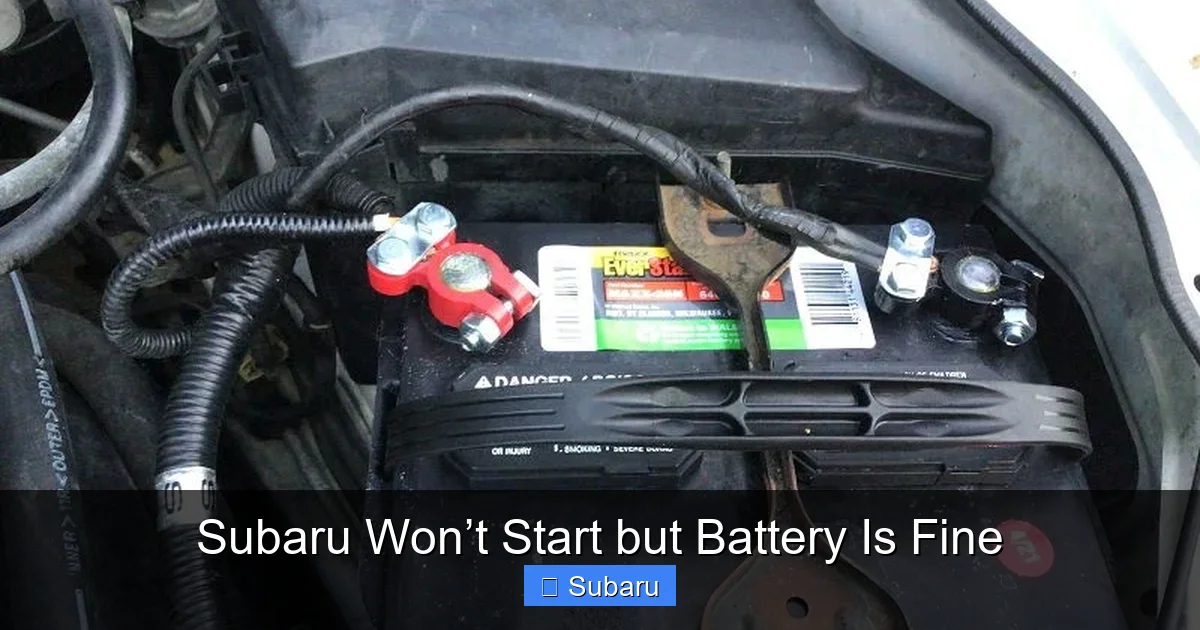
Visual guide about Subaru Won’t Start but Battery Is Fine
Image source: guidemechanic.com
Not all Subarus are created equal when it comes to no-start issues. Certain models have known quirks or recurring problems that owners should be aware of.
Subaru Outback and Legacy (2010–2019)
These popular wagons and sedans often suffer from faulty ignition switches and worn starter motors. Additionally, the fuel pump relay (located in the under-hood fuse box) is a known weak point—some owners install an aftermarket relay for peace of mind.
Subaru WRX and STI (2008–2014)
Turbocharged models are more sensitive to fuel pressure drops. A failing fuel pump or clogged filter can cause hard starts or no starts, especially in cold weather. Also, the clutch interlock switch (manual transmissions only) can prevent cranking if it’s misadjusted or broken.
Subaru Crosstrek and Forester (2018–Present)
Newer models with push-button start rely heavily on the key fob and immobilizer system. A dead fob battery or weak signal can prevent startup—even if the physical key works in the door. Always carry a spare fob battery (CR2032).
Subaru Ascent (2019–Present)
As a larger SUV, the Ascent has a higher electrical load. Weak ground connections or corroded battery cables can cause intermittent no-starts. Check the ground strap from the engine to the chassis—it’s often overlooked.
When to Call a Professional
Visual guide about Subaru Won’t Start but Battery Is Fine
Image source: guidemechanic.com
While many no-start issues can be resolved at home, some situations demand expert help. Don’t hesitate to visit a trusted mechanic or Subaru dealership if:
– You’ve checked fuses, relays, and battery—but still no luck
– The immobilizer light is flashing and won’t reset
– You suspect ECU or wiring harness damage
– The vehicle has recently been in an accident or flood
Modern Subarus use encrypted communication between modules, so some diagnostics require factory-level scan tools. A certified technician can perform bidirectional tests, reprogram keys, and verify sensor signals that DIY tools can’t access.
That said, even if you end up taking it to a shop, doing your own preliminary checks can save you money and help you communicate the issue clearly—leading to faster, more accurate repairs.
Preventative Maintenance Tips
The best way to avoid a no-start surprise is proactive care. Here are a few habits that keep your Subaru starting reliably for years:
– **Replace the fuel filter every 30,000–60,000 miles** (check your manual). A clogged filter strains the pump and reduces pressure.
– **Use quality fuel and additives occasionally** to prevent injector clogging.
– **Keep key fob batteries fresh**—replace them every 1–2 years.
– **Clean battery terminals annually** to ensure solid connections.
– **Listen for unusual sounds** during startup—grinding, whining, or hesitation are early warning signs.
Investing a little time now can prevent a roadside breakdown later.
Final Thoughts
Finding your Subaru won’t start—even with a healthy battery—is undeniably stressful. But as we’ve seen, the root cause is usually identifiable and often fixable without a major expense. Whether it’s a $10 fuse, a $50 relay, or a $300 starter motor, most no-start conditions have straightforward solutions once you know where to look.
Start with the basics: confirm battery health, check fuses and relays, listen for cranking behavior, and scan for codes. From there, you can methodically eliminate possibilities until you find the culprit. And remember—your Subaru is built to last. With proper care and timely troubleshooting, it’ll keep getting you where you need to go, season after season.
Don’t let a no-start incident shake your confidence in your vehicle. Arm yourself with knowledge, keep a basic toolkit and OBD2 scanner in the trunk, and you’ll be ready for whatever comes your way.
Frequently Asked Questions
Why won’t my Subaru start if the battery is fully charged?
Even with a good battery, issues like a faulty starter motor, bad ignition switch, fuel pump failure, or immobilizer glitches can prevent your Subaru from starting. Electrical or mechanical components—not the battery—are often the real culprits.
What does it mean if my Subaru clicks but won’t start?
A clicking sound usually indicates the starter solenoid is receiving power but the motor isn’t engaging. This could be due to a weak battery connection, corroded terminals, or a failing starter motor—even if the battery tests fine.
Can a bad fuel pump cause a no-start condition?
Yes. If the fuel pump isn’t delivering adequate pressure, the engine won’t ignite—even if it cranks normally. Listen for the pump priming when you turn the key to “ON,” and consider a fuel pressure test if you suspect this issue.
How do I reset the immobilizer on my Subaru?
Try replacing the key fob battery first. If that doesn’t work, turn the key to “ON” for 10 minutes to allow the system to reset. For persistent issues, visit a Subaru dealer—they can reprogram the immobilizer using factory tools.
Should I replace the starter myself if my Subaru won’t start?
If you’re comfortable with basic automotive repairs and have the right tools, yes—many Subaru starters are accessible with moderate effort. However, if you’re unsure, consult a mechanic to avoid damaging surrounding components.
Can a blown fuse really stop my car from starting?
Absolutely. A single blown fuse in the starter, fuel pump, or ignition circuit can completely disable the starting system. Always check the fuse box under the hood and inside the cabin before assuming a major repair is needed.