
How Much Can a Dodge 2500 Tow?

The Dodge 2500 (now Ram 2500) is a powerhouse heavy-duty pickup designed for serious towing. Depending on configuration, it can tow between 10,000 and 19,680 pounds—making it ideal for trailers, boats, and work equipment.
Key Takeaways
- Maximum Towing Capacity: The Dodge 2500 can tow up to 19,680 pounds when properly equipped, especially with the Cummins turbo diesel engine.
- Engine Options Matter: Gas V8 and turbo diesel engines offer different towing strengths—diesel provides more torque and towing power.
- Configuration Impacts Capacity: Cab size, bed length, axle ratio, and drivetrain (4×2 vs. 4×4) affect how much the truck can safely tow.
- Gooseneck and Fifth-Wheel Towing: The 2500 excels in gooseneck and fifth-wheel setups, often exceeding conventional towing limits.
- Proper Equipment is Essential: Towing at max capacity requires the right hitch, brake controller, and suspension upgrades.
- Payload vs. Towing: Don’t confuse payload (cargo in the bed) with towing—both are important for safe operation.
- Regular Maintenance Improves Performance: Keeping the transmission, cooling system, and brakes in top shape ensures reliable towing over time.
📑 Table of Contents
How Much Can a Dodge 2500 Tow?
If you’re in the market for a heavy-duty pickup that can handle serious hauling, the Dodge 2500—now officially known as the Ram 2500—is a top contender. Whether you’re towing a massive travel trailer across the country, hauling a horse trailer to the ranch, or pulling construction equipment to a job site, this truck is built for the task. But just how much can a Dodge 2500 tow? The answer isn’t one-size-fits-all. It depends on several factors, including engine choice, drivetrain, cab and bed configuration, axle ratio, and whether you’re using a conventional hitch or a gooseneck/fifth-wheel setup.
In this guide, we’ll break down everything you need to know about the Dodge 2500’s towing capabilities. We’ll explore the different engine options, explain how configuration affects towing, and share practical tips to help you tow safely and efficiently. Whether you’re a seasoned truck owner or a first-time buyer, understanding your truck’s limits is crucial—not just for performance, but for safety and longevity. So let’s dive in and uncover the real towing potential of this rugged American workhorse.
Understanding Towing Capacity Basics
Visual guide about How Much Can a Dodge 2500 Tow?
Image source: letstowthat.com
Before we get into the numbers, it’s important to understand what “towing capacity” actually means. Simply put, it’s the maximum weight your truck can safely pull behind it. This number is determined by the manufacturer based on rigorous testing of the vehicle’s frame, engine, transmission, suspension, brakes, and cooling systems. It’s not just about raw power—it’s about balance, stability, and control.
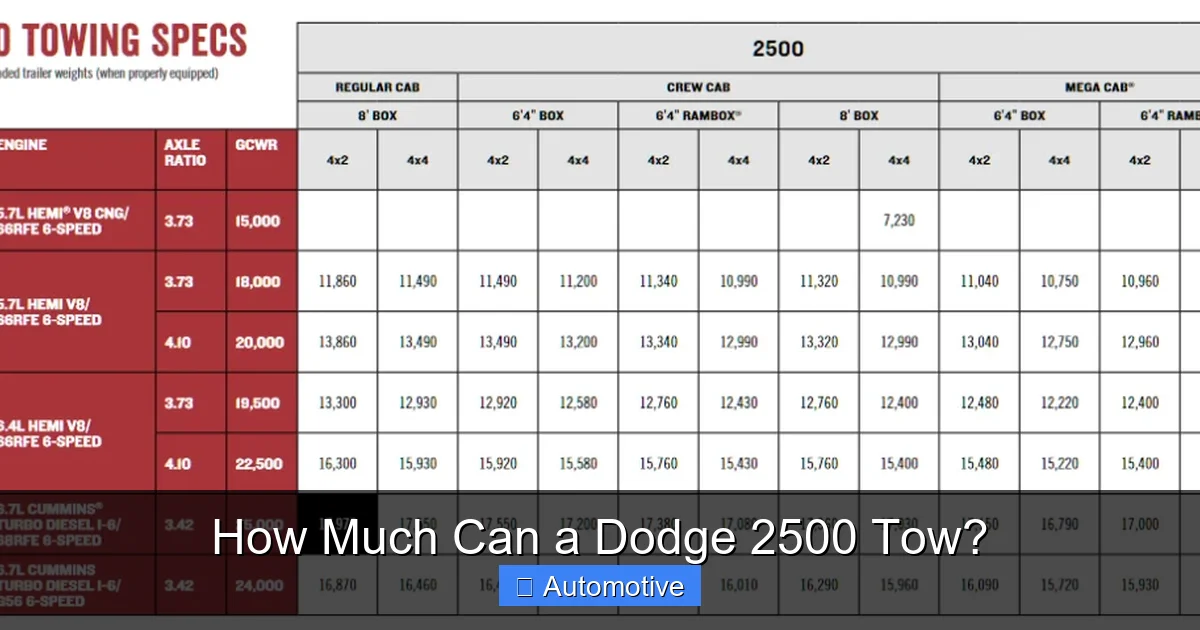
Towing capacity isn’t a fixed number across all models. Even within the same year and trim, different configurations can result in vastly different capabilities. For example, a Dodge 2500 with a gas V8 might tow 10,000 pounds, while one with a Cummins diesel engine could tow nearly double that. That’s why it’s essential to check the specific build of your truck or the one you’re considering buying.
Another key concept is “Gross Combined Weight Rating” (GCWR). This is the total allowable weight of the truck, passengers, cargo, and trailer combined. Your towing capacity is calculated by subtracting the truck’s curb weight and payload from the GCWR. Going over this limit can strain your engine, overheat your transmission, and compromise braking—potentially leading to dangerous situations on the road.
It’s also worth noting that towing capacity can vary based on how you connect the trailer. Conventional towing (using a bumper or receiver hitch) typically has lower limits than gooseneck or fifth-wheel towing, which distribute weight more evenly and allow for heavier loads. We’ll explore these differences in detail later.
What Affects Towing Capacity?
Several factors influence how much a Dodge 2500 can tow. Let’s look at the most important ones:
– **Engine Type:** The engine is the heart of your towing power. Diesel engines, especially the legendary Cummins turbo diesel, produce massive amounts of torque—ideal for pulling heavy loads from a stop and maintaining speed uphill.
– **Axle Ratio:** A higher numerical axle ratio (like 3.73 or 4.10) provides more torque to the wheels, improving towing performance. Trucks with lower ratios (like 3.42) are better for fuel economy but may struggle with heavy trailers.
– **Drivetrain:** Rear-wheel drive (4×2) trucks often have higher towing capacities than four-wheel drive (4×4) models because they’re lighter and have less mechanical resistance. However, 4×4 offers better traction in off-road or slippery conditions.
– **Cab and Bed Configuration:** A regular cab with a long bed typically tows more than a crew cab with a short bed, simply because it’s lighter and has a longer wheelbase for stability.
– **Suspension and Towing Packages:** Factory-installed towing packages often include upgraded shocks, heavy-duty springs, a transmission cooler, and a built-in brake controller—all of which support higher towing capacities.
Understanding these variables helps you make informed decisions when buying or modifying your truck. It also ensures you don’t accidentally overload your vehicle.
Engine Options and Their Towing Impact

Visual guide about How Much Can a Dodge 2500 Tow?
Image source: m.media-amazon.com
The engine you choose plays the biggest role in determining how much your Dodge 2500 can tow. Over the years, Dodge (now Ram) has offered several engine options for the 2500, each with distinct strengths and weaknesses when it comes to towing.
6.4L HEMI V8 Gas Engine
The 6.4L HEMI V8 is a popular choice for those who want strong performance without the complexity of a diesel engine. Producing around 410 horsepower and 429 lb-ft of torque, this engine delivers smooth, responsive power ideal for everyday driving and moderate towing.
In terms of towing, the 6.4L HEMI can handle up to **13,000 to 14,000 pounds** when properly equipped. That’s enough for most travel trailers, large boats, and equipment trailers. It’s a great option if you don’t need extreme towing power but still want a capable heavy-duty truck.
One advantage of the gas engine is lower upfront cost and simpler maintenance. There’s no diesel particulate filter (DPF) or selective catalytic reduction (SCR) system to worry about, and fuel is generally cheaper—at least when diesel prices spike. However, gas engines typically get lower fuel economy when towing, especially under heavy loads.
6.7L Cummins Turbo Diesel I6
If you’re serious about towing, the 6.7L Cummins turbo diesel is the king of the Dodge 2500 lineup. This engine has earned a reputation for durability, torque, and long-term reliability. Depending on the model year and tuning, it produces between 350 and 400 horsepower—but the real story is the torque, which ranges from **800 to 1,075 lb-ft**.
That massive torque allows the Cummins-powered 2500 to tow up to **19,680 pounds** in optimal configurations. That’s enough to pull a large fifth-wheel RV, a heavy equipment trailer, or even a small house on wheels. The diesel engine’s low-end grunt makes it exceptionally good at launching heavy loads and climbing steep grades without straining.
Diesel engines also tend to have better fuel economy when towing, thanks to their high efficiency and longer gearing. However, they come with higher initial costs, more complex emissions systems, and the need for regular maintenance like DEF (diesel exhaust fluid) top-offs and DPF regeneration cycles.
Older Engine Options (Pre-2019)
Earlier models of the Dodge 2500 (before the brand transitioned to Ram) featured other engines, such as the 5.7L HEMI V8 and the older 6.7L Cummins with lower output. While these engines were still capable, they generally offered lower towing capacities—often in the 10,000 to 15,000-pound range.
For example, a 2010 Dodge 2500 with the 5.7L V8 might tow around 10,500 pounds, while a 2015 model with the 6.7L Cummins could reach up to 17,980 pounds. Always check the specific model year and build sheet for accurate numbers.
Configuration Matters: Cab, Bed, and Drivetrain
Visual guide about How Much Can a Dodge 2500 Tow?
Image source: letstowthat.com
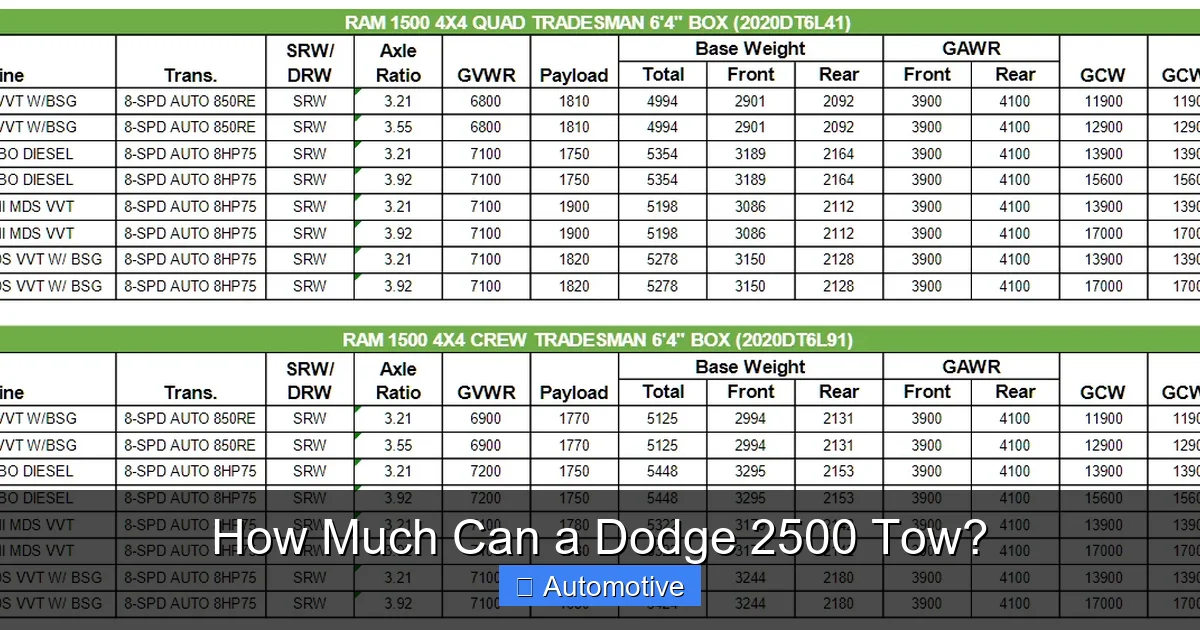
Even with the same engine, two Dodge 2500s can have very different towing capacities based on how they’re configured. Let’s break down the key configuration factors.
Cab Style: Regular, Crew, and Mega Cab
The cab style affects both weight and wheelbase, which in turn influence towing capacity.
– **Regular Cab:** The lightest and most basic option, the regular cab has two doors and seating for two or three. It’s often paired with a long bed (8 feet), giving it the longest wheelbase and best weight distribution for towing. This configuration typically offers the highest towing capacity.
– **Crew Cab:** With four full doors and seating for up to six, the crew cab is more family-friendly but heavier. It usually comes with a 6.4-foot bed, reducing wheelbase slightly. Towing capacity is still strong but may be 1,000 to 2,000 pounds less than a regular cab.
– **Mega Cab:** The largest cab option, the Mega Cab offers massive rear legroom and comfort. However, it’s the heaviest and has the shortest bed (6.4 feet), which can reduce towing capacity compared to lighter configurations.
For maximum towing, the regular cab with a long bed is usually the best choice.
Bed Length: 6.4 ft vs. 8 ft
Bed length impacts both payload and towing. An 8-foot bed provides more space for cargo and better weight distribution when towing a gooseneck or fifth-wheel trailer. It also allows for a longer wheelbase, which improves stability at high speeds and under heavy loads.
A 6.4-foot bed is more maneuverable and better for city driving, but it may limit towing capacity—especially for large trailers that require a longer wheelbase for safe handling.
Drivetrain: 4×2 vs. 4×4
Rear-wheel drive (4×2) trucks are generally lighter and have less drivetrain resistance, which can boost towing capacity. A 4×2 Dodge 2500 might tow 1,000 to 2,000 pounds more than its 4×4 counterpart.
However, 4×4 offers better traction in snow, mud, or off-road conditions. If you plan to tow in challenging terrain or frequently drive in adverse weather, the trade-off in towing capacity may be worth it for the added control and safety.
Axle Ratio: The Hidden Towing Booster
The axle ratio is often overlooked but critically important. It determines how many times the driveshaft turns for each rotation of the wheels. A higher ratio (like 4.10:1) means more torque multiplication, which helps with towing.
For example, a Dodge 2500 with a 3.42 axle ratio might tow 14,000 pounds, while the same truck with a 4.10 ratio could reach 18,000+ pounds. Always check the axle code on the door jamb or build sheet to know your ratio.
Conventional vs. Gooseneck vs. Fifth-Wheel Towing
How you connect your trailer makes a big difference in how much you can tow. Let’s compare the three main methods.
Conventional Towing (Bumper or Receiver Hitch)
This is the most common method, using a ball hitch mounted to the bumper or a receiver hitch in the bed. It’s simple, affordable, and works with most trailers.
However, conventional towing has the lowest capacity. Most Dodge 2500s max out around **10,000 to 14,000 pounds** with this setup, depending on engine and configuration. The weight is concentrated at the rear axle, which can cause sway and reduce control with heavy loads.
Gooseneck Towing
A gooseneck hitch connects to a ball mounted in the bed, forward of the rear axle. This setup allows the trailer to pivot closer to the truck’s center of gravity, improving stability and weight distribution.
Gooseneck towing significantly increases capacity. Many Dodge 2500s can tow **17,000 to 19,000+ pounds** with this method, especially with the Cummins diesel. It’s ideal for large livestock trailers, flatbeds, and heavy equipment.
Fifth-Wheel Towing
Similar to gooseneck, a fifth-wheel hitch uses a kingpin connection in the bed, but with a larger, more secure coupling. It’s the preferred method for large RVs and luxury trailers.
Fifth-wheel towing offers the highest capacity and smoothest ride. The Dodge 2500 can often reach its **maximum towing capacity of 19,680 pounds** with this setup. The weight is distributed more evenly, reducing strain on the rear axle and improving braking and handling.
Which Method Should You Choose?
– Use **conventional towing** for lighter trailers, boats, or utility trailers under 10,000 pounds.
– Choose **gooseneck** for heavy flatbeds, livestock trailers, or construction equipment.
– Opt for **fifth-wheel** if you’re towing a large RV or need maximum stability and capacity.
Always ensure your truck is equipped with the proper hitch, wiring, and brake controller for your chosen method.
Practical Tips for Safe and Efficient Towing
Knowing how much your Dodge 2500 can tow is only half the battle. Towing safely and efficiently requires preparation, the right equipment, and good habits.
Use the Right Hitch and Accessories
Invest in a high-quality hitch rated for your trailer’s weight. For gooseneck or fifth-wheel setups, choose a hitch designed for heavy-duty trucks. Consider weight distribution hitches for conventional towing to improve stability.
A brake controller is essential for trailers with electric brakes. It allows you to adjust brake force from the cab, ensuring smooth, controlled stops. Many newer Dodge 2500s come with a built-in controller, but aftermarket options are available.
Check Your Tires and Suspension
Towing puts extra stress on tires and suspension. Use LT (Light Truck) or P-metric tires with a high load rating. Check tire pressure before every trip—underinflated tires can overheat and fail.
Upgrade to heavy-duty shocks and air suspension if you frequently tow near max capacity. Air bags can help level the truck and improve ride quality when loaded.
Distribute Weight Properly
Improper weight distribution is a leading cause of trailer sway. Aim for **60% of the trailer’s weight on the front half** (ahead of the axles). Use a tongue weight scale to ensure you’re within the recommended range (usually 10–15% of total trailer weight for conventional towing).
Avoid overloading the truck’s bed. Remember, payload includes passengers, cargo, and hitch weight. Exceeding payload can damage your suspension and void your warranty.
Drive Smart and Stay Alert
Towing changes how your truck handles. Allow extra distance for braking, take turns slowly, and avoid sudden maneuvers. Use lower gears when descending hills to reduce brake wear.
Check your mirrors frequently and use a trailer camera if available. Be aware of wind, road conditions, and traffic. If you feel sway, ease off the accelerator—don’t brake hard, as this can worsen the situation.
Maintain Your Truck
Towing is hard on your vehicle. Regular maintenance is crucial:
– Change the transmission fluid and filter more often when towing.
– Check coolant levels and ensure the radiator and transmission cooler are clean.
– Inspect brakes, especially if you tow frequently or in mountainous areas.
– Monitor diesel emissions systems (DEF, DPF) to avoid downtime.
A well-maintained Dodge 2500 will tow reliably for hundreds of thousands of miles.
Real-World Towing Examples
Let’s look at some practical scenarios to illustrate how much a Dodge 2500 can tow.
Example 1: Family RV Trip
John and his family are planning a cross-country trip in their 35-foot fifth-wheel RV, which weighs 14,500 pounds. They drive a 2022 Ram 2500 (formerly Dodge 2500) with the 6.7L Cummins diesel, 4×2 drivetrain, and 4.10 axle ratio.
With a fifth-wheel hitch and proper setup, their truck can easily handle the load. The Cummins engine provides plenty of torque for mountain passes, and the long wheelbase keeps the ride smooth. They stay well under the 19,680-pound max and enjoy a safe, comfortable journey.
Example 2: Construction Work
Maria runs a landscaping business and needs to tow a 12,000-pound equipment trailer with a skid steer and tools. She uses a 2018 Dodge 2500 with the 6.4L HEMI V8 and gooseneck hitch.
Her truck’s towing capacity is around 13,500 pounds, so she’s within limits. She uses a weight distribution hitch and checks tire pressure before each trip. The gas engine handles the load well, though fuel economy drops when towing.
Example 3: Horse Trailer Hauling
David transports horses to shows in a 10,000-pound gooseneck trailer. He drives a 2020 Ram 2500 with the Cummins diesel and 4×4 drivetrain.
Even with the heavier 4×4 setup, his truck can tow up to 18,000 pounds. The diesel engine gives him confidence on steep grades, and the gooseneck hitch keeps the trailer stable. He adds air bags to level the rear suspension and uses a brake controller for smooth stops.
Conclusion
So, how much can a Dodge 2500 tow? The answer ranges from about **10,000 pounds** for a base gas model with conventional towing to an impressive **19,680 pounds** for a properly equipped Cummins diesel with a fifth-wheel or gooseneck setup. That’s a massive range, and it highlights the importance of understanding your truck’s specific configuration.
The Dodge 2500 (now Ram 2500) is one of the most capable heavy-duty pickups on the market, especially when equipped with the legendary 6.7L Cummins turbo diesel. Whether you’re towing a weekend camper, a work trailer, or a full-sized RV, this truck has the power, durability, and technology to get the job done.
But capability means nothing without responsibility. Always respect your truck’s limits, use the right equipment, and maintain your vehicle properly. Towing safely isn’t just about avoiding accidents—it’s about protecting your investment and ensuring years of reliable service.
If you’re shopping for a used or new heavy-duty truck, the Dodge 2500 is a smart choice. Just be sure to check the build sheet, engine type, and towing package to know exactly what you’re getting. With the right setup, this truck can handle almost anything you throw at it—or behind it.
Frequently Asked Questions
What is the maximum towing capacity of a Dodge 2500?
The maximum towing capacity of a Dodge 2500 is 19,680 pounds when equipped with the 6.7L Cummins turbo diesel engine, 4×2 drivetrain, and a fifth-wheel or gooseneck hitch. This requires the right axle ratio and towing package.
Can a Dodge 2500 tow a fifth-wheel RV?
Yes, the Dodge 2500 is excellent for fifth-wheel towing. With the Cummins diesel engine and proper hitch, it can safely tow large RVs weighing up to 19,000 pounds or more, depending on configuration.
Does the engine type affect towing capacity?
Absolutely. The 6.7L Cummins diesel provides far more torque and towing power than the 6.4L gas V8. Diesel engines are better for heavy loads, while gas engines are simpler and cheaper to maintain.
What’s the difference between payload and towing capacity?
Payload is the weight your truck can carry in the cab and bed (including passengers and cargo). Towing capacity is how much it can pull behind. Both are limited, and exceeding either can damage your truck.
Do I need a special hitch for heavy towing?
Yes. For loads over 10,000 pounds, a gooseneck or fifth-wheel hitch is recommended. These distribute weight better and allow higher towing capacities than conventional bumper hitches.
Can I increase my Dodge 2500’s towing capacity?
You can’t increase the factory-rated towing capacity, but you can optimize it with the right axle ratio, towing package, and hitch. Always stay within the manufacturer’s limits for safety.