
Can a Toyota Tacoma Pull a Boat

Yes, a Toyota Tacoma can pull a boat—but only if you match the right model, engine, and trailer setup to your boat’s weight. With proper preparation and understanding of towing limits, the Tacoma is a reliable and capable midsize truck for weekend fishing trips or lake adventures.
If you’re a proud owner of a Toyota Tacoma—or thinking about becoming one—you’ve probably asked yourself: *Can a Toyota Tacoma pull a boat?* Whether you’re dreaming of early morning fishing trips, weekend lake getaways, or hauling a small pontoon to the river, the answer is a resounding **yes… with the right setup**. The Tacoma has long been celebrated for its rugged reliability, off-road prowess, and everyday usability. But when it comes to towing, especially something as heavy and dynamic as a boat, there’s more to consider than just horsepower and torque.
The Toyota Tacoma is one of the most popular midsize trucks in America, and for good reason. It blends capability with comfort, offering a tough exterior and a surprisingly refined interior. But its real strength lies in its versatility. From construction sites to mountain trails, the Tacoma handles it all. And yes, that includes pulling a boat—provided you understand its limits and prepare accordingly. Towing a boat isn’t just about whether the truck can physically move it; it’s about safety, stability, and long-term reliability. Overloading your Tacoma can lead to brake failure, transmission overheating, or even accidents on the road.
So, can a Toyota Tacoma pull a boat? Absolutely. But like any good adventure, success depends on planning, knowledge, and the right tools. In this guide, we’ll break down everything you need to know—from towing capacities and engine options to boat types and safety tips—so you can confidently hitch up and hit the water with peace of mind.
Key Takeaways
- Towing capacity varies by model year and configuration: Newer Tacomas (2020–2024) can tow between 3,500 and 6,800 pounds, depending on engine, drivetrain, and cab style.
- Engine choice matters: The V6 engine offers significantly more towing power than the 4-cylinder, making it ideal for heavier boats.
- Boat and trailer weight must be calculated together: Always include the weight of the boat, motor, fuel, gear, and trailer to avoid overloading.
- Proper hitch and towing equipment are essential: Use a Class III or IV hitch, weight distribution system, and brake controller for safe towing.
- Driving conditions affect performance: Hills, wind, and high altitudes reduce effective towing capacity—plan accordingly.
- Regular maintenance improves towing safety: Check brakes, tires, transmission fluid, and cooling systems before long hauls.
- Not all boats are suitable: Smaller fishing boats, pontoon boats under 20 feet, and aluminum bass boats are ideal; larger cruisers may exceed limits.
📑 Table of Contents
Understanding Toyota Tacoma Towing Capacity
When it comes to towing, the first thing you need to know is your Tacoma’s maximum towing capacity. This number isn’t the same across all models—it varies significantly based on the year, engine, drivetrain, cab configuration, and whether you have a factory-installed towing package.
For example, the 2024 Toyota Tacoma offers two engine options: a 2.4L turbocharged 4-cylinder and a 3.5L V6. The 4-cylinder engine, while fuel-efficient and modern, is rated to tow up to 3,500 pounds. That’s enough for very small boats—think 12-foot aluminum fishing boats with a lightweight trailer. But if you’re eyeing anything larger, you’ll want the V6.
The 3.5L V6 engine, especially when paired with 4WD and the TRD Off-Road or TRD Sport packages, can tow up to 6,800 pounds. That’s a huge difference—and it opens the door to much larger boats, including 18- to 20-foot fiberglass fishing boats, pontoon boats, and even small cabin cruisers.
How Configuration Affects Towing
Not all V6 Tacomas are created equal when it comes to towing. The cab style plays a big role. A Double Cab (four-door) with a short bed typically has a higher towing capacity than an Access Cab (extended cab) with a long bed. Why? The longer wheelbase and heavier frame of the Access Cab can reduce payload and towing limits slightly.
Additionally, 2WD models often have a slight towing advantage over 4WD versions because they’re lighter. However, 4WD is highly recommended if you’re launching from gravel ramps, muddy shores, or steep inclines—common scenarios when boating.
Factory Towing Package vs. Aftermarket
Toyota offers a factory-installed towing package on most V6 models. This includes a heavy-duty radiator, transmission cooler, power steering cooler, and a 7-pin wiring harness. It also often comes with a Class IV hitch receiver. This package is highly recommended if you plan to tow regularly.
If your Tacoma doesn’t have the factory package, you can install aftermarket components—but be cautious. Not all aftermarket hitches and coolers are created equal. Stick with reputable brands like Curt, Draw-Tite, or OEM Toyota parts to ensure compatibility and safety.
Types of Boats a Tacoma Can Pull
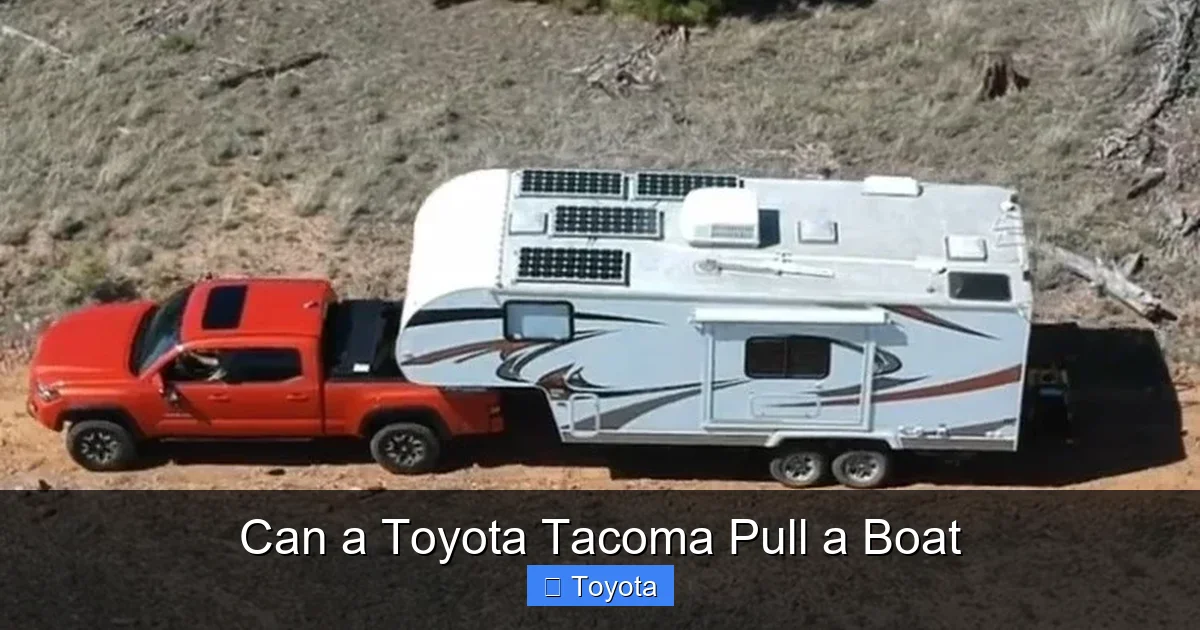
Visual guide about Can a Toyota Tacoma Pull a Boat
Image source: movrify.com
Now that you know your Tacoma’s towing limits, let’s talk about what kinds of boats it can realistically handle. The key is matching your boat’s total weight—including the trailer, motor, fuel, and gear—to your truck’s capacity.
Small Fishing Boats (Under 16 Feet)
These are the easiest for a Tacoma to tow. A 14-foot aluminum fishing boat with a 25-horsepower outboard motor might weigh around 1,200 pounds. Add a lightweight trailer (400–600 pounds), and you’re looking at a total of about 1,800–2,000 pounds. Even a 4-cylinder Tacoma can handle this with ease.
Popular examples include the Lund 1400 Fury, Tracker Topper 140, or a used Jon boat. These are perfect for solo fishing trips or small lakes where maneuverability matters.
Pontoon Boats (16–20 Feet)
Pontoon boats are heavier than fishing boats but still within reach of a well-equipped Tacoma. A 18-foot pontoon with a 60-horsepower motor and a tandem-axle trailer might weigh 3,500–4,500 pounds. This is right at the upper limit for a 4-cylinder Tacoma but well within range for a V6 model.
Brands like SunTracker, Bennington, or Harris FloteBote offer smaller models that work great with a Tacoma. Just make sure to account for extras like coolers, life jackets, and a full tank of gas—these can add hundreds of pounds.
Bass Boats and Ski Boats (16–20 Feet)
Fiberglass bass boats and ski boats are heavier due to their construction and larger engines. A 19-foot bass boat with a 150-horsepower motor and trailer can easily weigh 4,000–5,500 pounds. Again, this is manageable for a V6 Tacoma, especially with the towing package.
Models like the Ranger RT178 or Nitro Z17 are excellent choices. Just remember: fiberglass holds water and fuel, which adds weight. Always check the manufacturer’s dry weight and add 20–30% for fuel, gear, and water absorption.
What Boats Are Too Heavy?
Unfortunately, not all boats are suitable for a Tacoma. Anything over 6,000 pounds—like large cabin cruisers, houseboats, or 24-foot pontoons with dual engines—will exceed even the V6’s maximum capacity. These require a full-size truck like a Toyota Tundra, Ford F-150, or Ram 1500.
Also, be cautious with older, heavier trailers. Steel trailers can weigh significantly more than aluminum ones. A rusty, outdated trailer might add 1,000+ pounds you didn’t account for.
Essential Towing Equipment for Your Tacoma
Visual guide about Can a Toyota Tacoma Pull a Boat
Image source: rvandplaya.com
Having the right truck and boat is only half the battle. The other half is having the proper towing equipment. Without it, even a capable Tacoma can become unstable or unsafe on the road.
Hitch and Receiver
Your Tacoma needs a Class III or Class IV hitch receiver to safely tow a boat. Class III hitches handle up to 6,000 pounds, while Class IV can manage up to 10,000 pounds. Since the Tacoma’s max is 6,800 pounds, a Class IV is ideal for headroom and safety.
Make sure the hitch is properly rated for both tongue weight (typically 10–15% of total trailer weight) and gross trailer weight. For example, a 5,000-pound boat needs a hitch rated for at least 500–750 pounds of tongue weight.
Weight Distribution Hitch
For heavier loads (over 5,000 pounds), a weight distribution hitch is highly recommended. This system uses spring bars to redistribute the trailer’s weight across all four tires of the truck, improving stability and braking.
Without it, the rear of your Tacoma can sag, causing poor steering, reduced headlights visibility, and increased risk of trailer sway—especially in windy conditions or when passing large trucks.
Brake Controller
If your trailer has electric brakes (most tandem-axle trailers do), you’ll need a brake controller inside your cab. This device lets you manually activate the trailer brakes and adjust their sensitivity.
Toyota doesn’t include a brake controller by default, even with the towing package. You’ll need to install one—popular options include the Tekonsha P3 or the Redarc Tow-Pro. Installation is straightforward and usually takes under an hour.
Sway Control
Trailer sway is one of the most dangerous towing issues. It happens when the trailer starts fishtailing behind the truck, often due to wind, uneven roads, or improper loading.
Sway control devices—either built into the weight distribution hitch or added separately—help prevent this. They use friction or hydraulic resistance to keep the trailer in line. Always use sway control when towing over 4,000 pounds.
Safety Chains and Breakaway System
Never skip the basics. Always cross your safety chains under the trailer tongue to catch it if the hitch fails. And if your trailer has brakes, install a breakaway system—a battery-powered brake activator that engages if the trailer detaches.
These small details can prevent a major accident.
Driving Tips for Towing a Boat with a Tacoma
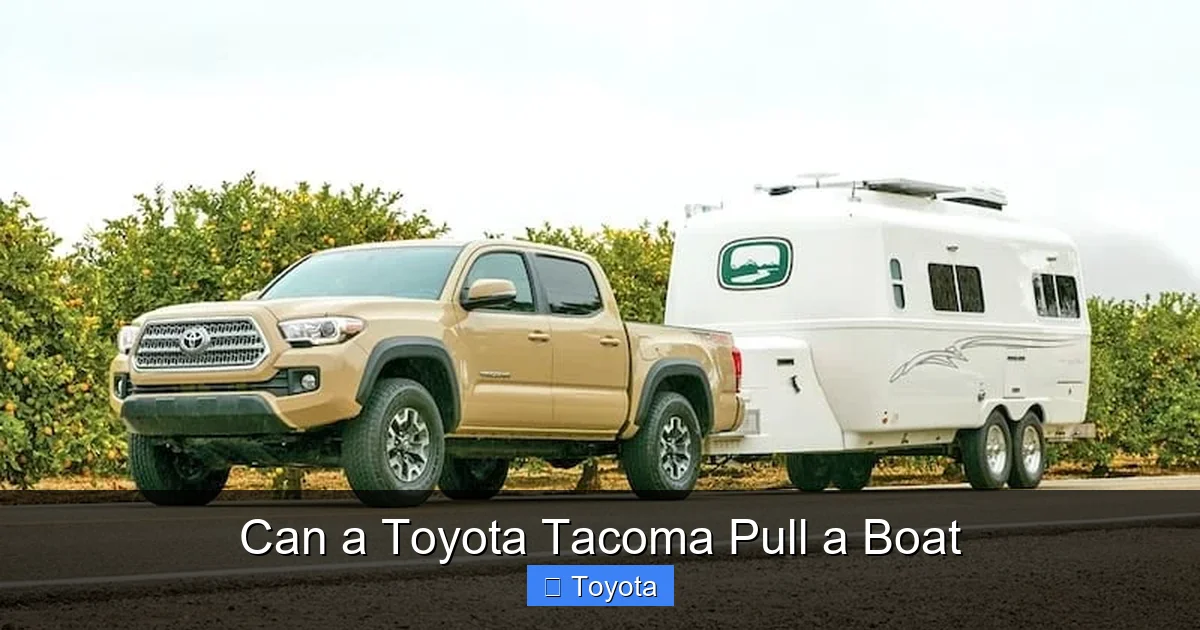
Visual guide about Can a Toyota Tacoma Pull a Boat
Image source: camperfront.com
Towing changes how your Tacoma drives. It’s heavier, slower to accelerate, and harder to stop. Here’s how to stay safe on the road.
Pre-Trip Inspection
Before you leave, do a full walk-around:
– Check tire pressure on both truck and trailer.
– Inspect lights (brake, turn, reverse).
– Ensure the hitch is secure and the coupler is locked.
– Verify the boat is tied down properly—use transom straps, not just the winch.
– Confirm the trailer brakes are working (test with the brake controller).
Loading the Trailer Correctly
Improper loading causes sway and poor handling. Follow the 60/40 rule: 60% of the boat’s weight should be in front of the trailer axles, 40% behind. This ensures proper tongue weight and stability.
Don’t overload the front—it can lift the truck’s rear tires. Don’t overload the back—it causes sway.
Driving Techniques
– Accelerate and brake slowly. Sudden movements increase sway risk.
– Allow extra following distance—up to 6 seconds behind the vehicle in front.
– Use lower gears when going downhill to avoid overheating the brakes.
– Avoid sudden lane changes. Make wide turns to prevent the trailer from cutting corners.
Launching and Loading
At the boat ramp, preparation is key:
– Back down slowly and straight.
– Use a spotter if possible.
– Don’t submerge the truck’s exhaust—it can cause backpressure and stall the engine.
– When loading, winch the boat up evenly and secure it before driving away.
Maintenance Tips for Towing with Your Tacoma
Towing puts extra strain on your truck. Regular maintenance ensures it stays reliable and safe.
Transmission and Cooling Systems
Towing generates heat. Make sure your transmission fluid is clean and at the right level. If you tow frequently, consider a transmission cooler—even if you have the factory package.
Also, check the engine coolant and radiator. Overheating can occur when climbing hills with a heavy load.
Brake Inspection
Towing wears out brakes faster. Have them inspected every 10,000 miles or after a long towing trip. Consider upgrading to heavy-duty brake pads if you tow often.
Tire Care
Underinflated tires overheat and can blow out. Check tire pressure weekly, especially before long trips. Use a quality tire pressure monitoring system (TPMS) for peace of mind.
Suspension Upgrades
If your Tacoma sags when hitched, consider upgrading the rear suspension. Options include:
– Heavy-duty leaf springs
– Air helper bags (like Firestone Ride-Rite)
– Upgraded shocks
These improve ride quality and help maintain proper alignment.
Real-World Examples: Tacoma Owners Who Tow Boats
Still not sure? Let’s look at real-world examples.
Example 1: Weekend Fisherman
Mike from Colorado owns a 2021 Tacoma TRD Off-Road with the V6 and towing package. He tows a 16-foot aluminum fishing boat with a 50-horsepower motor. Total weight: 2,800 pounds. He uses a Class IV hitch and a brake controller. “It handles like a dream,” he says. “Even on mountain passes, I feel confident.”
Example 2: Family Pontoon Enthusiast
Sarah from Texas has a 2023 Tacoma Limited with 4WD. She tows a 19-foot SunTracker pontoon with a 90-horsepower motor. Total weight: 4,700 pounds. She uses a weight distribution hitch and sway control. “We take it to the lake every weekend,” she says. “It’s smooth, stable, and never feels overloaded.”
Example 3: Overloader Gone Wrong
Jake from Michigan tried to tow a 22-foot fiberglass cruiser with his 4-cylinder Tacoma. Total weight: 6,200 pounds—well over the 3,500-pound limit. Halfway to the lake, his transmission overheated, and he had to call a tow truck. “I learned the hard way,” he admits. “Now I rent a bigger truck for big boats.”
These stories show that success comes from matching your Tacoma’s capabilities to your needs.
Conclusion
So, can a Toyota Tacoma pull a boat? The answer is a confident **yes**—if you do it right. With the proper model, equipment, and preparation, the Tacoma is more than capable of handling small to mid-sized boats for fishing, cruising, or water sports.
The key is understanding your truck’s towing capacity, calculating your boat’s total weight, and investing in the right towing gear. Don’t cut corners on safety. Use a quality hitch, brake controller, and weight distribution system. And always maintain your Tacoma to handle the extra strain.
Whether you’re launching a 14-foot Jon boat on a quiet pond or a 20-foot pontoon on a busy lake, your Tacoma can be a reliable partner—just respect its limits, and it will serve you well for years to come.
Frequently Asked Questions
What is the maximum boat weight a Toyota Tacoma can tow?
The maximum towing capacity for a Toyota Tacoma ranges from 3,500 to 6,800 pounds, depending on the model year, engine, and configuration. A V6-equipped Tacoma with the towing package can safely handle boats up to 6,000 pounds, including the trailer, motor, and gear.
Can a 4-cylinder Tacoma tow a boat?
Yes, but only very small boats. The 4-cylinder Tacoma can tow up to 3,500 pounds, which is suitable for lightweight aluminum fishing boats under 16 feet with a small motor and trailer. It’s not recommended for larger or heavier boats.
Do I need a special hitch to tow a boat with a Tacoma?
Yes. You’ll need at least a Class III hitch, but a Class IV is better for heavier loads. For boats over 5,000 pounds, a weight distribution hitch and sway control are strongly recommended for safety and stability.
Can I tow a pontoon boat with a Toyota Tacoma?
Yes, as long as the total weight (boat, motor, trailer, and gear) is within your Tacoma’s towing capacity. Most 16- to 20-foot pontoon boats can be towed by a V6 Tacoma with the proper equipment.
What happens if I overload my Tacoma when towing a boat?
Overloading can cause brake failure, transmission overheating, poor handling, and increased risk of accidents. It can also void your warranty and lead to costly repairs. Always stay within the manufacturer’s towing limits.
Should I upgrade my Tacoma’s suspension for towing?
If your truck sags or feels unstable when hitched, consider upgrading the rear suspension with air helper bags or heavy-duty leaf springs. This improves ride quality, maintains proper alignment, and enhances safety when towing heavy loads.
