
How Much Does a Volkswagen Beetle Weigh?

The Volkswagen Beetle’s weight varies by model year, engine type, and body style—ranging from about 1,800 to 3,200 pounds. Understanding its weight helps with fuel efficiency, performance, and towing considerations.
Key Takeaways
- Classic Beetles (1940s–2003): Weigh between 1,800 and 2,200 pounds, with air-cooled engines and lightweight steel bodies.
- New Beetle (1998–2011): Heavier due to modern safety features and water-cooled engines, averaging 2,800 to 3,100 pounds.
- Final Generation Beetle (2012–2019): Built on the Golf platform, these models weigh 3,000 to 3,200 pounds with added tech and comfort features.
- Weight impacts fuel economy: Lighter models like the original Beetle get better gas mileage than heavier modern versions.
- Towing and handling: Heavier Beetles offer more stability but may reduce agility and increase braking distance.
- Curb weight vs. GVWR: Always check both numbers—curb weight is the car’s base weight, while GVWR includes passengers and cargo.
- Restoration tip: Replacing parts with lightweight alternatives can reduce weight and improve performance in classic models.
📑 Table of Contents
- How Much Does a Volkswagen Beetle Weigh? A Complete Guide
- Why Does the Weight of a Volkswagen Beetle Matter?
- The Evolution of the Beetle: From Lightweight Classic to Modern Cruiser
- Breaking Down the Numbers: Curb Weight vs. GVWR
- How Weight Affects Performance and Efficiency
- Practical Tips for Beetle Owners and Buyers
- Conclusion: The Weight of a Legend
How Much Does a Volkswagen Beetle Weigh? A Complete Guide
If you’ve ever stood next to a Volkswagen Beetle—whether it’s the iconic rounded shape of a 1967 model or the sleek redesign of a 2018 edition—you might have wondered: just how much does this little car actually weigh? The answer isn’t as simple as one number, because the Beetle has evolved dramatically over its 80-year history. From its humble beginnings as a “people’s car” in post-war Germany to its status as a global pop culture icon, the Beetle’s weight has changed with every generation, reflecting advances in engineering, safety standards, and consumer expectations.
Understanding the weight of a Volkswagen Beetle isn’t just a fun fact—it’s useful information for anyone buying, restoring, or driving one. Weight affects everything from fuel efficiency and acceleration to handling and braking. Whether you’re comparing a vintage air-cooled Beetle to a modern turbocharged model, or planning to tow it behind an RV, knowing the numbers helps you make smarter decisions. In this guide, we’ll break down the weight of every major Beetle generation, explain what factors influence it, and show you how to find the exact specs for your specific model.
Why Does the Weight of a Volkswagen Beetle Matter?
Visual guide about How Much Does a Volkswagen Beetle Weigh?
Image source: trucksauthority.com
You might think weight is just a number on a spec sheet, but in the automotive world, it’s one of the most important performance indicators. A car’s weight influences how it drives, how much it costs to operate, and even how safe it is in a crash. For the Beetle, which has always been marketed as an affordable, efficient, and fun-to-drive vehicle, weight has played a central role in its design philosophy.
Let’s start with fuel economy. Heavier cars require more energy to move, which means they burn more fuel. The original Beetle, with its lightweight body and small engine, was a champion of efficiency—getting up to 30 miles per gallon in some models. In contrast, the heavier New Beetle and Final Generation models, while more powerful and comfortable, typically achieve 25–28 mpg. That difference might seem small, but over thousands of miles, it adds up in fuel costs.
Then there’s handling. Lighter cars like the classic Beetle are more nimble and responsive, especially in tight city driving. They accelerate faster relative to their engine size and can change direction quickly. But they also have less mass to absorb impact in a collision, which is why modern safety standards require heavier, more reinforced structures. The trade-off? Better crash protection at the cost of agility.
Weight also affects towing and payload capacity. If you’re planning to tow your Beetle behind a motorhome or carry heavy cargo, you need to know its Gross Vehicle Weight Rating (GVWR)—the maximum safe weight including passengers, luggage, and fuel. Exceeding this limit can strain the suspension, brakes, and transmission, leading to mechanical failure or unsafe driving conditions.
Finally, weight plays a role in restoration and customization. Enthusiasts who restore vintage Beetles often look for ways to reduce weight—swapping steel bumpers for fiberglass, using lightweight seats, or removing unnecessary trim. Every pound saved can improve performance, especially in older models with modest horsepower.
The Evolution of the Beetle: From Lightweight Classic to Modern Cruiser
Visual guide about How Much Does a Volkswagen Beetle Weigh?
Image source: i.ytimg.com
To truly understand how much a Volkswagen Beetle weighs, you need to look at its evolution across three major eras: the Original Beetle, the New Beetle, and the Final Generation Beetle. Each represents a different philosophy in design, technology, and target market—and each comes with its own weight profile.
The Original Beetle (1938–2003): The Lightweight Pioneer
The story of the Volkswagen Beetle begins in the late 1930s, when Ferdinand Porsche was commissioned to design an affordable car for the German people. The result was the Type 1, later known simply as the Beetle. Produced from 1938 to 2003 (with the last models rolling off the line in Mexico), the original Beetle was built for simplicity, durability, and low cost.
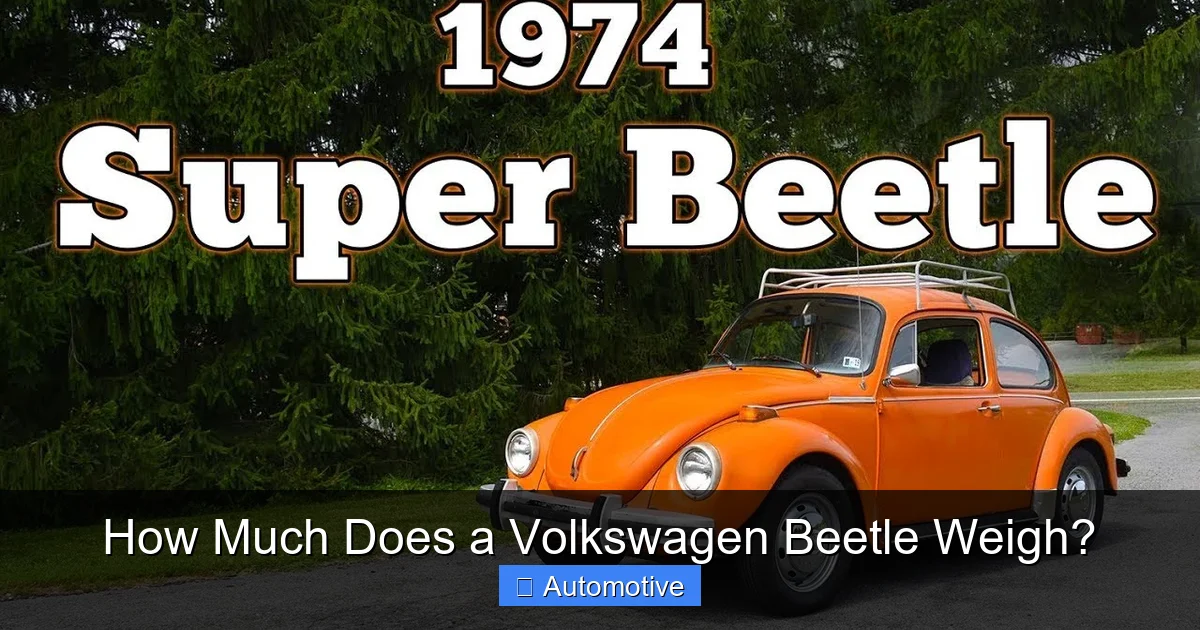
One of its defining features was its lightweight construction. Early models used a unibody steel frame with minimal sound insulation, thin glass, and a rear-mounted, air-cooled engine. This design kept the weight down—most models from the 1950s and 1960s weighed between 1,800 and 2,000 pounds. For example, a 1967 Beetle with a 1.2L engine tips the scales at about 1,850 pounds.
As the years went on, the Beetle gained a few pounds due to added features like heaters, improved suspension, and emissions controls. By the 1990s, the Mexican-built Beetles (often called “Vochos”) weighed closer to 2,200 pounds, especially with larger engines like the 1.6L or 1.8L variants. Still, compared to modern cars, these were featherweights.
The original Beetle’s light weight contributed to its legendary fuel efficiency and low maintenance costs. It also made it easy to work on—many owners could perform basic repairs in their driveway with minimal tools. However, the lack of crumple zones and advanced safety features meant it wasn’t as safe in crashes as today’s vehicles.
The New Beetle (1998–2011): A Nostalgic Heavier Ride
In 1998, Volkswagen revived the Beetle name with the New Beetle—a modern reinterpretation of the classic design. Built on the Golf platform and powered by water-cooled engines, the New Beetle was a radical departure from its predecessor. It featured front-wheel drive, a more spacious interior, and modern amenities like air conditioning, power windows, and advanced audio systems.
With all these upgrades came added weight. The New Beetle typically weighs between 2,800 and 3,100 pounds, depending on the trim and engine. For example, a 1999 New Beetle with a 2.0L inline-four engine has a curb weight of about 2,850 pounds. The turbocharged 1.8T model from 2002 weighs around 2,950 pounds, while the sportier RSi version (a rare limited edition) pushes the scale to nearly 3,100 pounds.
The increase in weight was due to several factors: a stronger safety cage, more sound insulation, a heavier transmission, and additional electronics. While this made the New Beetle more comfortable and safer, it also reduced its agility and fuel economy compared to the original. Still, the New Beetle remained popular for its retro charm and practicality as a daily driver.
The Final Generation Beetle (2012–2019): The Modern Cruiser
The last iteration of the Beetle, produced from 2012 to 2019, was based on the same platform as the Volkswagen Golf and Jetta. This generation featured a more aggressive front end, a lower stance, and a wider body, giving it a sportier look. It also came with more powerful engines, including a 2.0L turbocharged option that delivered over 200 horsepower.
With these improvements came even more weight. The Final Generation Beetle typically weighs between 3,000 and 3,200 pounds. A 2015 Beetle with the base 2.0L engine has a curb weight of about 3,050 pounds, while the turbocharged TDI diesel model weighs around 3,150 pounds. The high-performance Beetle R, though never officially sold in the U.S., weighed close to 3,200 pounds.
This generation also introduced more advanced safety features, including electronic stability control, multiple airbags, and collision avoidance systems—all of which add mass. The result is a car that feels more substantial and secure on the road, but less nimble than its ancestors.
Breaking Down the Numbers: Curb Weight vs. GVWR
Visual guide about How Much Does a Volkswagen Beetle Weigh?
Image source: thesamba.com
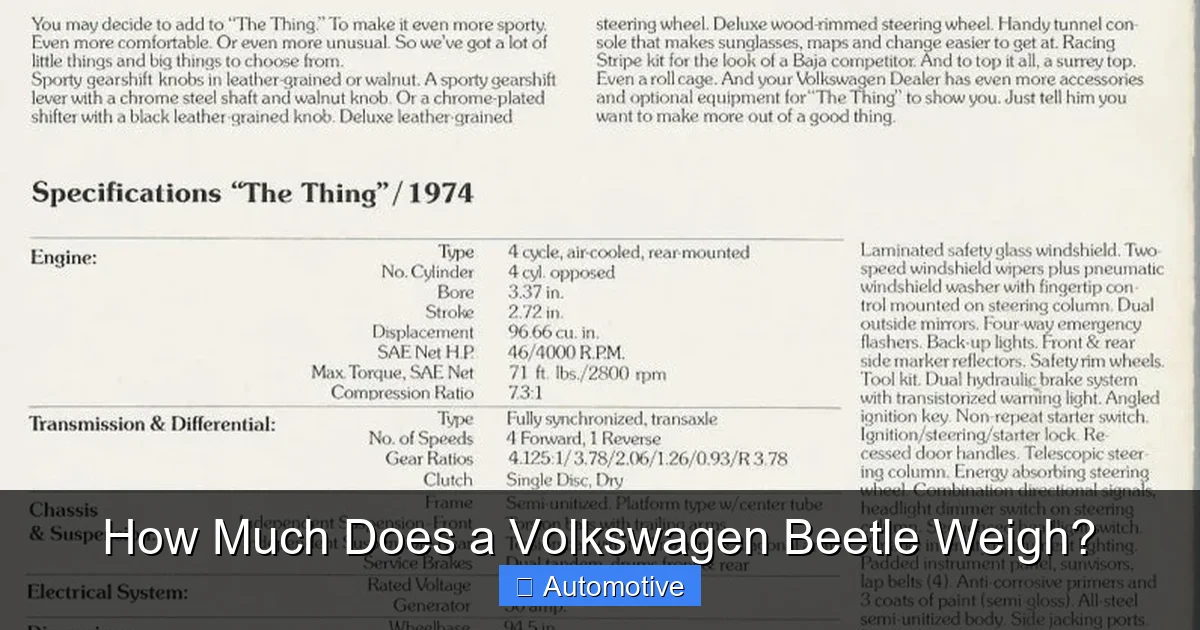
When discussing how much a Volkswagen Beetle weighs, it’s important to distinguish between two key terms: curb weight and Gross Vehicle Weight Rating (GVWR).
What Is Curb Weight?
Curb weight is the total weight of the vehicle with all standard equipment, a full tank of fuel, and all fluids (oil, coolant, etc.), but without passengers or cargo. It’s the weight you’d see if you drove the car onto a scale at the factory. This number is useful for comparing different models and understanding baseline performance.
For example:
– 1967 Beetle: ~1,850 lbs
– 2002 New Beetle 1.8T: ~2,950 lbs
– 2015 Beetle 2.0L: ~3,050 lbs
What Is GVWR?
GVWR stands for Gross Vehicle Weight Rating. It’s the maximum safe weight the vehicle can carry, including the driver, passengers, luggage, and fuel. Exceeding GVWR can damage the suspension, brakes, and tires, and may void your insurance in the event of an accident.
The GVWR for most Beetles is typically 500 to 800 pounds higher than the curb weight. For instance, a 2015 Beetle with a curb weight of 3,050 pounds might have a GVWR of 3,800 pounds. That means you can safely carry about 750 pounds of people and gear.
Always check your owner’s manual or the sticker on the driver’s door jamb for the exact GVWR. Never assume—overloading a Beetle, especially an older model, can be dangerous.
How Weight Affects Performance and Efficiency
Now that we’ve covered the numbers, let’s talk about what they mean in real-world driving.
Acceleration and Power-to-Weight Ratio
One of the most telling metrics is the power-to-weight ratio—how much horsepower the engine produces per pound of vehicle weight. A higher ratio means better acceleration.
For example:
– 1967 Beetle (50 hp, 1,850 lbs): ~0.027 hp/lb
– 2002 New Beetle 1.8T (150 hp, 2,950 lbs): ~0.051 hp/lb
– 2015 Beetle 2.0T (210 hp, 3,050 lbs): ~0.069 hp/lb
As you can see, even though the modern Beetle is heavier, its much more powerful engine gives it a significant advantage in acceleration. The 2015 model can go from 0 to 60 mph in about 6.5 seconds, while the 1967 model takes over 20 seconds.
Fuel Economy and Emissions
Weight directly impacts fuel consumption. Heavier cars require more energy to move, which means more fuel burned and higher emissions.
– Classic Beetle: 25–30 mpg
– New Beetle: 22–28 mpg
– Final Generation Beetle: 24–30 mpg (diesel models can reach 35+ mpg)
Interestingly, the Final Generation Beetle’s diesel version (TDI) achieves excellent fuel economy despite its weight, thanks to the efficiency of diesel engines. However, gasoline models trade some efficiency for performance and comfort.
Handling and Ride Quality
Lighter cars like the original Beetle have a more responsive feel, especially in city driving. They’re easier to park and maneuver in tight spaces. However, they can feel less stable at high speeds or in windy conditions due to their low mass.
Heavier Beetles, especially the Final Generation, offer a smoother, more planted ride. They handle better on highways and feel more secure in crosswinds. But they require longer braking distances and may feel less agile in tight corners.
Practical Tips for Beetle Owners and Buyers
Whether you’re buying a Beetle, restoring one, or just curious about its specs, here are some practical tips based on weight considerations.
Choosing the Right Model for Your Needs
If fuel economy and low maintenance are your priorities, a classic or early New Beetle might be ideal. These models are lighter, simpler, and cheaper to insure and repair.
If you want modern safety features, comfort, and performance, go for a Final Generation Beetle. Just be prepared for higher fuel and insurance costs.
Restoration and Weight Reduction
Classic Beetle enthusiasts often look for ways to reduce weight. Swapping steel bumpers for fiberglass, using lightweight seats, or removing rear seats can shave off 50–100 pounds. This improves acceleration and handling, especially in models with small engines.
However, avoid removing structural components or safety features. The Beetle’s unibody design relies on its frame for strength—cutting or weakening it can compromise safety.
Towing and Transporting Your Beetle
If you plan to tow your Beetle behind an RV or transport it on a trailer, know its weight and dimensions. Most Beetles can be towed flat (all four wheels on the ground) with a proper tow bar, but always check the owner’s manual.
For heavier models (over 3,000 lbs), use a trailer with adequate capacity and ensure your towing vehicle can handle the load.
Conclusion: The Weight of a Legend
So, how much does a Volkswagen Beetle weigh? The answer depends on which Beetle you’re talking about. From the featherlight 1,800-pound classic to the robust 3,200-pound modern cruiser, the Beetle’s weight tells the story of its evolution—from a utilitarian people’s car to a stylish, tech-savvy icon.
Understanding this weight isn’t just about numbers—it’s about appreciating how design, technology, and safety have shaped one of the most beloved cars in history. Whether you’re restoring a vintage model, driving a New Beetle, or considering a Final Generation for daily use, knowing the weight helps you get the most out of your Beetle experience.
And who knows? Maybe one day, with advances in lightweight materials and electric powertrains, the Beetle will return—lighter, cleaner, and just as charming as ever.
Frequently Asked Questions
How much does a 1967 Volkswagen Beetle weigh?
A 1967 Volkswagen Beetle typically weighs around 1,850 pounds. This includes the standard 1.2L air-cooled engine, steel body, and minimal interior features. It’s one of the lightest Beetles ever made.
What is the heaviest Volkswagen Beetle model?
The heaviest Beetles are from the Final Generation (2012–2019), especially the turbocharged or diesel models, which can weigh up to 3,200 pounds. These include modern safety features, electronics, and a more robust chassis.
Does the Beetle’s weight affect its fuel economy?
Yes, weight directly impacts fuel economy. Lighter Beetles like the original model get better gas mileage (25–30 mpg), while heavier modern versions average 24–28 mpg due to added mass and features.
Can I reduce the weight of my classic Beetle?
Yes, you can reduce weight by using lightweight parts like fiberglass bumpers, aluminum wheels, or racing seats. However, avoid removing structural components to maintain safety and integrity.
What is the GVWR of a 2015 Volkswagen Beetle?
The GVWR of a 2015 Beetle is typically around 3,800 pounds. This includes the curb weight (~3,050 lbs) plus passengers, cargo, and fuel. Always check the door jamb sticker for exact numbers.
Is the New Beetle heavier than the original?
Yes, the New Beetle (1998–2011) is significantly heavier, weighing 2,800 to 3,100 pounds compared to the original’s 1,800–2,200 pounds. This is due to modern safety systems, water-cooled engines, and added comfort features.