
How Much Freon Does a 2005 Dodge Ram Take

Knowing how much freon a 2005 Dodge Ram takes is essential for maintaining a cool, comfortable cabin during hot weather. This guide breaks down the exact refrigerant capacity, system types, and step-by-step recharging advice to help you DIY safely and effectively.
If you’re driving a 2005 Dodge Ram, especially during the sweltering summer months, having a properly functioning air conditioning system isn’t just a luxury—it’s a necessity. Whether you’re hauling cargo, towing a trailer, or just commuting to work, a cool cabin makes all the difference. But what happens when your AC starts blowing warm air or seems weaker than usual? One of the most common culprits is low refrigerant, often referred to as “freon.” And if you’re wondering, “How much freon does a 2005 Dodge Ram take?”—you’re in the right place.
Understanding your truck’s AC system and its refrigerant needs isn’t just about comfort. It’s also about safety, efficiency, and preventing costly repairs down the road. The 2005 Dodge Ram, part of the second generation of the popular Ram pickup series, was built with reliable climate control systems. However, like any mechanical component, the AC system requires periodic maintenance. Over time, refrigerant can slowly leak out due to worn seals, damaged hoses, or faulty connections. When levels drop below optimal, your AC won’t cool effectively—even if the compressor is running.
In this comprehensive guide, we’ll walk you through everything you need to know about the refrigerant capacity of your 2005 Dodge Ram. We’ll cover the exact amount of freon your system holds, how to identify low refrigerant levels, the tools you’ll need for a DIY recharge, and when it’s best to leave the job to a professional. Whether you’re a seasoned DIYer or a first-time truck owner, this article will equip you with practical knowledge to keep your Ram’s AC running strong all season long.
Key Takeaways
- Refrigerant Type: The 2005 Dodge Ram uses R-134a refrigerant, not the older R-12 or newer R-1234yf.
- System Capacity: Most models require between 22 to 28 ounces (1.375 to 1.75 pounds) of R-134a, depending on engine size and AC configuration.
- V8 vs. V6 Differences: V8-equipped Rams typically need slightly more freon than V6 models due to larger condensers and compressors.
- DIY Recharge Risks: Overcharging can damage the AC system—always use a pressure gauge and follow manufacturer guidelines.
- Professional Help Recommended: If the system has leaks or hasn’t been serviced in years, consult a certified technician.
- Signs of Low Freon: Weak airflow, warm air from vents, or hissing noises may indicate low refrigerant levels.
- Environmental Responsibility: Never release R-134a into the atmosphere—it’s illegal and harmful to the environment.
📑 Table of Contents
Understanding Your 2005 Dodge Ram’s AC System
Before diving into how much freon your 2005 Dodge Ram takes, it’s important to understand how the air conditioning system works. The AC system in your Ram is a closed-loop circuit that relies on refrigerant to absorb heat from inside the cabin and release it outside. This process involves several key components: the compressor, condenser, expansion valve (or orifice tube), evaporator, and receiver-drier (or accumulator).
The compressor, driven by a belt connected to the engine, pressurizes the refrigerant gas. This high-pressure gas then flows to the condenser, usually located in front of the radiator, where it cools down and turns into a liquid. From there, the liquid refrigerant passes through the expansion valve, which regulates its flow into the evaporator. Inside the evaporator, the refrigerant expands and evaporates, absorbing heat from the air passing over it. This cooled air is then blown into the cabin by the blower fan. Finally, the low-pressure gas returns to the compressor to start the cycle again.
The receiver-drier (found in systems with an expansion valve) or accumulator (in systems with an orifice tube) plays a crucial role in filtering moisture and debris from the refrigerant. Moisture is particularly harmful because it can mix with refrigerant to form acidic compounds that corrode internal components. That’s why it’s essential to replace the receiver-drier or accumulator whenever the system is opened for service.
One of the most common misconceptions about AC systems is that they “use up” refrigerant like fuel. In reality, refrigerant doesn’t get consumed—it circulates continuously. If your AC is low on freon, it’s almost always due to a leak somewhere in the system. Common leak points include O-rings, compressor seals, hose connections, and the condenser. Even small leaks can lead to significant refrigerant loss over time, especially in older vehicles like the 2005 Dodge Ram.
Why Refrigerant Type Matters
Not all refrigerants are created equal, and using the wrong type can damage your AC system or even void your warranty. The 2005 Dodge Ram was factory-filled with R-134a, a hydrofluorocarbon (HFC) refrigerant that replaced the older R-12 (Freon) due to environmental concerns. R-12 was phased out in the 1990s because it contained chlorine, which contributes to ozone depletion.
R-134a is chlorine-free and safer for the ozone layer, but it’s still a potent greenhouse gas. That’s why it’s illegal to vent R-134a into the atmosphere in most countries, including the United States. If you’re recharging your system, always use a recovery machine or take your vehicle to a certified technician who can handle refrigerant properly.
Some aftermarket “drop-in” replacements claim to work with R-134a systems, but they often contain additives or different chemical compositions that can cause compatibility issues. Stick with pure R-134a from a reputable brand to avoid compressor failure or reduced cooling performance.
System Variations by Engine and Trim
The 2005 Dodge Ram was available with several engine options, including the 3.7L V6, 4.7L V8, and 5.7L Hemi V8. While the basic AC system design is similar across all models, the refrigerant capacity can vary slightly depending on the engine size and optional equipment.
For example, trucks with the larger V8 engines often have bigger condensers and more robust compressors to handle the increased heat load, especially when towing or driving in hot climates. This means they may require a bit more refrigerant to achieve optimal performance. Additionally, some higher-trim models (like the Laramie or SLT+) may include rear AC units or dual-zone climate control, which can increase the total system capacity.
However, for the majority of 2005 Dodge Rams—especially those with standard front-only AC—the refrigerant charge falls within a narrow range. We’ll break down the exact numbers in the next section.
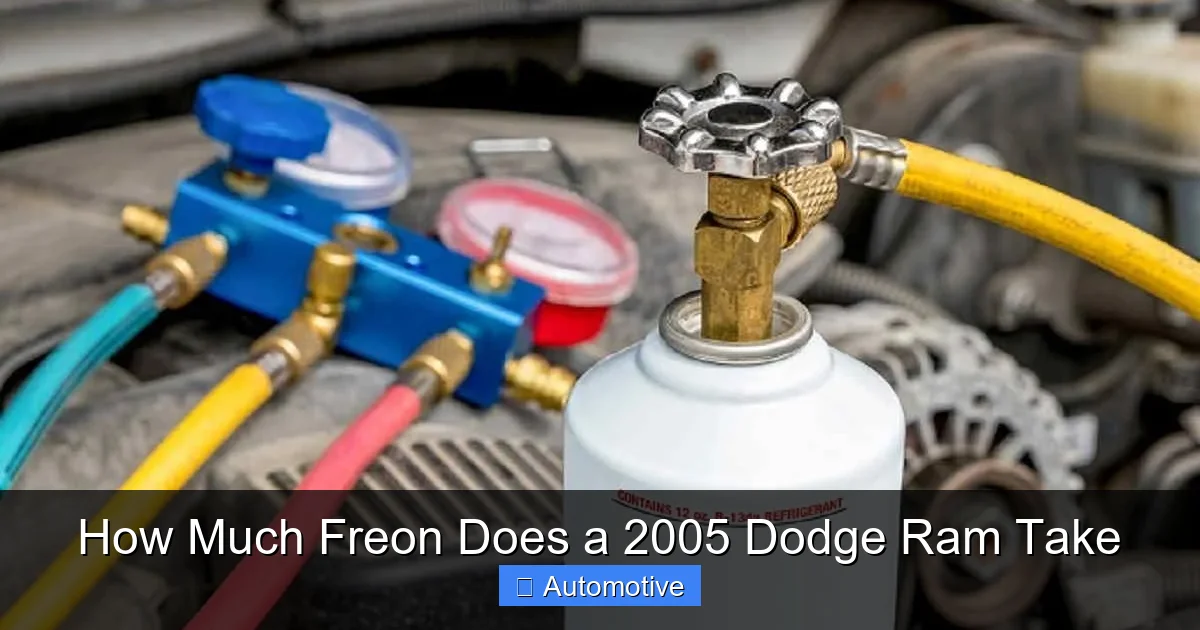
How Much Freon Does a 2005 Dodge Ram Take?

Visual guide about How Much Freon Does a 2005 Dodge Ram Take
Image source: vehiclerides.com
Now for the million-dollar question: How much freon does a 2005 Dodge Ram take? The answer isn’t one-size-fits-all, but it’s close. Most 2005 Dodge Rams with a standard front AC system require between **22 and 28 ounces** of R-134a refrigerant. That’s roughly **1.375 to 1.75 pounds**.
To put that in perspective, a typical can of R-134a contains 12 ounces. So, depending on your truck’s configuration, you’ll likely need one to two and a half cans to fully recharge the system. Here’s a more detailed breakdown:
– **3.7L V6 Models:** Typically require around 22 to 24 ounces (1.375 to 1.5 pounds).
– **4.7L V8 Models:** Usually need 24 to 26 ounces (1.5 to 1.625 pounds).
– **5.7L Hemi V8 Models:** Often require 26 to 28 ounces (1.625 to 1.75 pounds).
These figures are based on factory specifications and real-world testing by mechanics and DIY enthusiasts. Keep in mind that if your truck has a rear AC unit (common in crew cab models), the total capacity could increase by 6 to 8 ounces. Always check your owner’s manual or the under-hood emissions label for the exact specification.
Where to Find the Official Capacity
The most reliable source for your truck’s refrigerant capacity is the **under-hood emissions label**, usually located on the radiator support or near the firewall. This label lists critical information about your vehicle’s AC system, including the type of refrigerant (R-134a), the total charge in ounces or grams, and sometimes even the oil type and amount.
If you can’t find the label or it’s faded, consult your owner’s manual. Dodge typically includes AC system specifications in the “Maintenance” or “Specifications” section. Alternatively, you can search online using your VIN (Vehicle Identification Number) to find a digital copy of the manual or access forums where other Ram owners have shared their findings.
Why Precision Matters
Adding too little refrigerant means your AC won’t cool effectively. But adding too much can be just as bad—or worse. Overcharging the system increases pressure, which can strain the compressor, damage seals, and even cause the AC to shut down as a safety precaution.
Modern AC systems are designed to operate within a specific pressure range. When refrigerant levels are correct, the low-side pressure should be between 25 and 45 psi, and the high-side pressure between 150 and 250 psi (depending on ambient temperature). These values can be monitored using a manifold gauge set.
If you’re recharging your system yourself, always use a recharge kit with a built-in pressure gauge. Stop adding refrigerant once the low-side pressure reaches the recommended range and the air from the vents is cold. Never rely solely on the number of cans—always verify with a gauge.
Signs Your 2005 Dodge Ram Needs a Freon Recharge
Visual guide about How Much Freon Does a 2005 Dodge Ram Take
Image source: harapanrakyat.com
Low refrigerant is one of the most common reasons your AC isn’t working properly. But how do you know if your 2005 Dodge Ram is low on freon? Here are the most telltale signs:
– **Warm Air from Vents:** If your AC is blowing air that’s only slightly cooler than outside, or if it starts cold and gradually warms up, low refrigerant could be the culprit.
– **Weak Airflow:** While this can also indicate a clogged cabin air filter or blower motor issue, reduced airflow combined with warm air often points to low freon.
– **Hissing or Bubbling Noises:** These sounds near the AC components may indicate a refrigerant leak.
– **AC Compressor Cycling Frequently:** The compressor may turn on and off rapidly if the system is low on refrigerant, as the pressure switches detect abnormal levels.
– **Ice on AC Components:** In rare cases, low refrigerant can cause the evaporator to freeze, leading to ice buildup on the coils or hoses.
It’s important to note that these symptoms can also be caused by other issues, such as a faulty compressor, clogged condenser, or electrical problems. That’s why a proper diagnosis is essential before adding refrigerant.
DIY Diagnosis Tips
Before you grab a can of R-134a, take a few minutes to inspect your system. Check for visible signs of leaks, such as oily residue around hose connections, the compressor, or the condenser. Use a UV dye kit (available at auto parts stores) to detect hidden leaks—just add the dye to the system, run the AC, and use a UV light to spot the glow.
You can also use a set of manifold gauges to check the system pressure. With the engine off, connect the low-side gauge to the service port (usually on the larger aluminum line near the firewall). If the pressure is below 25 psi, the system is likely low on refrigerant.
When Not to Recharge Yourself
If you suspect a major leak, compressor failure, or if the system has been completely empty for a long time, it’s best to consult a professional. Recharging a system with a large leak won’t solve the problem—it will just waste refrigerant and potentially damage components. A certified technician can perform a leak test, repair the issue, evacuate the system with a vacuum pump, and recharge it to the correct level.
How to Safely Recharge Your 2005 Dodge Ram’s AC System

Visual guide about How Much Freon Does a 2005 Dodge Ram Take
Image source: ww2.justanswer.com
If you’ve confirmed that your truck is low on freon and there’s no major leak, you can safely recharge the system at home with the right tools and precautions. Here’s a step-by-step guide:
Tools and Materials You’ll Need
– R-134a refrigerant (12-ounce cans)
– Recharge hose with built-in pressure gauge
– Safety glasses and gloves
– Owner’s manual or under-hood label for capacity reference
Step-by-Step Recharge Process
- Park on Level Ground: Ensure your truck is on a flat surface and the engine is off.
- Locate the Low-Side Service Port: It’s usually on the aluminum suction line near the firewall, marked with an “L” or colored blue. Remove the cap.
- Attach the Recharge Hose: Screw the hose onto the service port. Make sure the valve on the hose is closed.
- Start the Engine and Turn AC to Max: Set the temperature to cold, fan to high, and recirculation mode on.
- Open the Valve and Add Refrigerant: Slowly open the valve on the recharge hose. Hold the can upright to prevent liquid from entering the system. Watch the pressure gauge—stop when it reaches 30–40 psi on the low side.
- Monitor Vent Temperature: Use a thermometer to check the air coming from the center vent. It should be 35–45°F cooler than ambient temperature.
- Disconnect and Replace Cap: Close the valve, disconnect the hose, and replace the service port cap.
Safety and Environmental Tips
– Always wear safety glasses and gloves—refrigerant can cause frostbite on contact.
– Never shake the can vigorously or invert it while charging.
– Work in a well-ventilated area.
– Dispose of empty cans according to local regulations.
Common Mistakes to Avoid
Even experienced DIYers can make mistakes when recharging an AC system. Here are some common pitfalls to watch out for:
– **Overcharging the System:** This is the #1 mistake. Always use a gauge and stop when pressures are in the correct range.
– **Using the Wrong Refrigerant:** Only use R-134a. Mixing refrigerants can cause chemical reactions and system failure.
– **Ignoring Leaks:** Adding freon without fixing a leak is a temporary fix. The system will lose refrigerant again.
– **Not Running the Engine:** The compressor won’t engage unless the engine is running and the AC is on.
– **Charging on the High Side:** Always charge through the low-side port. Charging on the high side can damage the compressor.
When to Call a Professional
While DIY recharging is possible for minor top-offs, there are times when you should leave it to the experts:
– The system has been empty for more than a few days.
– You suspect a major leak or compressor failure.
– The AC still doesn’t cool after recharging.
– You’re uncomfortable working with refrigerant.
A certified technician has the tools to evacuate the system, test for leaks, and recharge it to factory specifications. They can also check the compressor oil level and replace the receiver-drier if needed.
Maintaining Your AC System for Longevity
To keep your 2005 Dodge Ram’s AC running smoothly, follow these maintenance tips:
– Run the AC for 10 minutes every week, even in winter, to keep seals lubricated.
– Replace the cabin air filter every 12,000 to 15,000 miles.
– Inspect hoses and connections annually for cracks or leaks.
– Have the system professionally serviced every 2–3 years.
Conclusion
Knowing how much freon a 2005 Dodge Ram takes—typically 22 to 28 ounces of R-134a—is the first step to maintaining a cool, comfortable cabin. Whether you’re tackling a DIY recharge or scheduling a professional service, understanding your truck’s AC system helps you make informed decisions and avoid costly mistakes. With the right tools, knowledge, and care, your Ram’s air conditioning will keep you cool for many miles to come.
Frequently Asked Questions
Can I use R-12 refrigerant in my 2005 Dodge Ram?
No, the 2005 Dodge Ram is designed for R-134a refrigerant. Using R-12 is not only incompatible with the system but also illegal in most places due to environmental regulations.
How often should I recharge the AC in my 2005 Dodge Ram?
You shouldn’t need to recharge the AC regularly if there are no leaks. Most systems hold refrigerant for 5–10 years. Recharge only when performance declines and low pressure is confirmed.
Is it safe to recharge my AC system myself?
Yes, if you follow safety guidelines and use the correct tools. However, if you suspect a leak or system damage, consult a professional to avoid further issues.
Why is my AC blowing warm air even after recharging?
This could indicate a faulty compressor, clogged condenser, or electrical issue. Low refrigerant is just one possible cause—have the system inspected if problems persist.
Can I mix different brands of R-134a?
Yes, as long as they are pure R-134a with no additives. However, it’s best to use the same brand for consistency and to avoid potential chemical interactions.
What happens if I overcharge the AC system?
Overcharging increases pressure, which can damage the compressor, blow seals, or trigger safety shutdowns. Always use a pressure gauge and stop when readings are in the normal range.