
How Much Does a Toyota Tundra Weigh?

The Toyota Tundra’s weight varies significantly based on model year, cab configuration, bed length, and trim level—ranging from about 5,000 to over 6,000 pounds. Understanding its curb weight, gross vehicle weight rating (GVWR), and payload capacity helps you make informed decisions about towing, fuel efficiency, and overall performance.
If you’re eyeing a Toyota Tundra—or already own one—you’ve probably wondered: *How much does a Toyota Tundra weigh?* It’s not just a trivia question. Knowing your truck’s weight affects everything from fuel efficiency and insurance costs to towing ability and even where you can legally park it. Whether you’re hauling lumber, towing a camper, or just commuting daily, understanding the Tundra’s weight profile is essential for safe and smart driving.
The answer isn’t one-size-fits-all. Unlike smaller sedans or crossovers, full-size trucks like the Tundra come in multiple configurations—two-wheel drive vs. four-wheel drive, regular cab vs. crew cab, short bed vs. long bed, and now even hybrid powertrains. Each choice adds or subtracts pounds, shifting the overall mass of the vehicle. Plus, Toyota has made significant changes across generations, especially with the complete redesign that launched in 2022. That means a 2007 Tundra weighs dramatically less than a 2024 model—even if they look similar at first glance.
In this guide, we’ll break down exactly how much a Toyota Tundra weighs across different years, trims, and setups. You’ll learn why weight matters, how it impacts performance, and how to find the exact numbers for your specific truck. Whether you’re comparing models before buying or trying to max out your payload safely, this deep dive will give you the clarity you need.
Key Takeaways
- Weight varies by configuration: The Tundra’s curb weight ranges from roughly 5,000 to 6,200 pounds depending on cab type, bed size, engine, and trim.
- Newer models are heavier: The 2022+ redesigned Tundra is notably heavier than older generations due to upgraded frames, hybrid powertrains, and added tech.
- GVWR matters more than curb weight: Gross Vehicle Weight Rating (GVWR) determines how much you can safely carry—including passengers, cargo, and fuel—and directly affects towing capacity.
- Hybrid adds weight but improves efficiency: The i-FORCE MAX hybrid V6 adds around 200–300 pounds but delivers more torque and better fuel economy than the standard V6.
- Payload and towing are inversely related: Heavier trucks often have lower payload capacities because more of the GVWR is used just to carry the vehicle itself.
- Weight impacts real-world performance: Heavier Tundras may feel more stable on highways but can reduce fuel economy and increase braking distances.
- Always check your VIN or door jamb sticker: For precise weight specs, refer to your truck’s certification label or use Toyota’s official build-and-price tool.
📑 Table of Contents
Understanding Truck Weight Basics
Before we get into Tundra-specific numbers, let’s clarify some key terms. Not all “weight” is created equal when it comes to trucks—and confusing them can lead to overloading, safety risks, or wasted money at the pump.
First up: **curb weight**. This is the weight of the truck as it sits at the dealership—fully fueled, with all standard equipment, but without passengers or cargo. Think of it as the truck’s baseline mass. For most Tundras, curb weight falls between 5,000 and 6,200 pounds, depending on configuration.
Next is **Gross Vehicle Weight Rating (GVWR)**. This is the maximum total weight your truck is designed to safely carry—including itself, passengers, gear, fuel, and anything else you load into it. Exceeding GVWR voids your warranty, risks mechanical failure, and can make your vehicle illegal to operate on public roads. Most Tundras have a GVWR between 6,500 and 7,500 pounds.
Then there’s **payload capacity**, which is simply GVWR minus curb weight. It tells you how much actual cargo and people your truck can handle. For example, if your Tundra has a 5,800-pound curb weight and a 7,000-pound GVWR, your payload capacity is 1,200 pounds.
Finally, **towing capacity** is related but separate. While heavier trucks often tow more, it’s not a direct correlation—because towing also depends on frame strength, suspension, cooling systems, and hitch ratings. Still, weight plays a role: a lighter truck might struggle with tongue weight or trailer sway under heavy loads.
Understanding these distinctions helps you avoid common pitfalls—like assuming a high towing rating means you can also max out your bed with gravel. In reality, you might have to choose: tow the boat *or* fill the bed with mulch—but not both at the same time.
Toyota Tundra Weight by Generation

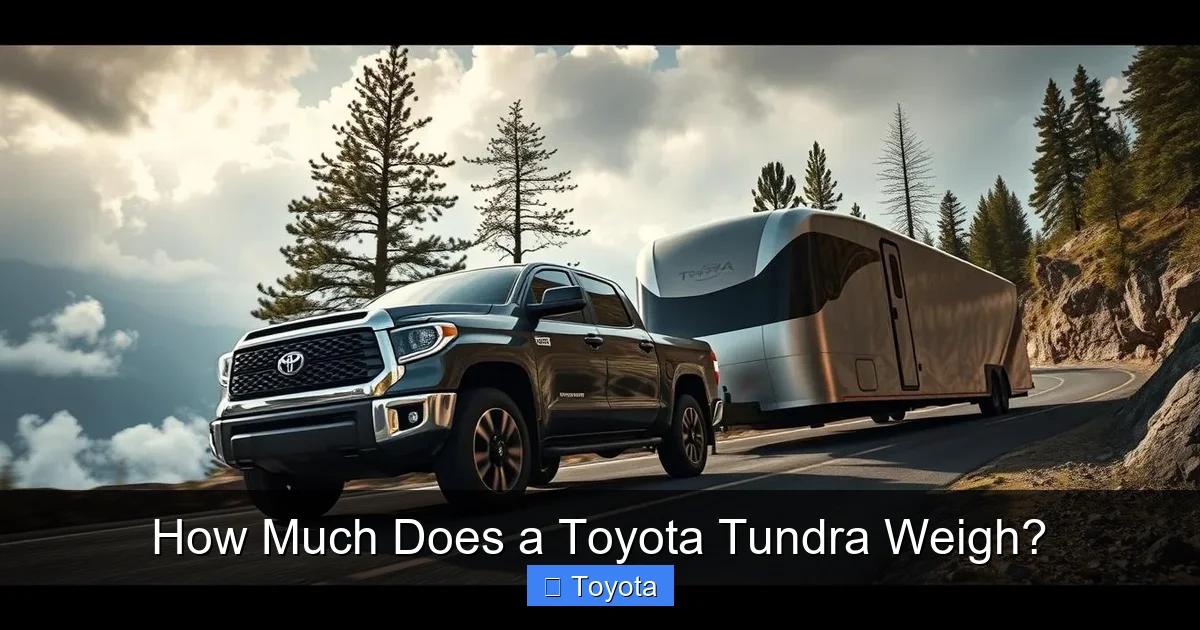
Visual guide about How Much Does a Toyota Tundra Weigh?
Image source: allaboutweigh.com
Toyota has built the Tundra in three main generations since its 2000 debut. Each brought major engineering changes that directly impacted weight.
First Generation (2000–2006)
The original Tundra was Toyota’s answer to American full-size trucks like the Ford F-150 and Chevy Silverado. Built on a modified Camry platform (yes, really!), it was lighter and more car-like than its rivals. Curb weights ranged from **4,900 to 5,400 pounds**, depending on cab and drivetrain. Regular cabs with V6 engines were the lightest, while crew cabs with V8s and 4WD tipped the scales closer to 5,400 lbs. These trucks had modest GVWRs—typically around 6,000–6,500 pounds—and lower towing capacities (up to 7,000 lbs).
Second Generation (2007–2021)
Toyota completely redesigned the Tundra in 2007, moving to a true full-size truck architecture with a stronger frame and bigger engines. This generation saw a noticeable jump in weight. Base models started around **5,200 pounds**, while fully loaded CrewMax 4WD V8 trims could exceed **5,800 pounds**. The introduction of the 5.7L V8 and reinforced rear suspension increased both capability and mass. GVWRs climbed to 6,800–7,300 pounds, and towing peaked at 10,500 lbs (with proper equipment). Despite the added heft, fuel economy suffered—a trade-off for greater durability and hauling power.
Third Generation (2022–Present)
The current Tundra represents the biggest leap yet. Toyota ditched the V8 entirely (except briefly in 2022) and introduced two new engines: a 3.5L twin-turbo V6 (i-FORCE) and a hybrid version (i-FORCE MAX). The frame is fully boxed and high-strength steel, and the truck now uses a coil-spring rear suspension instead of leaf springs—improving ride quality but adding weight.
As a result, **2022–2024 Tundras are the heaviest in history**. Curb weights now range from **5,400 to 6,200+ pounds**. Even the lightest SR regular cab 2WD starts around 5,400 lbs, while a fully loaded 1794 Edition CrewMax 4WD hybrid can exceed 6,200 lbs. GVWRs have also increased, reaching up to **7,500 pounds** on certain trims. Interestingly, despite being heavier, the new Tundra offers better fuel economy and class-leading towing (up to 12,000 lbs with the hybrid).
Why the weight gain? Safety features (like advanced driver aids), larger infotainment screens, reinforced frames for higher towing, and the hybrid battery pack all contribute. But Toyota engineers balanced this with aluminum body panels and optimized design to prevent excessive bloat.
How Cab and Bed Configuration Affect Weight
Visual guide about How Much Does a Toyota Tundra Weigh?
Image source: vehiclerides.com
Not all Tundras are built the same—even within the same model year. Your choice of cab style and bed length significantly impacts how much your truck weighs.
Regular Cab vs. Double Cab vs. CrewMax
– **Regular Cab**: The shortest and lightest option. Typically used for work trucks or fleet vehicles. Adds the least weight—often 200–400 pounds less than crew configurations.
– **Double Cab**: A mid-size option with four doors but tighter rear seating. Slightly heavier than Regular Cab due to extended wheelbase and additional structure.
– **CrewMax**: The largest cab with spacious rear seats and a full rear door opening. This is where weight really climbs—up to 300–500 pounds heavier than a Regular Cab due to extra steel, glass, and interior components.
For example, a 2023 Tundra SR Regular Cab 2WD might weigh **5,420 pounds**, while the same truck in CrewMax 4WD trim could hit **6,050 pounds**—a difference of over 600 pounds!
Short Bed vs. Long Bed
Bed length also plays a role:
– **Short Bed (5.5 ft)**: Standard on most CrewMax models. Lighter and more maneuverable.
– **Long Bed (6.5 ft or 8 ft)**: Found on Regular and Double Cabs. Adds steel, frame reinforcement, and suspension components—typically 100–200 pounds extra.
While the difference isn’t massive, it compounds with other choices. A Long Bed CrewMax 4WD hybrid will be among the heaviest Tundra configurations available.
Two-Wheel Drive vs. Four-Wheel Drive
4WD systems add significant weight due to transfer cases, front differentials, and additional driveshafts. Expect a **150–300 pound increase** when opting for 4WD over 2WD. This is one reason why base 2WD models often have slightly better fuel economy and marginally higher payload ratings.
Engine and Drivetrain Impact on Weight
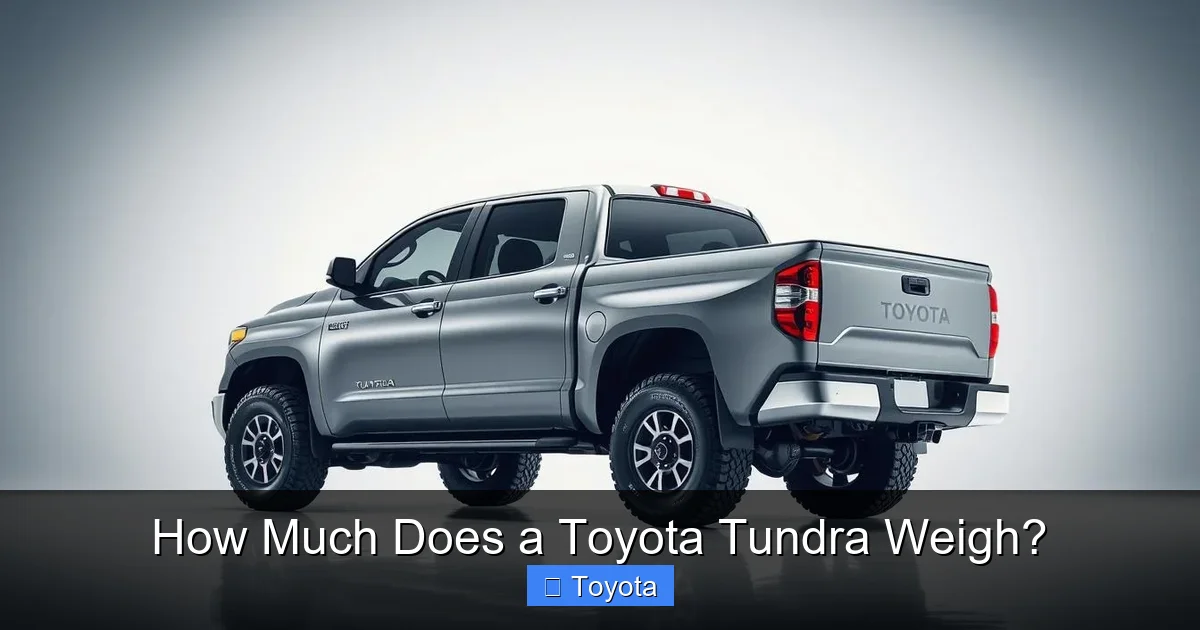
Visual guide about How Much Does a Toyota Tundra Weigh?
Image source: vehiclerides.com
The heart of your Tundra—its engine—also dictates how heavy it is.
V6 vs. Hybrid V6
Since 2022, Toyota offers two powertrains:
– **i-FORCE 3.5L Twin-Turbo V6**: Produces 389 hp and 479 lb-ft of torque. Standard on most trims. Adds moderate weight due to turbochargers and reinforced internals.
– **i-FORCE MAX Hybrid V6**: Combines the same V6 with an electric motor and 10-speed automatic transmission. Delivers 437 hp and a whopping 583 lb-ft of torque. However, the hybrid battery, motor, and cooling systems add **200–300 pounds** compared to the non-hybrid V6.
This extra weight is partly why hybrid Tundras sometimes have *lower* payload capacities than their gas-only counterparts—even though they tow more. The truck is using more of its GVWR just to carry itself.
Transmission and Axle Differences
All current Tundras use a 10-speed automatic transmission, but gear ratios and axle strengths vary by trim. Heavy-duty towing packages include reinforced rear axles and cooling systems, which add another 50–100 pounds. While not huge on its own, every ounce counts when you’re near your GVWR limit.
Real-World Implications of Tundra Weight
So what does all this weight mean for daily driving? More than you might think.
Fuel Economy
Heavier vehicles require more energy to move. A 6,000-pound Tundra will never match the efficiency of a 4,000-pound sedan—even with hybrid tech. Expect EPA estimates of **17–20 mpg combined** for gas models and **19–22 mpg** for hybrids. But remember: real-world mileage drops when towing, hauling, or driving in hilly terrain.
Towing and Payload Trade-Offs
Here’s a critical point: **towing capacity doesn’t equal payload capacity**. A Tundra rated to tow 12,000 pounds might only have a 1,500-pound payload. Why? Because the tongue weight of a heavy trailer (typically 10–15% of trailer weight) counts against your payload. So if you tow an 11,000-pound trailer, you’re already using 1,100–1,650 pounds of your payload just for the hitch load—leaving little room for passengers or gear.
Always calculate your total load: passengers + cargo + fuel + tongue weight. If it exceeds your GVWR, you’re overloaded—even if you’re under the towing limit.
Brake and Suspension Performance
Heavier trucks need stronger brakes and stiffer suspensions. The new Tundra’s coil-spring rear suspension improves ride comfort but requires precise tuning to handle the extra mass. Owners report excellent stability when towing, but some note that unloaded trucks can feel “floaty” on rough roads—a sign the suspension is optimized for heavy loads.
Parking and Maneuverability
A 6,200-pound CrewMax with a long bed is over 20 feet long and weighs more than many SUVs. Parallel parking in tight urban spaces? Tricky. Driving on narrow mountain roads? Challenging. And if you live in a city with weight-restricted bridges or parking garages, your Tundra’s weight could limit where you go.
How to Find Your Tundra’s Exact Weight
Don’t rely on guesswork or online averages. To get precise numbers for your truck:
1. **Check the door jamb sticker**: Open the driver’s side door and look for a white or yellow label. It lists GVWR, tire size, and sometimes curb weight.
2. **Use your VIN**: Enter your Vehicle Identification Number on Toyota’s official website or third-party decoder tools to pull factory specs.
3. **Consult the owner’s manual**: Toyota includes weight ratings and payload charts in every manual.
4. **Weigh your truck**: Visit a truck scale (often at truck stops or recycling centers) to get an actual measurement—including fuel, passengers, and cargo.
Pro tip: Weigh your truck *loaded* as you normally drive it. That gives you the most accurate picture of your real-world weight and helps avoid surprises at inspection stations or when renting trailers.
Why Weight Matters When Buying a Tundra
If you’re shopping for a Tundra, weight should factor into your decision—not just for performance, but for cost and legality.
– **Insurance**: Heavier, more powerful trucks often cost more to insure.
– **Registration fees**: Some states base registration costs on vehicle weight.
– **Emissions and taxes**: In certain regions, heavier vehicles face higher taxes or stricter emissions rules.
– **Resale value**: Lighter, more fuel-efficient models may hold value better in eco-conscious markets.
– **Off-road capability**: Surprisingly, lighter trucks can sometimes navigate tight trails more easily—though the Tundra’s weight is offset by excellent ground clearance and traction systems.
Ultimately, the “right” weight depends on your needs. If you tow weekly, the heavier hybrid might be worth the trade-offs. If you mostly commute, a lighter 2WD Double Cab could save you hundreds in fuel and maintenance over time.
Conclusion
So, how much does a Toyota Tundra weigh? The short answer: it depends. But the long answer reveals a nuanced picture shaped by engineering choices, use cases, and evolving technology. From the modest 5,000-pound first-gen models to today’s robust 6,200-pound hybrids, the Tundra has grown heavier—but also more capable, efficient, and refined.
Understanding your Tundra’s weight isn’t just about satisfying curiosity. It’s about driving safely, maximizing performance, and making smart decisions whether you’re buying, towing, or simply filling up at the pump. By knowing your curb weight, GVWR, and payload limits, you’ll get the most out of America’s most reliable full-size truck—without overloading your wallet or your wheels.
Whether you’re hauling gear across the country or just cruising downtown, the Tundra’s weight is a foundational part of its identity. And now, you know exactly what that means.
Frequently Asked Questions
What is the average weight of a Toyota Tundra?
The average curb weight of a Toyota Tundra ranges from 5,400 to 6,200 pounds for current models (2022–2024), depending on cab, bed, drivetrain, and engine. Older models (2007–2021) typically weigh between 5,200 and 5,800 pounds.
Does the Toyota Tundra hybrid weigh more than the gas model?
Yes, the i-FORCE MAX hybrid Tundra is about 200–300 pounds heavier than the standard i-FORCE V6 due to the electric motor, battery pack, and additional cooling systems.
How does weight affect the Tundra’s towing capacity?
While heavier trucks often have stronger frames and higher towing ratings, added weight reduces payload capacity. The Tundra’s towing capacity (up to 12,000 lbs) depends on configuration, but tongue weight counts against your payload limit.
Can I find my Tundra’s exact weight without a scale?
Yes! Check the certification label on the driver’s door jamb, your owner’s manual, or use your VIN on Toyota’s official build tool to get precise curb weight and GVWR.
Why is the new Tundra heavier than older models?
The 2022+ Tundra is heavier due to a fully boxed high-strength steel frame, coil-spring rear suspension, advanced safety features, larger infotainment systems, and the hybrid powertrain—all contributing to improved durability, comfort, and capability.
Does a longer bed make the Tundra significantly heavier?
Yes, a long bed (6.5 ft or 8 ft) adds approximately 100–200 pounds compared to a short bed (5.5 ft) due to extra frame reinforcement, steel, and suspension components.