
What Does Cruising Range Mean Toyota

Cruising range in Toyota vehicles refers to the estimated distance a car can travel on its current fuel or battery charge. It’s a vital metric for gas, hybrid, and electric models, helping drivers plan trips and manage refueling or charging stops efficiently.
When you’re behind the wheel of a Toyota—whether it’s a fuel-efficient Prius, a rugged RAV4 Hybrid, or the all-electric bZ4X—you’ve probably glanced at the dashboard and seen a number labeled “Cruising Range.” But what does that number really mean? Is it a hard limit? A suggestion? Or just a rough guess? Understanding cruising range can make a big difference in how confidently you drive, especially on long trips or when you’re low on fuel or battery.
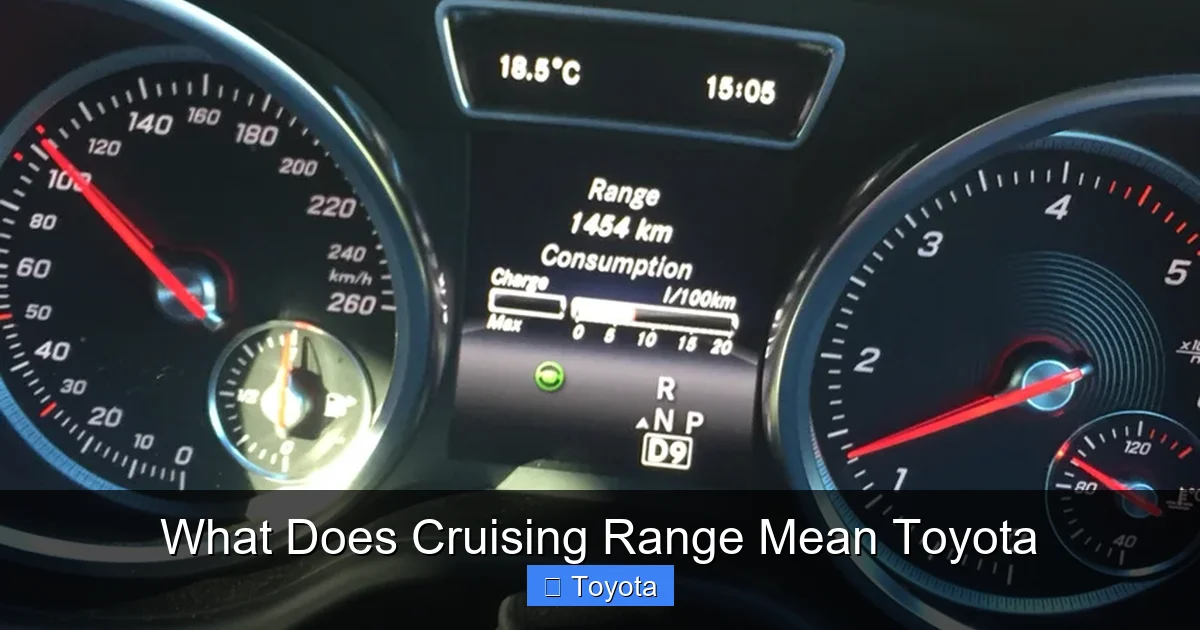
Cruising range, in simple terms, is the estimated distance your Toyota can travel before it runs out of fuel or battery power. It’s calculated by the vehicle’s onboard computer using real-time data like current fuel level, average fuel consumption, driving patterns, and even external factors such as temperature and terrain. This number updates as you drive, giving you a dynamic snapshot of how far you can go. For gas-powered cars, it’s based on fuel remaining in the tank. For hybrids, it may show a combination of gas and electric range. And for fully electric models, it’s all about how much juice is left in the battery.
But here’s the thing: cruising range isn’t a fixed number. It changes. If you’re driving aggressively—speeding, rapid acceleration, braking hard—your range will drop faster. If you’re cruising steadily on the highway with the windows up and AC off, you’ll likely go farther. That’s why it’s important to see cruising range not as a promise, but as a helpful guide. It’s like a GPS for your fuel or battery life, helping you decide when to stop, where to charge, or whether you can make it to your destination without a pit stop.
Key Takeaways
- Cruising range shows how far your Toyota can go: It estimates the distance your vehicle can travel based on current fuel or battery levels, helping you avoid unexpected stops.
- It varies by model and powertrain: Gas, hybrid, and electric Toyotas calculate cruising range differently, with EVs relying heavily on battery state of charge and driving habits.
- Real-world conditions affect accuracy: Weather, terrain, speed, and cargo load can reduce the displayed cruising range compared to ideal lab conditions.
- Hybrid models offer dual-range flexibility: Toyota hybrids like the Prius or RAV4 Hybrid show both gasoline and electric-only range, giving you more control over energy use.
- EVs use advanced algorithms for precision: Electric Toyotas like the bZ4X use real-time data and regenerative braking to update cruising range dynamically.
- You can improve your cruising range: Smooth driving, proper tire inflation, and regular maintenance help maximize how far your Toyota can go on a single tank or charge.
- It’s a planning tool, not a guarantee: Always keep a buffer and plan for refueling or charging before the range hits zero to avoid being stranded.
📑 Table of Contents
How Toyota Calculates Cruising Range
Toyota uses sophisticated onboard computers and sensors to calculate cruising range across its lineup. The method varies slightly depending on whether you’re driving a traditional gasoline vehicle, a hybrid, or a fully electric model. But the core idea remains the same: take the amount of usable energy (fuel or electricity) and divide it by the vehicle’s recent energy consumption rate.
For gasoline-powered Toyotas like the Camry or Tacoma, the system monitors fuel level via a sensor in the gas tank. It then looks at your recent fuel economy—say, the last 10–20 miles of driving—to estimate how much farther you can go. If you’ve been averaging 30 miles per gallon and have 4 gallons left, your cruising range might show around 120 miles. But if you suddenly start driving uphill or towing a trailer, that number will drop quickly.
Hybrid models like the Prius or Highlander Hybrid add another layer. These vehicles can run on gasoline, electricity, or a combination of both. The cruising range display often shows two numbers: one for the gasoline range and another for the electric-only range (if applicable). For example, a Prius might show “Gas Range: 300 miles” and “EV Range: 25 miles.” This dual readout helps drivers understand how much farther they can go in electric mode before the gas engine kicks in.
Electric Toyotas, such as the bZ4X, take a more advanced approach. The vehicle’s battery management system constantly monitors the state of charge (SoC), temperature, and power demand. It also factors in regenerative braking—how much energy is recovered when you slow down—and adjusts the cruising range accordingly. If you’re driving in cold weather, for instance, the battery’s efficiency drops, and the range estimate will reflect that. Toyota’s system even considers upcoming elevation changes if you’ve entered a destination into the navigation system, giving you a more accurate prediction.
Real-Time Adjustments and Learning Algorithms
One of the smartest features of Toyota’s cruising range calculation is its ability to adapt in real time. The system doesn’t just rely on a static average—it learns from your driving habits. If you typically drive smoothly and efficiently, the range estimate will be more optimistic. But if you’re someone who loves quick acceleration and high speeds, the system will adjust downward to reflect your actual usage.
This learning capability is especially useful for new drivers or when you’re driving in unfamiliar conditions. For example, if you usually drive in the city but suddenly hit the highway, the system will notice the improved fuel economy and increase your cruising range. Conversely, if you’re stuck in stop-and-go traffic, the range will drop faster than expected.
Toyota also uses historical data to improve accuracy. Over time, the vehicle builds a profile of your typical routes, speeds, and driving style. This helps the system make better predictions, especially on regular commutes. If you always drive the same 20-mile route to work, your Toyota will get better at estimating how much fuel or battery you’ll use each day.
Factors That Influence the Calculation
While Toyota’s system is advanced, it’s not perfect. Several external factors can affect how accurate the cruising range is:
– **Driving style:** Aggressive driving reduces range. Smooth acceleration and gentle braking help.
– **Speed:** Higher speeds increase wind resistance and reduce efficiency, especially for EVs.
– **Weather:** Cold temperatures reduce battery performance in electric vehicles and increase fuel consumption in gas models due to engine warm-up time.
– **Terrain:** Driving uphill uses more energy; downhill can help recover some through regenerative braking.
– **Cargo and passengers:** Extra weight reduces efficiency across all vehicle types.
– **Accessories:** Using the heater, AC, headlights, or infotainment system draws power and can lower range.
Understanding these factors helps you interpret the cruising range more wisely. It’s not just a number—it’s a reflection of your current driving environment and habits.
Gas vs. Hybrid vs. Electric: Range Differences Explained
Visual guide about What Does Cruising Range Mean Toyota
Image source: mbworld.org
Not all Toyotas are created equal when it comes to cruising range. The type of powertrain—gasoline, hybrid, or electric—plays a major role in how range is calculated and what it means for your driving experience.
Gasoline-powered Toyotas, like the Corolla or Tundra, rely solely on fuel. Their cruising range is straightforward: it’s based on how much gas is left and how efficiently the engine is burning it. These vehicles typically have the longest total range—often 400 to 600 miles on a full tank—but they don’t benefit from regenerative braking or electric assist. Once the gas is gone, you’re out of luck until you refuel.
Hybrid models, such as the RAV4 Hybrid or Camry Hybrid, offer the best of both worlds. They use a gasoline engine and an electric motor, often switching between them automatically. The cruising range display usually shows the total distance you can travel using both power sources. For example, a RAV4 Hybrid might show a cruising range of 500 miles, combining 450 miles from gasoline and 50 miles from electric assist. Some hybrids also allow you to drive in “EV mode” for short distances using only electricity, which is great for city driving or parking.
Electric Toyotas, like the bZ4X, operate entirely on battery power. Their cruising range is measured in miles per charge and depends heavily on battery capacity and efficiency. The bZ4X, for instance, has an EPA-estimated range of up to 252 miles, but real-world range can vary from 200 to 240 miles depending on conditions. Unlike gas cars, EVs can recover energy through regenerative braking, which helps extend range in stop-and-go traffic. However, cold weather, high speeds, and using climate control can significantly reduce how far you can go.
Why Hybrid Range Can Be Misleading
One common confusion with hybrid cruising range is that it often includes both gas and electric range in a single number. While this gives you a total estimate, it doesn’t tell you how much of that range comes from electricity alone. For example, if your Prius shows a cruising range of 400 miles, you might assume you can drive 400 miles without using any gas—but that’s not the case. Most of that range comes from the gasoline engine, with the electric motor assisting only part of the time.
To get a clearer picture, some Toyota hybrids allow you to view separate range estimates. You can check how many miles you can drive in EV mode before the gas engine starts. This is especially useful if you’re trying to minimize fuel use or drive emissions-free in urban areas.
EV Range Anxiety and How Toyota Addresses It
Range anxiety—the fear of running out of battery before reaching a charging station—is a real concern for EV drivers. Toyota helps ease this worry with accurate range estimates and smart features. The bZ4X, for example, includes a “Range Mode” that optimizes energy use by limiting acceleration and climate control. It also shows nearby charging stations on the navigation screen and estimates how much range you’ll gain from a quick charge.
Additionally, Toyota’s app connectivity allows you to monitor your vehicle’s state of charge remotely. You can check your cruising range from your phone, start charging, or precondition the cabin while plugged in—all helping you feel more in control.
Real-World Examples: How Cruising Range Behaves in Practice
Visual guide about What Does Cruising Range Mean Toyota
Image source: img.toyotask.com
Let’s look at a few real-world scenarios to see how cruising range works in action.
Imagine you’re driving a Toyota Camry Hybrid on a weekend road trip. You start with a full tank and a full battery. The dashboard shows a cruising range of 520 miles. You drive steadily at 65 mph on the highway with the AC on. After 200 miles, the range drops to 310 miles—right on track. But then you hit a mountain pass. The engine works harder, and the range drops faster than expected, down to 250 miles after just 50 more miles. This is normal—uphill driving consumes more energy.
Now, switch to a Toyota bZ4X electric SUV. You charge it to 100% overnight, and the display shows a cruising range of 240 miles. You drive 100 miles in mild weather with moderate use of the heater. The range drops to 140 miles—again, as expected. But then the temperature drops to 20°F. The battery loses efficiency, and the range suddenly drops to 110 miles. This is why cold weather can reduce EV range by 20–40%.
Finally, consider a Toyota Tacoma gas truck. You fill up and see a cruising range of 480 miles. You drive 300 miles with a light load, and the range shows 180 miles left. But then you load up a trailer for a camping trip. The range drops to 120 miles after just 50 more miles. Towing increases fuel consumption dramatically, so the system adjusts quickly.
These examples show that cruising range is dynamic and responsive. It’s not a fixed number—it’s a live estimate that changes with your driving.
Tips to Maximize Your Toyota’s Cruising Range
Visual guide about What Does Cruising Range Mean Toyota
Image source: img.toyotask.com
Want to get the most out of every tank or charge? Here are some practical tips to extend your Toyota’s cruising range:
– **Drive smoothly:** Avoid rapid acceleration and hard braking. Gradual speed changes improve efficiency.
– **Maintain a steady speed:** Use cruise control on highways to reduce speed fluctuations.
– **Reduce weight:** Remove unnecessary items from your trunk or bed. Extra weight burns more fuel or drains the battery.
– **Keep tires properly inflated:** Underinflated tires increase rolling resistance and reduce range.
– **Use eco mode:** Most Toyotas have an Eco driving mode that optimizes throttle response and climate control for efficiency.
– **Precondition your EV:** In cold weather, warm up your bZ4X while it’s still plugged in to preserve battery range.
– **Plan your route:** Use navigation to avoid traffic, hills, or long detours that can drain energy.
– **Limit accessory use:** Turn off heated seats, defrosters, and high-powered audio when not needed.
Small changes in behavior can add up to significant gains in range. For example, driving 5 mph slower on the highway can improve fuel economy by 7–14%, which directly increases your cruising range.
Understanding Range Warnings and Low Fuel Alerts
When your cruising range gets low, Toyota vehicles provide warnings to help you avoid getting stranded. These alerts vary by model but generally follow a similar pattern.
In gas-powered cars, a low fuel light typically comes on when there are about 30–50 miles of range left. Some models also show a message like “Refuel Soon” or “Low Fuel.” At this point, you should start looking for a gas station.
Hybrids may show a similar warning, but they might also alert you when the battery is low and the gas engine is about to start. This is especially important if you’re trying to drive in EV-only mode.
Electric Toyotas are more proactive. The bZ4X, for example, will display a “Low Battery” warning when range drops below 30 miles. It may also suggest nearby charging stations and reduce non-essential systems to conserve power. In extreme cases, it can enter a “limp mode” to help you reach a charger.
It’s important not to ignore these warnings. While modern Toyotas are designed to give you a buffer, running out of fuel or battery can leave you stranded and may require a tow.
Conclusion: Cruising Range Is Your Co-Pilot
Cruising range in Toyota vehicles is more than just a number on the dashboard—it’s a smart, adaptive tool that helps you drive smarter and more confidently. Whether you’re behind the wheel of a gas-powered sedan, a versatile hybrid SUV, or a cutting-edge electric crossover, understanding how cruising range works can improve your efficiency, reduce stress, and save you money.
Remember, cruising range is an estimate, not a guarantee. It changes based on how you drive, where you drive, and what the weather’s like. But by paying attention to it—and using it wisely—you can make better decisions on the road. Keep your tires inflated, drive smoothly, and plan ahead. And most importantly, don’t wait until the range hits zero. Always leave a buffer and refuel or recharge before it’s too late.
With Toyota’s advanced technology and your mindful driving, you’ll get the most out of every mile.
Frequently Asked Questions
What does cruising range mean on a Toyota?
Cruising range is the estimated distance your Toyota can travel based on current fuel or battery levels and recent driving habits. It’s displayed on the dashboard and updates in real time to help you plan refueling or charging stops.
Is cruising range accurate?
Cruising range is generally reliable but can vary due to driving style, weather, terrain, and vehicle load. It’s best used as a guide rather than an exact prediction.
Does cold weather affect Toyota’s cruising range?
Yes, especially for electric models. Cold temperatures reduce battery efficiency, which can lower EV range by 20–40%. Gas and hybrid models may also see reduced range due to longer engine warm-up times.
Can I improve my Toyota’s cruising range?
Absolutely. Smooth driving, proper tire inflation, using Eco mode, and reducing weight or accessory use can all help extend your range.
What happens when cruising range reaches zero?
Your Toyota will eventually run out of fuel or battery power and stop. To avoid this, always refuel or recharge before the range gets too low—most models give warnings when range drops below 30–50 miles.
Do all Toyota models show cruising range?
Most modern Toyotas—gas, hybrid, and electric—display cruising range. However, older models or base trims may not include this feature. Check your owner’s manual or dashboard settings.
