
When Is the Toyota Stout Coming Out?

The Toyota Stout is officially returning as a compact pickup truck, set to debut in late 2025 for the 2026 model year. Built on Toyota’s TNGA platform and powered by a hybrid powertrain, it aims to blend fuel efficiency with rugged capability—perfect for urban adventurers and light-duty work.
Key Takeaways
- Expected Release Date: The Toyota Stout is slated for a late 2025 launch, with deliveries beginning in early 2026.
- Hybrid Powertrain: It will feature a next-generation hybrid system, likely based on the 2.4L turbocharged engine used in the Toyota Crown and Lexus NX.
- Compact Size, Big Appeal: Positioned between the Tacoma and the discontinued Hilux, the Stout targets city drivers who want truck utility without the bulk.
- Global Launch Strategy: Initial rollout will focus on North America and select Asian markets, with European availability under review.
- Competitive Pricing: Expected to start around $32,000–$35,000, making it a strong rival to the Ford Maverick and Hyundai Santa Cruz.
- TNGA Platform: Built on Toyota’s modular TNGA-F architecture, ensuring improved ride quality, safety, and manufacturing efficiency.
- Rugged Design Language: The new Stout will feature bold styling cues inspired by the original 1960s model and modern Toyota trucks like the Tacoma and Tundra.
📑 Table of Contents
- When Is the Toyota Stout Coming Out?
- The Return of a Legend: A Brief History of the Toyota Stout
- Expected Features and Specifications
- Pricing and Trim Levels
- Market Competition and Positioning
- Global Availability and Launch Strategy
- What to Expect in 2025
- Conclusion: The Stout Is Coming—And It’s Worth the Wait
When Is the Toyota Stout Coming Out?
If you’ve been waiting for a compact, fuel-efficient pickup truck from Toyota that doesn’t sacrifice style or capability, your patience is about to pay off. The Toyota Stout—once a beloved workhorse in the 1960s and 70s—is officially making a comeback. After years of rumors, teasers, and概念 sketches, Toyota has confirmed that the modern Stout will hit dealerships in late 2025 as a 2026 model year vehicle.
This isn’t just a nostalgic revival. The new Stout is designed to meet today’s demands: better fuel economy, lower emissions, smart technology, and everyday practicality. It’s aimed at urban professionals, weekend adventurers, and small business owners who need a versatile vehicle that can handle groceries, gear, and gravel roads with equal ease.
But when exactly can you expect to see it on the road? Based on official statements from Toyota executives and industry insiders, the Stout will begin production in the third quarter of 2025, with customer deliveries starting in early 2026. That means if you’re planning your next vehicle purchase, you might want to keep an eye on Toyota’s announcements throughout 2025.
The Return of a Legend: A Brief History of the Toyota Stout
Visual guide about When Is the Toyota Stout Coming Out?
Image source: i0.wp.com
Before we dive into the future, let’s take a quick trip down memory lane. The original Toyota Stout was introduced in 1954 as a light-duty pickup truck based on the Toyota ToyoAce. It was compact, reliable, and perfect for small businesses and rural drivers in post-war Japan. Over the years, it evolved into a more capable vehicle, eventually becoming the foundation for what would later become the Toyota Hilux.
The Stout was known for its simplicity, durability, and affordability. It wasn’t flashy, but it got the job done—whether hauling tools, transporting produce, or navigating rough terrain. By the 1970s, as the Hilux grew in popularity and global reach, the Stout was phased out in most markets. But its legacy lived on, especially among classic truck enthusiasts and collectors.
Now, more than 50 years later, Toyota is bringing back the Stout name—not as a retro rehash, but as a modern reinterpretation. The new Stout won’t just honor its heritage; it will redefine what a compact pickup can be in the 2020s.
Why Bring Back the Stout Now?
So why resurrect a nameplate that hasn’t been used in decades? The answer lies in shifting consumer preferences and market gaps. In recent years, compact pickup trucks like the Ford Maverick and Hyundai Santa Cruz have seen a surge in popularity. These vehicles offer the utility of a truck bed without the size, fuel consumption, or parking challenges of full-size models like the F-150 or Toyota Tacoma.
Toyota, known for its strategic timing, sees an opportunity. The Tacoma dominates the midsize segment, but there’s growing demand for something smaller, more efficient, and more affordable. The Stout fills that gap perfectly. It’s not meant to replace the Tacoma—it’s meant to complement it.
Additionally, Toyota is doubling down on hybrid technology. With stricter emissions regulations and rising fuel prices, a hybrid-powered compact truck makes perfect sense. The Stout will likely be one of the first Toyota trucks to offer a standard hybrid powertrain, aligning with the brand’s goal of electrifying its entire lineup by 2030.
How the New Stout Honors Its Roots
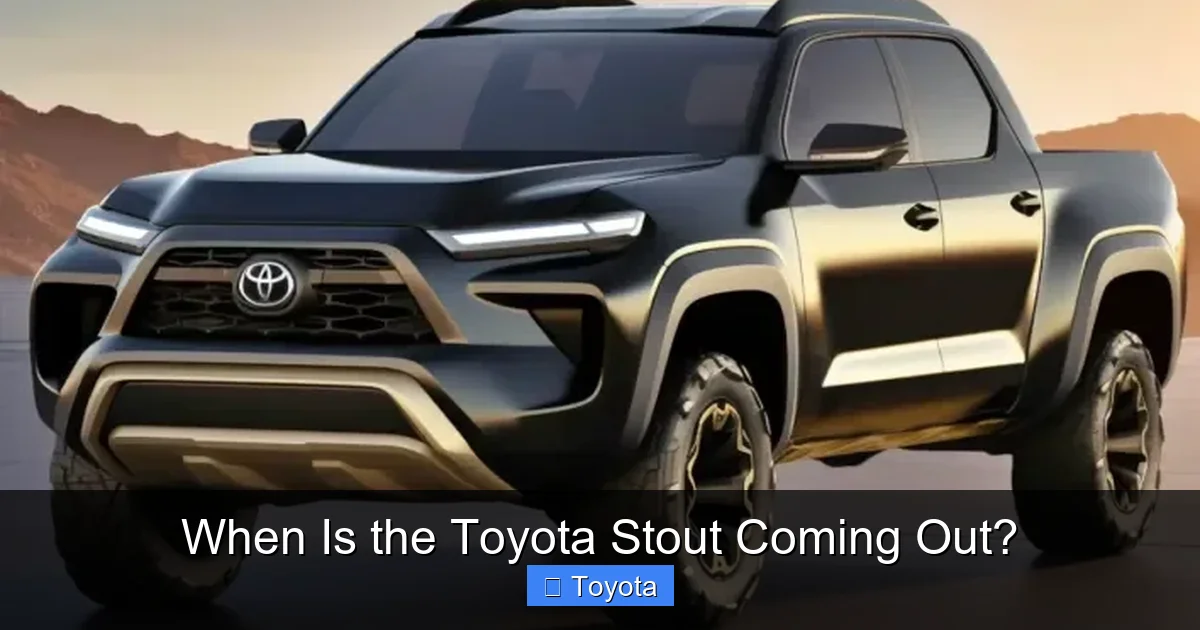
While the new Stout will be packed with modern tech and safety features, Toyota is paying homage to the original in subtle but meaningful ways. The front grille design echoes the bold, upright styling of the 1960s model, with a modern twist. The overall proportions—short overhangs, a high ground clearance, and a compact wheelbase—are reminiscent of the classic Stout’s rugged charm.
Even the name “Stout” carries weight. In automotive terms, “stout” implies strength, reliability, and endurance—qualities Toyota wants associated with this new vehicle. It’s not just a name; it’s a promise.
Expected Features and Specifications
Visual guide about When Is the Toyota Stout Coming Out?
Image source: techedu24.com
Now that we know when the Toyota Stout is coming out, let’s talk about what it will bring to the table. While Toyota hasn’t released full specs yet, several key details have been confirmed or strongly hinted at through patents, concept designs, and insider reports.
Powertrain: Hybrid Dominance
The biggest change from the original Stout? It’s going hybrid—standard. Toyota is expected to equip the new Stout with a 2.4-liter turbocharged four-cylinder engine paired with an electric motor, similar to the setup in the Toyota Crown and Lexus NX 350h. This hybrid system delivers around 340 horsepower and offers excellent fuel efficiency—likely in the range of 35–40 mpg combined.
This powertrain choice makes sense for several reasons. First, it aligns with Toyota’s commitment to hybridization. Second, it provides strong torque for towing and hauling, which is essential for a pickup truck. Third, it keeps emissions low, helping the Stout meet future environmental standards.
There’s also speculation about a plug-in hybrid (PHEV) variant down the line, especially for markets like Europe and California where PHEVs are increasingly popular. But for the initial launch, a conventional hybrid is the most likely option.
Platform: Built on TNGA-F
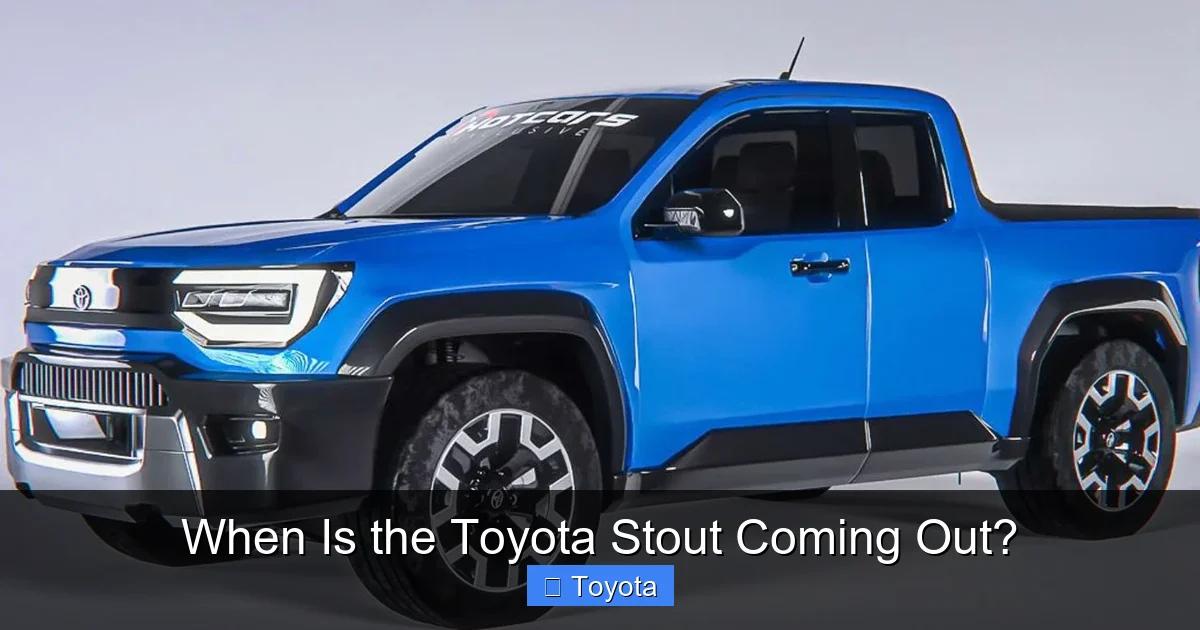
The new Stout will ride on Toyota’s TNGA-F (Toyota New Global Architecture – Front-engine) platform, the same one used for the Tacoma and Tundra. This platform is known for its rigidity, safety, and off-road capability. It allows for a body-on-frame construction, which is essential for a truck that needs to handle payloads and rough terrain.
Using TNGA-F also means the Stout will benefit from Toyota’s latest safety and driver-assistance technologies, including Toyota Safety Sense 3.0. This suite includes features like adaptive cruise control, lane departure warning, automatic emergency braking, and blind-spot monitoring.
Design: Rugged Yet Refined
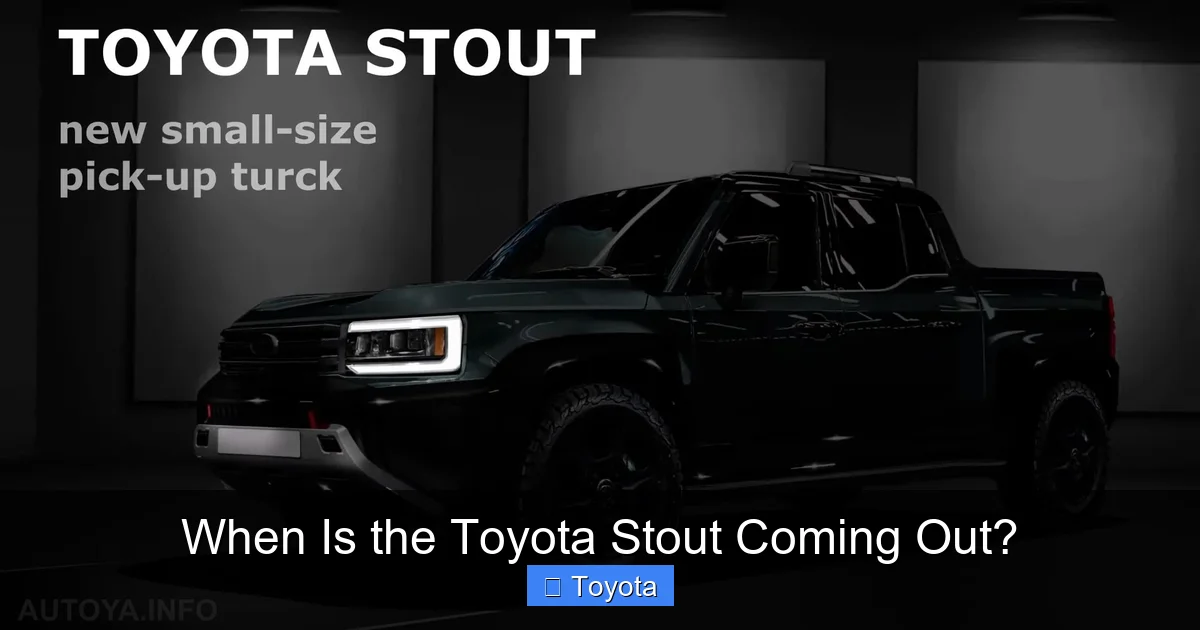
Styling-wise, the Stout will blend modern Toyota truck aesthetics with retro-inspired cues. Expect a bold front grille, squared-off fenders, and LED headlights with a distinctive signature. The truck bed will be compact—around 5 feet long—but designed for maximum utility with integrated tie-downs, a spray-in bedliner, and optional tonneau cover.
Inside, the cabin will likely feature a dual-screen setup: a digital instrument cluster and a large infotainment touchscreen (probably 12 inches or larger). Materials will be durable but comfortable, with available leather or synthetic upholstery. Toyota is known for practical interiors, and the Stout should be no different.
Towing and Payload Capacity
One of the biggest questions about the Stout is how much it can actually do. While it’s not meant to compete with heavy-duty trucks, it should offer respectable capability. Expect a towing capacity of around 5,000 pounds—enough for a small trailer, jet skis, or a pop-up camper. Payload capacity should be in the range of 1,500 to 1,800 pounds, making it suitable for hauling tools, mulch, or camping gear.
These numbers put it right in line with the Ford Maverick (4,000 lbs towing) and slightly ahead of the Hyundai Santa Cruz (5,000 lbs towing). It won’t replace a full-size truck for serious hauling, but for most daily and weekend tasks, it should be more than capable.
Pricing and Trim Levels
Visual guide about When Is the Toyota Stout Coming Out?
Image source: s1.cdn.autoevolution.com
Affordability is a key part of the Stout’s appeal. Toyota wants to position it as an accessible entry point into the truck market, especially for younger buyers and first-time truck owners.
Expected Starting Price
The base model is expected to start around $32,000–$35,000. That’s competitive with the Ford Maverick (starting at $23,000 for the base hybrid, but closer to $30,000 with options) and the Hyundai Santa Cruz (starting at $26,000, but $33,000+ for higher trims).
Toyota will likely offer three to four trim levels:
– **Base (L):** Standard hybrid powertrain, cloth seats, 8-inch touchscreen, basic safety features.
– **Mid (LE or XLE):** Upgraded infotainment, synthetic leather seats, larger wheels, additional driver aids.
– **High (Limited or TRD Off-Road):** Premium materials, advanced off-road package, larger screens, panoramic sunroof, and enhanced tech.
The TRD Off-Road trim will be particularly interesting for adventure seekers. It may include features like all-terrain tires, skid plates, upgraded suspension, and a locking rear differential.
Value Proposition
At this price point, the Stout offers a compelling mix of efficiency, capability, and brand reliability. Toyota’s reputation for longevity and low maintenance costs adds to its appeal. Plus, with standard hybrid power, owners can expect lower fuel bills and fewer trips to the pump.
For comparison, a similarly equipped Ford Maverick Hybrid might cost around $34,000, while a top-tier Santa Cruz Limited can exceed $40,000. The Stout could strike a sweet spot in the middle—offering Toyota’s legendary dependability at a competitive price.
Market Competition and Positioning
The compact truck segment is heating up, and the Stout will enter a crowded but growing market. Let’s see how it stacks up against its main rivals.
Ford Maverick
The Maverick is currently the segment leader, thanks to its low starting price, standard hybrid engine, and car-like driving dynamics. However, it’s based on a unibody platform (like a crossover), which some purists argue limits its true truck capability. The Stout, with its body-on-frame construction, may offer better durability and off-road performance.
Hyundai Santa Cruz
The Santa Cruz is stylish and well-equipped, but it’s also more expensive and less capable off-road. It shares its platform with the Hyundai Tucson SUV, which means it lacks the ruggedness of a traditional truck. The Stout’s TNGA-F platform and Toyota’s off-road expertise could give it an edge in real-world toughness.
Chevrolet Colorado/GMC Canyon
These are midsize trucks, so they’re not direct competitors. But some buyers might cross-shop them if they need more power or towing. The Stout’s smaller size and better fuel economy will be its main advantages here.
Future Competitors
Rivian and Tesla are rumored to be working on compact electric trucks, but those are likely years away. For now, the Stout’s hybrid powertrain gives it a practical edge—offering electric-like efficiency without range anxiety.
Global Availability and Launch Strategy
Toyota is taking a phased approach to the Stout’s global rollout.
North America First
The U.S. and Canada will be the first markets to receive the Stout, with production likely taking place at Toyota’s plant in San Antonio, Texas—the same facility that builds the Tacoma and Tundra. This makes logistical sense and allows Toyota to leverage existing infrastructure.
Asian Markets
Japan, Thailand, and Australia are also high-priority markets. These regions have a strong history with Toyota trucks and a growing interest in compact, efficient vehicles. The Stout could be a hit in urban centers like Tokyo or Bangkok, where parking and fuel costs are major concerns.
Europe and Beyond
European availability is still under review. While compact trucks are less common in Europe, the rise of lifestyle-oriented pickups (like the Ford Ranger and Toyota Hilux) suggests there could be demand. However, strict emissions regulations and high taxes on larger vehicles may limit the Stout’s appeal unless a plug-in hybrid or fully electric version is offered.
Right-Hand Drive Markets
Countries like the UK, Australia, and South Africa will get right-hand drive versions. Toyota has confirmed that RHD production is planned, ensuring the Stout can compete globally.
What to Expect in 2025
As we get closer to the Stout’s launch, here’s what you can expect:
Official Reveal
Toyota is likely to unveil the production-ready Stout at a major auto show in early 2025—possibly the Chicago Auto Show or the New York International Auto Show. Expect a full reveal with detailed specs, pricing, and trim information.
Pre-Order Program
Toyota may open a pre-order program in mid-2025, allowing customers to reserve their Stout with a small deposit. This was done with the bZ4X electric SUV and helped gauge demand.
Test Drives and Reviews
By late 2025, media outlets and dealerships will begin offering test drives. Keep an eye on automotive websites like MotorTrend, Car and Driver, and Edmunds for first-drive reviews.
Production Ramp-Up
Initial production numbers may be limited, so early adopters might face waitlists. Toyota will likely scale up production throughout 2026 to meet demand.
Conclusion: The Stout Is Coming—And It’s Worth the Wait
So, when is the Toyota Stout coming out? The answer is clear: late 2025, with deliveries starting in early 2026. This isn’t just a nostalgic throwback—it’s a smart, strategic move by Toyota to capture a growing segment of the market.
The new Stout combines the best of Toyota’s truck heritage with modern technology, hybrid efficiency, and everyday practicality. It’s designed for people who want a vehicle that can do it all: commute to work, haul gear, and explore off the beaten path—all without breaking the bank at the gas pump.
Whether you’re a longtime Toyota fan, a compact truck enthusiast, or just someone looking for a versatile new ride, the Stout is one to watch. With its expected pricing, features, and global availability, it has the potential to become a best-seller.
So mark your calendars, keep an eye on Toyota’s announcements, and get ready. The Stout is back—and it’s better than ever.
Frequently Asked Questions
When will the Toyota Stout be available for purchase?
The Toyota Stout is expected to begin production in late 2025, with customer deliveries starting in early 2026 as a 2026 model year vehicle.
Will the Toyota Stout be a hybrid?
Yes, the new Stout will come standard with a hybrid powertrain, likely a 2.4L turbocharged engine paired with an electric motor for improved fuel efficiency and performance.
How much will the Toyota Stout cost?
The starting price is expected to be between $32,000 and $35,000, making it competitive with the Ford Maverick and Hyundai Santa Cruz.
What platform will the Toyota Stout use?
The Stout will be built on Toyota’s TNGA-F platform, the same one used for the Tacoma and Tundra, ensuring durability and off-road capability.
Will the Toyota Stout be available outside the U.S.?
Yes, the Stout will launch in North America first, followed by select Asian markets. European availability is under review and may depend on emissions regulations.
Can the Toyota Stout tow trailers?
Yes, it’s expected to have a towing capacity of around 5,000 pounds, making it suitable for small trailers, boats, or campers.
