
What Does H4f Mean on a Toyota 4runner?

H4F on a Toyota 4Runner stands for “High Range 4WD with Front Axle Engagement.” It’s a key part of the vehicle’s part-time four-wheel-drive system, designed to improve traction on slippery or uneven terrain without sacrificing fuel efficiency on dry pavement.
If you’ve ever glanced at the dashboard of your Toyota 4Runner and spotted the letters “H4F” glowing on the display, you might have wondered—what exactly does that mean? Is it a warning? A performance mode? Something you should be worried about? The good news is, H4F isn’t a problem at all. In fact, it’s a sign that your 4Runner is doing exactly what it was built to do: giving you better control and traction when the road gets rough.
The Toyota 4Runner is one of the most rugged and reliable SUVs on the market, known for its off-road prowess and durability. Whether you’re navigating muddy trails, snowy mountain passes, or gravel backroads, the 4Runner’s advanced four-wheel-drive system is designed to keep you moving. And H4F—short for High Range 4WD with Front Axle Engagement—is a key part of that system. Understanding what H4F means, when to use it, and how it works can make a big difference in your driving experience, especially if you enjoy outdoor adventures or live in areas with unpredictable weather.
In this guide, we’ll break down everything you need to know about H4F on your Toyota 4Runner. From how it functions to when and how to engage it, we’ll cover the essentials so you can drive with confidence, no matter the conditions. Whether you’re a seasoned off-roader or a weekend warrior, this information will help you get the most out of your vehicle while keeping it in top shape for years to come.
Key Takeaways
- H4F means High Range 4WD with Front Axle Engagement: This mode locks the front and rear axles together for improved traction in challenging conditions like snow, mud, or gravel.
- Use H4F only when needed: Unlike full-time 4WD, H4F is part-time and should not be used on dry pavement to avoid drivetrain damage.
- Engage H4F at low speeds: Always shift into H4F while driving under 55 mph and only when road conditions require extra grip.
- H4F improves off-road capability: It enhances the 4Runner’s performance on trails, steep inclines, and loose surfaces by distributing power evenly.
- Know the difference between H4F and other modes: H4F is not the same as L4L (Low Range) or 2WD—each serves a different purpose based on terrain and speed.
- Regular use prevents mechanical issues: Occasionally engaging H4F helps keep the transfer case and front differential lubricated and functional.
- Always disengage when road conditions improve: Return to 2WD on dry, paved roads to protect your drivetrain and improve fuel economy.
📑 Table of Contents
Understanding the Toyota 4Runner’s 4WD System
The Toyota 4Runner is equipped with a sophisticated part-time four-wheel-drive (4WD) system that gives drivers the flexibility to choose between two-wheel drive (2WD) and four-wheel drive (4WD) depending on road conditions. This system is designed to deliver power to all four wheels when extra traction is needed, while allowing the vehicle to run in 2WD for better fuel efficiency on normal roads.
At the heart of this system is the transfer case, a mechanical component that splits engine power between the front and rear axles. The 4Runner’s transfer case offers several driving modes, including 2WD, H4F (High Range 4WD), and L4L (Low Range 4WD). Each mode is tailored to specific driving scenarios, and understanding how they work is essential for safe and effective operation.
In 2WD mode, power is sent only to the rear wheels—this is ideal for everyday driving on dry, paved roads. It reduces wear on the drivetrain and improves fuel economy. However, when you encounter slippery surfaces like snow, ice, mud, or loose gravel, switching to H4F can make a dramatic difference in stability and control.
H4F, or High Range 4WD with Front Axle Engagement, locks the front and rear axles together so that all four wheels receive equal power. This creates a more balanced and predictable driving experience, especially when one or more wheels begin to lose traction. Unlike full-time 4WD systems—which can operate on dry pavement—H4F is a part-time system. That means it should only be used when road conditions actually require four-wheel drive.
One of the key advantages of the 4Runner’s system is its simplicity and reliability. There are no complicated electronic controls or sensors that can fail. Instead, the driver manually selects the appropriate mode using a dial or lever, giving you full control over how your vehicle responds to the terrain. This mechanical approach is one reason why the 4Runner remains a favorite among off-road enthusiasts and overlanders.
How the Transfer Case Works
The transfer case is the brain of the 4Runner’s 4WD system. Located between the transmission and the front and rear axles, it takes the engine’s power and distributes it accordingly. In 2WD mode, all power goes to the rear wheels. When you shift into H4F, the transfer case engages a set of gears and clutches that lock the front and rear driveshafts together, ensuring that both axles turn at the same speed.
This locking action is what gives H4F its traction advantage. On slippery surfaces, if one wheel starts to spin, the locked axles prevent the other wheels from losing power. This helps the vehicle maintain forward momentum and reduces the risk of getting stuck.
It’s important to note that the transfer case doesn’t “sense” when you need 4WD—you have to tell it. That’s why knowing when and how to engage H4F is so crucial. Engaging it at the wrong time, such as on dry pavement, can cause what’s known as “drivetrain wind-up.” This happens when the front and rear axles are forced to turn at the same speed, but the wheels on different axles travel different distances during turns. The result can be a jerking sensation, tire scrubbing, and potential damage to the drivetrain.
Why Part-Time 4WD Matters
The 4Runner uses a part-time 4WD system, which means it’s not designed to run in 4WD all the time. This is different from full-time 4WD or all-wheel drive (AWD) systems found in some other SUVs. Full-time systems can operate safely on dry roads because they use a center differential or viscous coupling to allow for slight speed differences between the front and rear axles.
In contrast, the 4Runner’s part-time system lacks this differential. When H4F is engaged, the front and rear axles are locked together rigidly. This is great for off-road traction but problematic on pavement. That’s why Toyota recommends using H4F only when road conditions are slippery or uneven.
This design choice reflects the 4Runner’s heritage as a true off-road vehicle. It prioritizes durability and simplicity over convenience, which is why it remains a top choice for those who value capability over luxury. Understanding this distinction helps drivers use the system correctly and avoid unnecessary wear and tear.
What Does H4F Stand For?
Visual guide about What Does H4f Mean on a Toyota 4runner?
Image source: fourwheeltrends.com
Now that we’ve covered the basics of the 4Runner’s 4WD system, let’s dive deeper into what H4F actually means. The acronym stands for **High Range 4WD with Front Axle Engagement**. Let’s break that down:
– **High Range**: This refers to the gear ratio in the transfer case. High range is used for normal driving speeds—typically above 25 mph. It provides a balance of power and efficiency, making it suitable for highway driving, light off-roading, and slippery roads.
– **4WD**: Four-wheel drive means that power is sent to all four wheels simultaneously. This increases traction and stability, especially when one or more wheels lose grip.
– **Front Axle Engagement**: This indicates that the front axle is actively receiving power. In 2WD mode, only the rear axle is powered. When H4F is engaged, the front axle “locks in,” ensuring all four wheels are driven.
So, when you see “H4F” on your dashboard, it simply means your 4Runner is in four-wheel-drive mode, with the front and rear axles locked together, and the transfer case is in high range. This mode is ideal for conditions where extra traction is helpful but you’re still driving at normal speeds.
It’s worth noting that H4F is not the same as L4L (Low Range 4WD). L4L is used for extreme off-road situations like rock crawling, steep climbs, or deep mud. In L4L, the transfer case uses a lower gear ratio to multiply torque, giving you more pulling power at very slow speeds. H4F, on the other hand, is for higher-speed driving on challenging but not extreme terrain.
When You’ll See H4F Activated
You’ll typically engage H4F in situations like:
– Driving on snow-covered roads
– Navigating muddy trails
– Traveling on gravel or dirt roads
– Crossing streams or wet grass
– Driving in heavy rain where pavement is slick
In these conditions, H4F helps prevent wheel spin and keeps the vehicle stable. It’s especially useful when starting from a stop on a slippery surface, as all four wheels can contribute to forward motion.
However, H4F should not be used on dry, paved roads. Doing so can cause drivetrain binding, especially during turns, because the front and rear wheels travel different distances. This can lead to a jerking sensation, noise, and potential damage over time.
How H4F Compares to Other 4WD Modes
To fully understand H4F, it helps to compare it to the other modes available on the 4Runner:
– **2WD (Two-Wheel Drive)**: Power goes only to the rear wheels. Best for dry pavement and normal driving. Offers the best fuel economy.
– **H4F (High Range 4WD)**: All four wheels receive power. Use on slippery or uneven surfaces at speeds up to 55 mph.
– **L4L (Low Range 4WD)**: All four wheels receive power, but with a lower gear ratio for maximum torque. Use only at very low speeds (under 25 mph) for extreme off-roading.
Each mode has its place. H4F is the most commonly used 4WD mode for everyday adverse conditions, while L4L is reserved for serious off-road challenges. Knowing when to switch between them is key to getting the most out of your 4Runner.
When and How to Use H4F

Visual guide about What Does H4f Mean on a Toyota 4runner?
Image source: i31.photobucket.com
Using H4F correctly is essential for both performance and safety. Engaging it at the right time and in the right way ensures your 4Runner handles well and avoids mechanical stress. Here’s a step-by-step guide to help you use H4F effectively.
When to Engage H4F
You should shift into H4F when road conditions reduce traction. Common scenarios include:
– Snow or ice on the road
– Wet or muddy trails
– Gravel or loose dirt roads
– Heavy rain with standing water
– Off-road driving on uneven terrain
If you’re unsure whether to use H4F, ask yourself: “Are my tires slipping or struggling for grip?” If the answer is yes, H4F can help. If you’re driving on dry, smooth pavement, stay in 2WD.
It’s also a good idea to engage H4F before you need it. For example, if you know you’re about to enter a snowy mountain pass or a muddy trail, shift into H4F while you’re still on stable ground. This prevents getting stuck and ensures a smooth transition.
How to Shift into H4F
The process for engaging H4F varies slightly depending on your 4Runner’s model year and trim, but the general steps are the same:
1. **Come to a complete stop or drive below 55 mph**: You can shift into H4F while moving, but only at low speeds. Toyota recommends keeping your speed under 55 mph during the shift.
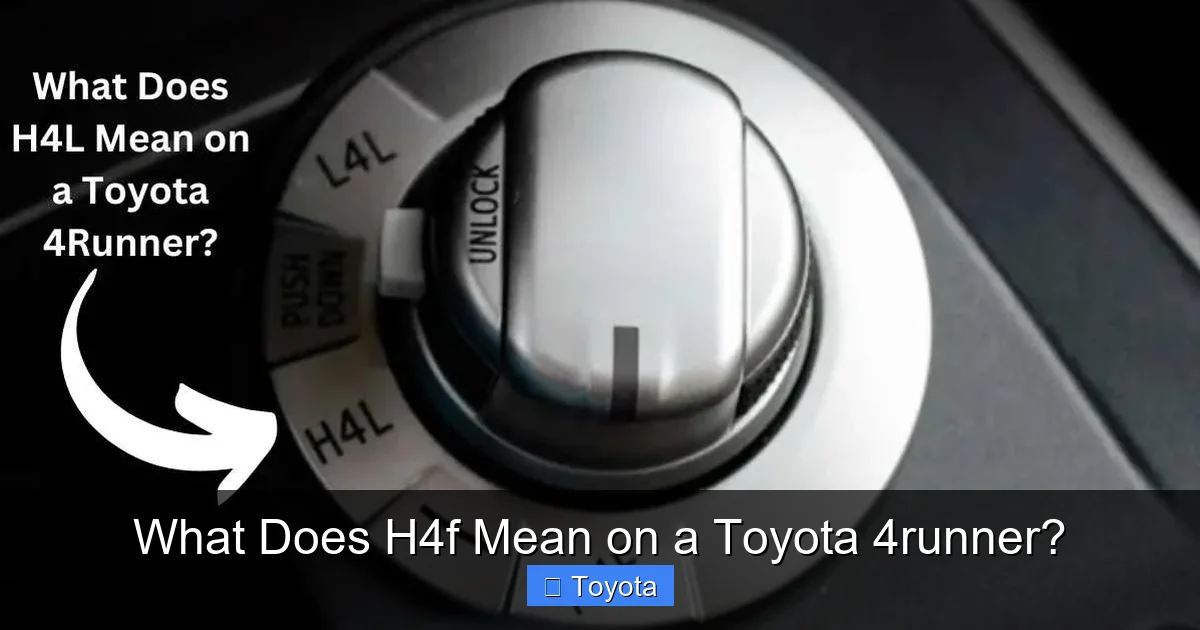
2. **Turn the 4WD selector dial or move the lever**: On most models, this is located on the center console. Turn it from “2WD” to “H4F.”
3. **Wait for confirmation**: You’ll usually see “H4F” appear on the dashboard display. Some models may also have a light or chime to confirm engagement.
4. **Drive normally**: Once engaged, your 4Runner will send power to all four wheels. You may notice a slight change in handling, especially on dry roads.
If you’re shifting from H4F to L4L (Low Range), you’ll need to come to a complete stop, shift the transmission into neutral, and then turn the dial to L4L. This is because the gear reduction in low range requires a full stop to avoid grinding.
Tips for Safe and Effective Use
– **Don’t use H4F on dry pavement**: This can cause drivetrain binding and damage.
– **Disengage when conditions improve**: Once you’re back on dry roads, shift back to 2WD to protect your drivetrain and save fuel.
– **Practice in a safe area**: If you’re new to 4WD, try shifting modes in an empty parking lot or quiet road to get a feel for how your vehicle responds.
– **Check your owner’s manual**: Always refer to your specific model’s instructions, as procedures can vary.
Benefits of Using H4F
Visual guide about What Does H4f Mean on a Toyota 4runner?
Image source: vehiclesauthority.com
Engaging H4F offers several advantages, especially when driving in challenging conditions. Here’s why it’s such a valuable feature on the Toyota 4Runner.
Improved Traction and Stability
The primary benefit of H4F is increased traction. By sending power to all four wheels, your 4Runner can maintain grip even when one or two wheels start to slip. This is especially helpful on snowy roads, where a rear-wheel-drive vehicle might spin out when accelerating.
H4F also improves stability during cornering on loose surfaces. Because all wheels are driven, the vehicle is less likely to slide or lose control. This gives you more confidence when driving on gravel, dirt, or wet pavement.
Better Off-Road Performance
For off-road enthusiasts, H4F is a game-changer. It allows the 4Runner to tackle trails, river crossings, and steep inclines with greater ease. The even power distribution helps prevent wheel spin and keeps the vehicle moving forward, even in deep mud or loose sand.
Combined with features like skid plates, high ground clearance, and available locking rear differentials, H4F makes the 4Runner one of the most capable SUVs in its class.
Enhanced Safety in Adverse Weather
In regions with frequent snow, ice, or heavy rain, H4F can significantly improve safety. It reduces the risk of skidding, sliding, or getting stuck, giving you better control in emergencies. Many drivers report feeling more secure and in command when H4F is engaged during winter storms.
Prevents Mechanical Seizure
Interestingly, occasionally using H4F can actually help maintain your drivetrain. When the front axle and transfer case are used regularly, the internal components stay lubricated and functional. If you never engage 4WD, parts can seize up or corrode over time. So even if you don’t off-road often, it’s a good idea to shift into H4F once in a while—just to keep things moving.
Common Misconceptions About H4F
Despite its usefulness, H4F is often misunderstood. Let’s clear up some common myths and misconceptions.
Myth: H4F Is the Same as AWD
All-wheel drive (AWD) and 4WD are not the same. AWD systems are typically full-time and use electronic controls to send power to the wheels with the most grip. They’re great for light snow and rain but not designed for serious off-roading.
H4F, on the other hand, is a mechanical, part-time system that locks the axles together. It’s more robust and better suited for extreme conditions, but it requires driver input and shouldn’t be used on dry roads.
Myth: You Can Use H4F All the Time
Some drivers think that because 4WD improves traction, they should use it all the time. But that’s not true for part-time systems like the 4Runner’s. Using H4F on dry pavement can cause drivetrain damage, tire wear, and poor handling. Reserve it for when you actually need it.
Myth: H4F Makes You Invincible Off-Road
While H4F greatly improves capability, it doesn’t make your 4Runner indestructible. You still need to drive carefully, avoid obstacles you can’t clear, and use proper recovery techniques if you get stuck. 4WD helps, but it’s not a substitute for skill and caution.
Maintenance Tips for Your 4Runner’s 4WD System
To keep your 4Runner’s 4WD system—including H4F—working properly, regular maintenance is key.
Check Fluids Regularly
The transfer case and front differential have their own fluid reservoirs. Check these levels during routine service and top them off if needed. Dirty or low fluid can lead to overheating and component failure.
Lubricate the Driveshaft and U-Joints
The driveshafts and universal joints should be greased periodically. This prevents rust and ensures smooth power transfer. If you hear clunking or vibration, it could be a sign of worn U-joints.
Inspect for Leaks and Damage
Look under your 4Runner for signs of fluid leaks, cracked seals, or damaged components. Off-roading can expose the undercarriage to rocks and debris, so regular inspections are important.
Use H4F Periodically
Even if you don’t off-road often, shift into H4F once a month for a few minutes. This keeps the transfer case and front axle lubricated and prevents parts from seizing.
Conclusion
H4F on your Toyota 4Runner is more than just a dashboard light—it’s a powerful tool that enhances traction, stability, and off-road capability. By understanding what it means, when to use it, and how to maintain your 4WD system, you can get the most out of your vehicle while keeping it in top condition.
Whether you’re driving through a snowstorm, exploring a backcountry trail, or just navigating a muddy driveway, H4F gives you the confidence to keep moving. Just remember: use it wisely, disengage when conditions improve, and treat your 4Runner’s mechanical systems with care.
With this knowledge, you’re ready to tackle whatever the road—or trail—throws your way.
Frequently Asked Questions
What does H4F mean on a Toyota 4Runner?
H4F stands for High Range 4WD with Front Axle Engagement. It means your 4Runner is in four-wheel-drive mode, with power sent to all four wheels for improved traction on slippery or uneven surfaces.
Can I drive on dry pavement in H4F mode?
No, you should not drive on dry pavement in H4F. This can cause drivetrain binding, tire wear, and potential damage because the front and rear axles are locked together.
When should I use H4F?
Use H4F when driving on snow, ice, mud, gravel, or wet roads where traction is reduced. It’s ideal for slippery conditions at speeds under 55 mph.
How do I shift into H4F?
You can shift into H4F while driving under 55 mph by turning the 4WD selector dial from 2WD to H4F. Wait for the dashboard confirmation before continuing.
Is H4F the same as L4L?
No, H4F is high-range 4WD for normal speeds, while L4L is low-range 4WD for extreme off-roading at very slow speeds. They serve different purposes.
Do I need to maintain my 4Runner’s 4WD system?
Yes, regular maintenance like checking fluids, lubricating driveshafts, and occasionally using H4F helps keep the system in good working order.
