
How Much Does It Cost to Lease a Chrysler 300?

Leasing a Chrysler 300 typically costs between $350 and $550 per month, depending on trim, location, credit score, and lease terms. With a down payment of $2,000 to $5,000 and 10,000–15,000 annual miles, you can drive this bold full-size sedan affordably. Always compare offers and negotiate to maximize value.
Thinking about leasing a Chrysler 300? You’re not alone. This full-size sedan has long been a favorite for drivers who want bold styling, a smooth ride, and a touch of American luxury—without the long-term commitment of ownership. Whether you’re commuting daily, road-tripping on weekends, or just love the presence of a powerful V6 under the hood, the Chrysler 300 delivers a confident driving experience. But before you sign on the dotted line, it’s smart to understand exactly how much it costs to lease a Chrysler 300 in today’s market.
Leasing isn’t just about monthly payments—it’s a bundle of factors including down payments, mileage limits, lease terms, and hidden fees. And while the Chrysler 300 may not be as flashy as some European sedans, it offers serious value, especially when you factor in current incentives and competitive lease deals. In this guide, we’ll break down everything you need to know about leasing a Chrysler 300, from average costs and what affects them, to tips for getting the best possible deal. By the end, you’ll be ready to walk into a dealership (or shop online) with confidence.
Key Takeaways
- Monthly lease payments for a Chrysler 300 range from $350 to $550, influenced by trim level, incentives, and creditworthiness.
- Down payments usually fall between $2,000 and $5,000, though $0-down deals may be available with strong credit and promotions.
- Lease terms are commonly 36 months, with 10,000 to 15,000 miles per year included; exceeding limits incurs extra fees.
- Higher trims like the 300C or 300S increase monthly costs due to upgraded features, performance, and luxury amenities.
- Manufacturer incentives and dealer promotions can reduce costs—timing your lease around end-of-year or model-year clearance events helps.
- Credit score significantly impacts lease rates; a score above 720 typically qualifies for the best money factors (interest rates).
- Always read the fine print to understand acquisition fees, disposition fees, wear-and-tear policies, and early termination penalties.
📑 Table of Contents
Understanding Chrysler 300 Lease Pricing
So, how much does it really cost to lease a Chrysler 300? The short answer: it depends. But on average, you can expect monthly payments to fall between $350 and $550. That’s a wide range, and it reflects the many variables that influence lease costs. Let’s unpack what drives that number.
First, the trim level matters. The base model—usually the Chrysler 300 Touring—starts at a lower price point and comes with standard features like an 8.4-inch touchscreen, Apple CarPlay, Android Auto, and a 3.6-liter V6 engine. Leasing this version will naturally cost less than stepping up to the 300S or the top-tier 300C, which adds performance upgrades, premium audio, leather seats, and more aggressive styling.
Next, your credit score plays a big role. Leasing companies use a “money factor” (similar to an interest rate) to calculate your monthly payment. If you have excellent credit (720 or higher), you’ll qualify for the lowest money factors, often below 0.00150. But if your score is lower, that number can climb, increasing your monthly cost by $30–$50 or more.
Location also affects pricing. Dealerships in high-demand urban areas or regions with strong incentives may offer better deals. For example, Chrysler often runs regional promotions that reduce capitalized costs or offer cash-back bonuses, which directly lower your lease payment.
Finally, the length of your lease and annual mileage allowance will shape your costs. Most leases are 36 months, but 24- or 48-month options exist. Shorter terms usually mean higher monthly payments but less total interest. Mileage limits typically range from 10,000 to 15,000 miles per year—go over, and you’ll pay 15 to 25 cents per extra mile.
Real-World Lease Examples
Let’s look at a few real-world scenarios to make this more concrete.
Imagine you’re leasing a 2024 Chrysler 300 Touring in Dallas, Texas, with a 36-month term and 12,000 miles per year. With a $3,000 down payment and excellent credit, your monthly payment might be around $399. That includes taxes and fees, and assumes you’re taking advantage of a current $2,000 cash incentive from Chrysler Financial.
Now, compare that to someone leasing the same car in New York City with a lower credit score and only $1,500 down. Their monthly payment could jump to $475 or more, even with the same incentives. The difference? Higher money factor and possibly additional fees for registration or documentation.
Or consider the 300S trim. With its sport-tuned suspension, larger wheels, and upgraded interior, the monthly payment might start at $450 with the same down payment and terms. Add in a $4,000 down payment, and you could push that down to $410—still a solid deal for a well-equipped sedan.
These examples show why it pays to shop around. A few hundred dollars in down payment or a slight improvement in credit can make a noticeable difference over three years.
Factors That Influence Lease Costs
Visual guide about How Much Does It Cost to Lease a Chrysler 300?
Image source: eautolease.com
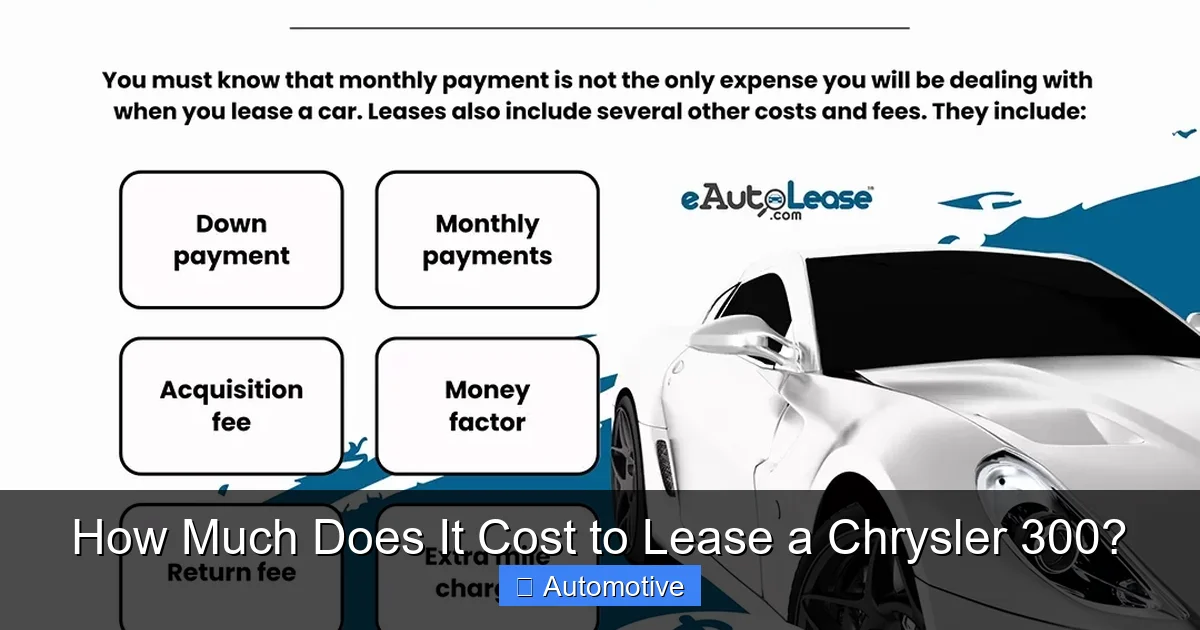
Now that you have a sense of the price range, let’s dive deeper into the factors that determine how much you’ll pay to lease a Chrysler 300. Understanding these elements will help you negotiate better and avoid surprises.
Trim Level and Options
The Chrysler 300 comes in several trims: Touring, Touring L, 300S, and 300C. Each adds features that increase the vehicle’s residual value and, by extension, your lease cost.
The Touring is the most affordable to lease, starting around $350–$400 per month with a reasonable down payment. It includes essentials like dual-zone climate control, a rearview camera, and a decent sound system.
Step up to the Touring L, and you get leather-trimmed seats, heated front seats, and a power-adjustable driver’s seat. This trim typically adds $30–$50 to your monthly payment.
The 300S is the sporty option, with a blacked-out grille, performance suspension, and optional all-wheel drive. It’s popular among drivers who want a more dynamic look and feel. Expect to pay $450–$520 per month, depending on options.
At the top is the 300C, which features a 5.7-liter HEMI V8 engine, premium Nappa leather, and a Harman Kardon audio system. This is the luxury performance version, and leasing it can cost $550 or more per month—especially if you add packages like the SafetyTec Group or panoramic sunroof.
Optional packages also affect pricing. For example, the Uconnect 5 NAV system with navigation and wireless charging might add $1,500 to the capitalized cost, increasing your monthly payment by $15–$20 over 36 months.
Down Payment and Capitalized Cost
Your down payment—also called a “cap cost reduction”—directly lowers the amount you’re financing, which reduces your monthly payment. Most lessees put down between $2,000 and $5,000.
But here’s a pro tip: don’t overpay. While a larger down payment lowers your monthly cost, it also increases your risk if the car is totaled or stolen. You won’t get that money back unless you have gap insurance. Many experts recommend keeping the down payment under $3,000 and using manufacturer incentives instead to reduce the capitalized cost.
For example, Chrysler often offers $1,500 to $2,500 in lease cash or bonus cash. This money goes directly toward the car’s price, lowering your monthly payment without tying up your cash. It’s smarter than a large down payment because it’s applied before taxes and fees.
Lease Term and Mileage Allowance
Most Chrysler 300 leases are 36 months long. This is the sweet spot for balancing monthly cost and total depreciation. Shorter leases (24 months) have higher payments but let you upgrade sooner. Longer leases (48 months) lower the monthly cost but may come with higher wear-and-tear charges and less favorable residual values.
Mileage is another key factor. The standard allowance is 12,000 miles per year. If you drive more, you can prepay for extra miles (usually at a discount) or pay per-mile fees later. For example, adding 3,000 extra miles per year might cost $600 upfront ($200 per year), but going over without prepaying could cost $0.25 per mile—$750 for the same 3,000 miles.
If you’re a low-mileage driver, consider a 10,000-mile lease to save money. But if you commute long distances or take frequent road trips, a 15,000-mile lease is worth the small increase in monthly cost.
Credit Score and Money Factor
Your credit score determines the money factor—the lease equivalent of an interest rate. A higher score means a lower money factor, which reduces your monthly payment.
Here’s a rough guide:
– Excellent credit (720+): Money factor around 0.00120–0.00150
– Good credit (680–719): 0.00150–0.00200
– Fair credit (620–679): 0.00200–0.00250
To put that in perspective, a 0.00150 money factor on a $30,000 lease equals about $45 in monthly finance charges. At 0.00250, it’s $75—a $30 difference every month. Over 36 months, that’s $1,080 more in interest.
If your credit isn’t perfect, consider improving it before leasing. Pay down credit card balances, correct errors on your report, and avoid new credit applications in the months leading up to your lease.
Current Incentives and Promotions
Visual guide about How Much Does It Cost to Lease a Chrysler 300?
Image source: motorbiscuit.com
One of the best ways to reduce how much it costs to lease a Chrysler 300 is to take advantage of manufacturer incentives. Chrysler Financial frequently offers lease deals, cash bonuses, and low-money-factor promotions—especially at the end of the model year (typically August to October) or during holiday sales events.
Lease Cash and Bonus Cash
Chrysler often provides $1,500 to $2,500 in “lease cash” that can be applied directly to the capitalized cost of the vehicle. This is free money that lowers your monthly payment without requiring a larger down payment.
For example, a $2,000 lease cash incentive on a $35,000 car reduces the amount you’re financing to $33,000. Over 36 months, that could save you $55–$60 per month.
Bonus cash works similarly but may have restrictions—like requiring you to finance through Chrysler Financial or trade in a vehicle. Always read the fine print.
Low Money Factor Promotions
During special promotions, Chrysler may offer a reduced money factor—sometimes as low as 0.00099—for qualified lessees. This is equivalent to a 2.4% APR, which is very competitive.
These deals are often tied to specific trims or regions, so check the Chrysler website or contact local dealers to see what’s available in your area.
Employee and Military Discounts
Chrysler offers additional savings for eligible groups, including:
– Chrysler Employee Pricing for eligible employees and family members
– Military Appreciation Cash ($500–$1,000)
– First Responder Cash ($500)
These discounts can be stacked with lease cash, further reducing your cost. Just bring proof of eligibility (like a military ID or employment verification) when you lease.
Timing Your Lease
The best time to lease a Chrysler 300 is typically in late summer or early fall, when dealers are clearing out current-year models to make room for new ones. You’ll find bigger incentives, more inventory, and greater negotiating power.
Avoid leasing during peak seasons like spring or right after a new model launch, when demand is high and incentives are low.
Hidden Fees and Fine Print

Visual guide about How Much Does It Cost to Lease a Chrysler 300?
Image source: tffn.net
Even with a great monthly payment, leasing a Chrysler 300 can come with hidden costs. Knowing these upfront will help you budget accurately and avoid surprises.
Acquisition Fee
Also called the “bank fee,” this is charged by the leasing company to set up your lease. It typically ranges from $595 to $895 and is often due at signing. Some dealers may roll it into your monthly payment, but that increases the total cost.
Disposition Fee
When your lease ends, you’ll likely pay a disposition fee of $395 to $495 if you don’t buy the car. This covers the cost of reconditioning and resale. It’s non-negotiable, so factor it into your total lease cost.
Excess Wear and Tear
Leased vehicles must be returned in good condition. Normal wear is expected, but excessive damage—like large dents, stained upholstery, or tire wear beyond acceptable limits—can result in charges.
Chrysler’s guidelines allow for minor scratches and small dings, but anything beyond that may cost you. Consider purchasing a wear-and-tear protection plan if you’re concerned.
Early Termination Fees
Ending your lease early can be expensive. Most leases charge a fee equal to several months of payments, plus any remaining depreciation. Only terminate early if absolutely necessary—and explore options like lease transfer or buyout first.
Tips for Getting the Best Lease Deal
Now that you know the costs and factors involved, here’s how to get the best possible deal on a Chrysler 300 lease.
Shop Multiple Dealers
Get quotes from at least three dealerships—preferably in different cities or regions. Online tools like Edmunds, TrueCar, and Leasehackr can help you compare offers. Even a $20 difference per month adds up to $720 over three years.
Negotiate the Capitalized Cost
Just like buying, you can negotiate the price of the car before leasing. Aim to get the capitalized cost below the invoice price. Use pricing guides and recent sales data to back up your offer.
Ask About Incentives
Always ask what incentives are available. Some dealers may not mention them unless you ask. Bring printed copies of current offers from the Chrysler website to ensure you get them.
Consider a Lease Transfer
If you find a great deal but aren’t ready to commit, look into lease transfer websites. You can take over someone else’s lease with low mileage and favorable terms—often with no down payment.
Read the Contract Carefully
Before signing, review every line. Confirm the monthly payment, mileage allowance, fees, and end-of-lease options. Don’t hesitate to ask questions or request changes.
Is Leasing a Chrysler 300 Right for You?
Leasing a Chrysler 300 makes sense if you:
– Want lower monthly payments than buying
– Prefer driving a new car every few years
– Don’t drive excessive miles
– Want to avoid long-term maintenance costs
But if you drive a lot, plan to keep the car long-term, or want to build equity, buying might be a better choice.
The Chrysler 300 offers a unique blend of style, comfort, and performance. With the right lease deal, it can be an affordable way to enjoy a premium sedan without the commitment of ownership.
By understanding how much it costs to lease a Chrysler 300—and how to reduce that cost—you can make a smart, informed decision. Take your time, compare offers, and don’t rush into a deal. Your future self will thank you.
Frequently Asked Questions
What is the average monthly lease payment for a Chrysler 300?
The average monthly lease payment for a Chrysler 300 ranges from $350 to $550, depending on trim, down payment, credit score, and location. Base models with lower down payments and good credit tend to fall on the lower end of that range.
Can I lease a Chrysler 300 with no money down?
Yes, some dealerships offer $0-down lease deals on the Chrysler 300, especially during promotional periods. However, these often require excellent credit and may result in higher monthly payments. A small down payment usually leads to better overall value.
How many miles are included in a Chrysler 300 lease?
Most Chrysler 300 leases include 10,000 to 15,000 miles per year. The standard is typically 12,000 miles. If you exceed your allowance, you’ll be charged 15 to 25 cents per additional mile at the end of the lease.
What happens at the end of a Chrysler 300 lease?
At the end of your lease, you can return the car (after paying any excess wear, mileage, or disposition fees), buy it at its residual value, or lease a new Chrysler. Make sure to schedule a pre-inspection to avoid surprise charges.
Are there any current lease incentives for the Chrysler 300?
Yes, Chrysler frequently offers lease cash, bonus cash, and low money factor promotions—especially at the end of the model year. Check the official Chrysler website or contact local dealers for the latest offers in your area.
Can I negotiate the terms of my Chrysler 300 lease?
Absolutely. You can negotiate the capitalized cost, down payment, and even some fees. Use pricing data, compare multiple offers, and don’t be afraid to walk away if the deal isn’t right.
