
What Is the Towing Capacity of a Toyota Rav4?

The Toyota RAV4 offers a towing capacity ranging from 1,500 to 3,500 pounds, depending on the model year, engine, drivetrain, and trim level. With proper equipment and setup, the RAV4 can handle small trailers, boats, and campers with ease—making it a versatile choice for weekend adventurers.
Key Takeaways
- Towing capacity varies by model: Older RAV4 models (pre-2019) typically tow up to 1,500–2,000 lbs, while newer models (2019–present) can reach up to 3,500 lbs with the right configuration.
- Engine and drivetrain matter: The 2.5L four-cylinder engine paired with AWD significantly increases towing capability compared to FWD-only setups.
- Hybrid vs. gas models differ: RAV4 Hybrid models generally have a lower towing capacity (1,500–2,000 lbs) than their gas-powered counterparts due to battery weight and cooling needs.
- Towing package is essential: To achieve maximum towing capacity, you’ll need the factory-installed Tow Package, which includes a transmission cooler, wiring harness, and reinforced suspension.
- Payload and tongue weight count: Always account for passenger weight, cargo, and trailer tongue weight—exceeding payload limits can compromise safety and handling.
- Check your owner’s manual: Always refer to your specific vehicle’s manual or Toyota’s official towing guide for accurate, model-specific towing ratings.
- Regular maintenance improves towing safety: Ensure brakes, tires, fluids, and cooling systems are in top condition before towing, especially on long trips or steep terrain.
📑 Table of Contents
- What Is the Towing Capacity of a Toyota RAV4?
- Understanding Towing Capacity: What It Means and Why It Matters
- Toyota RAV4 Towing Capacity by Model Year and Trim
- Gas vs. Hybrid: How Engine Type Affects Towing
- The Importance of the Tow Package
- Practical Towing Tips for RAV4 Owners
- What Can You Actually Tow with a RAV4?
- Conclusion: Is the RAV4 Right for Your Towing Needs?
What Is the Towing Capacity of a Toyota RAV4?
If you’re considering a Toyota RAV4 for your next adventure—whether that’s hauling a small camper to the mountains, pulling a jet ski to the lake, or towing a utility trailer for a weekend project—you’re probably wondering: *Just how much can this compact SUV actually tow?* The answer isn’t one-size-fits-all. The towing capacity of a Toyota RAV4 depends on several factors, including the model year, engine type, drivetrain, and whether it’s equipped with the proper towing package.
Unlike full-size trucks or heavy-duty SUVs, the RAV4 isn’t built to haul massive loads. But don’t let its size fool you. Over the years, Toyota has steadily improved the RAV4’s towing capabilities, especially with the introduction of more powerful engines and advanced all-wheel-drive systems. Today’s RAV4 can handle a surprising amount of weight—enough for most recreational towing needs.
In this guide, we’ll break down everything you need to know about the Toyota RAV4’s towing capacity. We’ll cover how it varies across different generations, what equipment you need to tow safely, and practical tips to make the most of your RAV4’s towing power. Whether you’re a first-time buyer or a long-time RAV4 owner, this article will help you understand what your SUV can—and can’t—do when it comes to towing.
Understanding Towing Capacity: What It Means and Why It Matters
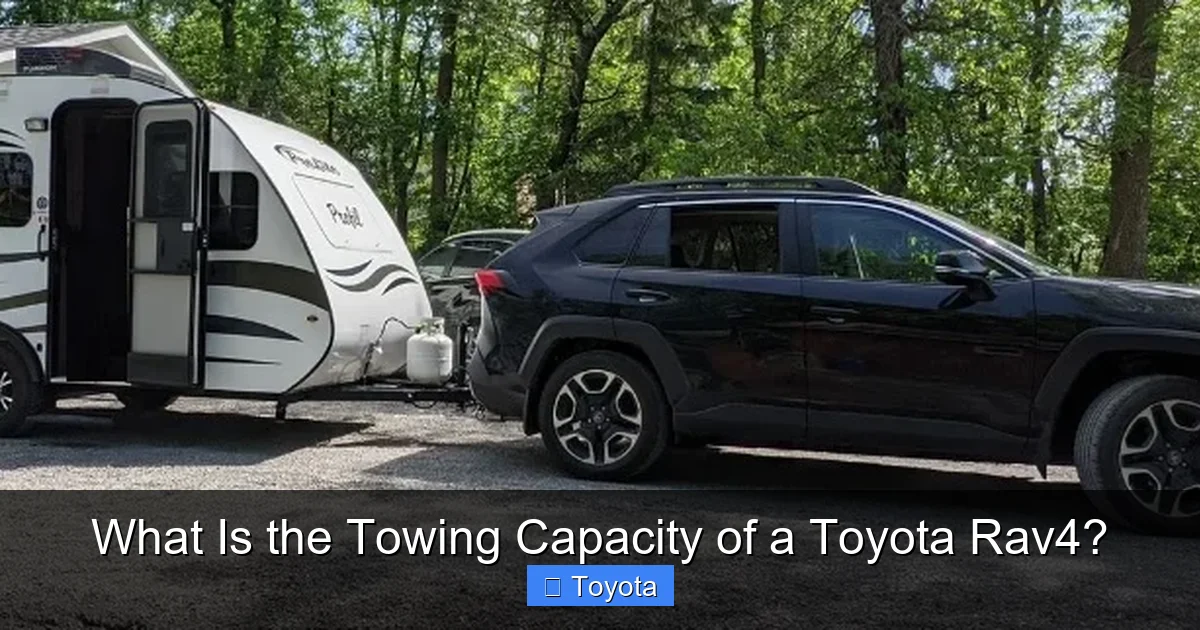
Visual guide about What Is the Towing Capacity of a Toyota Rav4?
Image source: towstats.com
Before diving into the numbers, it’s important to understand what “towing capacity” actually means. In simple terms, towing capacity is the maximum weight your vehicle can safely pull behind it, including the trailer, cargo, passengers, and any additional gear. Exceeding this limit can lead to serious safety risks, including brake failure, loss of control, transmission overheating, and even structural damage to your vehicle.
Toyota determines towing capacity based on rigorous testing that considers engine power, cooling systems, suspension strength, braking performance, and overall vehicle design. The rating you see isn’t just a suggestion—it’s a hard limit set by the manufacturer to ensure safe operation.
For the RAV4, this means that even if your friend’s RAV4 towed a 3,000-pound trailer last summer, your 2015 model with front-wheel drive might only be rated for 1,500 pounds. That’s why it’s crucial to know your specific vehicle’s capabilities.
Another key concept is “gross combined weight rating” (GCWR), which includes the weight of your vehicle, passengers, cargo, and the trailer. Your towing capacity is calculated by subtracting your vehicle’s curb weight and payload from the GCWR. Always stay within both the towing capacity and GCWR limits to avoid overloading.
Toyota RAV4 Towing Capacity by Model Year and Trim
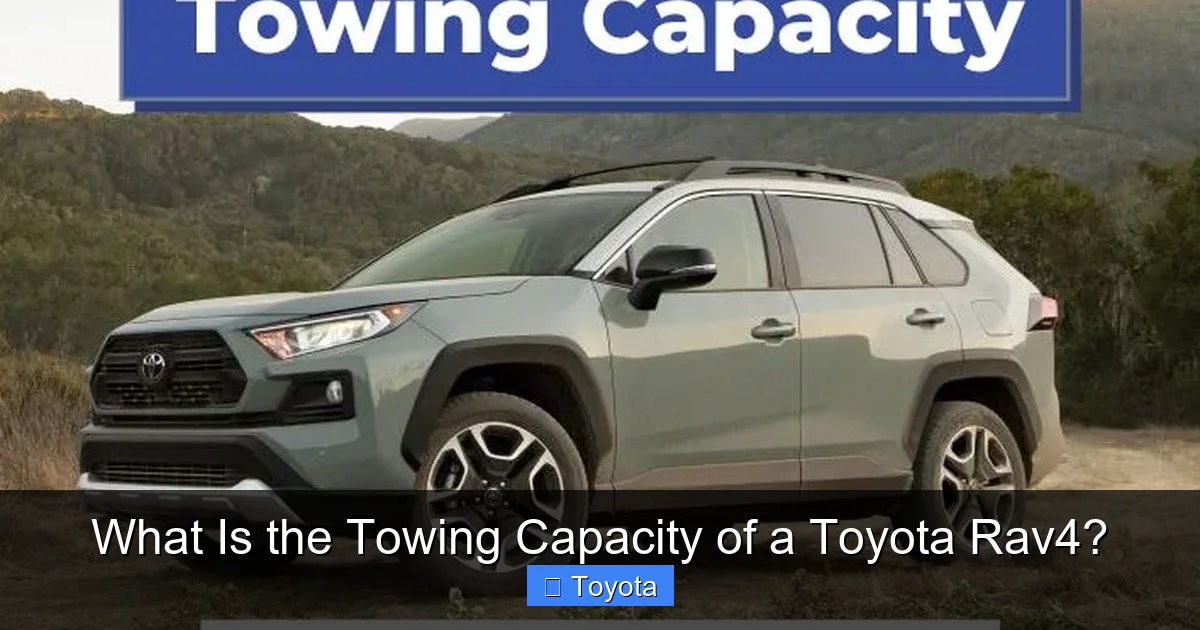
Visual guide about What Is the Towing Capacity of a Toyota Rav4?
Image source: towstats.com
The towing capacity of a Toyota RAV4 has evolved significantly over the years. Let’s take a closer look at how it varies across different generations and trims.
First Generation (1996–2000)
The original RAV4 was a compact, lightweight SUV designed more for city driving and light off-roading than heavy towing. These early models, equipped with a 2.0L four-cylinder engine and either front-wheel or all-wheel drive, had a modest towing capacity of just 1,500 pounds. That’s enough for a small utility trailer or a lightweight pop-up camper, but not much more.
Second Generation (2001–2005)
With the introduction of a more powerful 2.4L engine, the second-gen RAV4 saw a slight bump in towing capacity. Most models could now handle up to 1,500–2,000 pounds, depending on the drivetrain. AWD models with the larger engine were closer to the 2,000-pound mark, while FWD versions typically maxed out at 1,500 pounds.
Third Generation (2006–2012)
This generation brought a 2.4L or 3.5L V6 engine option, which significantly improved performance. The V6 models, especially those with AWD, could tow up to 3,500 pounds—a major leap for the RAV4. However, the four-cylinder models remained limited to around 1,500–2,000 pounds. It’s worth noting that the V6 was discontinued after 2012, so later models rely solely on four-cylinder engines.
Fourth Generation (2013–2018)
The fourth-gen RAV4 dropped the V6 engine and focused on fuel efficiency and refinement. As a result, towing capacity dropped back down. Most models, even with AWD, were rated for 1,500 pounds. However, some higher trims with the Tow Package could reach 2,000 pounds. This generation also introduced the RAV4 Hybrid, which had a towing capacity of just 1,500 pounds due to the added weight of the hybrid battery and cooling requirements.
Fifth Generation (2019–Present)
The current generation RAV4, introduced in 2019, marked a return to stronger towing performance. With a more robust 2.5L four-cylinder engine and improved AWD system, gas-powered models can now tow up to 3,500 pounds when properly equipped. This is a huge improvement and brings the RAV4 back in line with some of its competitors.
However, the RAV4 Hybrid and RAV4 Prime (plug-in hybrid) have lower towing capacities. The Hybrid is rated for 1,500–2,000 pounds, while the Prime can tow up to 2,500 pounds—still impressive for a plug-in hybrid, but less than the gas-only models.
Trim-Level Differences
Even within the same model year, towing capacity can vary by trim. For example, in the 2023 RAV4 lineup:
– LE and XLE trims with FWD: 1,500 lbs
– LE and XLE with AWD: 2,000 lbs
– XLE Premium, Limited, and TRD Off-Road with AWD and Tow Package: 3,500 lbs
Always check your specific trim and options to determine your exact towing capacity.
Gas vs. Hybrid: How Engine Type Affects Towing
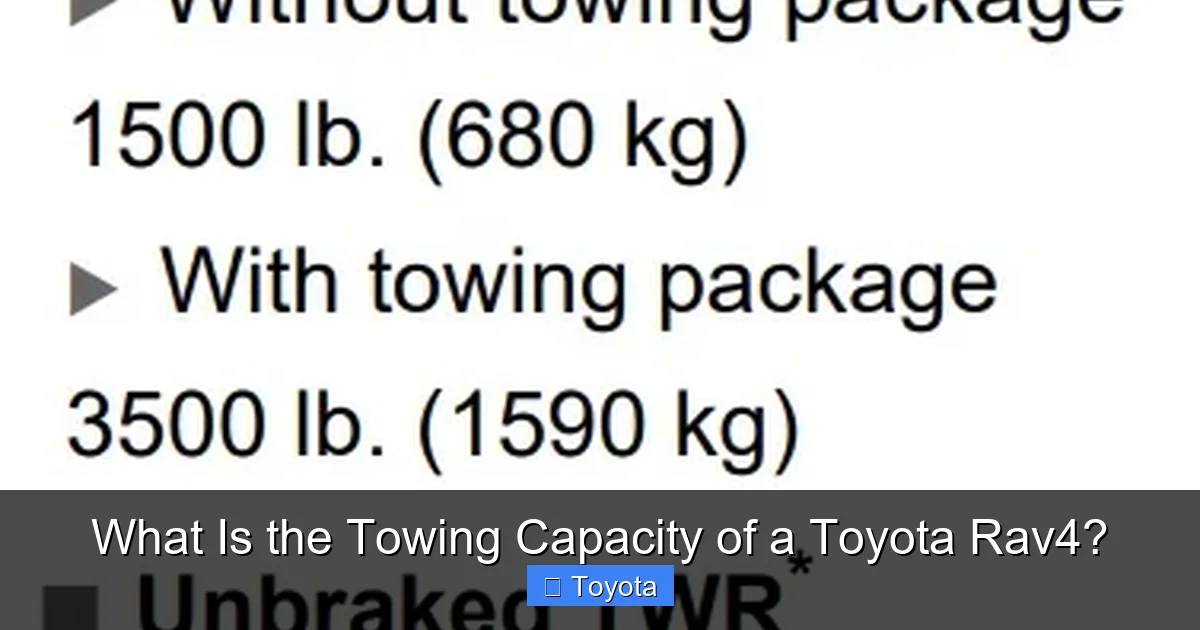
Visual guide about What Is the Towing Capacity of a Toyota Rav4?
Image source: towstats.com
One of the biggest factors influencing the RAV4’s towing capacity is whether it’s a gas-powered or hybrid model. While both are built on the same platform, their towing capabilities differ significantly.
Gas-Powered RAV4
The standard 2.5L four-cylinder engine in gas-only RAV4 models delivers 203 horsepower and 184 lb-ft of torque. When paired with AWD and the optional Tow Package, this engine provides enough power and cooling to handle up to 3,500 pounds. The Tow Package includes a transmission cooler, heavy-duty radiator, wiring harness, and upgraded suspension—all essential for safe towing.
Gas models also tend to have better weight distribution and simpler cooling systems, which help maintain performance under load. This makes them the better choice if you plan to tow frequently or pull heavier loads.
RAV4 Hybrid
The RAV4 Hybrid combines the same 2.5L engine with electric motors for a total output of 219 horsepower. While this sounds more powerful, the hybrid system adds weight—especially from the battery pack—and requires additional cooling. Toyota limits the Hybrid’s towing capacity to 1,500–2,000 pounds to protect the hybrid components and ensure longevity.
That said, the Hybrid’s electric motors provide instant torque, which can make low-speed towing feel smoother. It’s still capable of handling small trailers, kayaks, or lightweight campers, but it’s not ideal for heavier loads.
RAV4 Prime (Plug-In Hybrid)
The RAV4 Prime is the most powerful RAV4 ever made, with 302 horsepower from its plug-in hybrid system. Despite this, its towing capacity is capped at 2,500 pounds. The reason? The large battery pack adds significant weight, and Toyota prioritizes battery life and thermal management over towing performance.
Still, 2,500 pounds is enough for a small travel trailer or a pair of ATVs, making the Prime a solid option for eco-conscious adventurers who want both efficiency and capability.
The Importance of the Tow Package
If you’re serious about towing with your RAV4, the Tow Package isn’t optional—it’s essential. This factory-installed option is available on most AWD trims and significantly increases your vehicle’s towing capacity.
What’s Included in the Tow Package?
The Toyota RAV4 Tow Package typically includes:
– **Transmission cooler:** Prevents overheating when towing heavy loads, especially in hot weather or on long climbs.
– **Heavy-duty radiator:** Improves engine cooling under stress.
– **Wiring harness:** Allows you to connect trailer lights (brake, turn, and running lights) safely and legally.
– **Upgraded suspension:** Reinforces the rear suspension to handle the added weight and improve stability.
– **Trailer sway control:** Uses the vehicle’s stability control system to detect and correct trailer sway.
– **Tow hitch receiver:** A Class III hitch rated for up to 3,500 pounds (when properly equipped).
Without the Tow Package, your RAV4’s towing capacity may be reduced by as much as 1,500 pounds. For example, a 2023 RAV4 Limited with AWD can tow 3,500 pounds with the package, but only 2,000 pounds without it.
Can You Add the Tow Package Later?
Unfortunately, the Tow Package must be installed at the factory. You can’t add it as a dealer-installed accessory after purchase. If you’re buying a used RAV4, make sure it came with the Tow Package if you plan to tow near the maximum capacity.
However, some components—like the wiring harness or hitch—can be added separately. Just keep in mind that without the transmission cooler and upgraded cooling systems, you won’t achieve the full 3,500-pound rating.
Practical Towing Tips for RAV4 Owners
Towing safely with a RAV4 isn’t just about knowing the numbers—it’s about preparation, technique, and maintenance. Here are some practical tips to help you get the most out of your SUV’s towing capacity.
Know Your Payload Limit
Towing capacity isn’t the only limit you need to worry about. Your RAV4 also has a payload capacity—the total weight of passengers, cargo, and tongue weight (the downward force exerted by the trailer on the hitch). For most RAV4 models, payload ranges from 1,000 to 1,200 pounds.
For example, if your RAV4 has a 1,200-pound payload limit and you’re carrying three passengers (450 lbs), luggage (100 lbs), and a trailer with 300 pounds of tongue weight, you’ve already used 850 pounds. That leaves only 350 pounds for additional cargo—so pack light.
Distribute Weight Properly
When loading your trailer, aim to place 60% of the weight in the front half and 40% in the rear. This helps prevent trailer sway and improves handling. Avoid overloading the rear of the trailer, which can cause fishtailing.
Also, secure all cargo to prevent shifting during transit. Loose items can become dangerous projectiles in the event of sudden stops or swerves.
Use the Right Hitch and Ball
Make sure your hitch and ball are rated for the weight you’re towing. A Class III hitch is required for up to 3,500 pounds. The ball size (usually 2 inches) must match your trailer’s coupler.
Never use a bumper pull hitch or makeshift setup. These can damage your vehicle and are unsafe.
Check Tire Pressure and Brakes
Underinflated tires can overheat and fail when towing. Check your tire pressure before every trip and adjust according to the load. Also, inspect your brakes—towing puts extra strain on them, so ensure they’re in good condition.
Consider upgrading to high-performance brake pads if you tow frequently.
Practice Safe Driving Habits
Towing changes how your RAV4 handles. Allow extra distance for braking, take turns wider, and avoid sudden maneuvers. Use lower gears when descending hills to reduce brake wear.
If your trailer has electric brakes, make sure the brake controller is properly calibrated. Most RAV4s with the Tow Package come with a built-in brake controller.
Perform Regular Maintenance
Towing increases wear on your engine, transmission, and cooling system. Follow Toyota’s recommended maintenance schedule, and consider more frequent oil changes and fluid checks if you tow often.
Pay special attention to the transmission fluid—overheating is a common cause of transmission failure in towing scenarios.
What Can You Actually Tow with a RAV4?
Now that you know the numbers, let’s put them into real-world context. What kinds of trailers and equipment can a Toyota RAV4 realistically handle?
Lightweight Trailers (Up to 1,500 lbs)
– Small utility trailers (e.g., 4×6 or 5×8)
– Kayak or canoe trailers
– Motorcycle trailers
– Pop-up campers (lightweight models)
These are ideal for FWD RAV4s or Hybrid models. Even without the Tow Package, you can safely tow these with proper setup.
Medium Trailers (1,500–2,500 lbs)
– Small travel trailers (e.g., teardrop or A-frame campers)
– Jet ski or small boat trailers
– ATV or side-by-side trailers
– Medium utility trailers with cargo
These require AWD and, preferably, the Tow Package. The RAV4 Hybrid and Prime can handle this range, but gas models will perform better.
Heavy Trailers (2,500–3,500 lbs)
– Larger travel trailers (up to 20 feet)
– Small fishing boats with trailers
– Cargo trailers with heavy loads
– Small horse or equipment trailers
Only gas-powered RAV4s with AWD and the Tow Package should attempt these loads. Always double-check your trailer’s actual weight—including water, gear, and batteries—before hitting the road.
What You Should Avoid
– Large fifth-wheel or gooseneck trailers
– Heavy boats (over 3,000 lbs)
– Full-sized campers or RVs
– Multiple ATVs or vehicles
These exceed the RAV4’s design limits and can cause serious damage or accidents.
Conclusion: Is the RAV4 Right for Your Towing Needs?
The Toyota RAV4 may not be the first vehicle that comes to mind when you think of towing, but it’s more capable than many people realize. With the right configuration—especially a gas-powered model with AWD and the Tow Package—it can handle up to 3,500 pounds, making it suitable for a wide range of recreational towing tasks.
However, it’s not a workhorse. If you frequently tow heavy loads or need to haul large trailers, a pickup truck or larger SUV like the Toyota Highlander or 4Runner might be a better fit. But for weekend warriors, campers, and outdoor enthusiasts, the RAV4 strikes an excellent balance of efficiency, comfort, and capability.
The key is knowing your vehicle’s limits and preparing accordingly. Always check your owner’s manual, use the proper equipment, and practice safe towing habits. With the right approach, your RAV4 can be a reliable partner for years of adventures.
Frequently Asked Questions
Can a Toyota RAV4 tow a camper?
Yes, but it depends on the camper’s weight and your RAV4’s configuration. Lightweight pop-up or teardrop campers (under 2,000 lbs) are ideal. Heavier travel trailers may require a gas-powered RAV4 with AWD and the Tow Package to safely reach 3,500 lbs.
Does towing reduce the RAV4’s fuel economy?
Absolutely. Towing increases aerodynamic drag and engine load, which can cut fuel economy by 20–40%. Expect lower MPG, especially on highways or uphill terrain. Plan for more frequent fuel stops on long trips.
Can I tow with a RAV4 Hybrid?
Yes, but its towing capacity is limited to 1,500–2,000 pounds. It’s best for light trailers like kayaks, small campers, or utility loads. Avoid heavy loads to protect the hybrid system.
Do I need a special license to tow with a RAV4?
In most U.S. states, no special license is required to tow a trailer under 10,000 pounds with a standard passenger vehicle like the RAV4. However, check your local laws—some states have specific rules for trailers over certain weights.
Can I install a hitch on my RAV4 myself?
Yes, you can install a Class III hitch yourself if you’re mechanically inclined. However, for the full Tow Package (including transmission cooler and wiring), factory installation is required to achieve maximum towing capacity.
What happens if I exceed the RAV4’s towing capacity?
Exceeding the towing limit can cause transmission failure, brake overheating, loss of control, and void your warranty. It also increases the risk of accidents. Always stay within the manufacturer’s recommended limits.
