
How to Fix Check Hybrid System on Toyota Camry

If your Toyota Camry displays a “Check Hybrid System” warning, don’t panic—this guide walks you through common causes, DIY fixes, and when to seek professional help. From battery issues to software glitches, we cover everything you need to restore your hybrid’s performance safely and affordably.
Key Takeaways
- Understand the warning: The “Check Hybrid System” light indicates a fault in the hybrid powertrain, not just the engine or transmission.
- Common culprits include: Weak 12V battery, high-voltage battery degradation, inverter problems, or faulty sensors.
- DIY checks can help: Inspect the 12V battery, check for loose connections, and scan for error codes using an OBD2 scanner.
- Regular maintenance matters: Keep up with scheduled service, especially coolant changes and battery inspections.
- Don’t ignore the light: Driving with the warning on can cause further damage or leave you stranded.
- Software updates may fix it: Some issues are resolved with a simple ECU or hybrid system update from a dealer.
- Professional diagnosis is key: Complex hybrid systems require specialized tools and knowledge—know when to call a technician.
📑 Table of Contents
What Does “Check Hybrid System” Mean on a Toyota Camry?
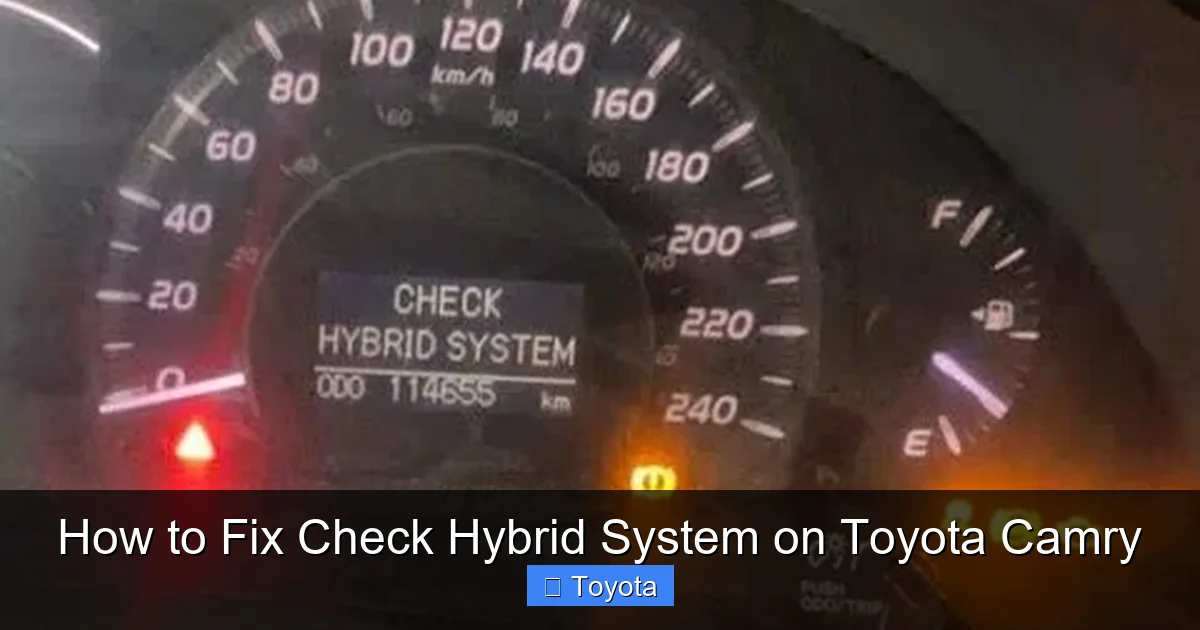
Seeing the “Check Hybrid System” warning light flash on your Toyota Camry’s dashboard can be alarming—especially if you’re not familiar with hybrid vehicle diagnostics. Unlike a simple “Check Engine” light, this message specifically points to an issue within the hybrid powertrain, which includes the electric motor, high-voltage battery, inverter, and control systems. It’s your car’s way of saying, “Something’s not right with how I’m managing power between gas and electric.”
This warning doesn’t always mean a major breakdown is imminent. In many cases, it’s triggered by minor issues like a weak auxiliary battery, a loose connection, or a temporary sensor glitch. However, it’s never something to ignore. The hybrid system is complex and tightly integrated, so even small faults can affect performance, fuel efficiency, and safety. For example, if the high-voltage battery isn’t charging properly, your Camry might struggle to switch between electric and gasoline modes, leading to reduced power or even a no-start condition.
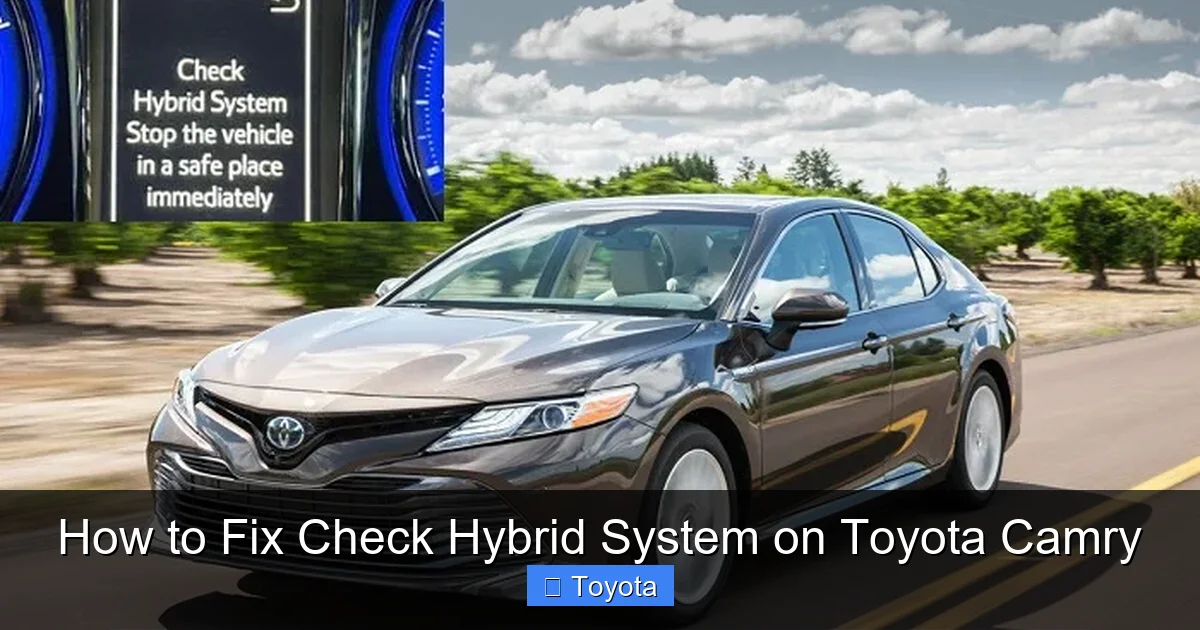
Understanding what this warning means is the first step toward fixing it. The Toyota Camry Hybrid relies on a sophisticated synergy between its gasoline engine and electric motor. When the onboard computer (ECU) detects an anomaly—such as voltage irregularities, temperature spikes, or communication errors between components—it triggers the warning light and may even put the vehicle into a “limp mode” to prevent damage. This mode limits power and speed, making driving uncomfortable and potentially unsafe.
So, while the message might seem vague, it’s actually a protective measure. Your Camry is trying to tell you that one or more parts of the hybrid system aren’t operating within normal parameters. The good news? Many of these issues are fixable—some even with basic tools and a little know-how. But to get there, you need to know where to start.
Common Causes of the “Check Hybrid System” Warning
Visual guide about How to Fix Check Hybrid System on Toyota Camry
Image source: i.ytimg.com
The “Check Hybrid System” light can stem from a variety of issues, ranging from simple and inexpensive to complex and costly. Let’s break down the most common causes so you can better understand what might be going on under the hood—or rather, under the hybrid system cover.
1. Weak or Failing 12V Auxiliary Battery
You might be surprised, but one of the top reasons for this warning is a weak 12V battery. Yes, even though your Camry is a hybrid, it still relies on a standard 12-volt battery to power the electronics, lights, and control modules. If this battery is old, undercharged, or has corroded terminals, it can cause communication errors between the hybrid control unit and other systems.
For example, if the 12V battery voltage drops too low, the hybrid system may not initialize properly when you start the car. This can trigger the warning light even if the high-voltage battery is perfectly healthy. Many Toyota Camry Hybrid owners overlook this because they assume the hybrid system runs entirely on the large battery pack. But in reality, the 12V battery is the nervous system’s power source—without it, nothing communicates correctly.
A simple voltage test with a multimeter can reveal if your 12V battery is the culprit. A healthy battery should read around 12.6 volts when the car is off and 13.7–14.7 volts when the engine is running. If it’s below 12.4 volts, it’s time to charge or replace it. Replacing a 12V battery is relatively inexpensive (typically $100–$200) and can be done in under an hour, even by a novice.
2. High-Voltage Battery Degradation
The high-voltage (HV) battery pack is the heart of your Camry’s hybrid system. It stores energy from regenerative braking and powers the electric motor. Over time, these batteries degrade—just like the battery in your phone or laptop. As they age, their capacity to hold a charge diminishes, which can trigger the “Check Hybrid System” warning.
Degradation doesn’t always mean the battery is dead. It might still function, but with reduced efficiency. For instance, you might notice shorter electric-only driving ranges, slower acceleration, or the engine kicking in more often than usual. In some cases, the battery management system (BMS) detects uneven cell voltages or excessive internal resistance and flags the issue.
Toyota Camry Hybrids typically have a warranty on the HV battery for 8 years or 100,000 miles (sometimes longer in certain states). If your car is still under warranty, you may be eligible for a free replacement or repair. Even out of warranty, many independent shops offer reconditioning services that can restore partial functionality at a fraction of the cost of a new pack.
3. Inverter or Converter Malfunction
The inverter is a critical component that converts DC power from the high-voltage battery into AC power for the electric motor. It also manages power flow during regenerative braking. If the inverter overheats, fails, or develops a fault, the hybrid system can’t function properly—leading to the warning light.
One telltale sign of inverter trouble is a burning smell or unusual noises from under the hood. You might also notice the car shuddering during acceleration or the electric motor not engaging at all. In severe cases, the vehicle may not start.
Inverters are expensive to replace (often $2,000–$4,000), but sometimes the issue is as simple as a blown fuse or a clogged cooling fan. The inverter is liquid-cooled in most Camry Hybrids, so checking the coolant level and condition is important. Low or contaminated coolant can cause overheating and trigger the warning.
4. Faulty Sensors or Wiring Issues
Modern hybrids rely on a network of sensors to monitor voltage, temperature, current, and system status. If a sensor—like the current sensor, temperature sensor, or voltage sensor—sends incorrect data, the ECU may interpret it as a system fault.
For example, a faulty temperature sensor might report that the HV battery is overheating when it’s actually fine. This can cause the system to shut down electric operation as a safety precaution. Similarly, corroded or loose wiring harnesses can cause intermittent communication errors.
These issues are often tricky to diagnose without a professional scan tool. However, visual inspections can help. Look for frayed wires, loose connectors, or signs of moisture intrusion—especially around the battery pack and inverter.
5. Software Glitches or Outdated Firmware
Believe it or not, sometimes the “Check Hybrid System” light comes on due to a software bug or outdated firmware. Toyota periodically releases updates for the hybrid control system to improve performance, fix bugs, and enhance diagnostics.
If your Camry hasn’t had a recent software update, a glitch could be causing false alarms. For instance, a temporary communication error between the hybrid ECU and the engine control module might trigger the light—even if everything is physically fine.
A visit to a Toyota dealership can resolve this with a quick reflash of the system software. This is often free under warranty and takes less than 30 minutes.
How to Diagnose the Problem Yourself
Visual guide about How to Fix Check Hybrid System on Toyota Camry
Image source: somegadgetguy.com
Before rushing to the mechanic, there are several steps you can take to diagnose the issue at home. While hybrid systems are complex, many common problems have simple checks you can perform with basic tools.
Step 1: Check the 12V Battery
Start with the easiest fix. Pop the hood and locate the 12V battery (usually near the front passenger side). Inspect the terminals for corrosion—white, powdery buildup can disrupt electrical flow. Clean them with a wire brush and a mixture of baking soda and water if needed.
Next, test the voltage with a multimeter. With the car off, a healthy battery should read 12.4–12.7 volts. If it’s below 12.2 volts, charge it using a battery charger. If it won’t hold a charge, it’s likely time for a replacement.
Step 2: Look for Obvious Damage or Leaks
Inspect the engine bay for signs of damage, leaks, or loose components. Check the inverter coolant reservoir—low coolant can cause overheating. Also, look for any disconnected or frayed wires, especially around the hybrid battery area (usually behind the rear seats).
Step 3: Use an OBD2 Scanner
Even though the “Check Hybrid System” light isn’t a standard OBD2 code, many modern scanners can read hybrid-specific trouble codes. Invest in a scanner that supports Toyota hybrid systems (like the BlueDriver or Autel MaxiCOM). Plug it into the OBD2 port (under the dashboard near the steering wheel) and scan for codes.
Common codes you might see include:
– P0A80: Replace Hybrid Battery Pack
– P3000: Hybrid Battery Control System Malfunction
– P3125: HV Battery Cooling System Problem
These codes give you a clearer picture of what’s wrong. For example, P0A80 often indicates battery degradation, while P3125 points to a cooling fan or sensor issue.
Step 4: Monitor Driving Behavior
Pay attention to how your Camry drives. Does it hesitate when accelerating? Does the engine run constantly? Does the electric motor seem weaker? These clues can help narrow down the issue. For instance, if the car won’t go into EV mode at low speeds, the HV battery or inverter might be at fault.
DIY Fixes You Can Try at Home
Visual guide about How to Fix Check Hybrid System on Toyota Camry
Image source: cararac.com
If your diagnosis points to a simple issue, you might be able to fix it yourself—saving time and money.
Replace the 12V Battery
If your 12V battery is weak or old (typically over 4–5 years), replacing it is a straightforward job. Buy a compatible battery (check your owner’s manual for specifications), disconnect the negative terminal first, then the positive, and install the new one in reverse order. Reset the system by turning the ignition on for a few minutes without starting the engine.
Clean Battery Terminals and Connections
Corrosion on the 12V or HV battery terminals can cause poor conductivity. Use a terminal cleaner brush and dielectric grease to clean and protect the connections. This simple step can resolve communication issues and improve system performance.
Reset the Hybrid System
Sometimes, a temporary glitch can be cleared with a system reset. Try this:
1. Turn off the car and remove the key (or press the power button to turn off).
2. Disconnect the negative terminal of the 12V battery.
3. Wait 10–15 minutes to allow the system to fully discharge.
4. Reconnect the terminal and restart the car.
This reset can clear minor software errors and reinitialize the hybrid control unit.
Check and Replace Fuses
Blown fuses can disrupt power to critical components. Locate the fuse box (usually under the hood or dashboard) and check the fuses related to the hybrid system. Replace any that are blown with the correct amperage fuse.
When to See a Professional
While DIY fixes are great for simple issues, some problems require professional attention. Here’s when you should visit a Toyota-certified technician:
– The warning light persists after trying basic fixes.
– You’re getting complex error codes like P0A80 or P3000.
– There’s a burning smell, smoke, or unusual noises.
– The car won’t start or goes into limp mode.
– You’re uncomfortable working with high-voltage systems.
Hybrid vehicles use high-voltage electricity (up to 650 volts), which can be deadly if mishandled. Only trained technicians should work on the HV battery, inverter, or wiring. Attempting DIY repairs on these components can result in injury or further damage.
A professional diagnosis typically involves a full system scan using Toyota’s Techstream software, which provides detailed insights into the hybrid system’s health. They can also perform load tests on the HV battery, check coolant flow, and update software.
Preventing Future “Check Hybrid System” Warnings
The best way to avoid this warning is through regular maintenance and smart driving habits.
Follow the Maintenance Schedule
Toyota recommends specific service intervals for hybrid vehicles. Key items include:
– HV battery coolant replacement (every 100,000 miles or 10 years)
– 12V battery inspection (every 2 years)
– Inverter coolant check (annually)
– Brake system inspection (regenerative braking affects battery health)
Drive Gently and Avoid Deep Discharges
Frequent hard acceleration and braking can stress the hybrid system. Try to drive smoothly and use regenerative braking to your advantage. Also, avoid letting the HV battery drain completely—this can accelerate degradation.
Park in Moderate Temperatures
Extreme heat or cold can affect battery performance. If possible, park in a garage or shaded area. In cold climates, consider using a block heater to maintain optimal operating temperatures.
Use Genuine Toyota Parts
When replacing components, always use OEM (original equipment manufacturer) parts. Aftermarket parts may not meet Toyota’s strict specifications and can cause compatibility issues.
Conclusion
The “Check Hybrid System” warning on your Toyota Camry doesn’t have to be a cause for panic. While it signals a real issue within the hybrid powertrain, many causes are fixable—some even with basic tools and a little patience. From a weak 12V battery to software glitches, understanding the common culprits can save you time, money, and stress.
Start with simple checks: test your 12V battery, scan for codes, and inspect for visible damage. If the problem persists, don’t hesitate to seek professional help—especially when dealing with high-voltage components. Regular maintenance and mindful driving can go a long way in preventing future warnings and keeping your Camry Hybrid running efficiently for years to come.
Remember, your hybrid system is designed to last, but it needs care and attention. By staying informed and proactive, you can enjoy the fuel efficiency, reliability, and smooth performance that make the Toyota Camry Hybrid a top choice for eco-conscious drivers.
Frequently Asked Questions
Can I still drive my Camry if the “Check Hybrid System” light is on?
You may be able to drive short distances, but it’s not recommended. The car might go into limp mode, limiting power and speed. Continuing to drive could cause further damage or leave you stranded.
How much does it cost to fix a “Check Hybrid System” issue?
Costs vary widely. A 12V battery replacement costs $100–$200, while HV battery or inverter repairs can range from $1,000 to $4,000. Software updates are often free at a dealership.
Will disconnecting the 12V battery reset the warning light?
It might temporarily clear the light, but if the underlying issue isn’t fixed, the warning will return. Use this method only as a diagnostic step, not a permanent solution.
How long do Toyota Camry hybrid batteries last?
Most HV batteries last 10–15 years or 150,000–200,000 miles. Proper maintenance and moderate driving habits can extend their life.
Can a bad alternator cause the “Check Hybrid System” light?
Not directly. Hybrids don’t have traditional alternators, but a failing 12V charging system (like a bad DC-DC converter) can cause similar symptoms.
Is the “Check Hybrid System” light covered under warranty?
Yes, if your Camry is under the hybrid component warranty (typically 8 years/100,000 miles). Check your warranty booklet or contact Toyota for details.