
How Many Catalytic Converters Does a Toyota Tacoma Have

The number of catalytic converters in a Toyota Tacoma varies by model year, engine size, and drivetrain configuration—typically ranging from one to three. Understanding your Tacoma’s setup helps with maintenance, emissions compliance, and diagnosing performance issues.
If you’re a Toyota Tacoma owner—or thinking about becoming one—you’ve probably heard the term “catalytic converter” thrown around, especially when discussing emissions, performance, or that dreaded “check engine” light. But here’s the thing: not all Tacomas are created equal when it comes to how many catalytic converters they have. Depending on the year, engine, and drivetrain, your Tacoma could have one, two, or even three of these essential emissions control devices.
So, how many catalytic converters does a Toyota Tacoma really have? The short answer is: it depends. But the long answer—the one that actually helps you understand your truck—is a bit more nuanced. In this guide, we’ll break down everything you need to know about catalytic converters in the Toyota Tacoma, from how they work to why the number varies, and what that means for you as a driver.
Whether you’re troubleshooting a P0420 code, considering a repair, or just curious about your truck’s emissions system, this article will give you the clarity you need. We’ll cover model-specific details, explain the differences between pre-cats and main cats, and even touch on why catalytic converters are such a hot target for theft. By the end, you’ll know exactly what’s under your Tacoma—and why it matters.
Key Takeaways
- Most Toyota Tacomas have two catalytic converters: one pre-cat (front) and one main cat (rear), especially in V6 and newer models.
- Older 4-cylinder models (pre-2005) often have only one catalytic converter, usually located under the vehicle near the exhaust manifold.
- Four-wheel-drive (4WD) and V6 engines are more likely to have dual catalytic converters due to higher emissions output and stricter regulations.
- Some high-performance or newer Tacomas (2016+) may include a third catalytic converter as part of advanced emissions control systems.
- Catalytic converter location matters for maintenance and theft prevention, with underbody placement making them vulnerable.
- Replacing or repairing catalytic converters can be costly, so knowing your Tacoma’s setup helps budget for repairs.
- Always verify your specific model’s configuration using the VIN or a trusted mechanic to ensure accurate information.
📑 Table of Contents
- What Is a Catalytic Converter and Why Does It Matter?
- How Many Catalytic Converters Does a Toyota Tacoma Have?
- Where Are the Catalytic Converters Located on a Toyota Tacoma?
- Signs of a Failing Catalytic Converter
- Replacing a Catalytic Converter on a Toyota Tacoma
- Catalytic Converter Theft: A Growing Concern for Tacoma Owners
- Conclusion: Know Your Tacoma’s Emissions System
What Is a Catalytic Converter and Why Does It Matter?
Before we dive into the specifics of the Toyota Tacoma, let’s take a step back and understand what a catalytic converter actually does. Think of it as your truck’s internal air filter—but for exhaust gases. Its job is to reduce harmful emissions by converting toxic pollutants like carbon monoxide, nitrogen oxides, and unburned hydrocarbons into less harmful substances like carbon dioxide, nitrogen, and water vapor.
This process happens through a chemical reaction inside the converter, which contains precious metals like platinum, palladium, and rhodium. These metals act as catalysts—hence the name—speeding up the reaction without being consumed in the process. The result? Cleaner air coming out of your tailpipe.
Now, why does this matter for your Tacoma? Because catalytic converters are not just good for the environment—they’re also required by law. In the U.S., all vehicles must meet strict emissions standards set by the Environmental Protection Agency (EPA), and catalytic converters are a key part of that compliance. If your converter fails or is removed, your truck won’t pass emissions testing, and you could face fines or registration issues.
But beyond legal compliance, a functioning catalytic converter also affects your truck’s performance. A clogged or failing converter can restrict exhaust flow, leading to reduced power, poor fuel economy, and even engine misfires. That’s why it’s so important to know how many you have—and whether they’re working properly.
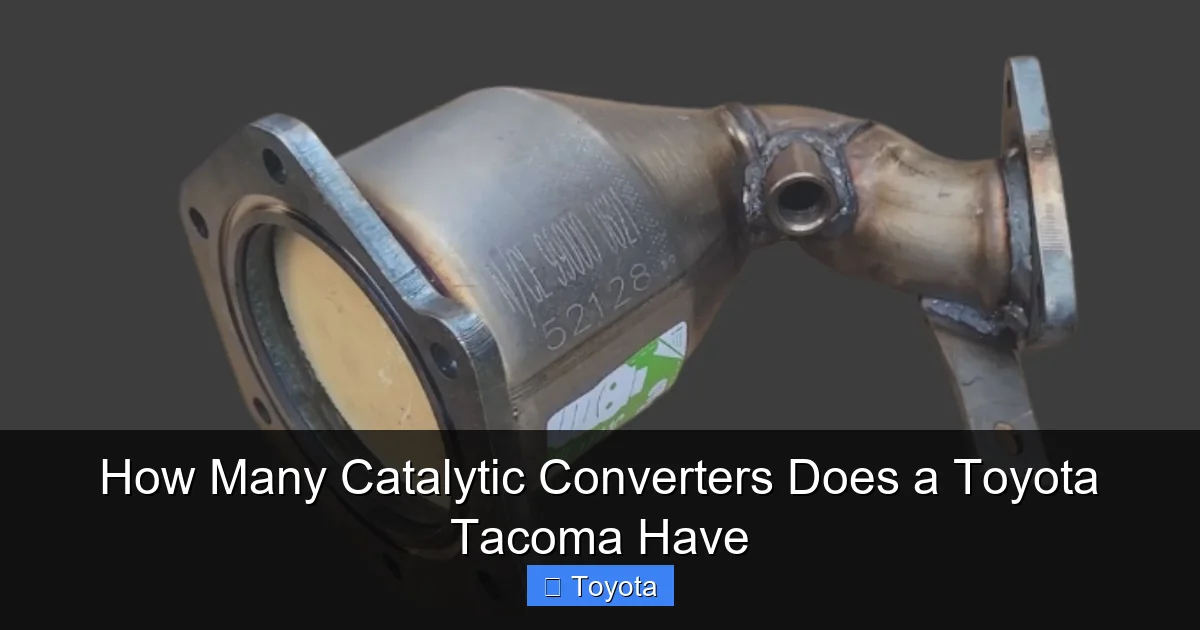
How Many Catalytic Converters Does a Toyota Tacoma Have?

Visual guide about How Many Catalytic Converters Does a Toyota Tacoma Have
Image source: rxmechanic.com
Now, let’s get to the heart of the matter: how many catalytic converters does a Toyota Tacoma have? As mentioned earlier, the answer isn’t one-size-fits-all. It depends on several factors, including the model year, engine type, and drivetrain configuration.
In general, most modern Toyota Tacomas—especially those from 2005 onward—are equipped with two catalytic converters. These are typically referred to as the “pre-cat” (or “pre-catalytic converter”) and the “main cat” (or “rear catalytic converter”). The pre-cat is usually located close to the engine, often integrated into the exhaust manifold or just downstream of it. The main cat is further back in the exhaust system, usually under the truck near the transmission or rear axle.
But here’s where it gets interesting: older models, particularly 4-cylinder Tacomas from the early 2000s or late 1990s, often have only one catalytic converter. These single-converter setups were common in earlier emissions systems, where a single unit was sufficient to meet the less stringent standards of the time.
Let’s break it down by generation and engine type to give you a clearer picture.
Tacoma Generations and Catalytic Converter Count
The Toyota Tacoma has gone through several generations since its introduction in 1995. Each generation brought changes in engine technology, emissions standards, and exhaust system design—all of which affect how many catalytic converters are installed.
First Generation (1995–2004): These early Tacomas were known for their simplicity and reliability. Most models came with a 2.4L or 2.7L 4-cylinder engine, and some later models offered a 3.4L V6. In the 4-cylinder versions, especially pre-2000, you’ll typically find just one catalytic converter, usually mounted under the vehicle near the front of the exhaust system. The V6 models, however, often had two converters—one near the engine and one further back—due to higher emissions output.
Second Generation (2005–2015): This generation marked a significant shift. With the introduction of the 4.0L V6 engine and updated emissions standards, most Tacomas from this era came standard with two catalytic converters. Even the 2.7L 4-cylinder models often had dual converters, especially in 4WD configurations or in states with stricter emissions laws like California.
Third Generation (2016–Present): The current generation of Tacomas continues the trend toward more advanced emissions control. Most models—whether equipped with the 2.7L 4-cylinder or the 3.5L V6—come with two catalytic converters. However, some high-performance variants or trucks with advanced emissions packages (like those sold in California or other CARB-compliant states) may include a third converter. This third unit is often a small, close-coupled converter mounted directly to the engine’s exhaust manifold, designed to reduce cold-start emissions.
Engine Type and Drivetrain Influence
It’s not just about the year—your Tacoma’s engine and drivetrain also play a big role in determining how many catalytic converters it has.
4-Cylinder Engines: In older Tacomas (pre-2005), the 2.4L and 2.7L 4-cylinder engines typically used a single catalytic converter. However, starting around 2005, even 4-cylinder models began incorporating dual converters, especially in 4WD or high-mileage variants. This was due to stricter emissions standards and the need to reduce cold-start pollutants.
V6 Engines: The 3.4L and 4.0L V6 engines have always produced more exhaust gases and higher emissions, so they’ve almost always used dual catalytic converters—even in the early 2000s. The V6’s higher output requires more aggressive emissions control, making two converters standard.
4WD vs. 2WD: Interestingly, 4-wheel-drive models are more likely to have dual converters, even with the same engine as a 2WD version. This is because 4WD systems add weight and complexity, which can increase emissions. Additionally, 4WD Tacomas are often used in more demanding conditions, prompting Toyota to include more robust emissions systems.
California and CARB-Compliant Models
If you live in California or another state that follows California Air Resources Board (CARB) regulations, your Tacoma may have additional emissions equipment—including extra catalytic converters. CARB standards are stricter than federal EPA requirements, so vehicles sold in these states often come with enhanced emissions systems.
For example, some 2016 and newer Tacomas sold in California include a third catalytic converter mounted directly to the engine’s exhaust manifold. This “close-coupled” converter heats up quickly during startup, reducing emissions before the main converter reaches operating temperature. While not all Tacomas have this third unit, it’s becoming more common in newer models, especially those with the 3.5L V6 engine.
Where Are the Catalytic Converters Located on a Toyota Tacoma?
Visual guide about How Many Catalytic Converters Does a Toyota Tacoma Have
Image source: vehiclechef.com
Knowing how many catalytic converters your Tacoma has is one thing—but knowing where they’re located is equally important, especially if you’re dealing with a repair, inspection, or theft concern.
In most Tacomas with dual converters, you’ll find:
– Pre-Cat (Front Catalytic Converter): This is usually located near the engine, often bolted directly to the exhaust manifold or just downstream. On V6 models, you may see two pre-cats—one for each bank of cylinders—especially in engines with dual exhaust manifolds. On 4-cylinder models, there’s typically one pre-cat.
– Main Cat (Rear Catalytic Converter): This is further back in the exhaust system, usually under the truck near the transmission or rear axle. It’s larger than the pre-cat and handles the bulk of the emissions conversion once the exhaust gases have cooled slightly.
In models with a third converter (like some CARB-compliant 2016+ V6 Tacomas), the additional unit is mounted directly to the engine, often referred to as a “manifold catalyst” or “close-coupled converter.” This unit is designed to reduce emissions during the critical first few minutes of engine operation, when the main converter is still cold and less effective.
Why Location Matters
The location of your catalytic converters isn’t just a technical detail—it has real-world implications.
Maintenance and Repairs: If you’re diagnosing a P0420 or P0430 code (which indicate catalytic converter efficiency issues), knowing which converter is affected can save time and money. Mechanics often use an infrared thermometer to check the temperature difference before and after each converter. A properly functioning cat will be hotter on the outlet side than the inlet side. If there’s no temperature rise, that converter may be clogged or failed.
Theft Prevention: Unfortunately, catalytic converters are a prime target for thieves because of the precious metals inside. The underbody location of the main cat makes it especially vulnerable. Pre-cats, being closer to the engine, are slightly harder to access—but still at risk. Some Tacoma owners install protective shields or etch their VIN onto the converter to deter theft.
Off-Roading and Clearance: If you take your Tacoma off-road, be mindful of low-hanging components. The main catalytic converter is often located in a spot that can be damaged by rocks or trail debris. While it’s protected by the vehicle’s underbody, repeated impacts can crack the ceramic honeycomb inside, leading to failure.
Signs of a Failing Catalytic Converter

Visual guide about How Many Catalytic Converters Does a Toyota Tacoma Have
Image source: 2carpros.com
Even with the best care, catalytic converters don’t last forever. Over time, they can become clogged, cracked, or contaminated by oil, coolant, or fuel. When that happens, your Tacoma will let you know—usually with a combination of performance issues and warning lights.
Here are the most common signs of a failing catalytic converter:
– Check Engine Light: The most obvious sign. A P0420 (Bank 1 Catalyst Efficiency Below Threshold) or P0430 (Bank 2) code often points to a failing converter. These codes are triggered when the oxygen sensors detect that the converter isn’t reducing emissions as effectively as it should.
– Reduced Engine Performance: A clogged converter restricts exhaust flow, which can cause your engine to feel sluggish, especially under acceleration. You might notice a loss of power, hesitation, or difficulty reaching highway speeds.
– Poor Fuel Economy: When exhaust flow is restricted, the engine has to work harder, which burns more fuel. If you’re suddenly getting fewer miles per gallon, a failing catalytic converter could be the culprit.
– Rattling Noise: If you hear a rattling sound from under the truck, especially when idling or accelerating, it could mean the ceramic honeycomb inside the converter has broken apart. This is a serious issue that requires immediate attention.
– Excessive Heat Under the Vehicle: A failing converter can overheat due to unburned fuel igniting inside the unit. If you notice a strong smell of sulfur (like rotten eggs) or see smoke coming from under the truck, pull over and have it inspected.
– Failed Emissions Test: If your Tacoma fails an emissions test, especially with high levels of hydrocarbons or carbon monoxide, the catalytic converter is likely not functioning properly.
What to Do If You Suspect a Problem
If you notice any of these symptoms, don’t ignore them. A failing catalytic converter can lead to more serious engine problems if left unchecked. Start by having a mechanic run a diagnostic scan to confirm the issue. They may also perform a backpressure test or use an infrared thermometer to check converter efficiency.
In some cases, the problem might not be the converter itself—but something else causing it to fail, like a misfiring spark plug or a rich fuel mixture. Fixing the root cause is essential before replacing the converter, or the new one will fail prematurely.
Replacing a Catalytic Converter on a Toyota Tacoma
Let’s face it: catalytic converters are expensive. Depending on the model and whether you go with OEM (original equipment manufacturer) or aftermarket parts, a replacement can cost anywhere from $1,000 to $3,000 or more—including labor.
So, what are your options if your Tacoma’s catalytic converter needs replacing?
OEM Replacement: This is the most reliable option, as it ensures compatibility and meets all emissions standards. However, it’s also the most expensive. OEM converters are built to Toyota’s specifications and often come with a warranty.
Aftermarket Converters: These are cheaper and widely available, but quality can vary. Look for converters that are EPA-compliant and, if you live in California or another CARB state, CARB-certified. Some aftermarket brands, like MagnaFlow or Walker, offer high-quality units that perform just as well as OEM.
Universal Converters: These are the cheapest option but require custom fabrication to fit your Tacoma. They’re not recommended for most owners, as improper installation can lead to leaks, performance issues, or emissions failures.
Used or Salvage Converters: While tempting due to the low cost, used converters are risky. You don’t know their history, and they may fail soon after installation. Plus, many states prohibit the use of used catalytic converters on emissions-controlled vehicles.
DIY vs. Professional Installation
Can you replace a catalytic converter yourself? Technically, yes—if you have the right tools, experience, and a safe workspace. However, it’s not a job for beginners. The converters are heavy, bolted in tight spaces, and often require cutting and welding if you’re using a universal unit.
Most experts recommend having a professional mechanic or exhaust shop handle the replacement. They have the equipment to safely remove the old converter, install the new one, and ensure it’s properly aligned and sealed.
Catalytic Converter Theft: A Growing Concern for Tacoma Owners
In recent years, catalytic converter theft has surged across the U.S.—and the Toyota Tacoma is a frequent target. Why? Because Tacomas are popular, often parked in driveways or on streets, and their converters contain valuable precious metals.
Thieves can remove a converter in under a minute using basic tools, selling them to scrap yards for $50 to $200—or more, depending on the metals inside. For Tacoma owners, this means not only the cost of replacement but also the hassle of repairs and potential downtime.
How to Protect Your Tacoma
While you can’t eliminate the risk entirely, there are steps you can take to reduce the chances of theft:
– Park in Well-Lit, Secure Areas: Avoid leaving your Tacoma on dark streets or in isolated parking lots. Garage parking is ideal.
– Install a Catalytic Converter Shield: These metal plates bolt over the converter, making it much harder to remove. Brands like Cat Security or Cat Clamp offer Tacoma-specific shields.
– Etch Your VIN on the Converter: This makes it harder to sell and easier to identify if recovered. Many police departments offer free etching events.
– Use a Vehicle Alarm with Motion Sensors: Some alarms can detect underbody movement and trigger an alert.
– Consider GPS Tracking Devices: Small trackers can be hidden near the converter to help locate it if stolen.
Conclusion: Know Your Tacoma’s Emissions System
So, how many catalytic converters does a Toyota Tacoma have? The answer depends on your specific model, but most modern Tacomas—especially V6 and 4WD versions—have two, with some newer or high-compliance models featuring a third.
Understanding your Tacoma’s catalytic converter setup isn’t just about technical curiosity. It’s about maintaining your truck’s performance, passing emissions tests, avoiding costly repairs, and protecting against theft. Whether you’re diagnosing a check engine light, planning a repair, or just want to know what’s under your truck, this knowledge empowers you to make informed decisions.
Remember: if you’re ever unsure, consult your owner’s manual, use your VIN to look up specifications, or talk to a trusted mechanic. Your Tacoma is built to last—and with the right care, its emissions system will keep running clean for years to come.
Frequently Asked Questions
How many catalytic converters does a 2020 Toyota Tacoma have?
Most 2020 Toyota Tacomas, especially those with the 3.5L V6 engine, have two catalytic converters: a pre-cat near the engine and a main cat under the vehicle. Some California or CARB-compliant models may include a third close-coupled converter.
Can a Toyota Tacoma run with a bad catalytic converter?
A Tacoma may still run with a failing catalytic converter, but performance will suffer. You’ll likely experience reduced power, poor fuel economy, and a check engine light. Driving with a severely clogged converter can damage the engine.
Are catalytic converters covered under Toyota warranty?
Yes, catalytic converters are covered under Toyota’s emissions warranty, which typically lasts 8 years or 80,000 miles—whichever comes first. This applies to defects in materials or workmanship.
How much does it cost to replace a catalytic converter on a Tacoma?
Replacement costs vary, but expect to pay between $1,000 and $3,000 for parts and labor. OEM converters are more expensive than aftermarket, and V6 models may cost more due to dual converters.
Can I drive my Tacoma if the catalytic converter is stolen?
Technically yes, but it’s not recommended. Your truck will likely fail emissions tests, and you may face legal penalties. Additionally, driving without a converter can damage the oxygen sensors and engine over time.
How can I tell which catalytic converter is failing on my Tacoma?
A mechanic can use an OBD2 scanner to read trouble codes (like P0420 or P0430) and perform a temperature test. The code will indicate which bank (1 or 2) is affected, helping pinpoint the faulty converter.
