
How Many Catalytic Converters Does a Toyota Tacoma Have?

The number of catalytic converters in a Toyota Tacoma depends on the model year, engine type, and drivetrain configuration. Most modern Tacomas have two catalytic converters—one upstream and one downstream—while some V6 and performance-oriented models may include additional units. Understanding your Tacoma’s setup helps with maintenance, emissions compliance, and theft prevention.
If you’re a Toyota Tacoma owner—or thinking about becoming one—you’ve probably heard the term “catalytic converter” thrown around, especially with the rise in thefts and emissions regulations. But how many catalytic converters does a Toyota Tacoma actually have? The answer isn’t always straightforward. It depends on several factors, including the year your Tacoma was made, the engine under the hood, and even the drivetrain configuration.
The catalytic converter is a critical part of your vehicle’s exhaust system. Its job is to reduce harmful emissions by converting toxic gases like carbon monoxide, nitrogen oxides, and hydrocarbons into less harmful substances such as carbon dioxide and water vapor. Because of this, modern vehicles—including the Toyota Tacoma—are equipped with one or more catalytic converters to meet strict environmental standards.
But here’s the thing: not all Tacomas are created equal when it comes to emissions hardware. A 2003 4-cylinder Tacoma might have just one converter, while a 2023 V6 TRD Pro could have three or even four. This variation exists because emissions regulations have tightened over the years, and Toyota has responded by adding more advanced exhaust systems. Understanding how many catalytic converters your Tacoma has isn’t just about technical curiosity—it affects maintenance, repair costs, theft risk, and even resale value.
In this guide, we’ll break down everything you need to know about catalytic converters in the Toyota Tacoma. From how many you likely have to why it matters, we’ll cover the essentials in a way that’s easy to understand—no engineering degree required. Whether you’re troubleshooting a check engine light, considering a repair, or just trying to protect your truck from theft, this article will give you the knowledge you need.
Key Takeaways
- Understanding How Many Catalytic Converters Does a Toyota Tacoma Have?: Provides essential knowledge
📑 Table of Contents
What Is a Catalytic Converter and Why Does It Matter?
Before diving into the specifics of the Toyota Tacoma, let’s take a moment to understand what a catalytic converter actually does—and why it’s such a big deal.
A catalytic converter is essentially a metal canister filled with a ceramic honeycomb structure coated in precious metals like platinum, palladium, and rhodium. As exhaust gases pass through this structure, chemical reactions occur that convert harmful pollutants into safer emissions. Think of it as a filter for your truck’s exhaust, but instead of just trapping dirt, it actually transforms toxic gases into something less damaging to the environment.
These devices became standard in the U.S. in the mid-1970s after the Clean Air Act was passed, and they’ve evolved significantly since then. Modern catalytic converters are far more efficient and durable than their early counterparts, but they’re also more complex—and more valuable.
Why does this matter for Tacoma owners? First, because catalytic converters are essential for passing emissions tests. If your converter isn’t working properly, your truck may fail inspection, especially in states with strict environmental regulations like California, New York, or Colorado. Second, because they contain precious metals, catalytic converters have become a target for thieves. In fact, catalytic converter theft has skyrocketed in recent years, with trucks like the Tacoma being particularly vulnerable due to their high ground clearance and accessible undercarriage.
Finally, catalytic converters aren’t cheap to replace. Depending on the model and year, a single unit can cost anywhere from $1,000 to over $3,000 when installed by a professional. That’s why knowing how many your Tacoma has—and how to protect them—can save you a lot of stress and money down the road.
How Many Catalytic Converters Does a Toyota Tacoma Have?
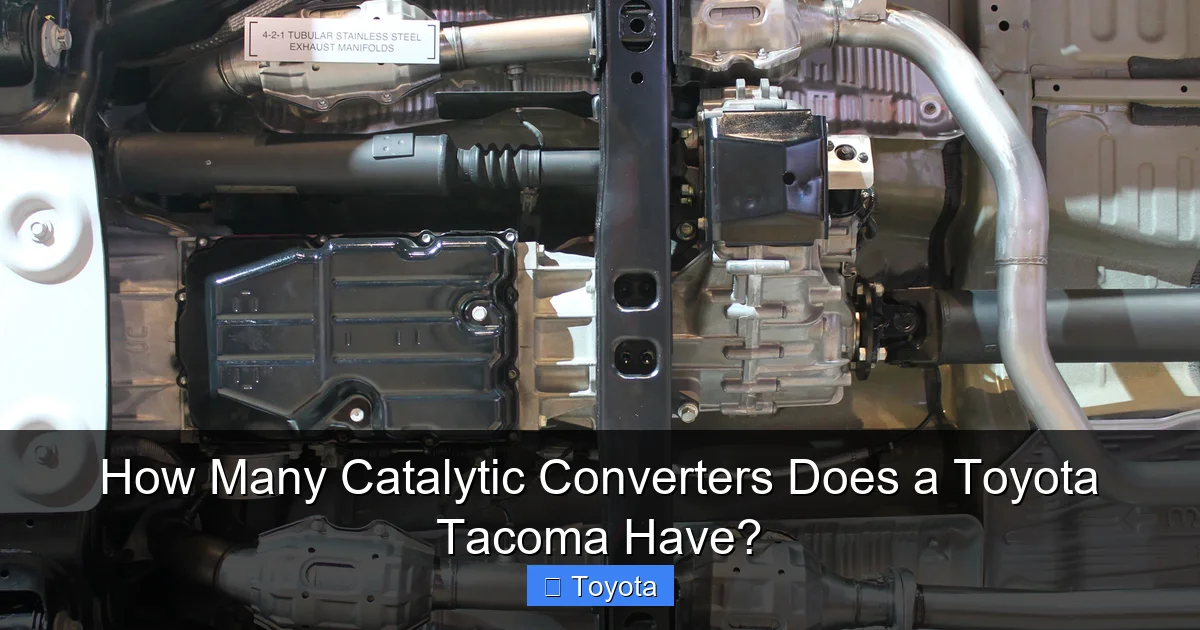
Visual guide about How Many Catalytic Converters Does a Toyota Tacoma Have?
Image source: motortrend.com
Now, let’s get to the heart of the matter: how many catalytic converters does a Toyota Tacoma have?
The short answer is: it depends. Most Toyota Tacomas from the mid-2000s onward have at least two catalytic converters—one upstream (closer to the engine) and one downstream (further along the exhaust system). However, some models, especially those with V6 engines or advanced emissions systems, can have three or even four.
Let’s break it down by generation and engine type.
Tacoma Generations and Converter Count
The Toyota Tacoma has gone through three major generations since its introduction in 1995:
– **First Generation (1995–2004):** These early models typically had one or two catalytic converters, depending on the engine. The 2.4L and 2.7L 4-cylinder engines usually had one converter, while the 3.4L V6 often had two—one for each bank of cylinders.
– **Second Generation (2005–2015):** With stricter emissions standards, most second-gen Tacomas came equipped with two catalytic converters. The 2.7L 4-cylinder and 4.0L V6 engines both featured a dual-converter setup, with one close to the engine manifold and another further down the exhaust pipe.
– **Third Generation (2016–Present):** This is where things get more complex. The 2016 redesign brought a new 3.5L V6 engine and updated emissions systems. Many of these newer Tacomas—especially TRD Off-Road and TRD Pro models—now have three catalytic converters. Some high-output or California-certified versions may even have four.
Engine Type and Drivetrain Impact
The number of catalytic converters in your Tacoma is heavily influenced by the engine and drivetrain:
– **4-Cylinder Engines (2.7L):** Most 4-cylinder Tacomas, especially from 2005 onward, have two catalytic converters—one upstream and one downstream.
– **V6 Engines (3.5L and 4.0L):** These engines often have more complex exhaust systems. The 4.0L V6 (used from 2005–2015) typically has two converters, but some models may have a third “mid-bed” converter. The newer 3.5L V6 (2016–present) frequently includes three converters: one per cylinder bank near the engine and a third downstream.
– **TRD Pro and Off-Road Models:** These performance-oriented versions often have additional emissions components, including extra catalytic converters, to meet stricter standards and improve exhaust flow.
– **4WD vs. 2WD:** While drivetrain doesn’t directly affect converter count, 4WD models often have more complex undercarriages, which can make converters more accessible—and more vulnerable to theft.
Real-World Examples
Let’s look at a few specific examples to illustrate the variation:
– **2008 Toyota Tacoma 4-Cylinder (2.7L):** This model typically has two catalytic converters—one near the engine and one further back.
– **2012 Toyota Tacoma V6 (4.0L):** Most of these have two converters, but some California-emissions models include a third converter in the mid-section of the exhaust.
– **2020 Toyota Tacoma TRD Pro (3.5L V6):** This model commonly has three catalytic converters—two close to the engine (one for each cylinder bank) and a third downstream.
– **2023 Toyota Tacoma Limited (3.5L V6):** Depending on the emissions package, this model may have up to four converters, including a pre-catalyst and multiple downstream units.
Why Do Some Tacomas Have More Than Two?
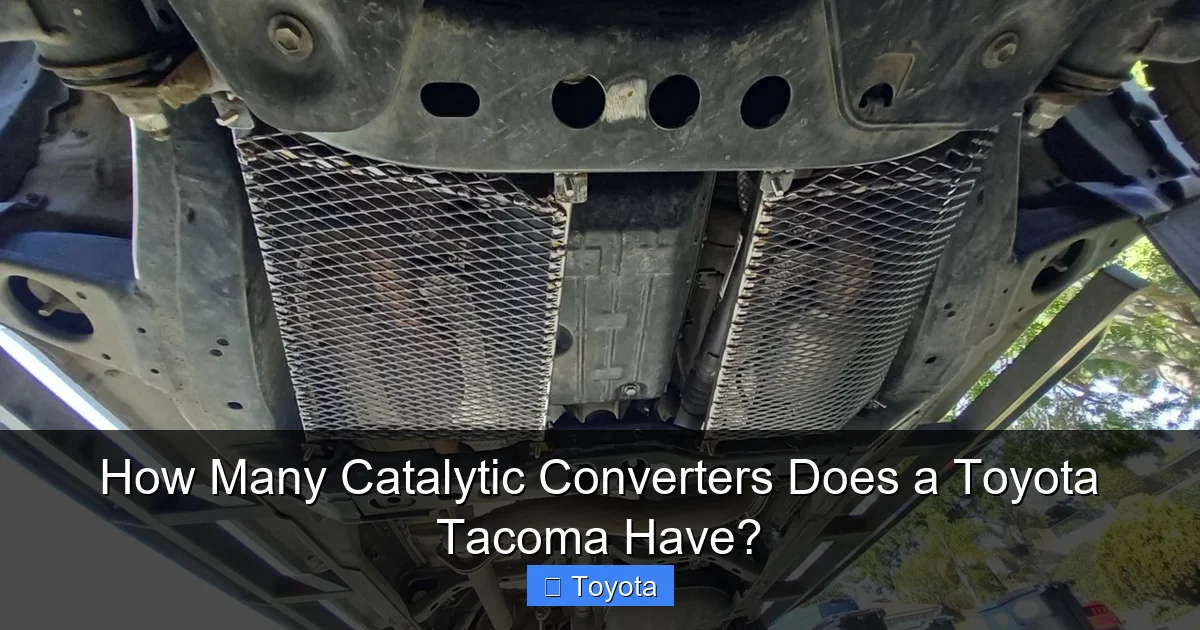
Visual guide about How Many Catalytic Converters Does a Toyota Tacoma Have?
Image source: twstatic.net
You might be wondering: why would a truck need three or four catalytic converters? Isn’t two enough?
The answer lies in emissions regulations and engine design.
Stricter Emissions Standards
Over the past two decades, environmental regulations have become increasingly strict. The Environmental Protection Agency (EPA) and California Air Resources Board (CARB) have imposed tighter limits on pollutants like nitrogen oxides (NOx) and hydrocarbons (HC). To meet these standards, automakers have had to improve the efficiency of their emissions systems.
One way to do this is by adding more catalytic converters. Multiple converters allow for better control of exhaust gases at different stages of the combustion process. For example, a “pre-catalyst” near the engine can start reducing emissions immediately, while downstream converters handle residual pollutants.
Engine Configuration and Exhaust Flow
V6 engines, like the 3.5L in newer Tacomas, have two cylinder banks. Each bank produces its own exhaust stream, which means each may have its own catalytic converter. This setup—called a “dual-bank” or “dual-converter” system—allows for more precise emissions control and better performance.
Additionally, some Tacomas use a “close-coupled” catalytic converter mounted directly to the exhaust manifold. This design heats up faster, improving efficiency during cold starts—a critical factor in reducing emissions.
Hybrid and Future Models
While the current Tacoma is not a hybrid, Toyota has announced plans for a hybrid version in the near future. Hybrid vehicles often have even more complex emissions systems, including multiple catalytic converters and regenerative exhaust treatments. If you’re considering a future Tacoma hybrid, expect even more converters—and potentially higher replacement costs.
Signs of a Failing Catalytic Converter
Visual guide about How Many Catalytic Converters Does a Toyota Tacoma Have?
Image source: workmanseuropeanauto.com
Knowing how many catalytic converters your Tacoma has is important, but it’s equally crucial to recognize when one might be failing. A malfunctioning converter can hurt performance, increase emissions, and even cause your truck to fail inspections.
Common Symptoms
Here are some signs that one or more of your catalytic converters may be going bad:
– **Check Engine Light:** This is the most common indicator. A faulty converter often triggers codes like P0420 or P0430, which relate to catalyst efficiency.
– **Reduced Fuel Economy:** A clogged converter restricts exhaust flow, making the engine work harder and burn more fuel.
– **Poor Acceleration:** If your Tacoma feels sluggish or struggles to accelerate, a blocked converter could be the culprit.
– **Rattling Noise:** A broken internal honeycomb structure can cause a rattling sound, especially when the engine is running.
– **Excessive Heat Under the Truck:** A failing converter may overheat, causing the underside of your truck to feel unusually hot.
– **Sulfur or Rotten Egg Smell:** This indicates that the converter isn’t properly processing hydrogen sulfide, a byproduct of combustion.
What to Do If You Suspect a Problem
If you notice any of these symptoms, it’s important to get your truck diagnosed by a qualified mechanic. They can use an OBD2 scanner to check for trouble codes and perform a visual inspection of the exhaust system.
In some cases, the issue may not be the converter itself but something else—like a faulty oxygen sensor or engine misfire—that’s causing the converter to fail prematurely. Addressing the root cause is essential to avoid repeated failures.
Catalytic Converter Theft: A Growing Threat
One of the biggest reasons Tacoma owners need to know about their catalytic converters is theft.
Catalytic converters contain precious metals—especially palladium and rhodium—that can be worth hundreds or even thousands of dollars per unit when recycled. Because of this, they’ve become a prime target for thieves, who can remove one in under a minute using basic tools.
Why Are Tacomas Targeted?
Toyota Tacomas are particularly vulnerable for several reasons:
– **High Ground Clearance:** Makes it easy for thieves to slide underneath and cut out the converter.
– **Popular and Common:** High resale value for parts.
– **Multiple Converters:** More converters mean more profit per theft.
– **Older Models:** Pre-2016 Tacomas often have converters with higher concentrations of precious metals.
How to Protect Your Tacoma
While you can’t eliminate the risk entirely, there are steps you can take to reduce the chances of theft:
– **Park in Well-Lit, Secure Areas:** Avoid leaving your truck in dark alleys or unmonitored lots.
– **Install a Catalytic Converter Shield:** These metal cages make it much harder to access the converter.
– **Engrave Your VIN:** Some police departments offer free etching services to mark your converter with your vehicle’s VIN.
– **Use a Security System:** Alarms with motion sensors can deter thieves.
– **Consider Insurance Coverage:** Comprehensive auto insurance often covers catalytic converter theft—check your policy.
Replacement Costs and What to Expect
If your catalytic converter fails or is stolen, replacement can be expensive. But how much should you expect to pay?
Cost Breakdown
The cost of replacing a catalytic converter depends on several factors:
– **Number of Converters:** More converters mean higher costs.
– **OEM vs. Aftermarket:** Original Equipment Manufacturer (OEM) parts are more expensive but often more reliable. Aftermarket converters can be cheaper but may not last as long.
– **Labor Costs:** Installation requires lifting the vehicle and welding or bolting in the new unit, which can add $200–$500 in labor.
– **Model Year and Engine:** Newer V6 models with multiple converters can cost $3,000 or more for a full replacement.
As a general rule:
– **One converter replacement:** $1,000–$2,500
– **Two converters:** $2,000–$4,000
– **Three or more converters:** $3,500–$6,000+
Tips to Save Money
– **Get Multiple Quotes:** Prices can vary widely between shops.
– **Consider Used or Remanufactured Parts:** These can be significantly cheaper, but make sure they’re CARB-compliant if you live in a strict emissions state.
– **Address Underlying Issues:** Fixing engine problems before replacing the converter can prevent repeat failures.
Conclusion
So, how many catalytic converters does a Toyota Tacoma have? The answer varies, but most modern Tacomas have two—and many newer V6 models have three or more. Understanding your truck’s specific setup is essential for maintenance, emissions compliance, and theft prevention.
Whether you’re driving a 2005 4-cylinder or a 2023 TRD Pro, knowing how many converters you have helps you make informed decisions about repairs, insurance, and security. And with catalytic converter theft on the rise, that knowledge could save you thousands of dollars.
By staying informed and proactive, you can keep your Tacoma running clean, efficient, and secure for years to come.
Frequently Asked Questions
How many catalytic converters does a 2020 Toyota Tacoma have?
Most 2020 Toyota Tacomas with the 3.5L V6 engine have three catalytic converters—two near the engine (one for each cylinder bank) and one downstream. Some California-emissions models may have a fourth.
Can a Toyota Tacoma run with a bad catalytic converter?
Technically, yes, but it’s not recommended. A failing converter can cause poor performance, reduced fuel economy, and increased emissions. It may also trigger the check engine light and cause your truck to fail emissions tests.
Are catalytic converters covered by warranty?
Yes, under federal law, catalytic converters are covered by emissions warranties for 8 years or 80,000 miles, whichever comes first. Toyota may also offer extended coverage on newer models.
How can I tell if my catalytic converter was stolen?
Signs include a loud rumbling noise from the exhaust, a noticeable drop in performance, and visible damage or missing components under the truck. If you suspect theft, contact the police and your insurance company immediately.
Do I need to replace all catalytic converters at once?
Not necessarily. If only one converter is faulty, you can replace just that unit. However, if multiple converters are old or damaged, replacing them together may be more cost-effective in the long run.
Can I install a catalytic converter myself?
While possible, it’s not recommended unless you have advanced mechanical skills and welding equipment. Improper installation can lead to leaks, performance issues, and failed emissions tests. Always consult a professional.
