
How Many Quarts of Transmission Fluid Does a Toyota Rav4 Need?

Knowing how many quarts of transmission fluid your Toyota RAV4 requires is essential for proper maintenance and long-term performance. The amount varies by model year, engine size, and whether your vehicle has a manual or automatic transmission—typically ranging from 3.5 to 8 quarts. Always consult your owner’s manual or a trusted mechanic to ensure you’re using the correct fluid type and quantity.
Key Takeaways
- Transmission fluid capacity varies by RAV4 model year and transmission type: Older models may need less fluid, while newer ones with advanced transmissions require more.
- Most Toyota RAV4s use between 3.5 and 8 quarts of transmission fluid: This includes both automatic and CVT (Continuously Variable Transmission) models.
- Always use the correct type of ATF (Automatic Transmission Fluid): Toyota recommends Genuine Toyota ATF WS (World Standard) for most modern RAV4s.
- Drain-and-fill vs. flush makes a difference: A standard drain-and-fill replaces only about 30–50% of the fluid, while a full flush can replace up to 100%.
- Check your owner’s manual for exact specifications: It’s the most reliable source for fluid type, capacity, and service intervals.
- Regular fluid changes extend transmission life: Toyota recommends changing the fluid every 60,000 to 100,000 miles, depending on driving conditions.
- Improper fluid levels can cause serious damage: Overfilling or underfilling may lead to shifting problems, overheating, or transmission failure.
📑 Table of Contents
- How Many Quarts of Transmission Fluid Does a Toyota RAV4 Need?
- Understanding Your Toyota RAV4’s Transmission
- Transmission Fluid Capacity by RAV4 Model Year
- How to Determine the Right Amount for Your RAV4
- How to Safely Add Transmission Fluid
- Signs Your RAV4 Needs a Transmission Fluid Change
- Maintenance Schedule and Best Practices
- Conclusion
How Many Quarts of Transmission Fluid Does a Toyota RAV4 Need?
If you own a Toyota RAV4—or you’re thinking about buying one—you’ve probably asked yourself: “How many quarts of transmission fluid does a Toyota RAV4 need?” It’s a great question, and one that’s more important than you might think. Your transmission is one of the most critical components in your vehicle, responsible for transferring power from the engine to the wheels. Without the right amount and type of fluid, it can overheat, wear out prematurely, or even fail entirely.
The good news? Most Toyota RAV4s are built with reliability in mind, and their transmissions are designed to last for hundreds of thousands of miles—when properly maintained. But that maintenance starts with knowing the basics: what kind of transmission you have, how much fluid it holds, and when it needs to be changed. Whether you’re doing a DIY fluid change or taking your RAV4 to a mechanic, understanding the fluid requirements helps you make smarter decisions about your vehicle’s care.
In this guide, we’ll break down everything you need to know about transmission fluid in the Toyota RAV4. From model-specific capacities to fluid types and maintenance tips, we’ll help you keep your RAV4 running smoothly for years to come.
Understanding Your Toyota RAV4’s Transmission
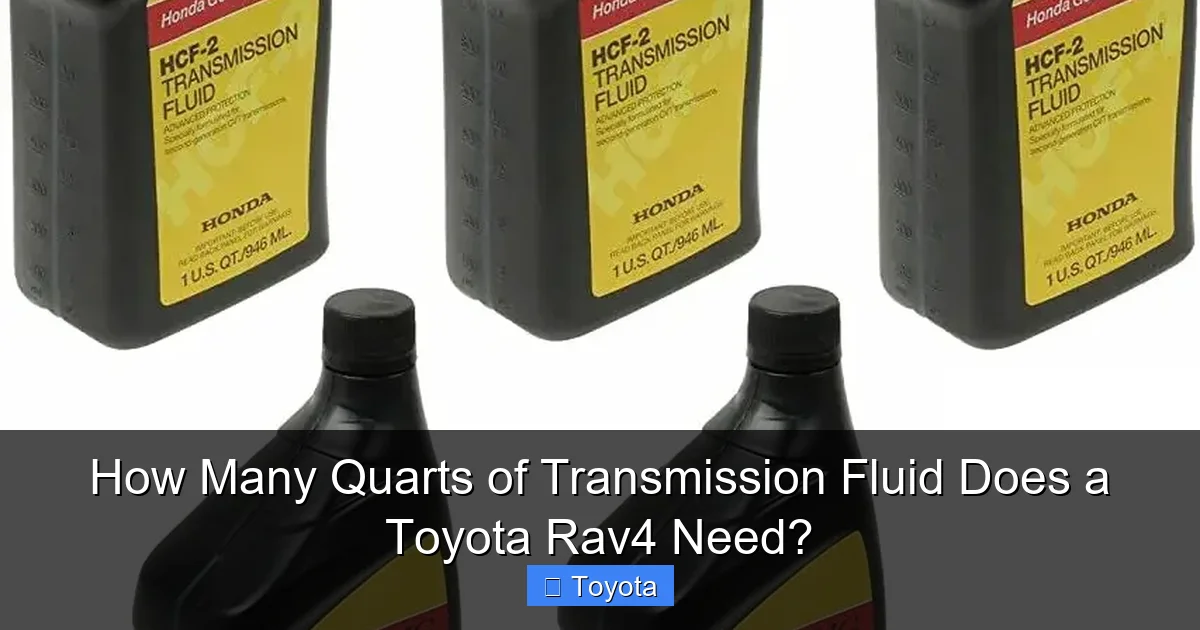
Visual guide about How Many Quarts of Transmission Fluid Does a Toyota Rav4 Need?
Image source: transmissioncar.com
Before we dive into how many quarts your RAV4 needs, let’s talk about the transmission itself. The transmission is essentially the “middleman” between your engine and your wheels. It adjusts the gear ratio so your engine can operate efficiently at different speeds. In most modern RAV4s, this is done automatically, which is why you’ll hear terms like “automatic transmission” or “CVT.”
There are two main types of transmissions found in the Toyota RAV4:
- Automatic Transmission (Traditional): Uses a torque converter and a set of planetary gears to shift between fixed gear ratios. Common in older RAV4 models (pre-2013).
- Continuously Variable Transmission (CVT): Uses a belt and pulley system to provide an infinite range of gear ratios, improving fuel efficiency and smoothness. Found in most RAV4s from 2013 onward, especially those with 4-cylinder engines.
Each type has different fluid requirements, both in terms of quantity and fluid type. For example, a traditional automatic may use a different ATF (Automatic Transmission Fluid) than a CVT, and the capacity can vary significantly.
Why Transmission Fluid Matters
Transmission fluid does more than just lubricate moving parts. It also:
- Cools the transmission by dissipating heat
- Cleans internal components by carrying away debris
- Protects against wear and corrosion
- Enables smooth shifting by maintaining proper hydraulic pressure
Over time, transmission fluid breaks down. It loses its viscosity, collects contaminants, and can even develop a burnt smell. That’s why regular changes are essential. But to change it properly, you need to know how much to add—and that’s where the “how many quarts” question comes in.
Transmission Fluid Capacity by RAV4 Model Year
Visual guide about How Many Quarts of Transmission Fluid Does a Toyota Rav4 Need?
Image source: autovfix.com
Now, let’s get into the numbers. The amount of transmission fluid your Toyota RAV4 needs depends heavily on the model year, engine size, and transmission type. Below is a breakdown by generation to help you find the right capacity for your vehicle.
First Generation (1996–2000)
The original RAV4 was a compact, boxy SUV with a simple 5-speed manual or 4-speed automatic transmission. These early models used traditional automatic transmissions with relatively small fluid capacities.
- Manual Transmission: Approximately 2.5–3 quarts
- Automatic Transmission: About 7.5–8 quarts (including torque converter)
Note: These models often required Dexron III or equivalent ATF. Always double-check your owner’s manual, as some may have specific requirements.
Second Generation (2001–2005)
The second-gen RAV4 introduced a more refined 4-speed automatic transmission. Fluid capacity remained similar to the first generation, but Toyota began standardizing fluid types.
- Automatic Transmission: 7.5–8 quarts (full system capacity)
- Drain-and-Fill Only: About 3–4 quarts (since only part of the fluid is replaced)
This generation also saw the introduction of all-wheel drive (AWD) models, but the transmission fluid capacity didn’t change significantly.
Third Generation (2006–2012)
The third-generation RAV4 brought a major update: a new 5-speed automatic transmission for most models. This improved shifting and fuel economy. Fluid requirements stayed in the same ballpark, but the type of fluid became more specific.
- 5-Speed Automatic: 7.5–8 quarts total
- Drain-and-Fill: 3.5–4 quarts
Toyota began recommending Genuine Toyota ATF Type T-IV for these models. Using the wrong fluid could cause shifting issues or damage the transmission.
Fourth Generation (2013–2018)
This is where things changed significantly. The 2013 RAV4 introduced a new platform and, for the first time, a Continuously Variable Transmission (CVT) for 4-cylinder models. The V6 models retained a 6-speed automatic.
- CVT (4-Cylinder): Approximately 8.5–9 quarts total
- 6-Speed Automatic (V6): About 8–8.5 quarts
- Drain-and-Fill (CVT): 3.5–4 quarts
The CVT requires a special fluid—Toyota Genuine CVT Fluid FE. Using regular ATF in a CVT can cause serious damage. Always confirm the fluid type before adding.
Fifth Generation (2019–Present)
The current-generation RAV4 (starting in 2019) features a more advanced 8-speed automatic transmission for gas models and an e-CVT for hybrid versions. These transmissions are more efficient but also more sensitive to fluid quality.
- 8-Speed Automatic (Gas): 8–8.5 quarts total
- e-CVT (Hybrid): 6–7 quarts total
- Drain-and-Fill: 3.5–4.5 quarts (depending on model)
Toyota now specifies Genuine Toyota ATF WS (World Standard) for most of these transmissions. This fluid is designed for high-performance, low-friction applications and is not interchangeable with older ATF types.
How to Determine the Right Amount for Your RAV4
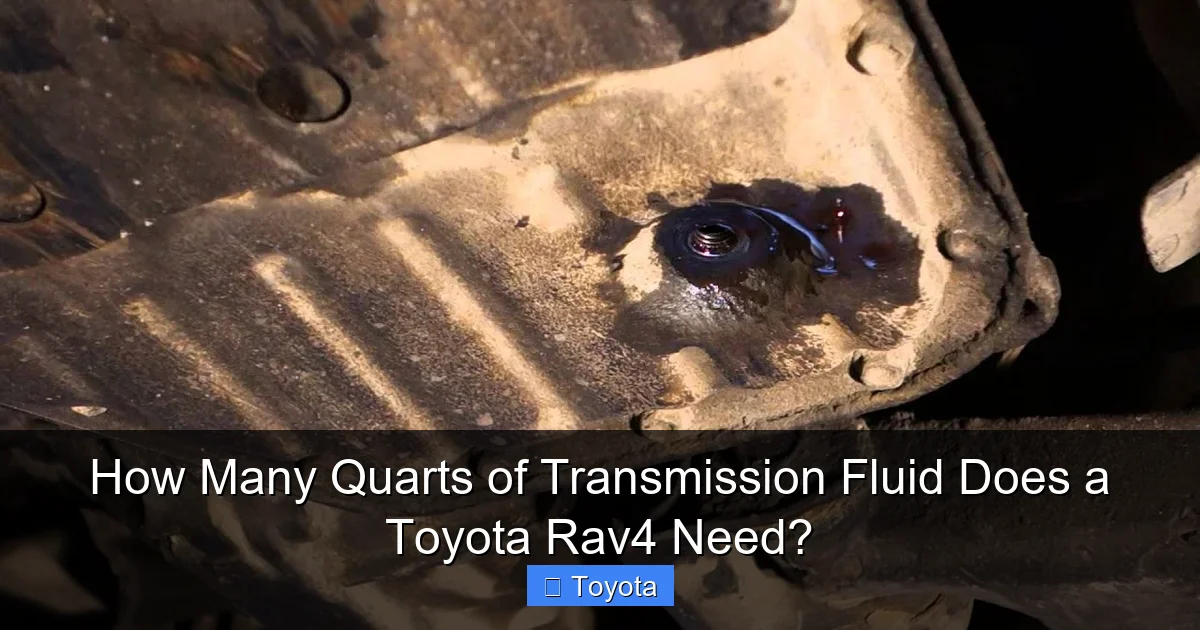
Visual guide about How Many Quarts of Transmission Fluid Does a Toyota Rav4 Need?
Image source: i.ytimg.com
So, how do you know exactly how many quarts your RAV4 needs? Here’s a step-by-step guide to help you figure it out.
Step 1: Check Your Owner’s Manual
This is the #1 rule. Your owner’s manual is the most accurate source for fluid type, capacity, and service intervals. Look for the “Maintenance” or “Capacities and Specifications” section. It will list the exact amount of transmission fluid required, often broken down by transmission type.
For example, a 2020 RAV4 LE with a 2.5L 4-cylinder engine and 8-speed automatic will specify:
- Transmission Fluid Type: Genuine Toyota ATF WS
- Capacity (Drain and Refill): 3.7 quarts
- Total System Capacity: 8.2 quarts
Step 2: Identify Your Transmission Type
Not all RAV4s have the same transmission. To find out what you have:
- Look at the gear shifter: Does it say “P-R-N-D” with fixed positions? Likely an automatic.
- Does it feel like it’s “slipping” or has no distinct shifts? Could be a CVT.
- Check under the hood: Some models have a label on the transmission itself.
- Use a VIN decoder online: Enter your Vehicle Identification Number to get detailed specs.
Step 3: Understand Drain-and-Fill vs. Full Flush
Here’s a common point of confusion: the amount of fluid you add during a service is usually much less than the total capacity. That’s because most DIY or basic shop services only drain the fluid from the pan—not the torque converter, cooler lines, or valve body.
- Drain-and-Fill: Replaces about 30–50% of the fluid. You’ll add 3.5–4.5 quarts, depending on the model.
- Full Flush: Uses a machine to circulate new fluid through the entire system, replacing up to 100%. This may require 8–9 quarts or more.
A full flush is more thorough but also more expensive. It’s often recommended for high-mileage vehicles or those with contaminated fluid.
Step 4: Use the Correct Fluid
Using the wrong transmission fluid is one of the most common—and costly—mistakes. Toyota has specific requirements:
- Pre-2013 Models: Often use ATF Type T-IV or Dexron III
- 2013–2018 CVT Models: Require CVT Fluid FE
- 2019+ Gas Models: Use ATF WS
- Hybrid Models: Use e-CVT Fluid (specific to hybrid systems)
Never substitute with generic or multi-vehicle fluids unless explicitly approved by Toyota. Using the wrong type can void your warranty and damage the transmission.
How to Safely Add Transmission Fluid
If you’re doing a DIY transmission fluid change, here’s how to do it safely and correctly.
Tools and Supplies You’ll Need
- Correct transmission fluid (check your manual)
- Funnel with long, narrow spout
- Socket wrench set
- Drain pan
- Jack and jack stands (or ramps)
- Gloves and safety glasses
- Clean rags
Step-by-Step Process
1. Warm Up the Engine: Start your RAV4 and let it run for 5–10 minutes. Transmission fluid should be at operating temperature for an accurate level check.
2. Park on Level Ground: This ensures the fluid level is measured correctly.
3. Lift the Vehicle: Use a jack and jack stands or drive onto ramps. Never work under a vehicle supported only by a jack.
4. Locate the Transmission Pan: It’s usually on the bottom of the transmission, held by bolts.
5. Drain the Old Fluid: Place the drain pan underneath, then remove the drain plug (if equipped) or loosen the pan bolts. Let the fluid drain completely.
6. Replace the Filter (if applicable): Some RAV4s have a replaceable filter inside the pan. Check your manual.
7. Reinstall the Pan: Clean the pan and magnet, then reattach with new gaskets if needed.
8. Add New Fluid: Use a funnel to pour the correct amount of fluid into the dipstick tube. Start with the drain-and-fill amount (e.g., 3.7 quarts).
9. Check the Level: Start the engine, shift through all gears (P-R-N-D), then return to Park. With the engine running, check the dipstick. Add more fluid if needed until it’s in the “Full” range.
10. Test Drive: Take a short drive to circulate the fluid, then recheck the level.
Tips for Success
- Never overfill. Excess fluid can cause foaming, overheating, and seal damage.
- If your RAV4 doesn’t have a dipstick (some newer models), you may need a scan tool or dealer service to check the level.
- Dispose of old fluid responsibly. Most auto parts stores accept used fluid for recycling.
Signs Your RAV4 Needs a Transmission Fluid Change
Even if you’re not due for a scheduled change, watch for these warning signs that your transmission fluid may be degraded or low:
- Delayed or Rough Shifting: Hesitation when accelerating or jerky gear changes.
- Transmission Slipping: The engine revs but the vehicle doesn’t accelerate as expected.
- Burning Smell: Overheated or burnt fluid gives off a distinct odor.
- Fluid Leaks: Red or brown fluid under your vehicle near the transmission.
- Dashboard Warning Light: Check Engine or Transmission Warning light may illuminate.
- Noisy Transmission: Whining, humming, or clunking sounds when shifting.
If you notice any of these symptoms, have your transmission inspected immediately. Ignoring them can lead to costly repairs.
Maintenance Schedule and Best Practices
Toyota recommends changing the transmission fluid every 60,000 to 100,000 miles, depending on driving conditions. Here’s a general guideline:
- Normal Driving: Every 100,000 miles
- Severe Driving: Every 60,000 miles (includes towing, stop-and-go traffic, extreme temperatures)
However, many mechanics recommend changing it more frequently—especially if you do a lot of city driving or live in a hot climate. Heat is the #1 enemy of transmission fluid.
Best Practices for Long-Term Health
- Use only Genuine Toyota or OEM-approved fluids.
- Stick to the recommended service interval.
- Avoid “lifetime” fluid myths—no fluid lasts forever.
- Keep records of all fluid changes.
- Consider a flush if you’re buying a used RAV4 with unknown maintenance history.
Conclusion
So, how many quarts of transmission fluid does a Toyota RAV4 need? The answer isn’t one-size-fits-all. Depending on your model year, engine, and transmission type, the capacity can range from about 3.5 quarts (for a drain-and-fill) to over 9 quarts (for a full system flush). The key is to consult your owner’s manual, use the correct fluid, and follow proper procedures.
Regular transmission maintenance is one of the best ways to protect your RAV4’s performance and longevity. Whether you’re a DIY enthusiast or prefer to leave it to the pros, understanding your vehicle’s fluid needs puts you in control. With the right care, your RAV4’s transmission can last well beyond 200,000 miles—keeping you on the road for years to come.
Frequently Asked Questions
How often should I change the transmission fluid in my Toyota RAV4?
Toyota recommends changing the transmission fluid every 60,000 to 100,000 miles, depending on driving conditions. Severe driving (like towing or city traffic) may require more frequent changes.
Can I use any transmission fluid in my RAV4?
No. Always use the fluid specified in your owner’s manual. Most modern RAV4s require Genuine Toyota ATF WS or CVT Fluid FE. Using the wrong type can damage the transmission.
How do I check the transmission fluid level in my RAV4?
With the engine warm and running, park on level ground, shift through all gears, then check the dipstick. Add fluid if it’s below the “Full” mark. Some newer models don’t have a dipstick and require a scan tool.
Is a transmission flush better than a drain-and-fill?
A flush replaces more fluid and is better for high-mileage vehicles, but it’s more expensive. A drain-and-fill is sufficient for routine maintenance and is often recommended for newer vehicles.
What happens if I overfill the transmission fluid?
Overfilling can cause foaming, overheating, and seal damage. It may also lead to leaks or poor shifting. Always add fluid gradually and check the level frequently.
Can I change the transmission fluid myself?
Yes, if you have the right tools and follow the correct procedure. However, if your RAV4 doesn’t have a dipstick or requires special tools, it’s best to have a professional perform the service.