
How Many Cans of Freon Does a Car Take?

Most cars need 1 to 3 cans of Freon (R-134a) to recharge the AC system, but the exact amount depends on your vehicle’s make, model, and system capacity. Overcharging can damage the AC, so always check your owner’s manual or consult a professional.
Key Takeaways
- Typical Freon Capacity: Most passenger vehicles require 16 to 32 ounces (1 to 2 pounds) of R-134a refrigerant, which equals 1 to 3 standard 12-ounce cans.
- Check the Owner’s Manual: Your vehicle’s manual lists the exact refrigerant capacity—never guess. Overfilling can cause compressor damage.
- Use the Right Refrigerant: Modern cars use R-134a; older models may use R-12 (now discontinued). Never mix refrigerants.
- Low Pressure Doesn’t Always Mean Low Freon: A weak AC could be due to leaks, faulty compressors, or clogged filters—not just low refrigerant.
- DIY Recharge Risks: While recharge kits are available, improper use can lead to injury or system damage. Professionals have gauges and recovery tools.
- Environmental and Legal Concerns: Releasing Freon into the air is illegal in many places. Always recycle or properly dispose of refrigerant.
- Signs You Need a Recharge: Warm air from vents, hissing sounds, or oily residue near AC components may indicate low Freon or a leak.
📑 Table of Contents
- How Many Cans of Freon Does a Car Take?
- Understanding Car AC Refrigerant: What Is Freon?
- How Much Freon Does a Typical Car Need?
- Signs Your Car Needs a Freon Recharge
- DIY vs. Professional Recharge: What You Need to Know
- Types of Refrigerant: R-134a vs. R-12 vs. R-1234yf
- Safety and Environmental Considerations
- Tips for Maintaining Your Car’s AC System
- Conclusion
How Many Cans of Freon Does a Car Take?
If your car’s air conditioning isn’t blowing cold air like it used to, you’re probably wondering: “How many cans of Freon does a car take?” It’s a common question, especially during the sweltering summer months when a working AC isn’t just a luxury—it’s a necessity.
The short answer? Most cars need between one and three standard 12-ounce cans of R-134a refrigerant to fully recharge the AC system. But that’s just the beginning. The real answer depends on several factors, including your vehicle’s make and model, the type of refrigerant it uses, and whether there’s an underlying issue like a leak or a failing compressor.
In this guide, we’ll walk you through everything you need to know about car AC refrigerant, from how much your car actually needs to the risks of DIY recharging and when to call a professional. Whether you’re a weekend mechanic or just trying to stay cool on your commute, this article will help you make smart, safe decisions about your car’s air conditioning system.
Understanding Car AC Refrigerant: What Is Freon?
Visual guide about How Many Cans of Freon Does a Car Take?
Image source: acavalanche.com
Before we dive into how many cans your car needs, let’s clarify what “Freon” actually is—and why it matters.
Despite the name, “Freon” is a brand name originally used by DuPont for a family of chlorofluorocarbon (CFC) refrigerants. The most well-known type was R-12, which was widely used in car AC systems from the 1930s until the 1990s. However, R-12 was found to deplete the ozone layer, leading to a global phaseout under the Montreal Protocol.
Today, most vehicles use **R-134a**, a hydrofluorocarbon (HFC) refrigerant that doesn’t harm the ozone layer. While it still contributes to global warming, it’s considered a safer alternative. Some newer cars are now transitioning to **R-1234yf**, a more environmentally friendly refrigerant with a lower global warming potential.
So when people ask, “How many cans of Freon does a car take?” they’re usually referring to R-134a—not the old R-12. It’s important to know which type your car uses, because mixing refrigerants can damage the system and is illegal in many areas.
Why Refrigerant Matters for Cooling
Your car’s AC system works by circulating refrigerant through a closed loop. The refrigerant absorbs heat from inside the cabin and releases it outside, creating cool air. This process relies on precise pressure and temperature changes, which only work correctly with the right amount and type of refrigerant.
If your system is low on refrigerant, the AC won’t cool properly—even if everything else is working. But adding too much can be just as bad. Overcharging increases pressure, which can damage the compressor, seals, and hoses.
That’s why it’s crucial to know exactly how much refrigerant your car needs—and how to add it safely.
How Much Freon Does a Typical Car Need?
Visual guide about How Many Cans of Freon Does a Car Take?
Image source: vehiclerides.com
Now for the big question: How many cans of Freon does a car take?
The average passenger vehicle holds **16 to 32 ounces (1 to 2 pounds)** of R-134a refrigerant. Since most recharge cans contain 12 ounces of refrigerant, this translates to **1 to 3 cans** for a full recharge.
But here’s the catch: you should never just “top off” your AC with a full can or two without checking the system first. Overfilling can cause serious damage.
Let’s break it down with some real-world examples:
– **Compact cars** (like a Honda Civic or Toyota Corolla) typically hold about 18–22 ounces. That’s roughly 1.5 to 2 cans.
– **Midsize sedans** (like a Ford Fusion or Nissan Altima) usually need 20–26 ounces—about 2 cans.
– **SUVs and trucks** (like a Toyota RAV4 or Ford F-150) may require 24–32 ounces, or 2 to 3 cans.
These are general estimates. The only way to know for sure is to check your **owner’s manual** or look up your vehicle’s specifications online.
How to Find Your Car’s Refrigerant Capacity
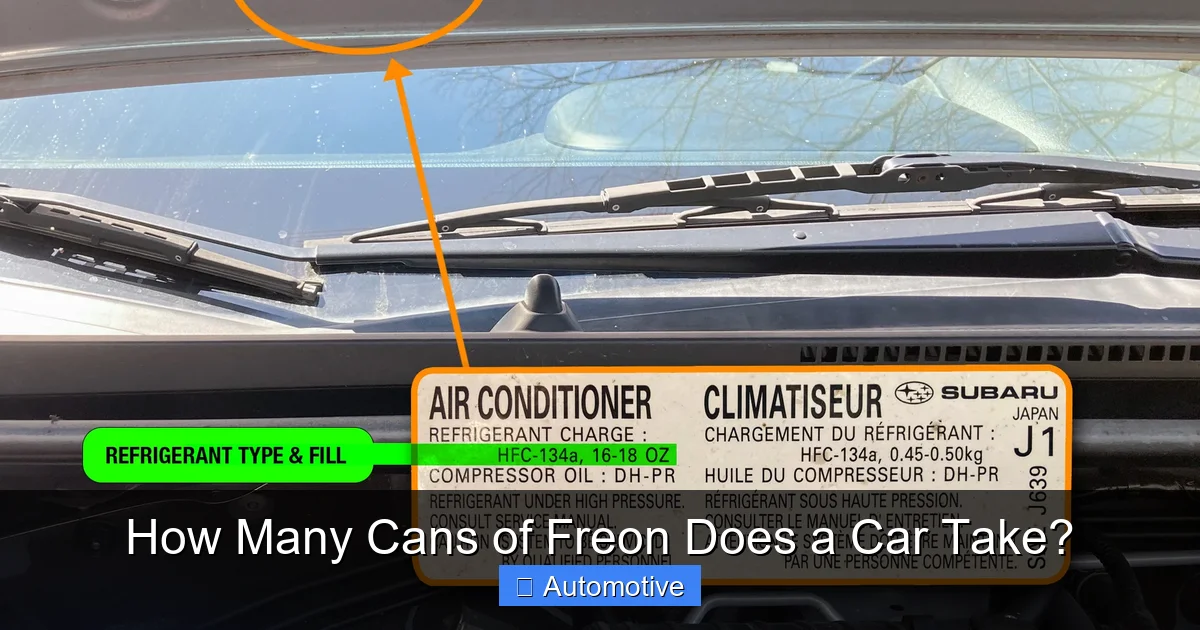
Your owner’s manual is the best source for this information. Look for a section on “Air Conditioning” or “Refrigerant Capacity.” It will usually list the amount in ounces or grams.
If you don’t have the manual, you can:
– Search online using your car’s year, make, and model + “AC refrigerant capacity.”
– Check the under-hood emissions label—some vehicles list refrigerant type and amount there.
– Visit the manufacturer’s website or contact a dealership.
For example, a 2015 Honda Accord requires about 20 ounces of R-134a. That’s just over 1.5 cans. A 2020 Ford F-150 might need up to 30 ounces—closer to 2.5 cans.
Why You Shouldn’t Guess the Amount
It’s tempting to grab a couple of cans and “eyeball” it, especially with DIY recharge kits available at auto parts stores. But guessing can lead to overcharging.
Overcharging increases pressure in the system, which can:
– Damage the compressor (the most expensive AC component)
– Cause seals to blow
– Reduce cooling efficiency
– Trigger the high-pressure switch, shutting down the AC
Even undercharging can be a problem. If your system is low, it may not cool properly, and the compressor can overheat due to lack of lubrication (refrigerant carries oil through the system).
So while 1 to 3 cans is a good rule of thumb, always aim for precision.
Signs Your Car Needs a Freon Recharge
Visual guide about How Many Cans of Freon Does a Car Take?
Image source: i.redd.it
Not every warm breeze from your vents means you’re low on Freon. But there are some telltale signs that your AC system might need attention.
1. Weak or Warm Air from Vents
This is the most obvious sign. If your AC used to blow ice-cold air but now only puts out lukewarm or room-temperature air, refrigerant levels could be low.
However, this symptom can also indicate other issues, like a clogged cabin air filter, a failing blower motor, or a problem with the blend door. So don’t assume it’s Freon right away.
2. Hissing or Bubbling Sounds
If you hear a hissing noise when the AC is running—especially near the firewall or under the hood—it could mean refrigerant is escaping from a leak. Bubbling sounds in the sight glass (if your system has one) also suggest low refrigerant.
3. Oily Residue Around AC Components
Refrigerant leaks often leave behind an oily film. Check around the compressor, hoses, and connections under the hood. If you see dark, greasy spots, there’s likely a leak.
4. AC Compressor Clutch Not Engaging
The compressor clutch should engage (click on) when you turn on the AC. If it doesn’t, it could be due to low pressure from low refrigerant. The system’s safety switch may prevent the compressor from running to avoid damage.
5. Long Cool-Down Times
If it takes much longer than usual for your car to cool down after starting, especially on hot days, low refrigerant could be the culprit.
Important: Low Freon Usually Means a Leak
Refrigerant doesn’t “wear out” or get used up like oil or gas. It’s a closed system—so if your levels are low, there’s almost always a leak.
Common leak points include:
– O-rings and seals (which dry out over time)
– The compressor shaft seal
– Hoses and connections
– The condenser (often damaged by road debris)
Simply adding Freon without fixing the leak is a temporary fix. The refrigerant will escape again, and you’ll be back to square one.
DIY vs. Professional Recharge: What You Need to Know
With recharge kits available for under $30, many drivers try to recharge their AC themselves. But is it safe? And effective?
How DIY Recharge Kits Work
Most DIY kits include:
– A can of R-134a refrigerant
– A hose with a pressure gauge
– A trigger or valve to control flow
You attach the hose to the low-pressure port (usually on the suction line near the firewall), open the valve, and let the refrigerant flow into the system.
Some kits also include UV dye to help detect leaks.
Pros of DIY Recharge
– Inexpensive (compared to a shop visit)
– Quick and easy for minor top-offs
– Can restore cooling temporarily
Cons of DIY Recharge
– No way to measure exact refrigerant levels
– Risk of overcharging
– Doesn’t fix leaks
– Can’t recover old refrigerant (illegal to vent)
– May void warranty if done incorrectly
When to Call a Professional
A certified technician has the tools and training to:
– Recover old refrigerant safely
– Evacuate the system (remove air and moisture)
– Weigh in the exact amount of refrigerant
– Test for leaks with electronic detectors or UV dye
– Check system pressures and performance
They can also diagnose other issues, like a failing compressor or clogged expansion valve.
If your AC is completely dead, has a known leak, or hasn’t been serviced in years, it’s best to leave it to the pros.
Cost Comparison
– **DIY recharge kit:** $20–$40
– **Professional recharge:** $100–$250 (depending on location and labor)
While the DIY option is cheaper upfront, a professional service is more thorough and safer in the long run.
Types of Refrigerant: R-134a vs. R-12 vs. R-1234yf
Not all refrigerants are created equal—and using the wrong one can destroy your AC system.
R-134a: The Standard for Most Cars
Introduced in the early 1990s, R-134a replaced R-12 in most vehicles. It’s widely available, affordable, and compatible with most modern AC systems.
If your car was made after 1995, it almost certainly uses R-134a.
R-12: The Old Standard (Now Banned)
R-12 was used in cars until the mid-1990s. It’s no longer produced due to environmental concerns, and it’s illegal to vent into the atmosphere.
If you have a classic car with R-12, you’ll need to have it retrofitted to R-134a or use reclaimed R-12 (which is expensive and hard to find).
R-1234yf: The New Eco-Friendly Option
Starting around 2013, some manufacturers began using R-1234yf, a refrigerant with a much lower global warming potential. It’s required in new vehicles in the U.S. and Europe.
R-1234yf is more expensive and requires special handling equipment. It’s not compatible with R-134a systems, and mixing them can cause damage.
Never Mix Refrigerants
Mixing different types of refrigerant is dangerous and illegal. It can cause chemical reactions, system corrosion, and complete failure.
Always check your owner’s manual or a professional before adding any refrigerant.
Safety and Environmental Considerations
Handling refrigerant isn’t just about mechanics—it’s also about safety and the environment.
Why Releasing Freon Is Illegal
Refrigerants like R-134a are greenhouse gases. R-134a has a global warming potential (GWP) 1,430 times greater than CO₂. Releasing it into the air contributes to climate change.
In the U.S., the Environmental Protection Agency (EPA) prohibits venting refrigerants under Section 608 of the Clean Air Act. Violators can face fines up to $37,500 per day.
Safe Handling Tips
– Always wear safety goggles and gloves.
– Work in a well-ventilated area.
– Never puncture or incinerate refrigerant cans.
– Use a recovery machine if removing refrigerant.
– Store cans upright and away from heat.
Disposal and Recycling
Used refrigerant must be recovered and recycled or destroyed by certified technicians. Many auto shops offer refrigerant recovery services.
Never try to “bleed off” old refrigerant—even a small amount can be harmful.
Tips for Maintaining Your Car’s AC System
Prevention is better than repair. Here’s how to keep your AC running smoothly and avoid frequent recharges.
1. Run the AC Regularly
Even in winter, run your AC for 10 minutes every few weeks. This keeps the compressor lubricated and seals flexible.
2. Replace the Cabin Air Filter
A clogged filter restricts airflow, making the AC work harder. Replace it every 12,000 to 15,000 miles.
3. Check for Leaks Annually
Have a technician inspect your AC system during routine maintenance. Early leak detection saves money and refrigerant.
4. Park in the Shade
Reducing interior heat lowers the load on your AC, helping it cool faster and last longer.
5. Use the Recirculation Mode
This mode cools the air already inside the cabin, rather than pulling in hot outside air. It’s more efficient on hot days.
6. Service Before Summer
Schedule an AC checkup in spring. Technicians can recharge, clean, and test the system before peak demand.
Conclusion
So, how many cans of Freon does a car take? For most vehicles, the answer is **1 to 3 standard 12-ounce cans of R-134a**, depending on the system’s capacity. But the real answer is more nuanced.
The key is to **check your owner’s manual** for the exact refrigerant capacity and to **diagnose the root cause** of weak cooling. Low Freon often signals a leak, which requires professional repair—not just a top-off.
While DIY recharge kits are tempting, they come with risks. Overcharging, using the wrong refrigerant, or ignoring leaks can lead to costly damage. For best results, consult a certified technician, especially if your AC is completely dead or you suspect a leak.
By understanding your car’s AC system, using the right refrigerant, and maintaining it properly, you can stay cool all summer long—without breaking the bank or harming the environment.
Frequently Asked Questions
How do I know if my car needs Freon?
If your AC blows warm air, takes a long time to cool, or you hear hissing sounds, you may be low on refrigerant. However, these symptoms can also indicate other issues like a clogged filter or failing compressor.
Can I add Freon myself?
Yes, with a DIY recharge kit, but it’s risky. Without proper gauges, you might overcharge the system or miss a leak. For safety and accuracy, a professional service is recommended.
How often should I recharge my car’s AC?
Refrigerant shouldn’t need regular recharging. If your system is low, there’s likely a leak. Have it inspected and repaired instead of repeatedly adding Freon.
Is it bad to overcharge a car with Freon?
Yes. Overcharging increases pressure, which can damage the compressor, seals, and hoses. It can also reduce cooling efficiency and trigger safety shutoffs.
What’s the difference between R-134a and R-1234yf?
R-134a is the standard refrigerant for most cars made after 1995. R-1234yf is newer, more eco-friendly, and used in many vehicles from 2013 onward. They are not interchangeable.
Can I use R-12 in a modern car?
No. R-12 is banned due to environmental concerns and is not compatible with modern AC systems. Older cars can be retrofitted to use R-134a by a professional.
