
How Much Car Can I Afford Based on Salary?

Figuring out how much car you can afford based on salary doesn’t have to be confusing. By using simple financial guidelines, understanding your monthly budget, and factoring in insurance, fuel, and maintenance, you can make a smart, sustainable car-buying decision that fits your lifestyle—not your debt.
Key Takeaways
- Use the 20/4/10 rule: Put 20% down, finance for no more than 4 years, and keep total car expenses under 10% of your gross monthly income.
- Your salary isn’t the only factor: Consider taxes, living expenses, debt, and future financial goals when calculating affordability.
- New vs. used cars matter: A used car often offers better value and lower depreciation, making it easier to stay within budget.
- Don’t forget ongoing costs: Insurance, fuel, maintenance, and repairs can add hundreds per month—factor these into your total cost.
- Pre-approval helps: Getting pre-approved for a loan gives you negotiating power and clarifies your true budget.
- Avoid stretching your budget: Buying a car that pushes your limits can lead to financial stress and missed savings opportunities.
- Use online tools: Car affordability calculators and budgeting apps can help you visualize what you can realistically afford.
📑 Table of Contents
- How Much Car Can I Afford Based on Salary?
- Understanding the Basics: Salary vs. Take-Home Pay
- The 20/4/10 Rule: A Simple Formula for Car Affordability
- Calculating Your True Car Budget: Beyond the Monthly Payment
- New vs. Used: Which Is More Affordable?
- How Debt and Other Expenses Affect Car Affordability
- Using Online Tools to Estimate Affordability
- Common Mistakes to Avoid When Buying a Car
- Final Tips for Smart Car Buying
- Conclusion
How Much Car Can I Afford Based on Salary?
So you’ve got a steady paycheck, and you’re ready to upgrade from public transit or that old beater that’s seen better days. But before you fall in love with that shiny new SUV or sleek sports car, it’s crucial to ask yourself: *How much car can I actually afford based on my salary?*
It’s easy to get swept up in the excitement of car shopping—especially when dealerships make financing sound simple. But buying a car isn’t just about monthly payments. It’s about your entire financial picture. Your salary is a starting point, but it’s not the whole story. Taxes, rent, groceries, student loans, and even your Netflix subscription all play a role in what you can truly afford.
The good news? With a little planning and some smart math, you can find a reliable, stylish vehicle that fits your budget—without sacrificing your financial peace of mind. In this guide, we’ll walk you through practical steps, proven rules of thumb, and real-world examples to help you determine exactly how much car you can afford based on your salary.
Understanding the Basics: Salary vs. Take-Home Pay

Visual guide about How Much Car Can I Afford Based on Salary?
Image source: newtraderu.com
Before we dive into car prices and loan terms, let’s clear up a common mistake: confusing your gross salary with your take-home pay.
Your **gross salary** is the amount your employer quotes you—say, $60,000 per year. But after taxes, Social Security, health insurance, and retirement contributions, your **take-home pay** is significantly less. For most people, take-home pay is about 70–80% of gross income. So if you earn $60,000 annually, you’re likely bringing home around $42,000 to $48,000 per year—or roughly $3,500 to $4,000 per month.
Why does this matter? Because your car payment should be based on what you actually have available each month—not what you earn before taxes.
Example: Breaking Down a $60,000 Salary
Let’s say you earn $60,000 per year. Here’s a rough breakdown:
– Gross monthly income: $5,000
– Estimated take-home pay (after taxes and deductions): $3,750
Now, if you’re using the 20/4/10 rule (more on that soon), your total car expenses—including loan payment, insurance, fuel, and maintenance—should not exceed 10% of your gross monthly income. That’s $500 per month.
But wait—your take-home pay is $3,750. So $500 is actually about 13% of your actual available income. That might be manageable, but it’s tight. If you have other debts or high living costs, even $500 could strain your budget.
This is why it’s essential to base your car budget on both your gross income (for rules of thumb) and your net income (for real-world affordability).
The 20/4/10 Rule: A Simple Formula for Car Affordability
Visual guide about How Much Car Can I Afford Based on Salary?
Image source: academy.fincheck.co.za
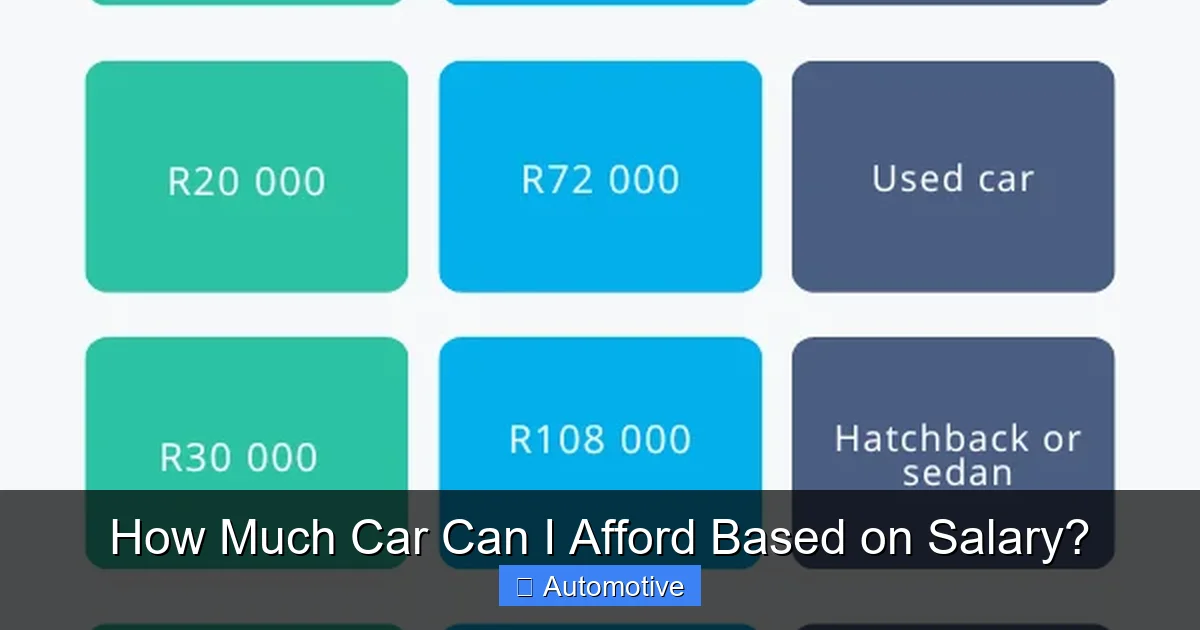
One of the most widely recommended guidelines for car affordability is the **20/4/10 rule**. It’s simple, practical, and designed to keep you from overextending financially.
Here’s how it works:
– **20% down payment:** Put at least 20% of the car’s price down upfront.
– **4-year loan term:** Finance the car for no more than 4 years (48 months).
– **10% of gross income:** Keep your total car expenses under 10% of your gross monthly income.
Let’s break this down with an example.
Applying the 20/4/10 Rule
Say you earn $75,000 per year. That’s a gross monthly income of $6,250.
According to the 10% rule, your total monthly car expenses should not exceed $625.
Now, let’s say you’re looking at a $30,000 car. You put down 20% ($6,000), so you’re financing $24,000 over 4 years at a 5% interest rate.
Your monthly loan payment would be about $552.
But that’s not all. Add in:
– Insurance: $120/month
– Fuel: $100/month
– Maintenance and repairs: $50/month
Total monthly cost: $552 + $120 + $100 + $50 = $822
Oops—that’s over your $625 limit. Even with a 20% down payment and a 4-year loan, this car pushes your budget.
So what can you afford?
Let’s try a $20,000 car with a $4,000 down payment (20%). You finance $16,000 over 4 years at 5%.
Monthly loan payment: ~$368
Insurance: $100
Fuel: $80
Maintenance: $40
Total: $588 per month
That’s under your $625 limit. This car fits the 20/4/10 rule and leaves room for unexpected costs.
Why the 20/4/10 Rule Works
This rule protects you in three key ways:
1. **The 20% down payment** reduces the amount you need to borrow, lowers your monthly payment, and helps you avoid being “upside-down” on your loan (owing more than the car is worth).
2. **The 4-year loan term** keeps interest costs low and ensures you’re not paying for a car long after it’s lost most of its value.
3. **The 10% cap** ensures your car doesn’t consume too much of your income, leaving room for savings, emergencies, and other expenses.
Of course, life isn’t always perfect. Maybe you can’t afford 20% down right now. That’s okay—just be aware of the trade-offs. A smaller down payment means a higher monthly payment and more interest over time. But the 20/4/10 rule gives you a solid starting point.
Calculating Your True Car Budget: Beyond the Monthly Payment

Visual guide about How Much Car Can I Afford Based on Salary?
Image source: moneybliss.org
When people ask, “How much car can I afford?” they often focus only on the monthly payment. But that’s like asking how much house you can afford based only on the mortgage—ignoring property taxes, utilities, and repairs.
Your **total cost of ownership** includes much more than the loan payment. Here’s what to consider:
1. Loan Payment
This is the amount you pay each month to the lender. It depends on:
– The car’s price
– Down payment
– Loan term (length)
– Interest rate
Use an online auto loan calculator to estimate your payment. For example, a $25,000 loan at 6% interest over 5 years equals about $483/month. Over 6 years? That drops to $404—but you’ll pay over $2,000 more in interest.
2. Insurance
Insurance costs vary widely based on:
– Your age, driving record, and location
– The car’s make, model, and safety features
– Coverage level (liability only vs. full coverage)
A brand-new sports car will cost far more to insure than a used sedan. For example, insuring a 2024 Honda Civic might cost $120/month, while a 2024 BMW M3 could run $300+/month.
Tip: Get insurance quotes *before* you buy. Some dealerships will estimate it for you, or you can call your insurer with the VIN.
3. Fuel
Gas prices fluctuate, but your car’s fuel efficiency matters. A truck that gets 15 MPG will cost about $200/month in gas if you drive 1,000 miles. A hybrid that gets 50 MPG? Around $60.
Use the EPA’s fuel economy website to compare vehicles.
4. Maintenance and Repairs
New cars come with warranties, so maintenance is minimal for the first few years. But even then, you’ll pay for oil changes, tire rotations, and inspections—typically $50–$100 every few months.
Used cars? Budget $50–$100/month for repairs, especially if the car is out of warranty. Luxury brands and high-mileage vehicles cost more to maintain.
5. Depreciation
This one doesn’t show up on your monthly budget, but it’s real. Cars lose value the moment you drive them off the lot. A new car can lose 20% of its value in the first year.
If you plan to sell or trade in the car later, depreciation affects your return. Used cars depreciate slower, making them a smarter financial choice for many buyers.
Putting It All Together: A Real-World Example
Let’s say you earn $50,000 per year ($4,167/month gross). You’re looking at two options:
**Option A: New Car**
– Price: $28,000
– Down payment: $5,600 (20%)
– Loan: $22,400 at 5% over 4 years → $517/month
– Insurance: $140/month
– Fuel: $120/month (25 MPG, 12,000 miles/year)
– Maintenance: $60/month
– **Total: $837/month**
**Option B: Used Car**
– Price: $16,000 (2021 model, 30,000 miles)
– Down payment: $3,200 (20%)
– Loan: $12,800 at 6% over 4 years → $298/month
– Insurance: $100/month
– Fuel: $100/month
– Maintenance: $80/month
– **Total: $578/month**
Even though the new car has a lower interest rate, the used car saves you $259/month—over $3,100 per year. That’s money you could put toward savings, travel, or paying off debt.
New vs. Used: Which Is More Affordable?
This is one of the biggest debates in car buying. And while new cars offer the latest tech and warranties, used cars often deliver better value.
The Case for Used Cars
– **Lower purchase price:** A 2–3-year-old car can cost 30–40% less than a new one.
– **Slower depreciation:** Most depreciation happens in the first few years.
– **Lower insurance:** Older cars typically cost less to insure.
– **Certified pre-owned (CPO) options:** Many dealers offer CPO programs with extended warranties and inspections.
The Case for New Cars
– **Warranty coverage:** Most new cars come with 3-year/36,000-mile basic warranties.
– **Latest safety features:** Newer models often have advanced driver-assist systems (like automatic braking and lane-keeping).
– **Customization:** You can choose exact colors, trims, and features.
– **Lower maintenance:** Fewer repairs in the first few years.
When to Choose Which
– **Choose used if:** You want to maximize value, minimize depreciation, and stay within a tight budget.
– **Choose new if:** You prioritize safety, technology, and long-term reliability—and can afford the higher cost.
A smart middle ground? Look for a **1–3-year-old certified pre-owned car**. You get most of the benefits of new without the steep depreciation.
How Debt and Other Expenses Affect Car Affordability
Your salary is important, but it’s not the only factor. Your **debt-to-income ratio (DTI)** and other monthly expenses play a huge role in how much car you can afford.
Debt-to-Income Ratio (DTI)
Lenders look at your DTI to determine loan approval. It’s calculated as:
> (Total monthly debt payments) ÷ (Gross monthly income)
For example, if you earn $5,000/month and pay $1,500 in debts (rent, student loans, credit cards), your DTI is 30%.
Most lenders prefer a DTI under 36%, and ideally under 28% for auto loans. If your DTI is already high, adding a car payment could push you over the edge.
Other Monthly Expenses
Ask yourself:
– Do you have student loans or credit card debt?
– Are you saving for a house or retirement?
– Do you have kids or support family members?
– Are you planning a big expense (wedding, vacation, medical procedure)?
If your budget is already tight, a car payment—even a modest one—might not be sustainable.
Emergency Fund Considerations
Before buying a car, make sure you have an emergency fund. Experts recommend 3–6 months’ worth of living expenses.
Why? Because cars break down. Tires wear out. Accidents happen. If you’re living paycheck to paycheck, a $500 repair bill could derail your finances.
If you don’t have savings yet, consider delaying the car purchase—or choosing a cheaper, more reliable option.
Using Online Tools to Estimate Affordability
You don’t have to do all the math by hand. Several free online tools can help you calculate how much car you can afford based on your salary and expenses.
Car Affordability Calculators
Websites like Bankrate, Edmunds, and NerdWallet offer car affordability calculators. You input:
– Your monthly income
– Down payment
– Loan term
– Interest rate
– Estimated insurance, fuel, and maintenance
The tool estimates your maximum car price and monthly payment.
Budgeting Apps
Apps like Mint, YNAB (You Need A Budget), and PocketGuard track your spending and help you set financial goals. You can use them to see how a car payment would fit into your current budget.
Pre-Approval Tools
Many banks and credit unions let you get pre-approved for a car loan online. This gives you a clear idea of your interest rate and loan amount—before you step onto a dealership lot.
Pro tip: Get pre-approved *before* shopping. It gives you negotiating power and prevents you from falling in love with a car you can’t afford.
Common Mistakes to Avoid When Buying a Car
Even with the best intentions, it’s easy to make costly mistakes. Here are some to watch out for:
1. Focusing Only on the Monthly Payment
Dealerships often stretch loan terms to lower your monthly payment—say, from 4 years to 7 years. That might make the car *seem* affordable, but you’ll pay thousands more in interest and risk being upside-down on the loan.
2. Skipping the Down Payment
Putting $0 down might seem tempting, but it increases your loan amount, monthly payment, and total interest. Aim for at least 10–20% down.
3. Ignoring Total Cost of Ownership
A $200/month car payment might seem fine—until you add $150 for insurance, $100 for gas, and $50 for maintenance. Suddenly, you’re paying $500/month.
4. Buying Based on Emotion
That red convertible looks amazing—but can you really afford it? Stick to your budget, even if it means choosing a less exciting car.
5. Not Shopping Around for Loans
Dealership financing is convenient, but it’s not always the best deal. Compare rates from banks, credit unions, and online lenders.
6. Forgetting About Trade-In Value
If you’re trading in a car, research its value beforehand (use Kelley Blue Book or Edmunds). Don’t let the dealer lowball you.
Final Tips for Smart Car Buying
– **Start with your budget, not the car.** Know your limits before you shop.
– **Get pre-approved.** It gives you clarity and confidence.
– **Test drive multiple cars.** Don’t rush into a decision.
– **Negotiate the price, not just the payment.** Focus on the total cost.
– **Read the fine print.** Watch for add-ons like extended warranties and gap insurance.
– **Consider total cost of ownership.** A cheaper car isn’t always the best deal if it costs more to maintain.
– **Sleep on it.** If a deal feels too good (or too stressful), walk away.
Conclusion
So, how much car can you afford based on salary? The answer isn’t a single number—it’s a balance of your income, expenses, debt, and financial goals.
Use the 20/4/10 rule as a guide, but tailor it to your real-life situation. Remember, a car is a tool—not a status symbol. The best car for you is one that gets you where you need to go without derailing your financial future.
By doing the math, planning ahead, and avoiding common pitfalls, you can drive away in a vehicle that fits your budget—and your life.
Frequently Asked Questions
How much of my salary should go toward a car?
Experts recommend keeping total car expenses—including loan payment, insurance, fuel, and maintenance—under 10% of your gross monthly income. This ensures your car doesn’t consume too much of your budget.
Can I afford a $30,000 car on a $50,000 salary?
It depends on your other expenses and down payment. With a $50,000 salary, your gross monthly income is about $4,167. Using the 20/4/10 rule, your total car costs should stay under $417/month. A $30,000 car may exceed this unless you put a large down payment or choose a cheaper model.
Is it better to buy new or used?
Used cars often offer better value due to lower depreciation and purchase prices. However, new cars come with warranties and the latest safety features. A certified pre-owned vehicle can be a smart middle ground.
Should I get pre-approved for a car loan?
Yes. Pre-approval gives you a clear budget, helps you compare rates, and strengthens your negotiating position at the dealership. It also prevents you from overspending based on monthly payment tricks.
What if I can’t afford 20% down?
It’s okay to put less down, but be aware of the trade-offs: higher monthly payments, more interest, and a greater risk of being upside-down on your loan. Aim for at least 10% if possible, and consider a less expensive car.
How do I calculate my true car budget?
Add up your estimated loan payment, insurance, fuel, maintenance, and repairs. Compare this total to your monthly take-home pay. If it exceeds 10–15% of your income, you may need to adjust your car choice or down payment.