
When Suzuki Jimny Was First Introduced

The Suzuki Jimny was first introduced in 1970 as a lightweight, affordable 4×4 vehicle designed for rugged terrain and practical use. Originally launched in Japan under the name “LJ10,” it quickly became a favorite among farmers, adventurers, and off-road enthusiasts for its simplicity, durability, and go-anywhere capability.
When the Suzuki Jimny first rolled off the production line in 1970, few could have predicted the lasting impact this tiny, boxy 4×4 would have on the automotive world. Born out of necessity and practicality, the Jimny began as a humble workhorse—a no-frills vehicle meant to tackle Japan’s rugged countryside, steep mountain paths, and unpaved rural roads. What started as a utilitarian machine for farmers and postal workers soon captured the imagination of off-road enthusiasts, adventurers, and even urban drivers who appreciated its charm and capability.
The story of the Suzuki Jimny is one of resilience, evolution, and enduring appeal. Over five decades, it has survived market shifts, changing consumer tastes, and the rise of larger SUVs, all while staying true to its roots. Unlike many vehicles that grow bigger and more complex with each generation, the Jimny has managed to retain its compact size, lightweight build, and go-anywhere spirit. It’s not the fastest, most luxurious, or most technologically advanced vehicle on the road—but that’s exactly why people love it. It’s honest. It’s tough. And it’s built to last.
Key Takeaways
- First launched in 1970: The Suzuki Jimny debuted as the LJ10, marking Suzuki’s entry into the compact off-road vehicle market.
- Designed for tough terrain: Built with a lightweight body and four-wheel drive, it was ideal for rural areas, farms, and mountainous regions.
- Evolution over generations: The Jimny has evolved through four major generations, each improving on performance, comfort, and design while retaining its core off-road DNA.
- Global popularity: Though initially a Japanese domestic model, the Jimny gained international fame, especially in Europe, Australia, and Africa.
- Cult following and legacy: Known for its boxy design and reliability, the Jimny has developed a passionate fan base and remains one of the few true compact off-roaders still in production.
- Engineering simplicity: Early models used simple mechanics like leaf springs and manual transmissions, making them easy to repair and maintain.
- Environmental adaptability: The Jimny’s small size and high ground clearance made it perfect for narrow trails, river crossings, and remote exploration.
📑 Table of Contents
The Birth of the Jimny: 1970 and the LJ10
The Suzuki Jimny was first introduced in May 1970 under the name **LJ10**, which stood for “Light Jeep 10.” This name was a nod to the vehicle’s inspiration—the American Willys Jeep—and its lightweight design. At the time, Japan was experiencing rapid economic growth, but rural areas still lacked reliable transportation. Farmers, forestry workers, and local authorities needed a vehicle that could handle muddy fields, rocky trails, and narrow mountain paths without breaking the bank.
Suzuki, then known primarily for motorcycles, saw an opportunity. The company had already dabbled in small vehicles with the Suzulight series in the 1950s, but the LJ10 marked its first serious foray into the 4×4 market. Weighing just 590 kilograms (about 1,300 pounds), the LJ10 was powered by a modest 359cc, two-stroke, air-cooled engine that produced around 25 horsepower. While that might sound laughably weak by today’s standards, it was more than enough for the Jimny’s intended use—slow, steady, and reliable movement over tough terrain.
One of the LJ10’s standout features was its full-time four-wheel-drive system, which was rare for such a small and affordable vehicle at the time. It also featured a compact wheelbase of just 1,920 mm (about 6.3 feet), making it incredibly maneuverable in tight spaces. The body was made of lightweight steel, and the suspension used leaf springs—simple, durable, and easy to repair in the field.
Despite its humble beginnings, the LJ10 quickly gained a reputation for toughness. It could climb steep hills, cross shallow streams, and carry heavy loads without complaint. Farmers used it to haul crops, postal workers drove it along remote routes, and even the Japanese military tested it for potential use. Its simplicity was its strength—there were fewer parts to break, and when something did go wrong, repairs were straightforward and inexpensive.
Design and Practicality of the LJ10
The LJ10’s design was purely functional. It had a short hood, a tall cabin, and a rear-mounted spare tire—hallmarks of classic off-roaders. The interior was spartan: basic seats, a simple dashboard with minimal gauges, and no heating or air conditioning. Windows were often manually rolled up and down, and the doors were lightweight and easy to remove. This minimalist approach kept costs down and made the vehicle easy to maintain.
One practical feature was the fold-down windshield, which allowed drivers to lower the front glass for better visibility in rough terrain or to reduce wind resistance when driving slowly. The LJ10 also had a low-range transfer case, giving it extra torque for climbing or pulling heavy loads. This made it ideal for agricultural work, where power and control were more important than speed.
Another key aspect of the LJ10’s design was its compact size. At just 3.0 meters (about 10 feet) long, it could navigate narrow forest trails and fit into small garages. Its high ground clearance—around 200 mm (8 inches)—allowed it to drive over rocks, logs, and uneven ground without getting stuck. These features made it a favorite among outdoor workers and adventurers who needed a vehicle that could go where others couldn’t.
Early Reception and Market Impact
When the LJ10 was first introduced, it was met with curiosity and skepticism. Many doubted that such a small, underpowered vehicle could handle serious off-road conditions. But real-world use quickly proved the doubters wrong. Farmers reported that the LJ10 could traverse muddy rice paddies and steep hillsides with ease. Postal workers praised its reliability on long, remote routes. Even the Japanese government took notice, using the LJ10 in rural development projects.
The LJ10’s affordability was another major selling point. Priced significantly lower than larger 4x4s like the Toyota Land Cruiser or Nissan Patrol, it opened up off-road capability to a much wider audience. It wasn’t just for the wealthy or the military—it was for everyday people who needed a tough, dependable vehicle.
By the mid-1970s, Suzuki had sold thousands of LJ10s across Japan. The vehicle’s success led to the development of the LJ20 in 1972, which featured a larger 539cc engine and improved suspension. This marked the beginning of the Jimny’s evolution—a process that would continue for decades.
Evolution Through the Generations

Visual guide about When Suzuki Jimny Was First Introduced
Image source: silodrome.com
The Suzuki Jimny didn’t stay the same for long. As technology advanced and consumer needs changed, Suzuki continued to refine and improve the vehicle. Over the years, the Jimny went through four major generations, each bringing new features while staying true to its core identity.
Second Generation: The LJ50 and Jimny 55 (1972–1981)
In 1972, Suzuki introduced the LJ50, also known as the Jimny 55. This model featured a more powerful 539cc, three-cylinder, two-stroke engine that produced 28 horsepower. It also had a longer wheelbase and improved suspension, making it more comfortable on rough roads. The body was slightly larger, offering a bit more interior space.
One of the biggest changes was the addition of a four-speed manual transmission, replacing the three-speed used in the LJ10. This gave drivers better control over speed and torque, especially when climbing hills or towing loads. The LJ50 also introduced a more robust chassis and better sealing against water and dust, improving its durability in harsh conditions.
By the late 1970s, Suzuki began exporting the Jimny to other countries, including Australia, New Zealand, and parts of Europe. The vehicle’s compact size and off-road ability made it popular in rural areas and among outdoor enthusiasts. It was often used for farming, hunting, and exploring remote regions.
Third Generation: The SJ30 and Jimny 8 (1981–1998)
The third generation, introduced in 1981, marked a major leap forward. Known as the SJ30 (or Jimny 8 in some markets), this model featured a completely redesigned body, a more powerful engine, and modernized mechanics. It was available with either a 970cc or 1.0-liter four-cylinder engine, offering up to 52 horsepower—nearly double the power of the original LJ10.
This generation also introduced a five-speed manual transmission, improved suspension with coil springs (replacing leaf springs in some models), and better interior comfort. The body was more aerodynamic, and the vehicle was offered in both short-wheelbase (3-door) and long-wheelbase (5-door) versions. The long-wheelbase model, known as the Jimny 1300, was especially popular in export markets.
The SJ30 was also the first Jimny to be widely sold in North America, where it was marketed as the Suzuki Samurai. While it gained a loyal following, it also faced criticism for its high center of gravity and rollover risk, which led to a controversial Consumer Reports review in 1988. Despite this, the Samurai remained popular in many regions, especially in developing countries where its affordability and durability were highly valued.
Fourth Generation: The JB43 and Modern Jimny (1998–2018)
In 1998, Suzuki launched the fourth-generation Jimny, known internally as the JB43. This model featured a more refined design, a 1.3-liter engine, and improved safety features. It retained the classic boxy shape but added modern touches like power steering, air conditioning, and better sound insulation.
The JB43 was also the first Jimny to offer a factory-fitted automatic transmission, making it more accessible to a wider range of drivers. It continued to be built on a ladder frame chassis with solid axles and part-time four-wheel drive, preserving its off-road capability.
This generation was especially popular in Europe and Australia, where it became a favorite among outdoor enthusiasts and urban drivers alike. Its small size made it easy to park in cities, while its 4×4 system allowed it to handle weekend adventures. The Jimny also gained a cult following among overlanders and off-road clubs, who appreciated its simplicity and reliability.
Fifth Generation: The 2018 Jimny Revival
After a long wait, Suzuki introduced the fifth-generation Jimny in 2018. This model brought a fresh design while staying true to the original spirit. It featured a retro-inspired boxy look, LED headlights, a modern infotainment system, and improved safety features like electronic stability control and multiple airbags.
Under the hood, it came with a 1.5-liter four-cylinder engine producing 102 horsepower, paired with either a five-speed manual or four-speed automatic transmission. Despite the added technology, the new Jimny retained its ladder frame, solid axles, and part-time 4WD system—making it one of the last true body-on-frame compact SUVs on the market.
The 2018 Jimny was an instant hit, especially in Europe and Japan. Its combination of old-school charm and modern reliability made it a favorite among both off-road purists and city drivers. However, due to strict emissions regulations in some regions, it was not sold in North America.
Global Popularity and Cultural Impact

Visual guide about When Suzuki Jimny Was First Introduced
Image source: globalsuzuki.com
While the Suzuki Jimny started as a Japanese domestic vehicle, it quickly gained international fame. Its compact size, low cost, and off-road ability made it popular in rural areas around the world. In Africa, it was used by farmers, aid workers, and safari guides. In Australia, it became a favorite among campers and outback explorers. In Europe, it was embraced by urban drivers who loved its quirky style and practicality.
The Jimny also became a symbol of resilience and simplicity. In an era of increasingly complex and expensive SUVs, the Jimny stood out for its honesty and durability. It didn’t try to be a luxury vehicle—it was a tool, a companion, and a friend to those who needed to get somewhere others couldn’t.
Its cultural impact extended beyond transportation. The Jimny appeared in movies, TV shows, and video games, often as a symbol of adventure and freedom. It became a favorite among overlanders, who modified it with roof racks, snorkels, and off-road tires for long-distance travel.
Why the Jimny Endures
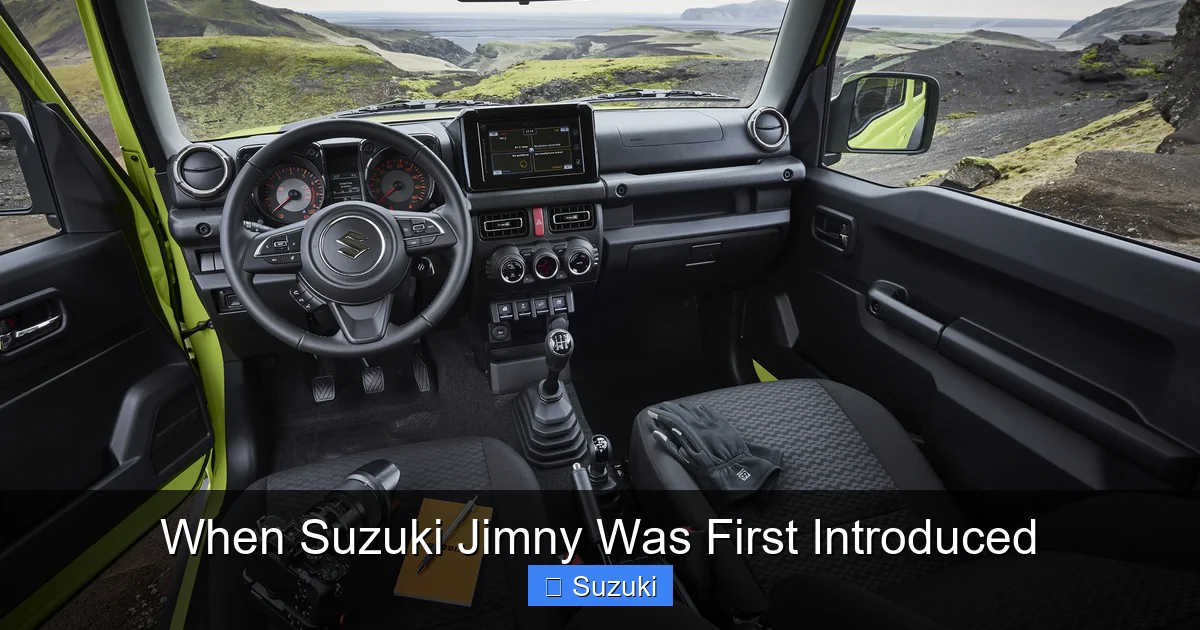
Visual guide about When Suzuki Jimny Was First Introduced
Image source: globalsuzuki.com
So why has the Suzuki Jimny lasted so long? In a world of constant change, the Jimny has remained remarkably consistent. It’s not the fastest, most luxurious, or most high-tech vehicle—but it’s one of the most capable and reliable.
Its success lies in its simplicity. The Jimny doesn’t rely on complex electronics or advanced aerodynamics. It uses proven mechanical systems that are easy to understand, repair, and maintain. This makes it ideal for remote areas where mechanics and spare parts may be scarce.
It’s also incredibly versatile. Whether you’re driving through a city, crossing a river, or climbing a mountain, the Jimny can handle it. Its small size makes it agile, while its 4×4 system gives it confidence in tough conditions.
And perhaps most importantly, the Jimny has heart. It’s not just a machine—it’s a character. Its boxy shape, rugged stance, and no-nonsense attitude have won over generations of drivers. It’s a vehicle that invites adventure, encourages exploration, and brings people together.
Conclusion
When the Suzuki Jimny was first introduced in 1970, it was a practical solution to a real problem. But over the decades, it has become so much more. It’s a symbol of durability, a testament to smart engineering, and a beloved icon of the off-road world.
From the humble LJ10 to the modern 2018 model, the Jimny has evolved without losing its soul. It’s still small, still tough, and still built to go anywhere. In a world that often values size and speed over substance, the Jimny reminds us that sometimes, the simplest solutions are the best.
Whether you’re a farmer in rural Japan, an adventurer in the Australian outback, or a city dweller with a love for weekend escapes, the Jimny has something to offer. It’s not just a vehicle—it’s a way of life.
Frequently Asked Questions
When was the Suzuki Jimny first introduced?
The Suzuki Jimny was first introduced in May 1970 under the name LJ10. It was Suzuki’s first compact 4×4 vehicle, designed for rugged terrain and practical use in rural Japan.
What did the original Jimny look like?
The original LJ10 had a boxy, utilitarian design with a short hood, tall cabin, and rear-mounted spare tire. It featured a fold-down windshield, lightweight doors, and a minimalist interior with basic controls.
Was the first Jimny powerful?
No, the first Jimny (LJ10) had a 359cc two-stroke engine producing only 25 horsepower. However, its low weight and four-wheel drive made it highly capable off-road despite the modest power.
Is the Jimny still in production?
Yes, the Suzuki Jimny is still in production as of 2024. The current fifth-generation model, introduced in 2018, remains one of the few compact, body-on-frame 4x4s available globally.
Why is the Jimny so popular?
The Jimny is popular for its durability, off-road capability, simplicity, and charming design. It’s affordable, easy to maintain, and perfect for both city driving and outdoor adventures.
Was the Jimny sold outside Japan?
Yes, the Jimny was exported to many countries, including Australia, New Zealand, Europe, Africa, and briefly North America (as the Suzuki Samurai). It gained a strong following in rural and off-road communities worldwide.
