
What Does Audi Mean?

Audi is more than just a car brand—it’s a legacy rooted in engineering excellence and a name derived from the Latin translation of founder August Horch’s surname. Learn how “Audi” came to represent innovation, precision, and luxury in the automotive industry.
Key Takeaways
- Audi means “listen” in Latin: The name is derived from the imperative form of the Latin verb “audire,” reflecting the founder’s intent to honor his surname while creating a globally recognizable brand.
- Founded by August Horch: The company traces its origins to 1899 when August Horch established his first automobile company, later leading to the creation of Audi in 1909.
- Part of the Auto Union: In 1932, Audi merged with three other brands—Horch, DKW, and Wanderer—to form Auto Union, symbolized by the four interlocking rings that remain Audi’s logo today.
- German engineering excellence: Audi is renowned for its commitment to precision, performance, and cutting-edge technology, including innovations like quattro all-wheel drive.
- Global luxury brand: Today, Audi is a leading premium automaker with a strong presence in over 100 countries, offering sedans, SUVs, and electric vehicles.
- Focus on innovation and sustainability: Audi is investing heavily in electric mobility and autonomous driving, with models like the e-tron lineup leading the charge.
- Brand values: Vorsprung durch Technik: Audi’s motto, “Advancement through Technology,” underscores its dedication to progress and forward-thinking design.
📑 Table of Contents
- What Does Audi Mean? The Story Behind the Name
- The Origins of Audi: From Horch to Audi
- The Four Rings: Audi and the Auto Union
- Audi’s Rise as a Global Luxury Brand
- Audi’s Brand Philosophy: Vorsprung durch Technik
- Audi and the Future: Electrification and Sustainability
- Conclusion: What Does Audi Mean Today?
What Does Audi Mean? The Story Behind the Name
When you hear the word “Audi,” you might think of sleek sedans, powerful SUVs, or cutting-edge electric vehicles. But have you ever stopped to wonder what “Audi” actually means? The name carries a rich history, linguistic depth, and a legacy of innovation that goes far beyond the badge on the grille.
At first glance, “Audi” sounds modern and sophisticated—perfect for a luxury car brand. But its roots are deeply embedded in language, family, and a bit of creative problem-solving. The story of how Audi got its name is one of the most fascinating in automotive history. It’s not just a random choice; it’s a clever linguistic twist that honors the company’s founder while making the brand accessible across languages and cultures.
To truly understand what Audi means, we need to go back to the late 19th century, when the automobile was still in its infancy. The journey begins with a man named August Horch, a pioneering engineer whose passion for mechanics and innovation laid the foundation for one of the world’s most respected car brands.
The Origins of Audi: From Horch to Audi

Visual guide about What Does Audi Mean?
Image source: thecarhow.com
The story of Audi starts with August Horch, a German engineer born in 1868. Horch was a true innovator, deeply involved in the early development of the automobile industry. In 1899, he founded his first company, A. Horch & Cie., in Cologne, Germany. The company quickly gained a reputation for building high-quality, reliable vehicles, and Horch himself became a respected figure in the automotive world.
However, by the early 1900s, internal disagreements and legal disputes led Horch to leave his own company. Determined to continue his work, he decided to start fresh. In 1909, he established a new automobile manufacturer. But there was one problem: he couldn’t use his own surname, “Horch,” because the original company still held the rights to the name.
So, what did he do? He turned to Latin.
The Latin Connection: “Horch!” Becomes “Audi!”
The word “Horch” is German for “listen” or “hark.” It’s an imperative verb—something you’d say to get someone’s attention: “Listen!” or “Hark!” August Horch wanted a name that would carry the same meaning but be distinct enough to avoid legal issues. His son, who was studying Latin at the time, suggested translating “Horch!” into Latin.
The Latin verb for “to listen” is “audire.” The imperative form—used to give a command—is “audi!” Meaning “listen!” in Latin. It was a perfect fit: it preserved the original meaning, honored the founder’s name, and created a brand that sounded elegant and international.
And just like that, Audi was born.
The name was officially registered in 1910, and the first Audi car—the Audi Type A—rolled off the production line in 1910. The brand quickly gained traction, known for its engineering precision and performance.
A Name That Travels Well
One of the smartest things about choosing “Audi” was its global appeal. Unlike “Horch,” which might be difficult to pronounce or remember in non-German-speaking countries, “Audi” is simple, short, and easy to say in many languages. It doesn’t carry any negative connotations, and it sounds modern and sophisticated.
This linguistic advantage helped Audi expand internationally in the decades that followed. Whether you’re in Tokyo, New York, or São Paulo, “Audi” is instantly recognizable. It’s a name that transcends borders—just like the cars themselves.
The Four Rings: Audi and the Auto Union
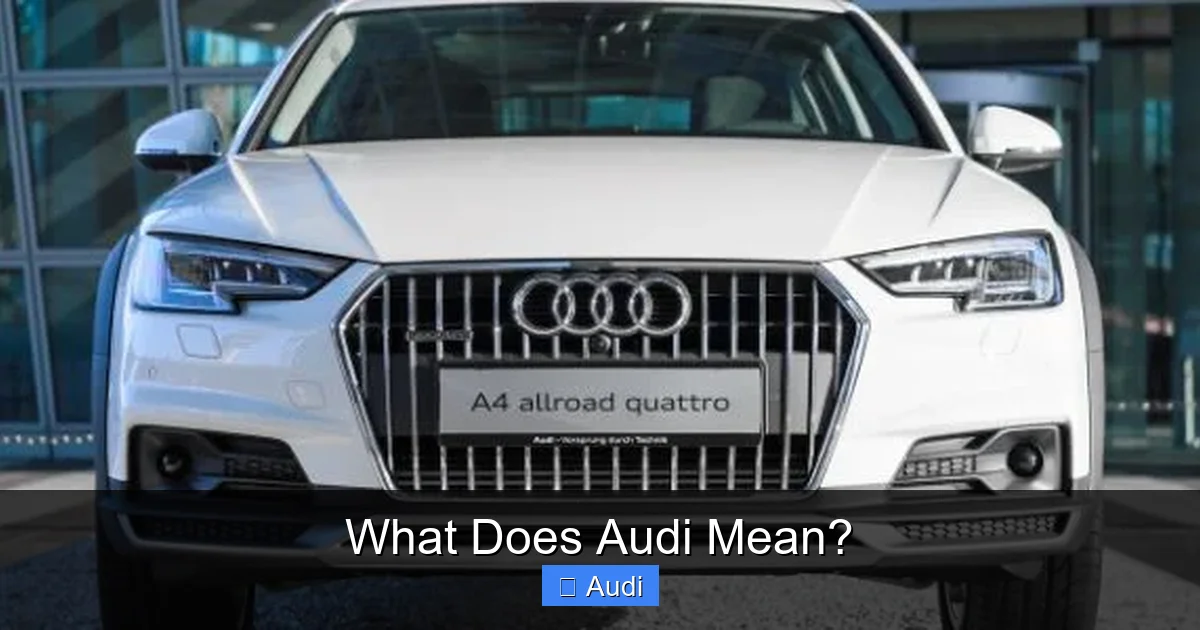
Visual guide about What Does Audi Mean?
Image source: blog.palmbeachautosalesoutlet.com
While the name “Audi” was a clever solution to a legal dilemma, the brand’s identity was further shaped by a major development in the 1930s: the formation of the Auto Union.
In 1932, four German automobile manufacturers—Audi, Horch, DKW, and Wanderer—merged to create Auto Union. This was a strategic move during a challenging economic period, allowing the companies to pool resources and survive the Great Depression.
To symbolize this union, the new company adopted a logo with four interlocking rings—one for each brand. This iconic emblem, still used by Audi today, represents unity, collaboration, and shared engineering excellence.
Audi’s Role in the Auto Union
Within the Auto Union, each brand had its own identity and market segment. Horch focused on luxury vehicles, DKW on small cars and motorcycles, Wanderer on mid-range sedans, and Audi on sporty, performance-oriented models. Audi became known for its advanced engineering and innovative designs, particularly in the realm of front-wheel drive and aerodynamic styling.
During this era, Audi also began to make a name for itself in motorsports. Auto Union racing cars, often powered by Audi engines, became legendary on the Grand Prix circuit. These high-speed machines, with their sleek bodies and powerful engines, captured the imagination of car enthusiasts and helped establish Audi’s reputation for performance.
The Legacy of the Four Rings
Even after the Auto Union dissolved in the post-war years, the four-ring logo endured. When Volkswagen Group acquired the rights to the Audi brand in the 1960s, they revived the name and the emblem. Today, the four rings are synonymous with Audi—representing not just a company, but a legacy of innovation and collaboration.
The rings also serve as a reminder of Audi’s roots. While the brand has evolved significantly, it still honors its history through design cues, engineering principles, and a commitment to quality that dates back to the early 20th century.
Audi’s Rise as a Global Luxury Brand

Visual guide about What Does Audi Mean?
Image source: thecarhow.com
After World War II, the German automotive industry underwent a major transformation. Many companies were restructured or dissolved, and the Auto Union was no exception. However, the Audi name survived, thanks in part to the efforts of Volkswagen Group.
In the 1960s, Volkswagen acquired the Auto Union assets, including the Audi brand. They reintroduced Audi as a standalone marque in 1965 with the launch of the Audi F103 series. These cars were based on Volkswagen technology but featured distinct styling and engineering, helping Audi establish its own identity.
The Quattro Revolution
One of the most pivotal moments in Audi’s history came in 1980 with the introduction of the Audi Quattro. This was the first production car to feature permanent all-wheel drive—a technology that would revolutionize the automotive industry.
The Quattro system, known as “quattro” (Italian for “four”), provided superior traction, stability, and performance, especially in challenging conditions like snow, rain, or off-road terrain. It quickly became a favorite among rally drivers and performance enthusiasts.
Audi’s dominance in the World Rally Championship during the 1980s, thanks to the Quattro’s capabilities, cemented the brand’s reputation for engineering excellence. The phrase “quattro” became synonymous with all-wheel drive, and the technology is now used across Audi’s entire lineup.
Expanding the Lineup
Over the decades, Audi expanded its range to include sedans, coupes, convertibles, and SUVs. Models like the Audi A4, A6, and A8 became benchmarks in the luxury segment, known for their refined interiors, advanced technology, and smooth driving dynamics.
Audi also embraced innovation in design and materials. The brand became known for its use of lightweight aluminum construction, particularly in the Audi A8, which featured an aluminum space frame—reducing weight while maintaining strength and safety.
Global Expansion
Audi’s commitment to quality and innovation helped it grow into a global brand. Today, Audi operates in over 100 countries and has manufacturing facilities in Germany, Hungary, China, and Mexico. The brand has a strong presence in key markets like Europe, North America, and Asia, and continues to attract a loyal customer base.
Audi’s Brand Philosophy: Vorsprung durch Technik
One of the most distinctive aspects of Audi is its brand philosophy: “Vorsprung durch Technik,” which translates to “Advancement through Technology.” This motto isn’t just a slogan—it’s a guiding principle that shapes everything Audi does.
Innovation as a Core Value
From the earliest days, Audi has been driven by a desire to push the boundaries of what’s possible. Whether it’s developing all-wheel drive, pioneering lightweight construction, or introducing cutting-edge infotainment systems, Audi has consistently been at the forefront of automotive technology.
For example, Audi was one of the first automakers to introduce LED headlights as standard equipment, improving visibility and energy efficiency. The brand also developed the MMI (Multi Media Interface) system, which set a new standard for in-car controls and connectivity.
Design and Craftsmanship
Audi places a strong emphasis on design, both inside and out. The brand’s vehicles are known for their clean lines, minimalist interiors, and attention to detail. The use of high-quality materials—like leather, wood, and aluminum—creates a luxurious and comfortable driving environment.
Audi’s design language, often described as “progressive” and “sporty elegance,” appeals to drivers who value both aesthetics and functionality. The brand’s designers work closely with engineers to ensure that form and function go hand in hand.
Customer Experience
Beyond the cars themselves, Audi focuses on delivering a premium customer experience. This includes everything from dealership service to digital tools like the Audi connect app, which allows drivers to remotely control their vehicle’s climate, lock status, and more.
Audi also offers personalized services, such as Audi exclusive, which allows customers to customize their vehicles with unique colors, materials, and finishes. This level of personalization reinforces Audi’s image as a luxury brand that values individuality and craftsmanship.
Audi and the Future: Electrification and Sustainability
As the automotive industry shifts toward sustainability and electrification, Audi is leading the charge. The brand has made a bold commitment to becoming carbon-neutral by 2050 and is investing heavily in electric mobility.
The e-tron Lineup
Audi’s electric vehicle (EV) lineup, branded as “e-tron,” includes a growing range of fully electric and plug-in hybrid models. The Audi e-tron SUV, launched in 2019, was one of the first premium electric SUVs on the market. It offers impressive range, fast charging, and the same level of luxury and performance that Audi is known for.
Other models in the e-tron family include the e-tron GT, a high-performance electric sports car, and the Q4 e-tron, a compact electric SUV designed for urban drivers. Audi plans to offer more than 20 fully electric models by 2025.
Charging and Infrastructure
Audi is also investing in charging infrastructure and partnerships to support EV adoption. The brand offers home charging solutions, access to public charging networks, and innovative services like battery swapping and mobile charging.
In addition, Audi is exploring new technologies like vehicle-to-grid (V2G) systems, which allow electric cars to feed energy back into the power grid during peak demand.
Sustainable Manufacturing
Audi is committed to reducing its environmental impact across the entire production process. The brand’s factories use renewable energy, recycle materials, and minimize waste. For example, the Audi e-tron plant in Brussels is powered entirely by renewable energy and has achieved carbon-neutral certification.
Audi is also working on sustainable materials, such as recycled plastics and vegan leather, to reduce the environmental footprint of its vehicles.
Autonomous Driving and Digitalization
Looking ahead, Audi is investing in autonomous driving and digital innovation. The brand’s Traffic Jam Pilot system, available in some models, allows for hands-free driving in certain conditions. Audi is also developing AI-powered systems for navigation, safety, and personalization.
The future of Audi is not just about electric power—it’s about creating smarter, safer, and more connected vehicles that enhance the driving experience.
Conclusion: What Does Audi Mean Today?
So, what does Audi mean in the modern era? It’s more than just a name—it’s a symbol of innovation, precision, and progress. From its Latin roots to its global presence, Audi represents a commitment to excellence that spans over a century.
The name “Audi” honors the past while looking toward the future. It’s a reminder of August Horch’s ingenuity, the power of collaboration, and the importance of listening—to customers, to technology, and to the world around us.
Today, Audi stands as a leader in the luxury automotive market, known for its cutting-edge technology, elegant design, and sustainable vision. Whether you’re driving an Audi A3 through city streets or an e-tron GT on an open highway, you’re experiencing the culmination of a legacy built on listening, learning, and advancing.
Audi doesn’t just make cars—it makes progress. And that’s what the name truly means.
Frequently Asked Questions
What does the name Audi mean in English?
The name Audi means “listen” in Latin. It comes from the imperative form of the Latin verb “audire,” which was chosen as a translation of the German word “Horch,” meaning “listen” or “hark.”
Who founded Audi and why was the name changed?
Audi was founded by August Horch in 1909. He had to change the name from “Horch” because his original company retained the rights to the name, so he used the Latin translation “Audi” to create a new brand.
What do the four rings in the Audi logo represent?
The four interlocking rings represent the merger of four German automakers—Audi, Horch, DKW, and Wanderer—into Auto Union in 1932. Each ring symbolizes one of the original companies.
Is Audi a German brand?
Yes, Audi is a German automobile manufacturer headquartered in Ingolstadt, Bavaria. It is part of the Volkswagen Group and is known for its engineering excellence and luxury vehicles.
What is Audi’s motto and what does it mean?
Audi’s motto is “Vorsprung durch Technik,” which translates to “Advancement through Technology.” It reflects the brand’s commitment to innovation, progress, and cutting-edge engineering.
Does Audi make electric cars?
Yes, Audi offers a full lineup of electric vehicles under the e-tron brand, including SUVs, sedans, and sports cars. The company is committed to expanding its EV offerings and achieving carbon neutrality by 2050.