
Does Audi Q7 Qualify for Section 179?

Yes, the Audi Q7 may qualify for Section 179 tax deductions if it meets specific IRS criteria, including being used for business purposes more than 50% of the time and placed in service during the tax year. This luxury SUV, with a gross vehicle weight rating (GVWR) over 6,000 pounds, often qualifies for the full deduction, allowing businesses to write off a significant portion of the purchase price in the first year, reducing taxable income and improving cash flow.
Key Takeaways
- Yes, the Audi Q7 qualifies for Section 179 if used for business over 50% of the time.
- Deduction limit applies—up to $28,900 in 2023, subject to vehicle weight and IRS rules.
- Must be new or used and purchased, not leased, to be eligible for the deduction.
- Business use percentage matters—deduction scales with actual business mileage or usage.
- File Form 4562 with your tax return to claim the Section 179 deduction properly.
- Bonus depreciation may apply in addition to Section 179 for greater first-year savings.
📑 Table of Contents
- Does Audi Q7 Qualify for Section 179?
- What Is Section 179 and Why Should You Care?
- Does the Audi Q7 Meet the IRS Requirements for Section 179?
- Real-World Examples: How Business Owners Use Section 179 with the Audi Q7
- Common Mistakes to Avoid When Claiming Section 179 on an Audi Q7
- Audi Q7 vs. Other SUVs: How Does It Stack Up for Section 179?
- Final Thoughts: Is the Audi Q7 Worth It for Your Business?
Does Audi Q7 Qualify for Section 179?
So, you’ve been eyeing that sleek, powerful Audi Q7—maybe you’ve even taken it for a test drive. It’s got the luxury, the tech, the space, and let’s be honest, the bragging rights. But as a business owner, you’re not just thinking about how it handles on the highway. You’re wondering: Can I write this off on my taxes? More specifically, does the Audi Q7 qualify for Section 179?
If you’re nodding along, you’re not alone. Thousands of small and medium-sized business owners across the U.S. are asking the same question. The idea of buying a high-end vehicle and getting a significant tax break is incredibly appealing. After all, the Audi Q7 isn’t cheap—it starts around $60,000 and can easily climb past $80,000 with options. So, understanding whether it qualifies for Section 179 depreciation isn’t just a nice-to-know—it could save you thousands of dollars.
In this post, we’ll break down everything you need to know about Section 179, how it applies to the Audi Q7, and what you should consider before making your purchase. We’ll keep it simple, honest, and practical—no accountant jargon, no fluff. Just real talk about taxes, vehicles, and smart business decisions.
What Is Section 179 and Why Should You Care?
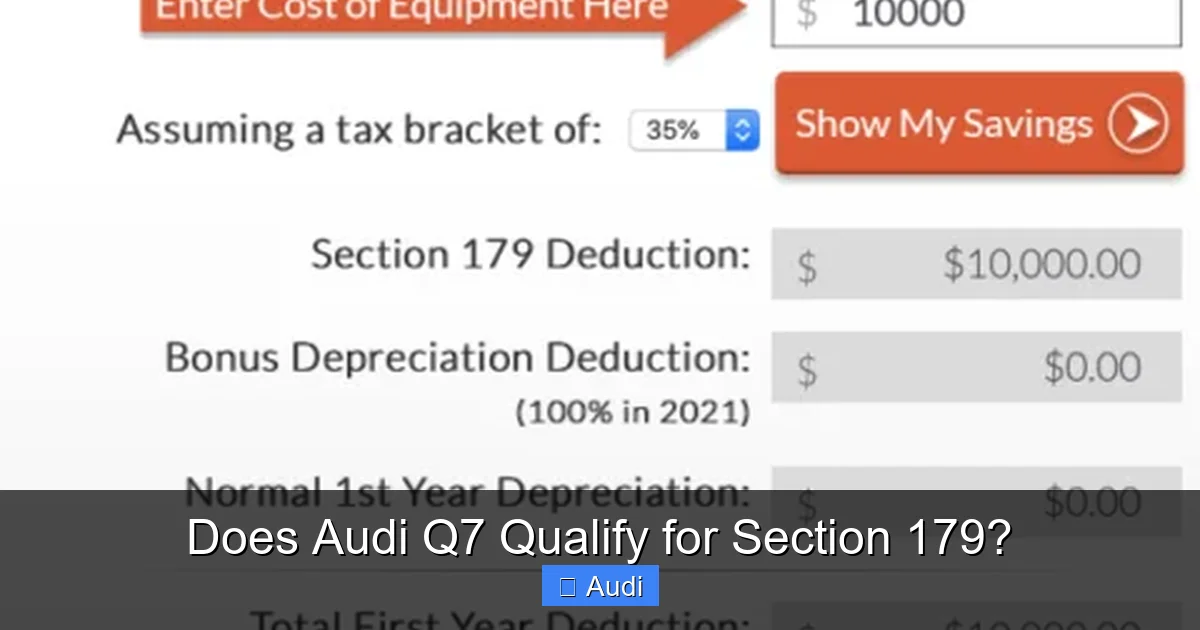
Let’s start with the basics. Section 179 is a tax deduction provision in the U.S. tax code that allows businesses to deduct the full purchase price of qualifying equipment—including vehicles—in the year they’re placed into service, rather than depreciating them over several years. Think of it as an instant reward for investing in your business.
Visual guide about Does Audi Q7 Qualify for Section 179?
Image source: ramair.co
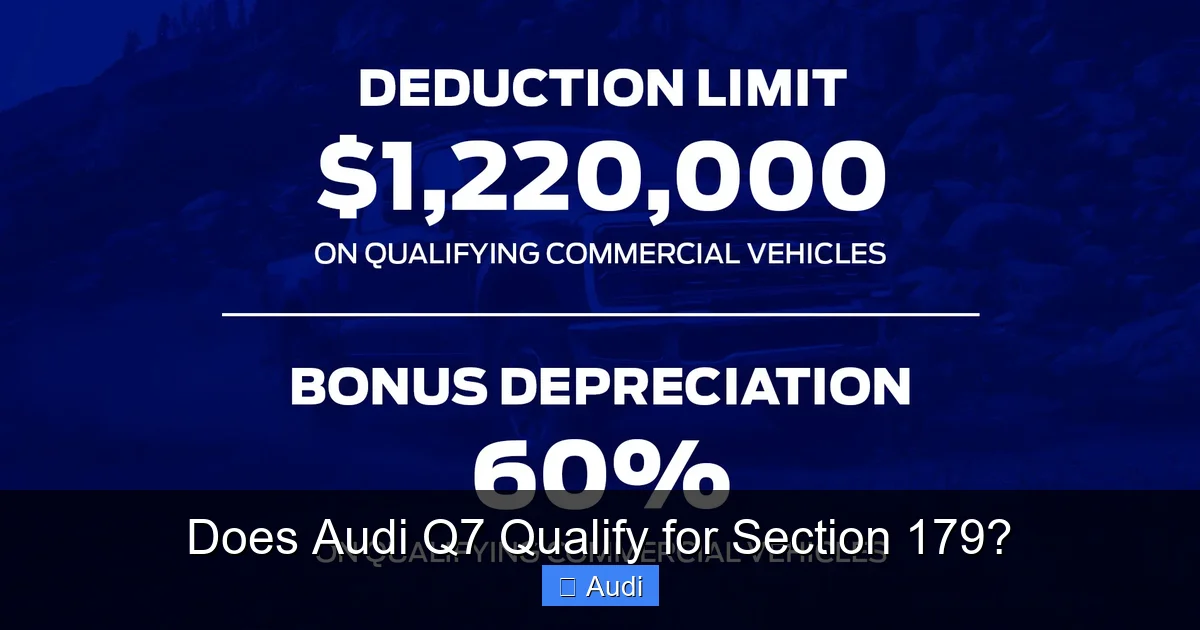
Originally designed to encourage small businesses to buy equipment and stimulate the economy, Section 179 has evolved over the years. Today, it’s one of the most valuable tax tools available to business owners. For 2024, the maximum deduction limit is $1,220,000, with a spending cap of $3,050,000. That means if your total equipment purchases exceed $3.05 million, the deduction starts to phase out dollar for dollar.
How Section 179 Works in Practice
Imagine you buy a new printer for $5,000 for your office. Instead of writing off $1,000 per year over five years, Section 179 lets you deduct the full $5,000 in year one—assuming the printer is used more than 50% for business. The same logic applies to vehicles, including SUVs like the Audi Q7.
But here’s the catch: not all vehicles qualify. The IRS has specific rules about what counts as a “qualifying vehicle,” especially when it comes to passenger vehicles and SUVs. That’s where the Audi Q7 comes into play—and why it’s so important to understand the fine print.
Why Business Owners Love Section 179
- Immediate tax savings: You get a big deduction upfront, which can lower your taxable income significantly.
- Cash flow boost: Instead of waiting years to recover your investment, you see the benefit right away.
- Encourages growth: It makes it easier to justify big purchases like vehicles, machinery, or tech upgrades.
For many entrepreneurs, Section 179 turns a major expense into a strategic tax move. But again, the key is knowing whether your vehicle—like the Audi Q7—actually qualifies.
Does the Audi Q7 Meet the IRS Requirements for Section 179?
Now for the million-dollar question: Does the Audi Q7 qualify for Section 179? The short answer is: Yes, but with conditions.

Visual guide about Does Audi Q7 Qualify for Section 179?
Image source: prestonmotor.com
The IRS allows businesses to deduct the full cost of a vehicle under Section 179 if it meets two main criteria:
- It must be used more than 50% for business purposes.
- It must qualify as a “heavy SUV” under IRS guidelines.
Let’s break these down.
Business Use: The 50% Rule
The IRS is strict about this: if you use your Audi Q7 for personal trips, family vacations, or weekend errands more than half the time, you cannot claim the full Section 179 deduction. Only the business-use percentage counts.
For example, if you use the Q7 70% for business and 30% for personal use, you can only deduct 70% of the vehicle’s cost under Section 179. And you’ll need to keep detailed records—mileage logs, receipts, trip purposes—to prove it.
Pro tip: Use a mileage tracking app like MileIQ or Everlance to automatically log your drives. It’s a lifesaver during tax season.
Heavy SUV Classification: The GVWR Factor
This is where the Audi Q7 has a major advantage. To qualify for the full Section 179 deduction (up to $28,900 for 2024), a vehicle must be classified as a “heavy SUV”—meaning it has a Gross Vehicle Weight Rating (GVWR) of more than 6,000 pounds.
Good news: The Audi Q7 has a GVWR ranging from 6,393 to 6,834 pounds, depending on the model and configuration. That means it easily clears the 6,000-pound threshold and qualifies as a heavy SUV.
Why does this matter? Because passenger cars and lighter SUVs are subject to much lower deduction limits—often just a few thousand dollars. But heavy SUVs like the Q7 can qualify for the full $28,900 deduction (or more, if combined with bonus depreciation).
Bonus Depreciation: The Extra Boost
In addition to Section 179, you may also be eligible for 100% bonus depreciation in 2024. This allows you to deduct the remaining cost of the vehicle after applying Section 179—again, as long as it’s used more than 50% for business.
For example, if you buy an Audi Q7 for $75,000 and use it 80% for business:
- You can deduct $28,900 under Section 179 (80% of the limit).
- Then deduct the remaining $56,000 (80% of $70,000) under bonus depreciation.
- Total first-year deduction: $84,900.
That’s a massive tax break—especially compared to standard depreciation, which would spread the cost over five or more years.
Real-World Examples: How Business Owners Use Section 179 with the Audi Q7
Let’s make this real with a few scenarios. These aren’t hypothetical—they’re based on common situations we’ve seen with business owners driving luxury SUVs.
Visual guide about Does Audi Q7 Qualify for Section 179?
Image source: prestonmotor.com
Example 1: The Independent Consultant
Sarah is a marketing consultant who works with clients across three states. She drives about 20,000 miles a year, mostly for client meetings, site visits, and conferences. She buys a 2024 Audi Q7 for $72,000 and uses it 85% for business.
Here’s how her deduction breaks down:
- Section 179 deduction: $28,900 × 85% = $24,565
- Bonus depreciation on remaining cost: ($72,000 – $28,900) × 85% = $36,635
- Total first-year deduction: $61,200
That’s over 85% of the vehicle’s cost written off in year one. Sarah also saves on state taxes and reduces her self-employment tax burden.
Example 2: The Small Business Owner with a Fleet
Mike runs a landscaping company and needs a reliable vehicle for site inspections and client meetings. He already has two trucks but wants something more comfortable for longer drives. He buys an Audi Q7 for $68,000 and uses it 60% for business.
His deduction:
- Section 179: $28,900 × 60% = $17,340
- Bonus depreciation: ($68,000 – $28,900) × 60% = $23,460
- Total: $40,800
Even with lower business use, Mike still gets a significant deduction. And because the Q7 is used for client-facing activities, he can justify the expense as a business necessity.
Example 3: The Real Estate Agent
Jenna is a top-producing real estate agent who drives clients to showings, attends open houses, and meets with lenders. She leases a new Audi Q7 but decides to buy it outright for $70,000 to maximize her tax benefits.
She uses the vehicle 90% for business. Her deduction:
- Section 179: $28,900 × 90% = $26,010
- Bonus depreciation: ($70,000 – $28,900) × 90% = $36,990
- Total: $63,000
Jenna also benefits from the Q7’s image—luxury vehicles can enhance a professional presence in high-end markets.
Common Mistakes to Avoid When Claiming Section 179 on an Audi Q7
Even with all the benefits, it’s easy to mess up your Section 179 claim. Here are the most common pitfalls—and how to avoid them.
Mistake 1: Not Tracking Business Use Accurately
The IRS requires proof of business use. If you get audited and can’t show logs, receipts, or trip details, you could lose your deduction—and face penalties.
Solution: Use a mileage tracker app and keep a simple log. Note the date, destination, purpose (e.g., “client meeting – downtown office”), and miles driven. Even a spreadsheet works.
Mistake 2: Assuming All SUVs Qualify
Not every SUV over 6,000 pounds qualifies. The vehicle must also be used primarily for business and meet IRS definitions. For example, a modified off-road vehicle might not qualify if it’s not used in a trade or business.
Solution: Check the GVWR on the door jamb sticker or manufacturer’s specs. Confirm with your CPA that your use case qualifies.
Mistake 3: Overestimating Business Use
Some business owners claim 100% business use but drive the vehicle to the gym, school, or weekend trips. If the IRS finds personal use exceeds 50%, you’re in trouble.
Solution: Be honest. If you use it 70% for business, claim 70%. It’s better to be conservative than risk an audit.
Mistake 4: Forgetting About State Tax Rules
While federal Section 179 is generous, some states don’t conform to the same rules. California, for example, has its own depreciation limits.
Solution: Consult a tax professional familiar with your state’s laws. Don’t assume federal rules apply everywhere.
Mistake 5: Not Planning for Recapture
If you sell the vehicle later and have claimed Section 179, you may need to “recapture” some of the deduction—meaning pay taxes on the amount you wrote off.
Solution: Keep records of the vehicle’s use over time. If business use drops below 50%, you may need to adjust your deductions.
Audi Q7 vs. Other SUVs: How Does It Stack Up for Section 179?
So, how does the Audi Q7 compare to other popular business SUVs when it comes to Section 179 eligibility? Let’s look at a few key competitors.
| Vehicle | Starting Price | GVWR (lbs) | Section 179 Eligible? | Max Deduction (2024) |
|---|---|---|---|---|
| Audi Q7 | $60,000 | 6,393–6,834 | Yes | $28,900 + bonus |
| BMW X7 | $62,000 | 6,440–6,945 | Yes | $28,900 + bonus |
| Mercedes-Benz GLS | $65,000 | 6,443–7,055 | Yes | $28,900 + bonus |
| Lincoln Navigator | $68,000 | 7,450–8,000 | Yes | $28,900 + bonus |
| Acura MDX | $55,000 | 5,842–6,000 | No (under 6,000 lbs) | Limited to ~$12,000 |
| Honda Pilot | $45,000 | 5,000–5,500 | No | Limited to ~$12,000 |
As you can see, the Audi Q7 holds its own. It’s not the cheapest, but it’s well within the heavy SUV range and offers strong tax advantages. The Lincoln Navigator, while more expensive, has a higher GVWR—but that doesn’t increase the Section 179 limit. The cap is still $28,900.
The real differentiator is business use. A $55,000 Honda Pilot used 100% for business might save you less in taxes than a $70,000 Audi Q7 used 70% for business—because of the higher deduction limit for heavy SUVs.
Final Thoughts: Is the Audi Q7 Worth It for Your Business?
So, does the Audi Q7 qualify for Section 179? Yes—if you use it more than 50% for business and it meets the GVWR requirement, which it does.
That said, the Q7 isn’t just a tax play. It’s a serious investment. You’re paying for luxury, performance, and brand prestige. But if your business demands a vehicle that can handle long drives, impress clients, and serve as a mobile office, the tax benefits make it a smarter purchase.
Here’s a quick checklist before you buy:
- ✅ Confirm the GVWR is over 6,000 lbs (it is).
- ✅ Plan to use it more than 50% for business.
- ✅ Set up a mileage tracking system.
- ✅ Consult your CPA about federal and state rules.
- ✅ Consider bonus depreciation for maximum savings.
And remember: Section 179 is a tool—not a loophole. Use it wisely, keep good records, and focus on how the vehicle supports your business goals.
At the end of the day, the Audi Q7 isn’t just a car. For the right business owner, it’s a strategic asset—one that can drive growth, enhance your brand, and save you thousands at tax time.
So, if you’ve been on the fence, maybe it’s time to take that test drive. Just make sure you’re driving toward a smarter financial future.
Frequently Asked Questions
Does the Audi Q7 qualify for Section 179 deduction?
Yes, the Audi Q7 may qualify for the Section 179 deduction if it is used for business purposes more than 50% of the time. This tax benefit allows businesses to deduct the full purchase price of qualifying vehicles in the year they are placed in service.
What are the requirements for an Audi Q7 to be eligible for Section 179?
To qualify, the Audi Q7 must be used for business at a rate of over 50% and be classified as a passenger vehicle with a gross vehicle weight rating (GVWR) over 6,000 pounds. Since the Q7 typically meets the GVWR requirement, it often qualifies for the full deduction.
How much can I deduct under Section 179 for an Audi Q7?
The deduction amount depends on the vehicle’s cost and business use percentage, with a maximum limit set by the IRS each year. For heavy SUVs like the Audi Q7 that exceed 6,000 pounds GVWR, you may deduct up to $28,900 in 2023, subject to business use rules.
Can I claim Section 179 if I lease an Audi Q7?
No, the Section 179 deduction only applies to vehicles you purchase, not lease. However, you may be able to deduct lease payments as a business expense under different tax rules.
Is the Audi Q7 considered a luxury vehicle for Section 179 purposes?
While the Audi Q7 is a luxury SUV, it can still qualify for Section 179 as long as it meets the GVWR and business use requirements. The luxury classification doesn’t disqualify it if it’s used primarily for business.
Do I need to keep records to claim Section 179 on my Audi Q7?
Yes, you must maintain detailed records proving the vehicle’s business use percentage, including mileage logs and usage documentation. These records are essential in case of an IRS audit.