
Graco 4Ever DLX Grad 5-in-1 Car Seat Details: Specs, Modes, Fit & Features

Quick Answer
The Graco 4Ever DLX Grad 5-in-1 Slim Car Seat is an all-in-one child restraint designed to cover five stages from infancy through seat-belt training. According to the official Graco 4Ever DLX Grad specifications, it supports children from 4 to 120 pounds depending on the selected mode.
Key Graco 4Ever DLX Grad details
- Five stages: Rear-facing harness, forward-facing harness, highback booster, backless booster, and removable seat-belt trainer.
- Overall range: Different modes cover children from 4 pounds through a maximum of 120 pounds.
- Slim footprint: The current manufacturer listing measures 18 inches wide.
- Fast adjustment: The harness and 10-position headrest move together without rethreading.
- Installation help: SnugLock technology works in rear-facing and forward-facing configurations.
- Long useful life: Graco instructs owners to stop using the restraint 10 years after its manufacture date.
Before buying
- Check your child’s current height, weight, maturity, and your vehicle’s available back-seat space before choosing a mode.
If you’re researching Graco 4Ever DLX Grad 5-in-1 car seat details, the similar 4Ever names can make comparison harder than it should be. The Grad is the newer five-stage version with a removable seat-belt trainer and a slimmer body.
As of 2026, I would focus less on the “5-in-1” label and more on how those five modes fit your child and vehicle. This guide breaks down the important numbers, features, installation details, and differences.
In This Guide
- What Is the Graco 4Ever DLX Grad 5-in-1 Car Seat?
- What Are the Five Graco 4Ever DLX Grad Modes?
- How Big Is the Graco 4Ever DLX Grad?
- Which Graco 4Ever DLX Grad Features Matter Most?
- How Do You Install and Use the Graco 4Ever DLX Grad Safely?
- Graco 4Ever DLX Grad vs 4Ever DLX: What’s Different?
- Graco 4Ever DLX Grad Frequently Asked Questions
What Is the Graco 4Ever DLX Grad 5-in-1 Car Seat?
The Graco 4Ever DLX Grad is a convertible all-in-one car seat that changes configuration as a child grows. It starts as a rear-facing harness seat and can eventually become a removable seat-belt trainer.
A 5-in-1 car seat is one seat designed to perform five different child-restraint jobs. The Grad adds a fifth stage beyond the four modes found on the traditional 4Ever DLX.
Its five configurations are:
- Rear-facing harness.
- Forward-facing harness.
- Highback belt-positioning booster.
- Backless booster.
- Removable seat-belt trainer.
The seat-belt trainer is the feature that gives the Grad its unusual fifth stage. It is meant for an older child who is moving beyond a conventional booster but still needs help positioning the vehicle belt properly.
Graco also designed the trainer to detach from the main restraint. That lets a family use the main car seat for one child while another eligible child uses the trainer.
One point matters here: five modes do not mean every mode is appropriate at the same time. Your child’s height, weight, age, maturity, and the instructions for that specific mode still control the transition.
For current child-restraint guidance, the NHTSA car-seat safety guide recommends keeping children in each restraint stage as long as they remain within the manufacturer’s allowed limits.
What Are the Five Graco 4Ever DLX Grad Modes?
The Grad covers a broad range, but each mode has its own limits. The table below shows Graco’s current recommended-use figures.
| Mode | Weight | Height / Age Guidance | What It Does |
|---|---|---|---|
| Rear-facing harness | 4–40 lb | Head at least 1 inch below the headrest adjustment handle | Supports infants and younger children facing the rear |
| Forward-facing harness | 26.5–65 lb | Up to 49 inches | Uses the built-in five-point harness |
| Highback booster | 40–100 lb | 43–57 inches; at least 4 years old | Positions the vehicle lap-and-shoulder belt |
| Backless booster | 40–120 lb | 43–57 inches; at least 4 years old | Raises the child for better vehicle-belt positioning |
| Seat-belt trainer | 50–120 lb | 43–60 inches; at least 5 years old | Helps an older child position the vehicle belt |
Notice the overlap between several ranges. Reaching the minimum number for the next stage does not automatically mean a child should move forward.
For example, a child who reaches 40 pounds may fit the minimum weight for a highback booster. That child can still remain in the harness when the harness limits and other instructions allow it.
Rear-facing deserves the same attention. Graco and NHTSA both advise keeping children rear-facing as long as possible within the seat’s rear-facing limits.
When booster time eventually arrives, belt fit becomes critical. The lap belt should sit across the upper thighs, while the shoulder belt should cross the chest and shoulder rather than the neck.
How Big Is the Graco 4Ever DLX Grad?
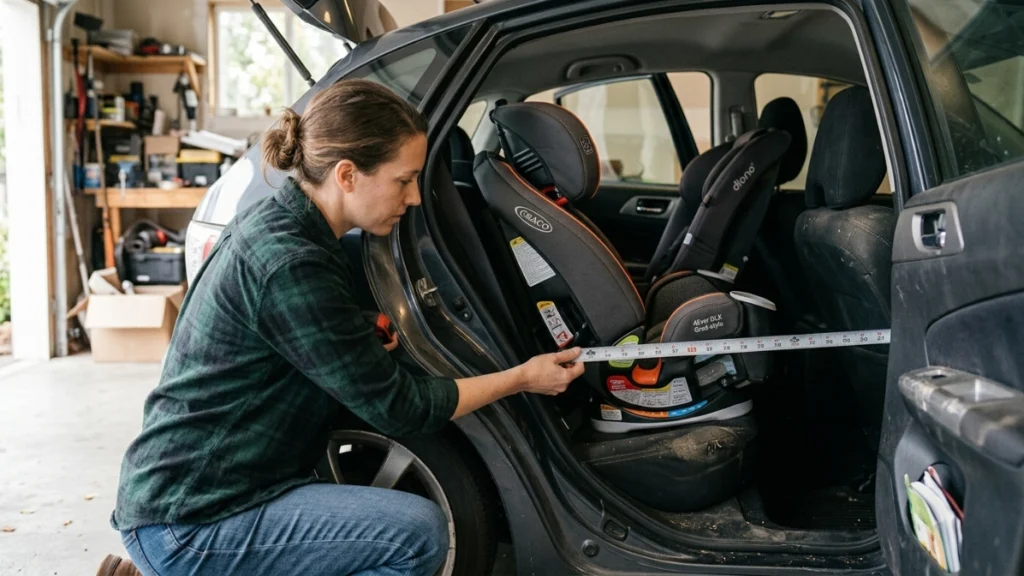
The current Graco listing gives the 4Ever DLX Grad a width of 18 inches. That slimmer measurement is one of the model’s strongest practical differences.
- Width: 18.0 inches.
- Height: 26.2 inches.
- Depth: 19.8 inches.
- Product weight: 24.1 pounds.
- Headrest positions: 10.
- Recline positions: 6.
The Harrison version listed by Graco carries model number 2215747. Model numbers can differ across versions, so use the label on your actual seat when registering it or checking safety information.
Graco says the Grad is 10% slimmer at the cupholders than the standard 4Ever DLX. That can make a meaningful difference when another passenger or child restraint shares the rear bench.
Still, an 18-inch advertised width does not guarantee a three-across installation. Door panels, seat contours, buckle locations, and neighboring restraints all affect real-world fit.
I would measure the narrowest usable portion of your rear bench before ordering. Check front-to-back clearance too, especially when the seat will remain rear-facing.
The 24.1-pound weight also matters if you regularly move seats between vehicles. This is better viewed as a stay-installed all-in-one restraint than a lightweight seat you carry around daily.
Which Graco 4Ever DLX Grad Features Matter Most?
The Grad has a long feature list, but a few items make the biggest difference during everyday use. I would put installation, harness adjustment, cleaning, and space efficiency at the top.
No-Rethread Harness and 10-Position Headrest
Graco’s Simply Safe Adjust system moves the harness and headrest together. You do not need to remove and manually thread the shoulder straps through a new slot as your child grows.
That is more than a convenience feature. Easier adjustment reduces the temptation to leave a growing child in an outdated harness position.
Six Recline Positions
The seat includes six recline settings. They help achieve the required installation angle while also supporting comfort in the appropriate modes.
The correct position depends on how the seat is being used. Always follow the indicator and instructions on the restraint rather than choosing a recline position only because it looks comfortable.
Rapid Remove Cover
The seat pad is removable and machine washable according to Graco’s care instructions. Graco specifies cold water, gentle soap, a delicate cycle, and drip drying.
The harness requires different care. It should be surface cleaned rather than submerged in water.
Harness Storage and Cup Holders
Built-in harness storage pockets hold the straps aside when you place a child in the seat. Two adjustable cupholders provide spots for drinks or snacks without extending the body as far as the standard 4Ever DLX.
Steel-Reinforced Frame and Energy-Absorbing Foam
The structure includes a steel-reinforced frame and energy-absorbing foam. Graco also states that its ProtectPlus engineering evaluates the restraint for frontal, side, rear, and rollover crash conditions.
Those descriptions should not be treated as a substitute for correct use. Even a well-designed restraint depends on correct installation, harness fit, and the right mode for the child.
How Do You Install and Use the Graco 4Ever DLX Grad Safely?

The Grad uses Graco’s SnugLock installation system in its rear-facing and forward-facing harness modes. It can work with the vehicle seat belt or the vehicle’s lower anchors when permitted by the instructions.
Graco advertises installation in less than one minute based on its average installation procedure. I would treat that as a convenience claim, not a reason to rush the final checks.
Use the Correct Belt Path
Rear-facing and forward-facing installations use different belt paths. Route the vehicle belt or lower-anchor strap only through the path specified for the selected mode.
After tightening, check movement at the belt path rather than pulling on the top of the shell. Follow the manual’s allowed movement standard exactly.
Use the Top Tether When Forward-Facing
NHTSA recommends using the top tether with a forward-facing car seat when the vehicle and child-restraint manufacturers permit it. The tether helps limit forward movement during a crash.
Locate the actual tether anchor using your vehicle owner’s manual. Do not attach the tether to a cargo hook or another point that merely looks similar.
Do Not Rush Into Booster Mode
A booster uses the vehicle’s lap-and-shoulder belt instead of the built-in harness. The child must also be mature enough to stay correctly positioned for the entire ride.
If you’re unsure which restraint type matches your child’s measurements, use the NHTSA Car Seat Finder as a starting point. Then confirm every limit in the Graco manual.
Register and Check for Recalls
Record the model number and manufacture date from your actual restraint. Registration allows the manufacturer to contact you when a safety notice affects that product.
You can also search child-restraint recalls through the NHTSA recall lookup. Checking the exact model matters more than assuming every product with the 4Ever name is identical.
Know the 10-Year Limit
Graco instructs owners to stop using this child restraint 10 years after its date of manufacture. That clock starts from manufacturing, not the day you first place a child in it.
Crash history matters too. NHTSA recommends replacing child restraints after moderate or severe crashes and provides separate criteria for evaluating a minor crash.
Graco 4Ever DLX Grad vs 4Ever DLX: What’s Different?
The names are similar, but the Grad 5-in-1 and traditional 4Ever DLX 4-in-1 are not the same seat. The extra stage and slimmer design are the clearest differences.
| Feature | 4Ever DLX Grad 5-in-1 | Traditional 4Ever DLX 4-in-1 |
|---|---|---|
| Number of modes | 5 | 4 |
| Seat-belt trainer | Yes, removable | No |
| Listed width | 18.0 in | 21.5 in on the current Graco listing checked |
| Listed product weight | 24.1 lb | 23 lb on the current Graco listing checked |
| Harness installation feature | SnugLock | Integrated belt lock-off and InRight lower-anchor connectors |
Both versions cover rear-facing, forward-facing harness, highback booster, and backless booster stages. Their child-weight limits across those shared modes are also broadly similar on Graco’s current listings.
The Grad makes the most sense when rear-seat width matters or you specifically want the fifth seat-belt-training stage. The traditional DLX remains a four-stage design without that detachable trainer.
One tradeoff is weight. Despite being slimmer, the Grad’s listed 24.1-pound weight is slightly higher than the 23-pound traditional DLX listing I checked.
I would therefore choose between them based on actual vehicle fit and the usefulness of the fifth stage. The word “Grad” alone should not decide the purchase.
Graco 4Ever DLX Grad Frequently Asked Questions
What is the weight limit for the Graco 4Ever DLX Grad?
The overall maximum is 120 pounds, but that number applies only to certain later modes. Rear-facing ends at 40 pounds, forward-facing harness mode ends at 65 pounds, and the highback booster ends at 100 pounds.
Can a newborn use the Graco 4Ever DLX Grad?
Graco lists rear-facing use beginning at 4 pounds. A newborn still needs to meet all fit requirements, including the required head position and correct harness placement.
How wide is the Graco 4Ever DLX Grad?
The current manufacturer specification lists the seat at 18 inches wide. Graco also describes the cupholder area as 10% slimmer than the standard 4Ever DLX.
Does the Graco 4Ever DLX Grad become a backless booster?
Yes. Its fourth configuration is a backless booster for children weighing 40–120 pounds, measuring 43–57 inches, and meeting Graco’s minimum age requirement of 4 years.
What is the fifth mode on the Graco 4Ever DLX Grad?
The fifth mode is a removable seat-belt trainer. Graco lists that stage for children weighing 50–120 pounds, measuring 43–60 inches, and at least 5 years old.
How long can you use the Graco 4Ever DLX Grad?
Graco says to stop using the restraint 10 years after its manufacture date. Check the product label rather than calculating from your purchase date.
Is the Graco 4Ever DLX Grad good for small cars?
Its 18-inch listed width can help in tighter rear seats, but vehicle fit cannot be guaranteed from width alone. Measure your back seat and check front-seat clearance before deciding.
The main takeaway: the Graco 4Ever DLX Grad is most compelling for families who want one restraint covering five distinct stages while using less side-to-side space than the traditional 4Ever DLX.
Before buying, match your child’s measurements to the correct mode and confirm the seat fits your actual vehicle. After installation, consider having the setup checked by a certified child-passenger-safety technician if you have any doubts.
