
How to Turn a Graco Car Seat Into a Booster

Quick Answer
To turn a compatible Graco car seat into a booster, first confirm that your child and seat meet the booster-mode requirements. Then store or remove the harness exactly as your model’s manual directs, position the seat forward-facing, and use the vehicle’s lap-and-shoulder belt to secure your child. Follow NHTSA car seat guidance when deciding whether your child is ready.
Quick conversion steps
- Check the model: Confirm your specific Graco seat actually includes a belt-positioning booster mode.
- Check your child: Verify the minimum age, height, and weight printed in your car seat manual.
- Store the harness: Place the harness, chest clip, and buckle in their designated storage locations if your model uses built-in storage.
- Set booster mode: Adjust the seat and headrest to the booster position specified by Graco.
- Route the belt: Run the vehicle shoulder belt through the correct belt guide.
- Check belt fit: The lap belt belongs across the upper thighs, while the shoulder belt should cross the chest and shoulder.
Before you drive
- Never assume the conversion procedure for one Graco model applies to another.
Turning a Graco car seat into a booster can look surprisingly simple. The important part is knowing which pieces should move, which should stay, and when your child is genuinely ready.
I approach this as a safety setup rather than a seat modification. If the instructions in your manual don’t match the seat in front of you, stop and verify the model number before continuing.
In This Guide
- Can Your Graco Car Seat Be Converted Into a Booster?
- When Is a Child Ready for Booster Mode?
- How Do You Turn a Graco Car Seat Into a Booster?
- Do Graco Booster Conversion Steps Differ by Model?
- How Should the Seat Belt Fit in Booster Mode?
- What Graco Booster Conversion Mistakes Should You Avoid?
- Frequently Asked Questions
Can Your Graco Car Seat Be Converted Into a Booster?
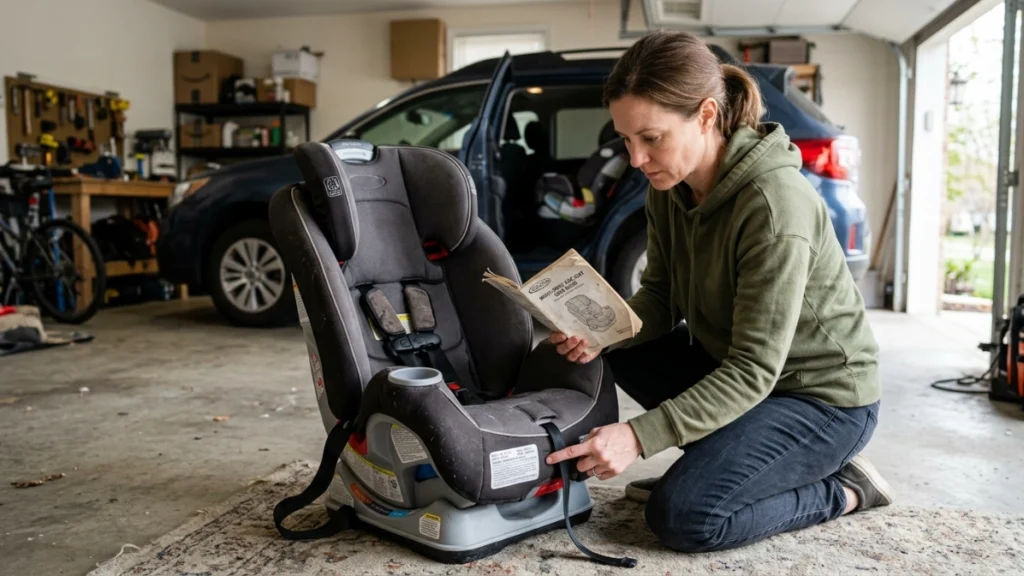
Only a Graco seat designed with a booster mode can be converted into one. A rear-facing or forward-facing car seat does not automatically become a booster just because the harness can be moved.
A belt-positioning booster is a child restraint that raises and positions a child so the vehicle’s lap-and-shoulder belt crosses the stronger areas of the hips, chest, and shoulder correctly.
Look for wording such as highback booster, belt-positioning booster, or backless booster on the seat’s labels and instructions.
Common Graco product families with booster-capable versions include:
- 4Ever models
- TriRide
- SlimFit
- Nautilus harness boosters
- Grows4Me
- Turn2Me 3-in-1
- Some Extend2Fit all-in-one versions
Model names matter. For example, different versions sold under a similar product-family name may have different modes or instructions.
Find your exact Graco model first
Check the sticker on the seat for its model number and manufacture date. Graco says model information is normally found on the back of the product or, on some products, around the base.
Enter that information into Graco’s official product instruction finder. This gives you the correct manual instead of relying on a video or instructions for a similar-looking seat.
Practical check: If your manual never lists a booster mode, do not remove or hide the harness to create one.
When Is a Child Ready for Booster Mode?
A child should move to a booster only after meeting the requirements for the specific seat. Reaching one minimum number doesn’t necessarily mean it’s time to switch.
NHTSA recommends keeping children in a forward-facing seat with a harness and tether until they reach the upper height or weight limit permitted by the manufacturer.
Check four things before converting
- Age: Check the minimum age stated for your Graco model.
- Weight: Your child must fall within the booster-mode weight range.
- Height: The child must meet any minimum height requirement and remain below the maximum.
- Maturity: The child must sit upright without leaning, slouching, or placing the shoulder belt behind their body.
Many current Graco booster-capable models list a minimum booster age of at least 4 years. Several also list a minimum weight of 40 pounds and minimum height around 43 inches.
Those numbers aren’t universal. Read the limits printed on your specific seat.
Safer approach: Don’t rush the transition simply because booster mode is technically allowed. Keep using the harness while your child still fits its permitted limits and you can use it correctly.
How Do You Turn a Graco Car Seat Into a Booster?
The exact harness-storage procedure changes by model. However, most Graco combination and all-in-one seats follow the same general sequence.
1. Remove the seat from everyday use for the conversion
Park somewhere safe and give yourself room to work. Don’t try to change modes while your child is sitting in the seat.
2. Confirm the booster requirements
Find the booster-mode section in the manual. Verify your child’s age, height, and weight before changing anything.
Also check whether your model supports only a highback booster or both highback and backless configurations.
3. Loosen the harness system
Loosen the shoulder straps using the harness adjustment mechanism. This gives you enough slack to place the harness into storage if your seat uses built-in storage.
Do not cut the straps. Don’t force them through openings unless your manual tells you to remove them.
4. Store or remove the harness exactly as directed
This is where model-specific instructions become important. Some Graco seats have compartments that allow the harness to remain attached but safely hidden during booster use.
For example, Graco describes the TriRide and SlimFit as having integrated harness-storage compartments for belt-positioning booster mode.
- Open the storage area specified in your manual.
- Position the harness straps as illustrated.
- Store the chest clip where instructed.
- Store or reposition the crotch buckle as directed.
- Return the seat pad to its normal position.
If your manual tells you to physically remove any harness components, follow its sequence carefully and keep every reusable part together.
5. Adjust the headrest
Raise or lower the headrest so the shoulder-belt guide sits in the proper position above your child’s shoulder. Your specific manual may provide additional positioning rules.
6. Place the seat in the back seat
Set the booster flat on an approved vehicle seating position. Make sure the base isn’t hanging improperly over the edge or being pushed out of position by the vehicle’s head restraint.
7. Route the vehicle shoulder belt
Feed the vehicle’s shoulder belt through the designated shoulder-belt guide. Do not run the belt through a harness-mode belt path unless the manual specifically instructs you to do so.
8. Buckle your child with the vehicle belt
In belt-positioning booster mode, the vehicle’s lap-and-shoulder belt restrains your child. The five-point harness is no longer the child’s primary restraint.
Check the entire belt path before every drive.
Do Graco Booster Conversion Steps Differ by Model?
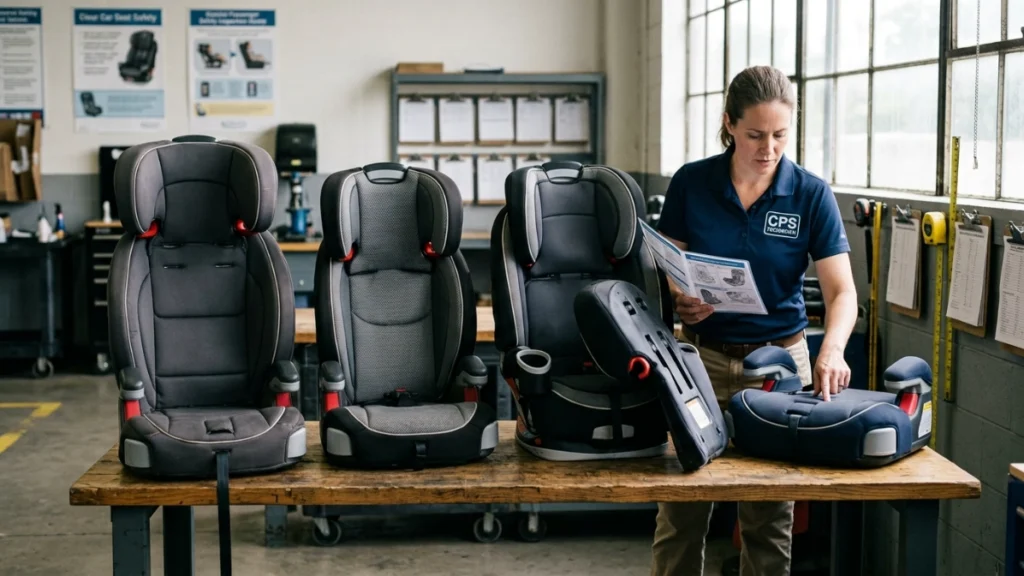
Yes. Similar-looking Graco seats can have different modes, storage systems, and booster limits.
As of 2026, current Graco product information shows the following examples:
| Graco model | Forward-facing harness | Highback booster | Backless booster |
|---|---|---|---|
| TriRide 3-in-1 | 26.5–65 lb, up to 49 in. | 40–100 lb, 43–57 in., at least 4 years | Not listed as a mode |
| SlimFit 3-in-1 | 26.5–65 lb, up to 49 in. | 40–100 lb, 43–57 in., at least 4 years | Not listed as a mode |
| 4Ever DLX 4-in-1 | 26.5–65 lb, up to 49 in. | 40–100 lb, 43–57 in., at least 4 years | 40–120 lb, 43–57 in., at least 4 years |
| Nautilus 2.0 LX | 26.5–65 lb, up to 49 in. | 40–100 lb, 43–57 in., at least 4 years | 40–120 lb, 43–57 in., at least 4 years |
The comparison shows why using a generic conversion video can cause confusion. One Graco model may end at highback booster mode while another converts again into a backless booster.
You can also review Graco’s 4Ever DLX specifications to see how the manufacturer separates the four modes.
How Should the Seat Belt Fit in Booster Mode?
A successful conversion isn’t finished when the harness disappears. The vehicle belt must fit your child correctly every time.
NHTSA’s booster seat installation guidance gives two critical belt-positioning checks.
- Lap belt: It should lie snugly across the upper thighs rather than across the stomach.
- Shoulder belt: It should cross the chest and shoulder rather than the neck or face.
Use the shoulder-belt guide correctly
Many highback Graco boosters include an open-loop or similar shoulder-belt guide near the headrest. Route the shoulder portion of the belt through this guide exactly as shown in your manual.
The belt should move freely. It shouldn’t be twisted, trapped, or prevented from retracting normally.
Watch how your child sits
Your child should sit with their back against the booster. Their body should remain in that position for the entire trip.
Don’t allow these common workarounds:
- Putting the shoulder belt behind the child’s back
- Running the shoulder belt under the child’s arm
- Allowing the lap belt to ride onto the stomach
- Letting the child lean far sideways or forward
- Using a lap-only belt with a belt-positioning booster
My simplest fit check: Look at the belt before checking anything else. If it isn’t naturally sitting low across the hips and centered across the shoulder area, re-check the booster position and belt guide.
What Graco Booster Conversion Mistakes Should You Avoid?
Most conversion problems come from treating booster mode like a slightly modified harness mode. It is a different restraint setup with different rules.
Converting too early
A child meeting the lowest permitted booster weight doesn’t automatically mean the harness should be retired. Continue using the forward-facing harness while your child fits within its limits and the manufacturer permits its use.
Following instructions for the wrong Graco model
Graco has several seats with similar names and appearances. Always use the model number on your own seat when downloading instructions.
Leaving harness parts loose behind the cover
If your seat provides integrated harness storage, use it. Don’t improvise by stuffing straps into random openings where they can interfere with the seat or belt path.
Using the wrong vehicle belt
Belt-positioning boosters require an appropriate lap-and-shoulder belt. A lap-only belt cannot provide the required shoulder-belt positioning.
Assuming lower anchors restrain the child
Some booster seats allow lower anchors to keep the booster attached to the vehicle. That doesn’t replace the vehicle lap-and-shoulder belt around the child.
Whether lower anchors remain connected in booster mode depends on your specific Graco model and vehicle setup. Follow both manuals.
Forgetting about an empty booster
An unoccupied booster should still be secured as its instructions require. NHTSA warns that an unsecured booster can move through the vehicle during a sudden stop or crash.
Need a second set of eyes? NHTSA provides information on child-passenger safety inspection stations where trained technicians can check car-seat installation and use.
Frequently Asked Questions
Can every Graco car seat turn into a booster?
No. Only models specifically designed and labeled with a booster mode should be used as boosters. Check your seat’s model number and instruction manual before removing, storing, or repositioning the harness.
Do I remove the harness when converting a Graco seat to a booster?
It depends on the model. Several Graco seats use integrated compartments that store the harness while it remains with the seat, while other designs may use a different procedure. Follow the booster-conversion section of your exact manual.
What weight should a child be before using a Graco booster?
Many current Graco highback booster modes begin at 40 pounds, but weight alone isn’t enough. Age, height, harness limits, maturity, and the specifications for your exact model also matter.
Can I use LATCH when my Graco car seat is in booster mode?
Some Graco models permit lower-anchor use in booster mode, while others may have different instructions. When permitted, those anchors hold the booster to the vehicle; the child still uses the vehicle’s lap-and-shoulder belt.
Can I turn my Graco highback booster into a backless booster?
Only if your model specifically includes a backless booster mode. For example, the 4Ever DLX and Nautilus 2.0 LX include backless modes, while the TriRide 3-in-1 is listed as ending with highback booster mode.
When can my child stop using a booster completely?
Keep using a booster until the vehicle seat belt fits properly without it. The lap belt should stay low across the upper thighs, while the shoulder belt should cross the chest and shoulder correctly.
What should I do if I lost my Graco manual?
Find the model number and manufacture date on the seat, then use Graco’s online product-instruction finder. Avoid relying on a manual for a different model, even when the seats look similar.
The safest way to turn a Graco car seat into a booster is to treat the model-specific manual as the final authority. Confirm your child’s readiness, store the harness exactly as directed, and check lap-and-shoulder belt fit before every trip.
If anything about the conversion looks different from the manual, don’t guess. Re-check the model information or have the setup inspected before putting the seat back into regular use.
