
Why Is My Hyundai Check Engine Light On?

Contents
- 1 Key Takeaways
- 2 📑 Table of Contents
- 3 Introduction: That Glowing Reminder on Your Dashboard
- 4 How the Hyundai Check Engine Light System Works
- 5 Top 10 Common Reasons Your Hyundai’s Check Engine Light Is On
- 6 What to Do Immediately When the Light Comes On
- 7 The Professional Diagnostic Process
- 8 When to See a Mechanic Immediately vs. Soon
- 9 Conclusion: Knowledge is Power (and Savings)
- 10 Frequently Asked Questions

Car Ambient Light Kit

Car Storage Net

Car Scratch Remover

Tire Shine Spray
Your Hyundai’s check engine light is a critical warning that shouldn’t be ignored. It can signal anything from a simple loose gas cap to major engine problems. Understanding the causes and taking prompt action can save you from expensive repairs and keep your car running safely and efficiently.
Key Takeaways
- The check engine light is part of your Hyundai’s onboard diagnostics (OBD-II) system, monitoring engine and emissions performance.
- Common triggers range from minor issues like a loose gas cap to serious failures like a faulty catalytic converter or oxygen sensor.
- A steadily illuminated light indicates a problem, while a flashing light signals a severe issue that requires immediate shutdown to prevent engine damage.
- Always check for accompanying symptoms like rough idling, poor fuel economy, or strange noises to help diagnose the problem.
- Using an OBD-II scanner to read diagnostic trouble codes (DTCs) is the fastest way to identify the specific cause.
- Simple fixes like tightening the gas cap can be done yourself, but complex issues should be handled by a qualified mechanic.
- Ignoring the check engine light can lead to costly repairs, failed emissions tests, and potential safety risks on the road.
📑 Table of Contents
- Introduction: That Glowing Reminder on Your Dashboard
- How the Hyundai Check Engine Light System Works
- Top 10 Common Reasons Your Hyundai’s Check Engine Light Is On
- What to Do Immediately When the Light Comes On
- The Professional Diagnostic Process
- When to See a Mechanic Immediately vs. Soon
- Conclusion: Knowledge is Power (and Savings)
Introduction: That Glowing Reminder on Your Dashboard
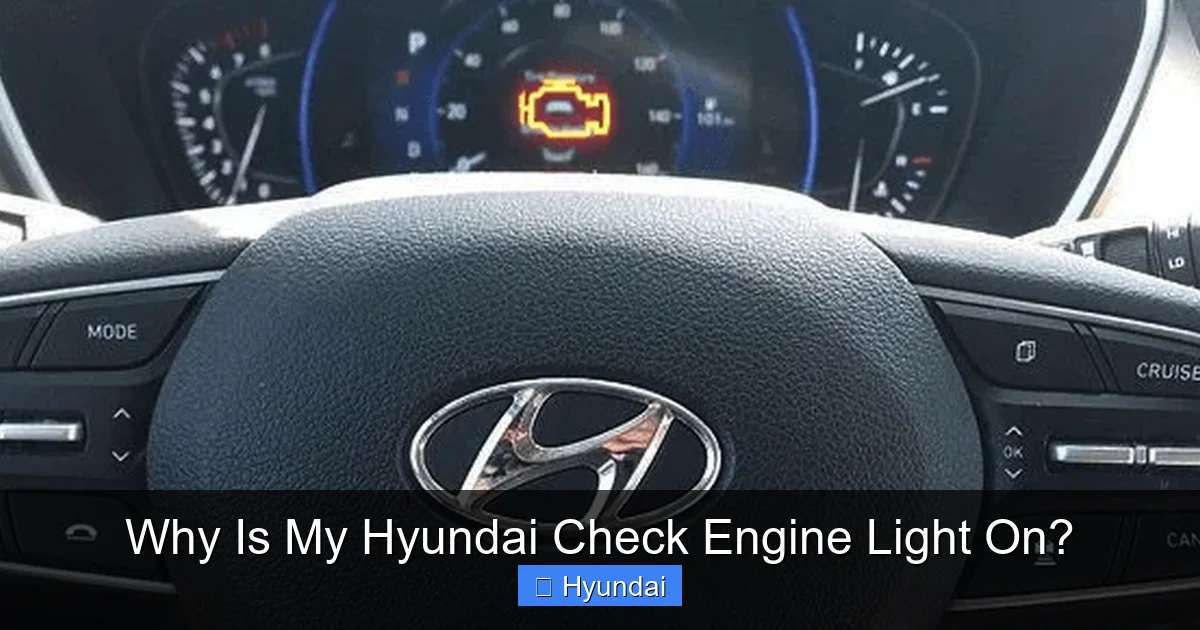
You’re driving your Hyundai, everything seems fine, and then you see it—that small, glowing icon on your dashboard that looks like an engine. Your heart sinks a little. The check engine light. It’s one of the most common—and most misunderstood—warnings in any car, including Hyundais. This little light is your car’s way of saying, “Hey, something needs your attention.” But what exactly does it mean? Is it an emergency? Can you keep driving? We’re here to demystify the Hyundai check engine light, break down the potential causes in simple terms, and give you a clear action plan. Think of this as your friendly, no-nonsense guide to handling that dashboard alert with confidence.
How the Hyundai Check Engine Light System Works
Before we dive into the “why,” it helps to understand the “how.” Your Hyundai is equipped with a sophisticated computer system called the Engine Control Module (ECM) or Powertrain Control Module (PCM). This computer constantly monitors dozens of sensors and components throughout your engine and emissions system. It’s like a team of microscopic inspectors checking everything from fuel mixture to exhaust output.
Visual guide about Why Is My Hyundai Check Engine Light On?
Image source: guidemechanic.com
The Role of the OBD-II System
Since 1996, all cars sold in the U.S., including Hyundais, have used the On-Board Diagnostics II (OBD-II) standard. This system is the brain behind the check engine light. When a sensor detects a value that’s too high, too low, or just plain missing, it reports a “diagnostic trouble code” (DTC) to the car’s computer. If the issue is significant or persistent, the computer illuminates the check engine light to alert you. There are hundreds of possible codes, each pointing to a specific area of concern.
Steady Light vs. Flashing Light: A Critical Difference
Not all check engine lights are created equal. Pay close attention to how yours is behaving:
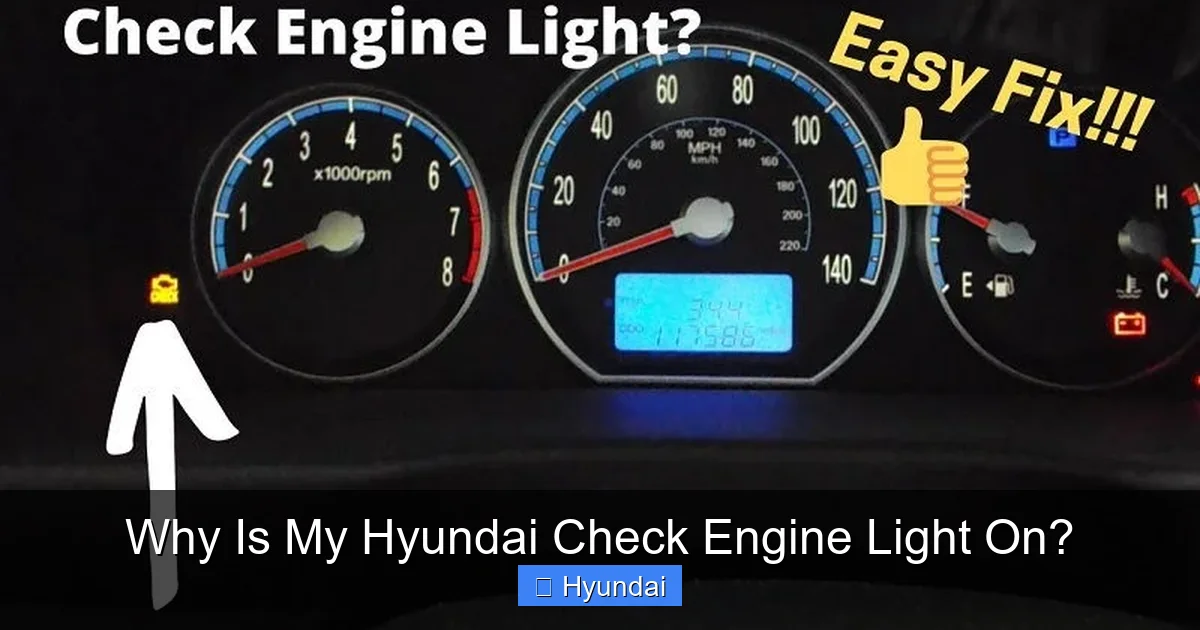
- Steady Yellow/Orange Light: This indicates a non-emergency issue. Your car is likely safe to drive for a short period, but you should schedule a diagnosis soon. Common causes include a loose gas cap or a failing oxygen sensor.
- Flashing or Blinking Light: This is your car’s panicked scream. A flashing light means a severe problem is happening right now that could cause catastrophic engine damage, such as a severe misfire that’s dumping unburned fuel into your catalytic converter. If your check engine light is flashing, pull over safely, turn off the engine, and call for assistance. Do not continue driving.
Top 10 Common Reasons Your Hyundai’s Check Engine Light Is On
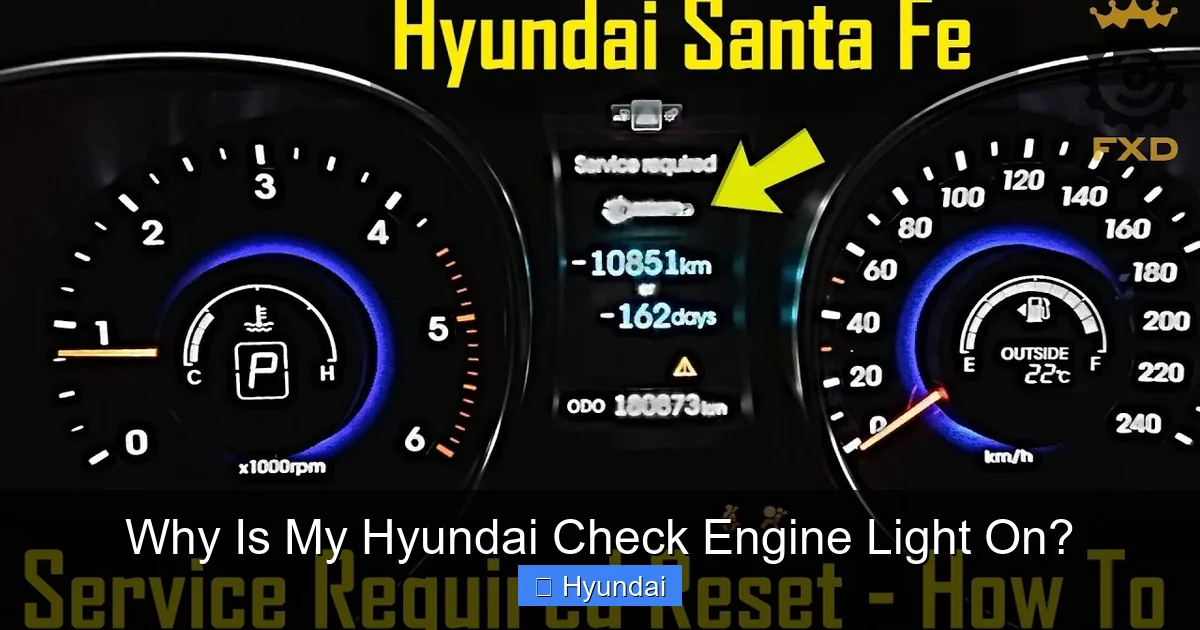
So, what’s actually causing that light to glow? While only a proper diagnostic scan can give you the exact code, certain issues are notoriously frequent across Hyundai models, from the Elantra and Sonata to the Tucson and Santa Fe. Here are the most common culprits, starting with the simplest.
Visual guide about Why Is My Hyundai Check Engine Light On?
Image source: i.ytimg.com
1. Loose, Damaged, or Missing Gas Cap
Yes, really! It might sound too simple, but a gas cap that isn’t tightened properly or is damaged is the #1 cause of a check engine light. The fuel system is a sealed environment. A loose cap allows fuel vapors to escape, which the evaporative emissions (EVAP) system detects as a leak. This triggers a code like P0455 (EVAP large leak detected) or P0442 (EVAP small leak detected). The fix is often as easy as removing the cap, ensuring the seal is intact, and twisting it until it clicks. If the cap is cracked or the seal is worn, replacing it is cheap and easy.
2. Faulty Oxygen (O2) Sensor
Modern Hyundais have at least two oxygen sensors. The upstream sensor (before the catalytic converter) monitors the oxygen level in the exhaust to help the engine computer adjust the fuel mixture for optimal efficiency and low emissions. When an O2 sensor fails or sends inaccurate readings (common codes: P0130-P0134, P0150-P0154), your fuel economy can plummet, your car may run rough, and you’ll likely fail an emissions test. Over time, sensors can become contaminated by oil leaks or rich fuel mixtures. Replacing an O2 sensor is a common repair.
3. Catalytic Converter Failure
The catalytic converter is a crucial emissions component that turns harmful gases into less harmful ones. It works with the oxygen sensors. If it becomes clogged, damaged, or inefficient (often indicated by codes P0420 or P0430), the check engine light will come on. Symptoms include poor acceleration, a sulfur-like “rotten egg” smell from the exhaust, and failed emissions tests. Catalytic converters can fail due to age, contamination from unburned fuel (often from misfires), or physical damage. This is a more expensive repair, which is why addressing misfires early is critical.
4. Worn Spark Plugs or Ignition Coils
Spark plugs ignite the air-fuel mixture in your engine’s cylinders. If they’re worn out, gapped incorrectly, or fouled, or if the ignition coils that send power to them fail, you get misfires. Misfire codes (P0300-P0304) are serious. A single-cylinder misfire (e.g., P0302 for cylinder 2) might cause a rough idle and loss of power. A random misfire (P0300) or multiple cylinder misfire can cause the light to flash. Worn spark plugs are a routine maintenance item; faulty coils are a common replacement part.
5. Failing Mass Airflow (MAF) Sensor
The MAF sensor measures how much air is entering your engine so the computer can calculate the correct amount of fuel. A dirty or failed MAF sensor (codes P0100-P0103) will cause poor fuel economy, rough idling, hesitation, and a lack of power. It’s often located in the air intake tube and can be cleaned with a special MAF cleaner spray. If cleaning doesn’t work, replacement is necessary.
6. Issues with the Evaporative Emissions (EVAP) System
This system captures fuel vapors from your gas tank and stores them in a charcoal canister, eventually burning them in the engine. Leaks can occur in the gas tank, fuel lines, or the network of small hoses and valves. A common, easy fix is a loose or faulty gas cap (see #1). Other components like the purge valve or vent solenoid can also fail, triggering codes like P0440, P0441, or P0455.
7. Engine Overheating
If your engine temperature gauge is in the red or you see steam, your Hyundai is overheating. This is an emergency that can cause severe damage. The check engine light will often illuminate alongside a specific temperature warning. Overheating can be caused by a coolant leak, a failed thermostat, a broken water pump, or a clogged radiator. If you suspect overheating, stop driving immediately. For more on this critical issue, you can read about why cars overheat when the AC is on, which covers similar cooling system principles.
8. Faulty Exhaust Gas Recirculation (EGR) Valve
The EGR valve recirculates a small amount of exhaust gas back into the engine to reduce combustion temperatures and lower nitrogen oxide emissions. If it becomes clogged with carbon or sticks open/closed, it can cause rough idling, hesitation, and a check engine light (common code P0401). Cleaning or replacing the EGR valve is the typical repair.
9. Bad or Weak Battery
While a dead battery will trigger the battery light, a weak or failing battery can also cause voltage fluctuations that confuse the car’s computer, leading to a check engine light. Modern cars are very sensitive to proper voltage. If your battery is more than 3-4 years old and you’re experiencing electrical gremlins along with the check engine light, have the battery and charging system tested.
10. Transmission Issues (On Some Models)
On newer Hyundais with advanced transmissions, a problem with the transmission control module or a sensor (like the transmission fluid temperature sensor) can illuminate the check engine light. Symptoms might include harsh shifting, slipping, or failure to shift properly. A code like P0700 indicates a general transmission control system issue.
What to Do Immediately When the Light Comes On
Seeing that light can be stressful, but don’t panic. Follow this step-by-step checklist to assess the situation safely.
Visual guide about Why Is My Hyundai Check Engine Light On?
Image source: richsautobodyshop.com
Step 1: Assess the Severity
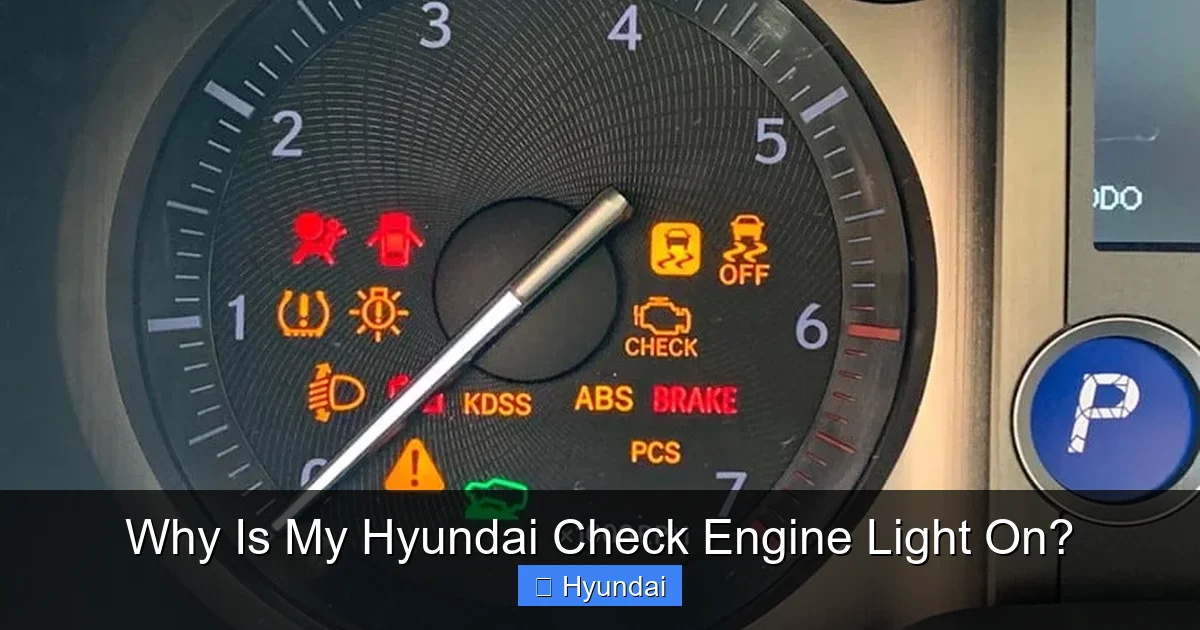
First, determine if the light is steady or flashing. As emphasized, a flashing light means stop driving. A steady light means you have time to diagnose, but you shouldn’t ignore it for weeks. Next, check for other warning lights. Is the oil pressure light on? Is the temperature gauge in the red? Are there any unusual sounds, vibrations, or smells? These clues are vital.
Step 2: Check the Simple Stuff First
Before you go to a mechanic, do these quick, free checks:
- Tighten the gas cap: Remove it and reinstall it firmly until you hear several clicks. This solves a huge percentage of cases.
- Check engine oil level: Low oil can cause issues. If it’s low, top it off with the correct oil. A severely low oil level might trigger the oil light first, but it’s worth checking.
- Look for obvious leaks: Pop the hood (when the engine is cool) and look for any puddles of fluid or disconnected hoses.
- Listen and feel: Start the engine. Does it idle smoothly? Any tapping, knocking, or hissing sounds? Does it feel like it’s missing?
Step 3: Read the Diagnostic Trouble Codes (DTCs)
This is the most important step. You need to know what the car’s computer is complaining about. You have a few options:
- Use an OBD-II scanner: You can buy a basic Bluetooth or wired scanner for $20-$50 that connects to the OBD-II port (usually under the dash near the steering column). Pair it with a free app on your phone (like Torque or Hyundai’s own app if available) to read and clear codes. This gives you the specific code (e.g., P0171, P0420).
- Visit an auto parts store: Many national chains (like AutoZone, O’Reilly, Advance Auto Parts) offer free code scanning as a customer service. They’ll plug in their scanner and print out the code(s) for you. They may also provide a basic definition, but don’t rely on them for a full diagnosis.
- Take it to a mechanic: A professional shop will use a more advanced scanner that can read manufacturer-specific codes and live data streams.
Important: A code tells you where to look, not what to replace. For example, a P0301 code (Cylinder 1 Misfire Detected) means cylinder 1 isn’t firing properly. The cause could be a spark plug, ignition coil, fuel injector, or compression problem. The code is your starting point for diagnosis.
The Professional Diagnostic Process
If the problem isn’t obvious (like a loose gas cap), you’ll likely need a professional. Here’s what a good mechanic does that goes beyond just reading a code.
Reading Codes and Live Data
The technician will use a high-end scan tool to pull all stored codes, including pending and manufacturer-specific ones. Then they’ll look at “live data”—real-time readings from all the sensors. They’ll compare these readings to factory specifications. For example, if an oxygen sensor code is set, they’ll check if the sensor’s voltage is switching properly between rich and lean conditions. If it’s stuck, it’s bad.
Performing Targeted Tests
Based on the code and live data, the mechanic performs specific tests. For a misfire code, they might swap the ignition coil from the misfiring cylinder to a good one. If the misfire moves to the new cylinder, the coil is bad. For an EVAP leak code, they might use a smoke machine to pressurize the system and visually find the leak. For a fuel trim code (like P0171), they’ll check for vacuum leaks, measure fuel pressure, and inspect the air intake system.
Why a “Code” Isn’t a “Part”
This is a crucial concept for car owners to understand. The check engine light points to a system or circuit that’s out of spec. Replacing the part suggested by the code name (e.g., “O2 sensor”) without verification is a guessing game that can be costly. A reputable mechanic will diagnose the root cause. A bad O2 sensor might be caused by an oil leak burning on the sensor, which needs fixing first, or a failing catalytic converter causing excessive backpressure. Always ask for an explanation of the diagnosis.
When to See a Mechanic Immediately vs. Soon
Not all situations are equal. Here’s a practical guide to timing.
Stop Driving Immediately (Tow the Car):
- The check engine light is flashing.
- You have severe engine knocking, ticking, or metallic noises.
- The car is overheating (temperature gauge in the red or steam from the hood).
- You experience a total loss of power or the car won’t accelerate.
- There are thick, abnormal exhaust smoke (blue = burning oil, white = coolant leak).
Diagnose Within 24-48 Hours:
- Steady check engine light with noticeable performance issues (rough idle, poor acceleration, shaking).
- Steady light with a noticeable drop in fuel economy.
- Any unusual smells (sulfur, sweet coolant, burning oil).
Schedule a Diagnosis Within a Week or Two:
- Steady light with no apparent drivability problems.
- You’ve recently refueled and tightened the gas cap, but the light remains on (it can take a few drive cycles for the system to reset).
Remember, even if the car seems fine, an unresolved issue can cause long-term damage, increase emissions, and cause you to fail your next emissions or safety inspection. In some regions, a lit check engine light means an automatic fail.
Conclusion: Knowledge is Power (and Savings)
Your Hyundai’s check engine light is not a design flaw—it’s a sophisticated communication tool. It’s your car’s way of proactively telling you about a problem before it becomes a breakdown. By understanding the basics—the difference between a steady and flashing light, the most common causes, and the importance of a proper diagnostic scan—you move from a place of anxiety to a place of action.
Start with the free, simple checks: tighten that gas cap! Then, get the codes read. Use that information to have an informed conversation with a trusted mechanic. A small investment in diagnosis now can prevent a catastrophic and expensive engine repair later. And if you’re ever in a position where you need to sell your Hyundai, be aware that a check engine light will significantly impact its value and your ability to complete a private sale. You can learn more about selling a car with a check engine light to understand your options and legal obligations.
Ultimately, treating that little engine icon with respect is one of the best ways to protect your investment, ensure your safety, and keep your Hyundai running reliably for years to come. Don’t ignore it—investigate it.
Frequently Asked Questions
What’s the difference between a steady and flashing check engine light on my Hyundai?
A steady light indicates a problem that needs attention soon but isn’t immediately destructive. A flashing light signals a severe engine misfire that is dumping unburned fuel into your exhaust, which can overheat and destroy the catalytic converter. You must stop driving immediately if the light flashes.
Can I keep driving my Hyundai with the check engine light on?
If the light is steady and the car is running normally (no rough idling, no loss of power), you can drive it briefly to a safe location for diagnosis. However, you should not delay getting it checked, as prolonged driving can cause further damage and increase emissions. If the light flashes or you have serious symptoms, do not drive it.
How urgent is a check engine light?
The urgency depends on the behavior. A flashing light is an emergency—stop driving. A steady light with performance issues is urgent (diagnose within 48 hours). A steady light with no other symptoms is less urgent but still important to address within a couple of weeks to prevent future damage and ensure your car passes emissions tests.
Will the check engine light reset itself?
Sometimes, if the problem was temporary and the car’s computer goes through a certain number of successful drive cycles without detecting the issue, the light may turn off on its own. However, the underlying problem may still exist and will likely return. It’s always best to diagnose and fix the issue rather than hoping it goes away.
How much does it cost to diagnose a check engine light?
A simple code scan at an auto parts store is often free. A full diagnostic at a repair shop typically ranges from $80 to $150, sometimes more. This fee is usually applied toward the repair if you proceed with that shop. The cost to fix the problem varies wildly from $0 (tightening a gas cap) to over $1,000 for a catalytic converter replacement.
Can low oil cause the check engine light to come on?
Severely low oil pressure will typically trigger the oil pressure light first. However, a low oil level can sometimes cause other issues, like increased friction or abnormal sensor readings, which might indirectly set a check engine code. Always check your oil level if any dashboard light comes on.


