Who Makes Mazda Oil

Contents
- 1 Key Takeaways
- 2 📑 Table of Contents
- 3 The Idemitsu Partnership: Mazda’s Chosen Lubricant Partner
- 4 Decoding Mazda’s Oil Specifications: More Than Just a Viscosity
- 5 Bottling, Blending, and Distribution: From Plant to Your Pan
- 6 Aftermarket vs. Genuine Mazda Oil: Making the Right Choice
- 7 Mazda Oil Recommendations by Model and Engine
- 8 Practical Maintenance: Applying This Knowledge
- 9 Conclusion: The Simple Truth About Mazda Oil
- 10 Frequently Asked Questions

Car Dent Repair Kit

Octane Booster

Rear View Camera

Car Fog Light Bulb
Genuine Mazda oil is primarily manufactured by Idemitsu Kosan Co., Ltd., a major Japanese chemical company, under Mazda’s exact specifications. Mazda does not produce its own oil but sets rigorous standards for viscosity, additives, and performance tailored to its engines, including SkyActiv technology. Using Mazda-approved oil, whether genuine or aftermarket meeting the same specs, is critical for engine longevity, fuel efficiency, and warranty compliance.
You pop the hood of your Mazda, grab the dipstick, and check the golden liquid that keeps your engine alive. But have you ever wondered, "Who actually makes the oil that carries the Mazda name?" It’s a fascinating question that gets to the heart of how modern automakers operate. Unlike some brands that might have a legendary history of producing their own lubricants in-house, Mazda takes a different, highly strategic path. Understanding who makes Mazda oil isn’t just trivia; it’s key to making informed decisions about your car’s most vital fluid. It empowers you to choose between genuine Mazda oil and high-quality aftermarket options with confidence. In this deep dive, we’ll unravel the corporate partnerships, technical specifications, and practical realities behind the bottle with the Mazda logo.
Think of Mazda as a master chef. The chef doesn’t grow the vegetables or milk the cows. Instead, they have an exquisite, secret recipe and work with the very best suppliers to source the precise, high-quality ingredients needed to execute it perfectly every single time. Mazda’s approach to engine oil is exactly that. They don’t have massive refining and additive blending plants. Instead, they formulate an incredibly detailed, performance-oriented specification and partner with a world-class lubricant manufacturer to bring it to life. This partnership ensures that every drop of "Genuine Mazda Oil" is engineered from the ground up to protect the unique characteristics of a Mazda engine, from the high-revving Skyactiv-G gasoline engines to the efficient Skyactiv-D diesel powerplants. Let’s pull back the curtain and see how this collaboration works and what it means for you, the Mazda owner.
Key Takeaways
- Primary Manufacturer: Idemitsu Kosan, a prestigious Japanese company, is the principal producer of genuine Mazda-branded motor oil.
- Specification-Driven: Mazda designs specific oil standards (like Mazda FL-4 or 0W-20) for its engines; the manufacturer must meet these, not just general industry grades.
- Bottling & Distribution: Oil is typically blended at Idemitsu facilities and bottled under the Mazda brand, often at regional distribution centers.
- Aftermarket Alternatives: Many major brands (e.g., Mobil 1, Pennzoil) produce oils that meet or exceed Mazda’s specifications, offering valid alternatives to genuine oil.
- Model-Specific Needs: Different Mazda engines (Skyactiv-G, Skyactiv-D, rotary) have unique oil requirements; always consult your owner’s manual.
- Warranty Considerations: Using an oil that meets Mazda’s listed specification is generally required to maintain your new vehicle warranty.
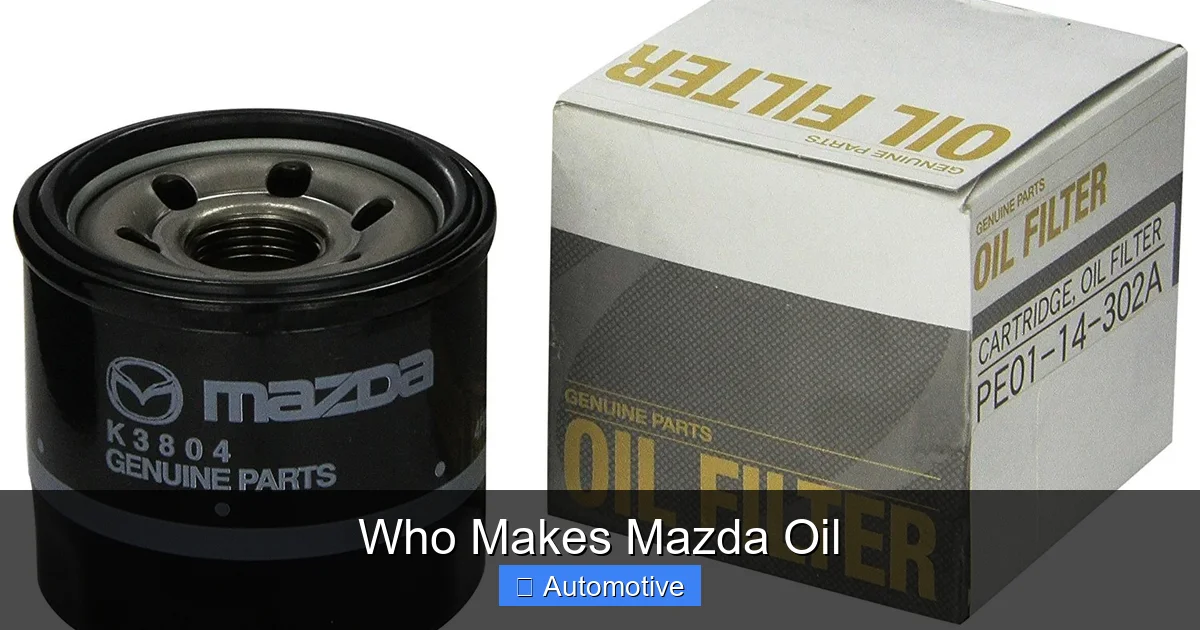
- Filters Matter Too: The oil filter is equally important; Mazda’s filters are often made by reputable suppliers like Denso or Mahle, similar to how Subaru’s oil filters are sourced from trusted manufacturers.
📑 Table of Contents
- The Idemitsu Partnership: Mazda’s Chosen Lubricant Partner
- Decoding Mazda’s Oil Specifications: More Than Just a Viscosity
- Bottling, Blending, and Distribution: From Plant to Your Pan
- Aftermarket vs. Genuine Mazda Oil: Making the Right Choice
- Mazda Oil Recommendations by Model and Engine
- Practical Maintenance: Applying This Knowledge
- Conclusion: The Simple Truth About Mazda Oil
The Idemitsu Partnership: Mazda’s Chosen Lubricant Partner
So, who is the "chef" Mazda trusts with its secret recipe? The answer is Idemitsu Kosan Co., Ltd., one of Japan’s largest and most respected petroleum and chemical companies. This isn’t a random choice; it’s a strategic alliance rooted in shared Japanese engineering philosophy and a long history of collaboration.
Who is Idemitsu Kosan?
Founded in 1911, Idemitsu is a global energy and materials company headquartered in Tokyo. While it operates across many sectors, its lubricant division, Idemitsu Lubricants, is a world leader. They are renowned for their cutting-edge research in synthetic base stocks and additive technology. Their products power everything from consumer automobiles to heavy industrial machinery and even space exploration equipment. Partnering with Idemitsu gives Mazda access to this immense R&D capability without the multi-billion-dollar investment of building its own lubricant empire. This relationship is so deep that Idemitsu is not just a supplier; they are a development partner. Engineers from both companies work together to translate Mazda’s engine performance goals—like the precise fuel injection timing of a Skyactiv-X engine or the extreme pressures in a rotary apex seal—into specific chemical requirements for the oil.
Why This Partnership Makes Sense
The Mazda-Idemitsu partnership is a perfect example of industry synergy. Mazda is a relatively small, focused automaker compared to giants like Toyota or Volkswagen. It’s far more efficient for them to outsource commodity-but-critical components like oil and even something as specific as Toyota’s oil filters, which are also typically sourced from major suppliers. This allows Mazda to concentrate its capital and genius on what it does best: designing and building exhilarating, efficient vehicles. For Idemitsu, securing a long-term, exclusive partnership with a prestigious brand like Mazda is a huge endorsement and a stable, high-volume business. It’s a win-win that ensures Mazda gets a tailor-made product and Idemitsu gets a marquee client.
This model is not unique. You’ll find similar arrangements across the industry. Honda oils are often made by Idemitsu or other blenders like ExxonMobil. Many "German" car brands source oil from companies like Fuchs or BASF. The key takeaway is that the brand on the bottle is a specification stamp, not necessarily a manufacturing mark. When you buy Genuine Mazda Oil, you are buying an Idemitsu product that has been certified to meet Mazda’s demanding internal standards.
Decoding Mazda’s Oil Specifications: More Than Just a Viscosity
This is the most crucial part of the whole equation. Mazda doesn’t just say "use 0W-20 oil." They publish specific, proprietary specifications that oils must meet to be considered "Mazda-approved." These specifications are far more detailed than the standard API (American Petroleum Institute) or ILSAC (International Lubricants Standardization and Approval Committee) ratings you see on the back of any oil bottle.

Visual guide about Who Makes Mazda Oil
Image source: rparts-sites.s3.amazonaws.com
The Mazda Specification Hierarchy
Mazda uses a letter-number code system to define its oil requirements. The most common you’ll encounter for modern gasoline engines is Mazda FL-4 or the newer Mazda FL-6 for certain models. For diesel engines, look for Mazda D-5 or similar. These codes represent a complete set of laboratory and engine bench tests that evaluate:
- Viscosity Stability: How well the oil maintains its thickness across a huge temperature range, from a cold Canadian winter to a hot Arizona summer.
- Fuel Economy: Oils are tested for their ability to reduce internal engine friction, which directly impacts your miles per gallon. Mazda’s Skyactiv engines are designed for efficiency, and the oil plays a role.
- Wear Protection: This is huge. Mazda engines, especially the high-compression Skyactiv-G and the high-revving rotary, have specific contact stresses. The oil must form a film strong enough to protect bearings, cam lobes, and piston skirts under extreme conditions.
- Turbocharger Protection: For turbocharged models like the Mazda CX-5 with the 2.5T engine, the oil must prevent turbo "coking" (deposit formation) during the extreme heat of shutdown.
- Seal Compatibility: The oil must keep engine seals and gaskets supple and prevent leaks, a common issue with poorly formulated oils.
- Aftermarket Capability: Tests for sludge prevention, oxidation resistance, and acid neutralization to ensure long engine life under severe service.
An oil that simply meets API SP and ILSAC GF-6A standards is a great starting point, but it may not have been tested for the specific, sometimes unique, demands of a Mazda engine. This is why you’ll see "Meets Mazda FL-4 Specification" prominently on Genuine Mazda Oil bottles and on many high-quality aftermarket brands like Pennzoil Platinum Euro or Mobil 1 Extended Performance.
Finding the Right Spec for Your Mazda
The golden rule is always your owner’s manual. It will list the exact specification (e.g., "Mazda FL-4 0W-20") and often the API/ILSAC service category. For example:
- Most 2012+ Skyactiv-G gasoline engines (Mazda3, Mazda6, CX-5, CX-30): 0W-20, meeting Mazda FL-4 or FL-6.
- Older MZR engines (pre-2012): Often 5W-20 or 5W-30, meeting older Mazda specs.
- Skyactiv-D diesel engines: 0W-20 or 5W-30, meeting Mazda D-5 spec. (Note: Diesel oils are a different category).
- Rotary engines (RX-8, older RX-7): Have special needs, often requiring specific 10W-30 or 20W-50 oils with high anti-wear additives.
Using an oil with the correct viscosity but the wrong additive package can, over time, lead to increased wear, poor performance, or even damage. This specification focus is what separates proper maintenance from guesswork.
Bottling, Blending, and Distribution: From Plant to Your Pan
Once Idemitsu (or another approved blender) creates the oil to Mazda’s spec, it’s ready for the final steps before reaching you. This process is more complex than many realize and explains why you might see different bottlers or slightly different formulations in different regions.

Visual guide about Who Makes Mazda Oil
Image source: rerev.com
The Global Supply Chain
It’s highly unlikely that every single bottle of Genuine Mazda Oil is blended in one central factory in Japan. For logistical and economic reasons, the base oil and additive packages are often shipped in bulk to regional blending and bottling plants. These could be Idemitsu-owned facilities or even third-party blenders who are licensed and audited to meet Mazda’s standards. The oil is blended to the exact formula, tested, and then packaged into the distinctive Mazda-branded containers. This means a bottle of Mazda oil purchased in the United States might have been blended in Texas, while one in Australia might come from a facility in Singapore. The core formula, however, must be identical and certified.
Private Label vs. Co-Branded
This leads to an interesting point: is "Genuine Mazda Oil" simply Idemitsu oil with a Mazda label? In essence, yes, but with a critical caveat. It’s Idemitsu oil that has been blended to Mazda’s specific formula and is sold under the Mazda brand. This is different from a pure private label where a company just puts its name on a standard, off-the-shelf product. Mazda’s involvement is in the specification and quality control. This is analogous to how Toyota Motor Oil is produced by major refiners like ExxonMobil or Shell to Toyota’s own internal specs. The partnership ensures the product is not a generic oil; it’s a Mazda-specific product.
This also means that if you find an aftermarket oil that explicitly states it "meets or exceeds Mazda FL-4/FL-6 specifications," you are getting a product formulated for the same performance targets. The difference may be in the exact additive chemistry (which is a closely guarded secret for all brands) and the marketing. The Genuine Mazda bottle provides absolute certainty, while a reputable aftermarket brand offers often better value or different product lines (like high-mileage oils).
Aftermarket vs. Genuine Mazda Oil: Making the Right Choice
This is the practical dilemma every Mazda owner faces at the auto parts store or during an oil change. Should you stick with the dealer’s Genuine Mazda Oil or opt for a trusted brand from the shelf? Both can be correct choices, but understanding the landscape is key.

Visual guide about Who Makes Mazda Oil
Image source: engineoiljournal.com
The Case for Genuine Mazda Oil
- Absolute Certainty: It is guaranteed to meet Mazda’s specification. There is no guesswork, no need to decode API labels. It’s the "one size fits all" solution officially sanctioned by Mazda.
- Warranty Peace of Mind: During the new car warranty period, using Genuine Mazda Oil is the simplest way to ensure you are 100% compliant with the manufacturer’s lubrication requirements. If an engine issue arises, you have no questions about oil specification.
- Dealer Integration: It’s what Mazda dealerships use. If you have your car serviced at the dealer, this is what will go in.
- Consistent Supply: You know exactly what you’re getting every time, regardless of the region or store.
The Case for High-Quality Aftermarket Oil
- Cost & Value: Genuine oils often carry a premium. You can find excellent synthetic oils from brands like Mobil 1, Royal Purple, or Pennzoil that meet the Mazda spec for significantly less money per quart.
- Specialized Formulations: Need a high-mileage oil for your 2008 Mazda6 with 180,000 miles? Or a specific oil for your modified engine? Aftermarket brands offer a wider variety of formulations (high-mileage, extended drain, racing) that may not be available in the Genuine Mazda line.
- Convenience: It’s available at every auto parts store, Walmart, and even some gas stations. You don’t have to go to a dealer or order online.
- Comparable or Better Performance: Top-tier aftermarket brands invest billions in R&D. Their top-tier synthetic lines are often formulated to exceed the original equipment specifications of many automakers, including Mazda. Reading the bottle for "Meets Mazda FL-4" is your checklist.
Practical Tip: For a car under warranty, if you change your own oil, keep detailed receipts showing the brand, viscosity, and that it "meets Mazda FL-4/FL-6." For out-of-warranty cars, feel free to shop for value, but never sacrifice specification for price. A cheap oil that doesn’t meet the spec is a false economy. And remember, the oil filter is just as important. Whether you choose a Mazda-branded filter or a premium brand like Bosch or Mobil 1, ensure it is high-quality and meets the engine’s demands.
Mazda Oil Recommendations by Model and Engine
Let’s get specific. While the owner’s manual is always the final authority, here is a general guide for popular modern Mazda models. Note that "Skyactiv" is Mazda’s umbrella technology for its efficient engines.
Skyactiv-G (Gasoline) Engines
This is Mazda’s mainstream gasoline engine family, found in the Mazda3, Mazda6, CX-3, CX-5, CX-30, and MX-5 Miata (ND).
- Viscosity: Almost universally 0W-20 for models from approximately 2012 onward. This ultra-thin oil is key to the engine’s high fuel efficiency and smooth operation.
- Specification: Mazda FL-4 is the baseline. Newer models (like some 2022+) may specify Mazda FL-6, which has even stricter requirements for fuel economy and LSPI (Low-Speed Pre-Ignition) prevention, a concern in turbocharged direct-injection engines.
- Example: A 2020 Mazda CX-5 with the 2.5L Skyactiv-G requires SAE 0W-20 oil that meets Mazda FL-4 and API SP/ILSAC GF-6A.
- What to Buy: Genuine Mazda 0W-20, or any major brand’s full synthetic 0W-20 that states "Meets Mazda FL-4" on the back label.
Skyactiv-D (Diesel) Engines
Sold primarily in markets outside North America (like Europe and Japan), these efficient diesel engines have unique needs.
- Viscosity: Typically 0W-20 or 5W-30, which is surprisingly thin for a diesel. This is part of Skyactiv-D’s efficiency strategy.
- Specification: Mazda D-5 or similar. This is a diesel-specific standard, not to be confused with gasoline specs. It focuses on soot handling, oxidation stability, and wear protection under high compression.
- Critical: Never use a standard gasoline oil in a Skyactiv-D. The additive packages are completely different. Look for oils explicitly labeled for diesel engines and that list the Mazda D-5 spec.
Rotary (Wankel) Engines
The legendary, high-revving heart of the RX-7 and RX-8. These engines have oil consumption as a design characteristic and place unique demands on lubricant.
- Viscosity: Often 10W-30 or 20W-50, especially for high-RPM use or warmer climates. Thicker oil helps maintain film strength at extreme speeds and temperatures.
- Specification: Mazda had specific rotary-approved oils (like "Mazda Rotary Oil"). For modern replacements, you need an oil with high anti-wear (ZDDP) content and excellent high-temperature stability. Many enthusiasts use specific racing oils or high-quality synthetics like Motul 8100 X-Clean 5W-40, but always research for your specific model year.
- Tip: Rotary engines require religious oil level checks (every 1,000 miles) and top-ups. Using the correct, slightly thicker oil is part of managing this characteristic.
For older models like the Mazda Tribute (based on the Ford Escape) or the Mazda5, refer to the manual, as they may use more standard Ford or Chrysler specifications. When in doubt, the spec code is your guide.
Practical Maintenance: Applying This Knowledge
Knowing who makes the oil and what spec you need is useless if you don’t apply it correctly. Here is actionable advice for every Mazda owner.
The Oil Change Decision: DIY or Dealer?
Both are valid. A dealer service ensures Genuine Mazda parts (oil and filter) and a full warranty stamp. A DIY change with a high-quality aftermarket oil and filter that meets the spec saves significant money and gives you control. If you DIY, invest in a good quality oil filter wrench and a funnel. Always use a new crush washer on the drain plug. If you use an independent shop, communicate clearly: "I need 5.4 quarts of full synthetic 0W-20 meeting Mazda FL-4 specification. Please show me the bottles before you start." This avoids shops using cheaper bulk oils that may not meet the spec.
Checking and Topping Up Oil Between Changes
This is simple but critical. Check your oil on level ground, with the engine off for at least 5-10 minutes. Pull the dipstick, wipe it, reinsert fully, then pull again to read. The level should be between the MIN and MAX marks. If it’s near or below MIN, add a small amount (about 0.5 quart) of the correct oil. Never mix vastly different oils (e.g., conventional with full synthetic), but adding a quart of a different brand that meets the same spec (e.g., Mobil 1 to a Pennzoil fill) is perfectly safe in a pinch. For a detailed guide on this process, see how to safely add oil to your car. Consistently low oil levels between changes can indicate a leak or, in older or high-mileage engines, oil consumption. Address this promptly.
What Happens If You Use the Wrong Oil?
Short-term, a one-time mistake of using the wrong viscosity (e.g., 5W-30 instead of 0W-20) might not cause immediate disaster, but it can affect cold-start performance and fuel economy. Long-term, using an oil that lacks the required wear protection or has the wrong additive package can lead to:
- Increased engine wear and tear, shortening engine life.
- Turbocharger failure (from incorrect coking protection).
- Sludge and deposit formation, clogging oil passages.
- Potential seal swelling or shrinkage, causing leaks.
- Voiding of the powertrain warranty if a failure is linked to improper lubrication.
The "wrong oil" isn’t just about the numbers on the bottle; it’s about the entire formulation meeting the Mazda spec. This is why the specification code is your best friend.
Conclusion: The Simple Truth About Mazda Oil
So, who makes Mazda oil? The definitive answer is that the "Genuine Mazda" brand is manufactured by Idemitsu Kosan, a top-tier global lubricant company, under a highly specific and rigorous set of Mazda engineering standards. Mazda acts as the配方者 (formulator) and quality controller, not the blender. This model is smart, efficient, and ensures that the oil in your Mazda is not an off-the-shelf product but a tailored component of the engine system.
For you, the owner, this knowledge translates into power. You can confidently choose Genuine Mazda Oil for the ultimate in specification certainty and warranty simplicity. Or, you can shop the aftermarket with an educated eye, seeking out any full synthetic oil that explicitly states it meets the Mazda FL-4, FL-6, or other relevant specification for your model year and engine. The most important rule is this: Prioritize the specification over the brand name on the bottle. Whether it has a Mazda logo, a Mobil 1 eagle, or a Pennzoil Platinum label, if it meets the spec listed in your owner’s manual, it is the right oil for your engine. Treat your oil as the critical, performance-defining fluid it is, and your Mazda will reward you with years of smooth, efficient, and joyful driving.
Frequently Asked Questions
Is all Mazda oil made by Idemitsu?
Yes, Genuine Mazda-branded motor oil is manufactured by Idemitsu Kosan Co., Ltd. under a long-term partnership. Mazda sets the exact specifications, and Idemitsu produces and often bottles the lubricant to meet those standards.
Can I use regular oil (like Valvoline or Castrol) in my Mazda?
You can, but only if the oil meets the specific Mazda specification (e.g., FL-4 for most Skyactiv-G engines) and has the correct viscosity (usually 0W-20). Always check the back label for "Meets Mazda FL-4/FL-6." Generic "SAE 0W-20" without the spec may not have the right additive package.
What oil should I use in my 2021 Mazda CX-5?
Your CX-5 with the 2.5L Skyactiv-G engine requires SAE 0W-20 full synthetic oil that meets Mazda specification FL-4 (or FL-6 for some model years) and API SP/ILSAC GF-6A. Check your owner’s manual for the exact code.
Do I need to use a Mazda-branded oil filter?
No, but you must use a high-quality filter that meets or exceeds OEM standards. Mazda filters are often made by companies like Denso. Reputable aftermarket brands like Mobil 1, Bosch, and Wix XP make excellent filters that are perfectly suitable. The key is quality, not necessarily the brand name.
Where can I buy Genuine Mazda oil?
You can purchase it at any Mazda dealership parts department. It is also sometimes available through online retailers like Amazon or eBay, but be cautious of counterfeits. For convenience and often better value, many owners opt for equivalent-specification oils from major brands at auto parts stores.
Will using non-Mazda oil void my warranty?
Not if you use an oil that meets the exact specification (viscosity and performance standard like FL-4) listed in your owner’s manual. Mazda cannot void your warranty for using an aftermarket product that meets their published requirements. Keep your receipts as proof of specification compliance.