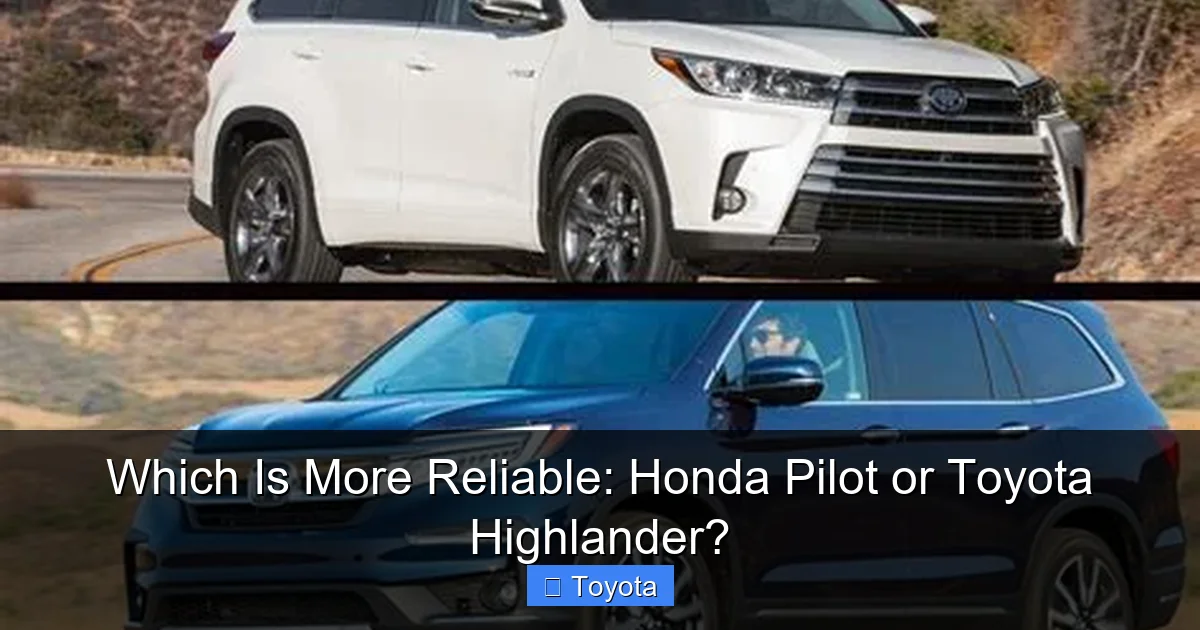
Which Is More Reliable: Honda Pilot or Toyota Highlander?

Contents
- 1 Key Takeaways
- 2 📑 Table of Contents
- 3 Understanding Reliability: What Do the Numbers Say?
- 4 Powertrain Deep Dive: Engines and Transmissions
- 5 Long-Term Ownership Costs: Repairs and Depreciation
- 6 Safety and Technology: A Reliability Factor?
- 7 Real-World Owner Feedback: Forums and Long-Term Reports
- 8 Making Your Decision: Which One Is Right for You?
- 9 Frequently Asked Questions

When it comes to raw, long-term reliability, the Toyota Highlander holds a consistent edge over the Honda Pilot. Toyota’s powertrain proven over decades typically sees fewer major issues past 100,000 miles. However, the Honda Pilot often offers lower repair costs when problems do arise and provides excellent initial quality. Your choice should prioritize Toyota for maximum longevity and Honda for balanced value and space.
Choosing a three-row family SUV is a big decision. You’re investing in a vehicle that will haul kids to soccer practice, handle grocery runs, and possibly embark on cross-country adventures. Reliability isn’t just a buzzword; it’s the foundation of peace of mind. It means fewer unexpected repair bills, less time stranded, and a vehicle that simply works when you need it to. Two giants in this segment are the Honda Pilot and the Toyota Highlander. Both are excellent, respected choices. But if the sole question is “Which is more reliable?” we need to dig into the data, the engineering, and the real-world experiences of thousands of owners.
This isn’t about which SUV is faster, more stylish, or has a better infotainment screen. This is a deep dive into durability, longevity, and the cost of keeping the vehicle running for the long haul. We’ll examine reliability ratings from the most trusted sources, break down the critical powertrain components, discuss long-term ownership costs, and look at what actual owners are saying in forums. By the end, you’ll have a clear, evidence-based answer to help you decide between the Honda Pilot and the Toyota Highlander for your family’s most reliable companion.
Key Takeaways
- Toyota’s Legendary Consistency: The Highlander benefits from Toyota’s decades-long reputation for building engines and transmissions that routinely surpass 200,000 miles with basic maintenance.
- Honda’s Cost-Effective Ownership: While the Pilot may see slightly more frequent repairs than the Highlander, those repairs are often less expensive due to widely available parts and simpler designs.
- Transmission History Matters: Pilot models from 2009-2015 require scrutiny for potential transmission issues, while certain Highlander years (2004-2007) have known engine concerns. Always check specific model year reports.
- Highlander’s Resale Value Advantage: Due to its perceived bulletproof reliability, the Toyota Highlander consistently retains a higher percentage of its value over five years compared to the Honda Pilot.
- Maintenance is Non-Negotiable: Both vehicles will reward diligent, scheduled maintenance. Neglecting oil changes or coolant flushes will quickly undermine the reliability of either brand.
- Newer Models Are a Different Game: For 2020+ models, the reliability gap narrows significantly as both manufacturers have refined their 3.5L V6 engines and 6/8/9-speed transmissions.
📑 Table of Contents
- Understanding Reliability: What Do the Numbers Say?
- Powertrain Deep Dive: Engines and Transmissions
- Long-Term Ownership Costs: Repairs and Depreciation
- Safety and Technology: A Reliability Factor?
- Real-World Owner Feedback: Forums and Long-Term Reports
- Making Your Decision: Which One Is Right for You?
Understanding Reliability: What Do the Numbers Say?
Before we compare the two, we must define “reliability” in an automotive context. It’s a composite score, usually based on things like: the frequency of owner-reported repair visits, the severity and cost of those repairs, and the vehicle’s ability to reach high mileage without major overhauls. Organizations like J.D. Power, Consumer Reports, and iSeeCars compile this data annually. Their findings provide our starting point.
The J.D. Power & Consumer Reports Verdict
For over a decade, Toyota has consistently outperformed Honda in J.D. Power’s long-term vehicle dependability studies. The Highlander frequently ranks at or near the top of the midsize SUV category. Honda does well, often earning “above average” scores, but it typically lags slightly behind Toyota’s “much better than average” ratings. Consumer Reports, which places a heavy emphasis on owner surveys about problems, also gives the Highlander a slight, persistent edge in predicted reliability for recent model years. Their data suggests that while the Pilot is a very solid vehicle, the Highlander’s powertrain and major systems show fewer chronic issues as they age. This isn’t about build quality—both are exceptionally well-assembled—but about engineering choices that prioritize long-term simplicity and robustness over peak performance or cutting-edge tech.
The iSeeCars Study: A Mileage Perspective
A fascinating study by iSeeCars analyzed which vehicles were most likely to reach 200,000 miles. The results were telling. While the Honda Pilot made the list, the Toyota Highlander consistently appears higher on the rankings. This real-world data points to the Highlander’s engines and transmissions being more likely to survive the extreme test of high mileage with minimal catastrophic failure. It’s one thing to be reliable for the first 80,000 miles under warranty; it’s another to be the vehicle a family trusts to cross the 200k threshold. The Highlander has a statistically stronger track record here. If you’re planning to keep your SUV for 10+ years or buy a high-mileage used model, this data is paramount. You can see a similar pattern in other Toyota models when you read why Toyota is so reliable.
Powertrain Deep Dive: Engines and Transmissions
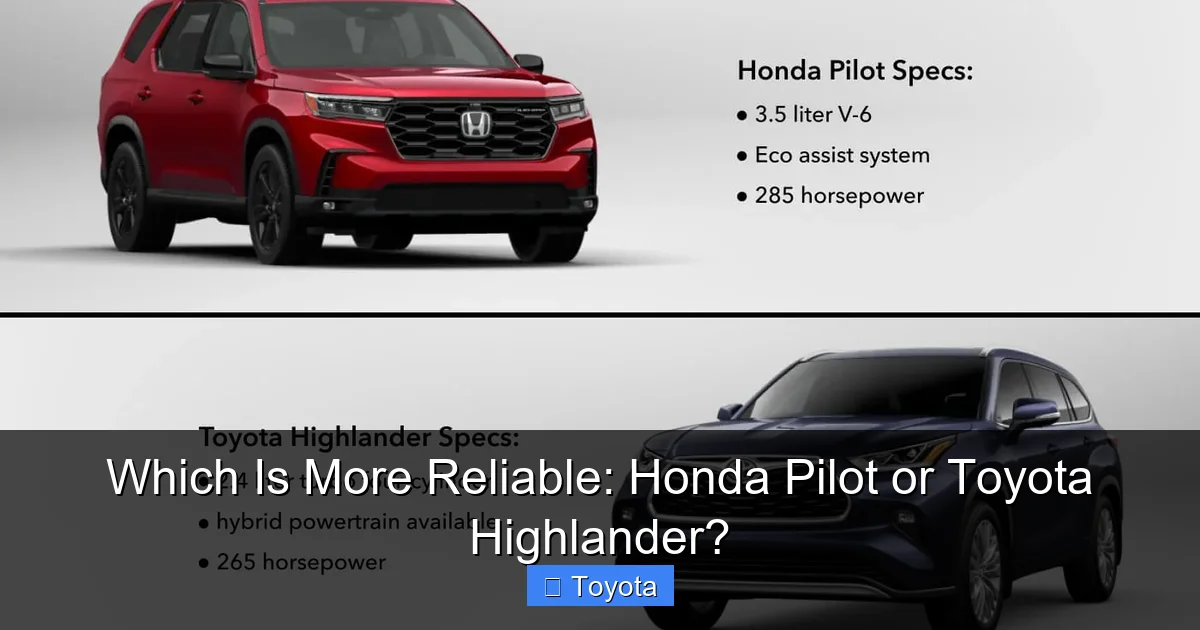
The heart of any vehicle’s reliability is its powertrain—the engine and transmission. This is where the most expensive failures happen. Both the Pilot and Highlander primarily use 3.5L V6 engines paired with sophisticated transmissions. The devil is in the details of their design and historical performance.
Visual guide about Which Is More Reliable: Honda Pilot or Toyota Highlander?
Image source: darcarshonda.com
The Honda Pilot’s V6 and 9-Speed Transmission
The current-generation Pilot (2016+) uses Honda’s excellent J35 series V6 engine. This engine family has a strong reputation for durability and is used across Honda’s lineup. The main area of historical concern for the Pilot lies in its transmission. Models from 2009 to 2015, particularly the 2013-2015 years, have documented issues with the 6-speed automatic transmission. Problems range from harsh shifting to complete failure, often requiring a costly rebuild or replacement. Honda addressed many of these concerns with software updates and, in later model years, a switch to a more robust 9-speed ZF-sourced transmission (2016+). For a used Pilot, the transmission history is the single most important check. A well-maintained 2016+ Pilot with the 9-speed is considered very reliable. The engine itself, if oil changes have been kept up, is a stout unit.
The Toyota Highlander’s V6 and 8-Speed Transmission
The Highlander has used its proven 2GR-FE (and later 2GR-FKS) 3.5L V6 engine for many years. This is a workhorse engine known for smooth operation and exceptional longevity. It’s not as peaky or performance-tuned as some rivals; it’s designed for steady, reliable power. The transmission story is more stable. For many years, it used a 6-speed automatic that was, and is, considered bulletproof. The current 8-speed automatic (introduced around 2014-2015) has also earned high marks for durability and smooth shifts. There are no widespread, catastrophic transmission failure reports for Highlanders like there were for certain Pilot years. The engine design is also less prone to oil consumption issues than some other modern V6s. This combination of a famously durable engine and a trouble-free transmission is the core of the Highlander’s reliability crown. For specific model years to avoid, it’s wise to consult a guide like which Toyota Highlander years should you avoid.
Long-Term Ownership Costs: Repairs and Depreciation
Reliability isn’t just about whether something breaks; it’s about the total cost of ownership over 5, 10, or 15 years. This includes repair frequency, cost of parts, and how much value the vehicle retains.

Visual guide about Which Is More Reliable: Honda Pilot or Toyota Highlander?
Image source: carlogos.org
Frequency and Cost of Repairs
Data from repair databases like RepairPal shows that while the annual average repair cost for a Highlander is slightly higher than for a Pilot ($562 vs. $542), the *frequency* of unscheduled visits is generally lower for the Toyota. This means a Highlander owner might pay a bit more per visit when something does need fixing (due to sometimes more complex or proprietary parts), but those visits happen less often. A Pilot owner might find themselves at the shop marginally more frequently, but for typically less severe and less expensive issues—like a starter or alternator—which are often more readily available and cheaper. The big transmission repair on a problematic Pilot model year can, of course, skew this average catastrophically. For the newer, well-maintained models, the Pilot’s cost per repair is often lower, but the Toyota’s overall “pain point” frequency is better.
The Resale Value Story
This is a clear win for Toyota. Kelley Blue Book and other valuation guides consistently show the Toyota Highlander holding a higher percentage of its original MSRP after 3 and 5 years compared to the Honda Pilot. The market perceives the Highlander as a safer long-term bet. Buyers are willing to pay more for a used Highlander because of its reputation for going the distance. This stronger resale value effectively lowers your total cost of ownership if you plan to sell or trade-in. You recoup more of your initial investment with the Highlander. It’s the financial embodiment of its reliability reputation. This also means buying a used Highlander often comes with a smaller depreciation hit, which can be a factor in your decision.
Safety and Technology: A Reliability Factor?
Modern SUVs are rolling computers. Infotainment systems, advanced driver-assist aids (ADAS), and complex electrical grids add a new layer to the reliability equation. These systems can be sources of frustration and expensive fixes.

Visual guide about Which Is More Reliable: Honda Pilot or Toyota Highlander?
Image source: dealerimages.dealereprocess.com
Infotainment and Electronics
Both brands have had their share of buggy infotainment systems. Early implementations of Honda’s HondaLink and Toyota’s Entune were criticized for slow response and glitches. However, both have improved significantly with newer hardware and software updates. In terms of long-term hardware failure (like a dead screen or failed control module), neither has a significant, widespread advantage or disadvantage. These components are generally reliable but can be costly to replace out of warranty. The simpler, more proven systems tend to be more durable. This is an area where the reliability gap between the two is minimal compared to the powertrain.
Advanced Safety Suite (Honda Sensing vs. Toyota Safety Sense)
Both vehicles come standard with comprehensive suites: Honda Sensing (Collision Mitigation Braking, Road Departure Mitigation, Adaptive Cruise Control) and Toyota Safety Sense (Pre-Collision System, Lane Departure Alert, Dynamic Radar Cruise Control). These systems rely on cameras and radar sensors. Their “reliability” is different—it’s about calibration and sensor cleanliness rather than mechanical failure. They are generally robust. A misaligned bumper from a minor accident can throw off calibration, leading to warnings or disabled systems, which is a repair cost to consider. Neither system has a reputation for chronic, expensive failures. Their primary reliability concern is physical damage or extreme weather affecting sensors, not inherent design flaws.
Real-World Owner Feedback: Forums and Long-Term Reports
The numbers tell one story, but the voices of thousands of owners tell another. Forums like Pilot.org and ToyotaNation.com are treasure troves of long-term experience.
Honda Pilot Owner Sentiment
Pilot owners, especially those with 2016+ models, are generally very positive. They praise the spacious, flexible interior, comfortable ride, and strong V6 power. The common refrain for newer models is “it’s just a solid, no-nonsense hauler.” For older models (pre-2016), the forums are dominated by transmission discussion—a major red flag. Even among 2016+ owners, some report minor issues like occasional infotainment gremlins, sunroof rattles, or premature wear on interior trim. The overall tone is satisfaction with the vehicle’s core function, but with a keen awareness that the transmission was a historic weak spot that was seemingly fixed.
Toyota Highlander Owner Sentiment
Highlander forums have a different vibe. The conversation is less about “what’s broken” and more about “how to modify” or “what’s the best oil.” Complaints are often about minor annoyances: wind noise, less-cargo space than competitors, or a hesitant infotainment system. The overwhelming narrative is one of trouble-free mileage. You’ll see countless threads from owners with 250,000+ miles reporting they’ve done nothing but brakes, tires, and scheduled maintenance. There’s a palpable sense of trust in the powertrain. The few major complaints often center on specific, isolated issues like oil consumption on some 2014-2019 models or rare engine failures, but nothing on the scale of the Pilot’s transmission era. This anecdotal evidence strongly supports the quantitative data.
Making Your Decision: Which One Is Right for You?
So, we’ve established that on paper and in practice, the Toyota Highlander has a stronger, more consistent reliability reputation, particularly for long-term, high-mileage ownership. But does that make it the automatic choice for everyone? Not necessarily. The “most reliable” is not always the “best” vehicle for your specific situation.
Prioritize the Toyota Highlander If:
- You plan to keep the vehicle for 10+ years or drive 15,000+ miles annually. You want the statistical best chance of hitting 200,000 miles with only routine maintenance.
- Resale value is a major concern. You want to lose the least amount of money when you eventually sell.
- You are buying a used SUV and want the lowest risk of a major powertrain repair. A Highlander from any recent decade is generally a safer bet than a Pilot from the problematic 2009-2015 era.
Consider the Honda Pilot If:
- You are buying new or a late-model used (2016+) and want a lower initial purchase price or more features for the money. Pilot often has a lower MSRP and better standard content.
- You prioritize interior space and flexibility. The Pilot’s Magic Seats and cargo layout are famously practical for families.
- You are a confident DIYer or have a trusted local mechanic. The Pilot’s repairs, when needed, are often simpler and cheaper, making it a more cost-effective project if something minor fails.
- You find a phenomenal deal on a post-2016 Pilot with a clean title and full service history. You’re getting a very reliable vehicle that may be a better value.
It’s also worth noting that if you’re considering a different class or size, you might look at how the Pilot compares to a crossover like the Honda CR-V vs. Toyota Highlander. The CR-V is a different beast, but the brand reliability philosophies carry over.
Final Verdict: If your primary, non-negotiable criterion is the highest possible probability of the engine and transmission lasting 200,000+ miles with minimal drama, the Toyota Highlander is the more reliable choice. Its powertrain design philosophy prioritizes longevity and consistency. The Honda Pilot, especially from 2016 onward, is a very reliable vehicle—but its history includes a major transmission flaw, and its overall long-term durability scores, while excellent, don’t quite match Toyota’s peak. Choose the Highlander for bulletproof peace of mind. Choose the Pilot for a slightly more engaging drive, more flexible interior, and potentially better value, accepting a marginally higher long-term risk profile. For either choice, a thorough pre-purchase inspection by a specialist is the smartest investment you can make.
Frequently Asked Questions
Is the Honda Pilot or Toyota Highlander more reliable overall?
Based on long-term dependability studies from J.D. Power and Consumer Reports, as well as real-world high-mileage data, the Toyota Highlander is generally considered more reliable overall, especially for models intended to be kept beyond 150,000 miles.
What are the worst years for the Honda Pilot to avoid?
You should be extremely cautious with model years 2009-2015 due to widespread reports of transmission failure. The 2013-2015 models are particularly notorious. For used shopping, a 2016 or newer Pilot with the 9-speed transmission is a much safer reliability bet.
What are the worst years for the Toyota Highlander to avoid?
The Highlander’s reliability is very strong across most years, but the 2004-2007 models with the 3.3L V6 have some reports of oil consumption and head gasket issues. The 2014-2019 models with the 3.5L V6 have isolated reports of excessive oil consumption. Always get a pre-purchase inspection for any used vehicle.
Does the Honda Pilot have transmission problems?
Yes, but it’s model-specific. The 6-speed automatic transmission in Pilots from 2009-2015 (especially 2013-2015) has a known failure rate. Honda largely corrected this with the more robust 9-speed transmission introduced for the 2016 model year. A 2016+ Pilot’s transmission is considered reliable.
Is maintenance more expensive for a Highlander or a Pilot?
On average, routine maintenance costs are similar. However, when major repairs are needed, the Honda Pilot often has a lower cost per repair due to more common parts. But the Toyota Highlander typically requires those major repairs less frequently over the long term, potentially leading to lower lifetime ownership costs despite slightly higher individual repair bills.
Which SUV has better resale value: Pilot or Highlander?
The Toyota Highlander consistently has better resale value. Its reputation for long-term reliability gives buyers more confidence, allowing it to retain a higher percentage of its original price after 3 and 5 years compared to the Honda Pilot.