Where Is the Mazda 3 Built?

Contents
- 1 Key Takeaways
- 2 📑 Table of Contents
- 3 The Evolution of Mazda 3 Production: From Hiroshima to the World
- 4 Primary Manufacturing Hubs: Where Your Mazda 3 Comes From
- 5 Regional Distribution: Which Plant Serves Which Market?
- 6 Does Build Location Affect Quality or Features?
- 7 The Future of Mazda 3 Production: 2026 and Beyond
- 8 Conclusion: The Global Journey of a Cohesive Car
- 9 Frequently Asked Questions

Solar Car Battery Maintainer

Interior Cleaner Spray

Car Ambient Light Kit

Dash Cam
The Mazda 3 is built in multiple global locations, including Japan, Mexico, Thailand, and China, with specific plants serving distinct regional markets. While core engineering and early production remain centered in Hiroshima, Japan, Mazda has strategically expanded manufacturing to optimize logistics and tariffs. Quality standards are rigorously maintained worldwide, but subtle differences in features or specifications can occur based on the assembly plant. Understanding where your specific Mazda 3 was built provides insight into its origin and potential regional characteristics.
So, you’re eyeing a Mazda 3. That’s a fantastic choice. It’s consistently praised for its nimble handling, upscale interior, and driver-focused design. But have you ever wondered, as you sit behind the wheel, “Where exactly was this car built?” It’s a question that goes beyond simple curiosity. The answer speaks to global manufacturing strategies, economic realities, and the intricate dance of modern automotive logistics. For the Mazda 3, the story of its birthplace is a tale of a proud Japanese heritage thoughtfully blended with a pragmatic global footprint. Let’s unravel exactly where this beloved compact car comes to life in 2026.
Understanding the “where” is more than trivia. It can influence your perception of the car’s character, inform you about potential feature sets, and even hint at future model directions. Whether your Mazda 3 rolled off the line in the shadow of Mazda’s corporate headquarters in Hiroshima or from a state-of-the-art facility in the Americas, the core soul of the vehicle—its engineering and driving dynamics—remains unmistakably Mazda. Let’s take a comprehensive tour of the global factories that build the Mazda 3.
Key Takeaways
- Primary Global Hubs: The Mazda 3 is primarily built at Mazda’s Hiroshima Plant No. 1 & 2 in Japan, and the Salamanca plant in Mexico. Additional production occurs in Thailand and China for specific markets.
- Regional Distribution: North American-market Mazda 3s are sourced from Mexico (since 2021) and occasionally Japan. European models often come from Japan or Thailand. Asian and Australian markets are served by Thai and Japanese production.
- Consistent Global Quality: Mazda enforces identical “Mazda Quality” standards across all global plants, ensuring consistent build quality, materials, and engineering regardless of the assembly location.
- Feature & Spec Variations: The most noticeable differences between plants are market-specific equipment packages, engine calibrations for local fuel types, and minor lighting/emissions hardware to meet regional regulations.
- VIN Decoding is Key: The 11th digit of the Vehicle Identification Number (VIN) reveals the specific assembly plant, allowing owners to definitively identify where their Mazda 3 was built.
- Future Shifts Towards EVs: By 2026, Mazda’s manufacturing strategy is evolving toward electrification. The dedicated EV platform will likely have a primary production base, potentially altering the traditional Mazda 3 (ICE) production footprint long-term.
📑 Table of Contents
- The Evolution of Mazda 3 Production: From Hiroshima to the World
- Primary Manufacturing Hubs: Where Your Mazda 3 Comes From
- Regional Distribution: Which Plant Serves Which Market?
- Does Build Location Affect Quality or Features?
- The Future of Mazda 3 Production: 2026 and Beyond
- Conclusion: The Global Journey of a Cohesive Car
The Evolution of Mazda 3 Production: From Hiroshima to the World
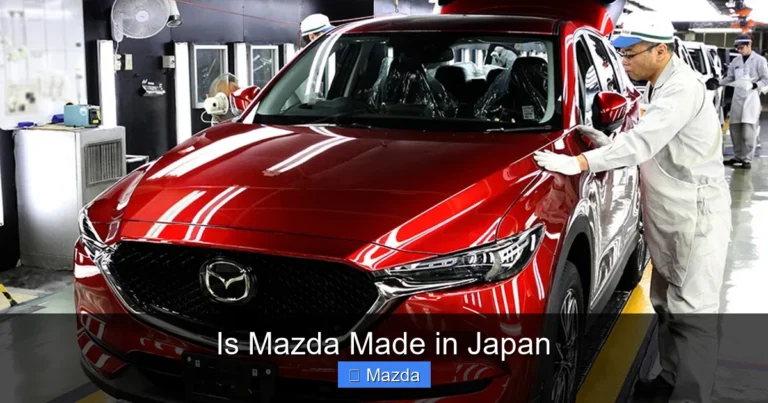
The Mazda 3’s manufacturing story begins, and fundamentally remains anchored, in Hiroshima, Japan. This isn’t just a corporate headquarters; it’s the spiritual and engineering home of Mazda. The Hiroshima Plant No. 1 (Ujina) and the more modern Hiroshima Plant No. 2 (Hofu) have been the epicenters of Mazda 3 production since its debut as the Familia/323 replacement. For decades, if you bought a Mazda 3 anywhere in the world, chances were extremely high it was built in Japan. This “Made in Japan” badge carried significant weight, synonymous with meticulous craftsmanship, tight tolerances, and a legendary attention to detail.
However, the automotive industry is a global game of chess, influenced by currency exchange rates, trade policies, and the imperative to be closer to key markets to reduce shipping costs and avoid tariffs. Mazda, while smaller than its Japanese rivals, is no exception to this rule. The pivotal shift began in the late 2010s. Mazda invested heavily in its Salamanca, Mexico, plant to transform it into a global production hub for North America. This strategic move allowed Mazda to serve the massive US and Canadian markets with locally built vehicles, insulating it from certain trade fluctuations and aligning with consumer preference for “locally assembled” vehicles in those regions. By the 2021 model year, the vast majority of Mazda 3s sold in the United States and Canada were coming from Mexico.
Simultaneously, Mazda deepened its commitment to Southeast Asia. Its plant in Rayong, Thailand, which had been producing vehicles for the regional market since the 1990s, was upgraded to handle global production of the Mazda 2 and Mazda 3 for specific export markets, including Australia and parts of Europe. This Thai facility became a key node in Mazda’s network, leveraging local supply chains and cost structures. Production in China, through its joint venture with Changan Mazda, primarily serves the enormous domestic Chinese market but also sees some exports to neighboring countries. This multi-polar production strategy means that a Mazda 3 buyer in 2026 could be driving a car assembled on any of three major continents.
The Heart of It All: Hiroshima, Japan
To ignore Hiroshima is to miss the soul of the Mazda 3. The Hiroshima plants are more than just assembly lines; they are centers of innovation and the final checkpoint for Mazda’s most advanced engineering. Vehicles built here often serve as the global benchmark. The plant workers, many with decades of experience, are steeped in the “Monozukuri” philosophy—the art of making things with pride and craftsmanship. While automation is high, there’s a human-centric quality control process that is legendary.
In 2026, Hiroshima continues to produce Mazda 3s for the Japanese domestic market (JDM), which often have unique specifications and trims not found elsewhere. It also supplies markets with stringent regulations or those where the “Japanese-built” premium is a significant selling point, such as parts of Europe and the Middle East. Furthermore, limited-edition models, special trims, and early production runs of new generations frequently originate here. If you own a Mazda 3 with a VIN starting with “JM1” (for most models) or “3MY” (for some later models), it was almost certainly built in Hiroshima. This is the origin point, the template against which all other plants are measured.
The North American Hub: Salamanca, Mexico
The story of the Salamanca plant is one of transformation and strategic brilliance. Mazda didn’t just set up a simple CKD (Completely Knocked Down) assembly operation; it built a world-class, fully integrated manufacturing facility. Opened in 2014, the plant was designed from the ground up to produce the then-new Mazda 3 and later the Mazda CX-30. Its location in Guanajuato provides excellent logistics for the North American market.
For the US and Canadian buyer, this is the most likely source of their vehicle. The Mexican-built Mazda 3s are identical in core engineering, safety structure, and powertrain to their Japanese-built counterparts. Mazda invested heavily in training its Mexican workforce in the “Mazda Way” of production, ensuring that the famed rotary-engine maker’s quality DNA was embedded from day one. The plant uses the same rigorous quality assurance systems and many of the same suppliers as the Japanese facilities. The primary driver for this location is economic: avoiding the 2.5% Chicken Tax on light trucks (which doesn’t apply to cars) and reducing ocean freight costs and times. In 2026, Salamanca remains the sole source for North American-market Mazda 3s, a status solidified over the past five years.
The Asian Strategist: Rayong, Thailand
Mazda’s Thai plant, operated by Mazda Manufacturing (Thailand) Co., Ltd., has a history dating back to 1991. It has evolved from assembling older models to becoming a critical export hub for right-hand drive markets and select left-hand drive regions. The Rayong facility produces the Mazda 3 for markets like Australia, New Zealand, the UK (for a period), and various Southeast Asian nations.
Its role is strategic. Thailand is a major automotive manufacturing hub with a robust local supplier base, allowing for cost-effective production. For markets like Australia, which have historically strong ties to Thai manufacturing (Toyota, Holden, Ford all had major plants there), a Thai-built Mazda 3 makes logistical and economic sense. The quality here is held to the same global Mazda standards. The VIN for Thai-built Mazda 3s typically starts with “MM1” or “4MZ”. A key differentiator for Thai-built models is their adaptation for tropical climates and specific regional preferences, which might include different interior material treatments or standard equipment lists compared to a North American or Japanese model.
The Joint Venture: Chongqing, China
Through Changan Mazda Automobile Co., Ltd., Mazda produces vehicles for the world’s largest auto market. The Chongqing plant is a state-of-the-art facility that builds the Mazda 3 (sold as the Axela in China) primarily for domestic consumption. Chinese-market Mazda 3s often feature unique styling cues, infotainment systems deeply integrated with local apps (like Baidu), and engines specifically tuned for locally available fuel grades.
While exports from China are currently limited, the plant’s capacity and technology are significant. For the global Mazda 3 story, China represents the massive, self-contained market that operates on its own set of rules and consumer preferences. A Chinese-built Mazda 3 is exceptionally rare outside of China, so for most international readers, this plant is more of a footnote in the global production narrative than a direct source. However, its existence highlights Mazda’s commitment to a truly global presence.
Primary Manufacturing Hubs: Where Your Mazda 3 Comes From
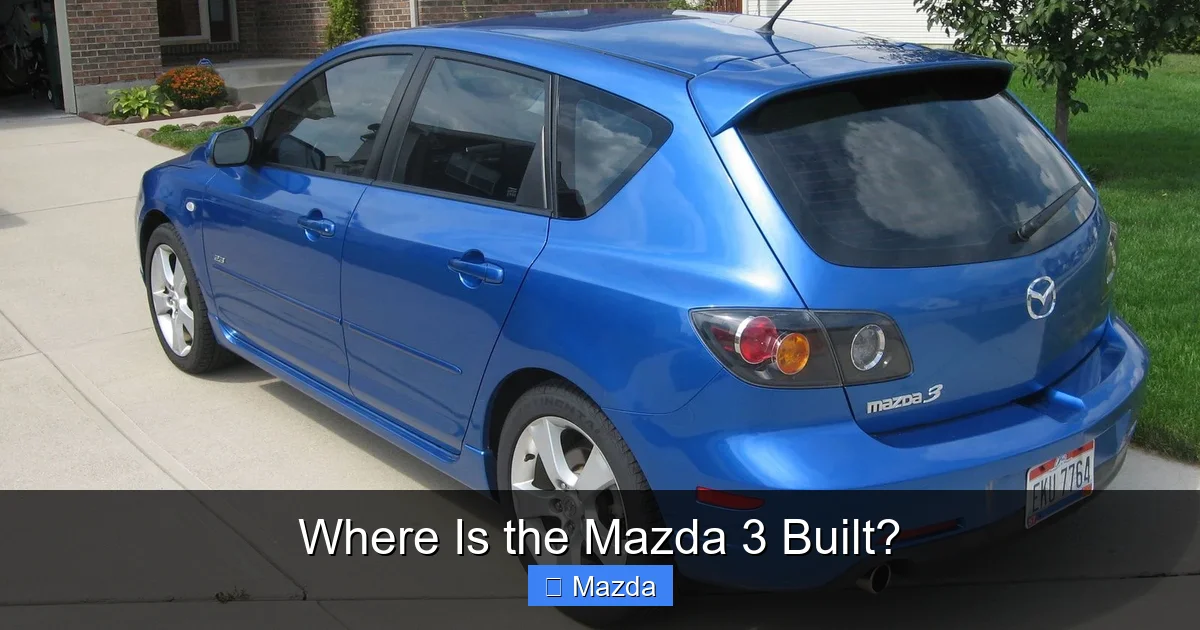
Now, let’s get specific. If you’re standing in a dealership or looking at a listing, how do you know where a particular Mazda 3 was built? The answer lies in its Vehicle Identification Number (VIN). The 10th digit indicates the model year, but the 11th digit is the plant code. This is your definitive source. Here’s a breakdown of the primary plants and their codes for the current and recent Mazda 3 generations (circa 2024-2026 model years).
Visual guide about Where Is the Mazda 3 Built?
Image source: i.pinimg.com
- Hiroshima Plant No. 1 & 2, Japan: Code is typically “1” or “M”. VIN starts with “JM1” (for most recent models) or “3MY”. These are the cars with the strongest connection to Mazda’s heritage.
- Salamanca Plant, Mexico: Code is “3”. VIN starts with “3M1” or “MMM”. These are the workhorses for North America.
- Rayong Plant, Thailand: Code is “4” or “M”. VIN starts with “MM1” or “4MZ”. These supply Asia-Pacific and some global RHD markets.
- Chongqing Plant, China (Changan Mazda): Code is “L”. VIN starts with “LVS”. These are for the Chinese domestic market.
When shopping for a used Mazda 3, this VIN decoding can be a useful tool. While a Japanese build might hold a slight premium in some buyers’ eyes due to the “origin” narrative, a Mexican or Thai build from the last decade is not an indicator of lower quality. Mazda’s global quality control system is designed to be seamless. The real differences you’ll encounter are not in build integrity but in the specific equipment packages and regulatory compliance items that vary by region.
How to Find Your Car’s Birthplace
Finding your car’s plant is straightforward. The VIN is located on the driver’s side dashboard near the windshield (visible from outside), on the driver’s side door jamb sticker, and on your title and registration documents. Once you have the 17-digit VIN, you can use any free online VIN decoder, or simply look at the first three characters (World Manufacturer Identifier) and the 11th character. For Mazda, the first three are almost always “JM1” (Japan), “3M1” (Mexico), “MM1” (Thailand), or “LVS” (China). The 11th character confirms the specific plant within that country. This is a foolproof method to satisfy your curiosity or verify a seller’s claim.
Regional Distribution: Which Plant Serves Which Market?
The global production network isn’t random; it’s a carefully mapped supply chain. Mazda allocates production to minimize logistics costs and navigate trade barriers. Here’s a simplified map of where Mazda 3s from each plant typically end up as of the 2026 model year.

Visual guide about Where Is the Mazda 3 Built?
Image source: thumbs.dreamstime.com
North America (USA, Canada): Almost exclusively the Salamanca, Mexico plant. This has been the case since mid-2020 for the 4th generation (2019+) Mazda 3. Prior to that, North America received a mix of Japanese and Mexican builds. This localization is a major trend in the industry, and Mazda is fully on board. If you’re buying new in the US or Canada, you are getting a Mexican-built Mazda 3. This is a fixed point.
Europe: A more complex picture. Historically supplied by Hiroshima, Japan. As Thai production ramped up and trade dynamics shifted, some European markets, particularly the UK and those with right-hand drive, began receiving Thai-built Mazda 3s. Other mainland European countries may still get a mix or primarily Japanese models, depending on the specific country’s import channels and Mazda’s regional allocation strategy for that model year. There’s no single “European plant”; it’s a blend of Japanese and Thai origins.
Japan (Domestic Market – JDM): Solely Hiroshima, Japan. The cars sold in Mazda’s home market are built at home. They often have unique trim levels (like the “Black Tone Edition”), different standard features, and sometimes even slightly different tuning to suit local tastes and the famously tight Japanese parking spaces.
Australia, New Zealand, Southeast Asia (Singapore, Malaysia, etc.): Primarily Rayong, Thailand. This makes perfect logistical sense. The Thai plant is optimized for these markets, with right-hand drive production capability and supply chains within the region. These cars are built specifically for these conditions.
China: Exclusively Chongqing, China, via Changan Mazda. The Chinese market has its own distinct model variants and feature sets, separate from the global model. These vehicles are not typically exported.
This regional distribution is fluid. Mazda constantly optimizes its production allocation based on sales forecasts, plant capacities, and global economic conditions. The best way to know for sure is to check the VIN of the specific vehicle you’re interested in.
A Note on “Global Cars” and Localization
The Mazda 3 is what the industry calls a “global car.” Its fundamental architecture—the Skyactiv chassis, the engine families (Skyactiv-G 2.0L, 2.5L), the transmission—are designed to be built anywhere. However, “global” doesn’t mean “identical.” Localization is the name of the game. A Mexican-built Mazda 3 for the US will have a different infotainment system (with Apple CarPlay/Android Auto standard, SiriusXM, etc.) and instrument cluster language than a Thai-built one for Australia or a Japanese-built one for Japan. It will have specific emissions hardware for US EPA and California Air Resources Board (CARB) standards. It might have different headlight assemblies to meet FMVSS vs. ECE regulations. The core is the same, but the wrapper is tailored. This is true for every global car model, from the Toyota Corolla to the Volkswagen Golf. It’s not about quality; it’s about compliance and market appeal.
Does Build Location Affect Quality or Features?
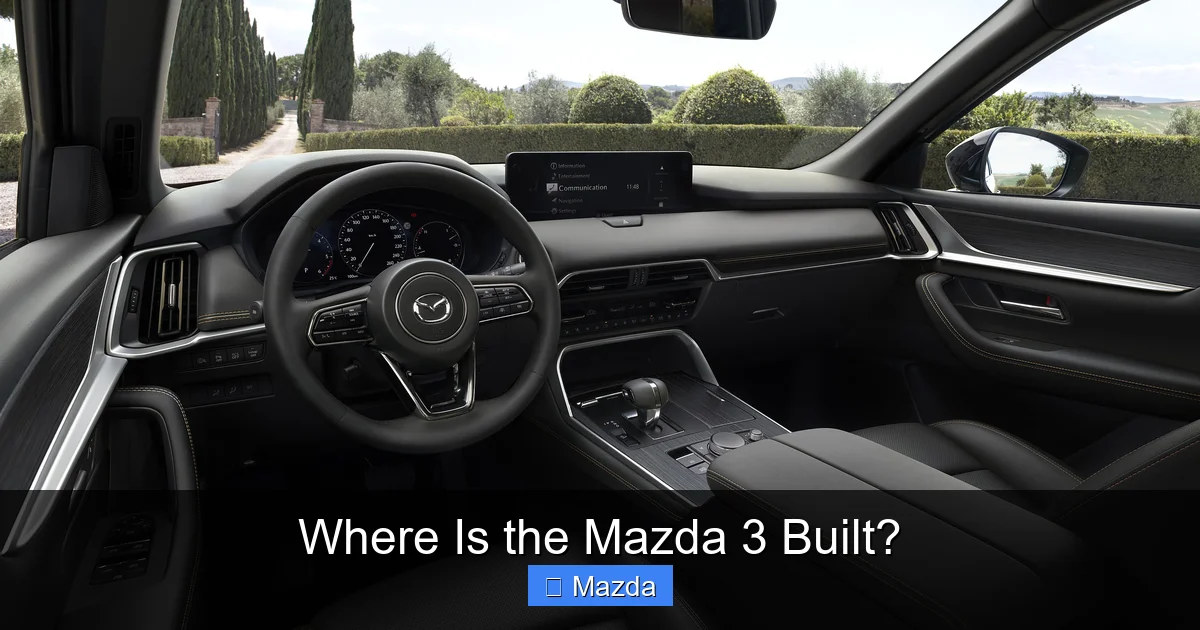
This is the million-dollar question for many car shoppers. The short, definitive answer is: No, not in terms of fundamental build quality, materials integrity, or engineering. Mazda does not have “tiered” quality based on geography. The company’s reputation hinges on its driving dynamics and premium feel, and it would be catastrophic for the brand if a Mexican or Thai-built Mazda 3 was perceived as inferior. Therefore, Mazda invests equally in training, tooling, and quality control systems at all its primary plants.
Visual guide about Where Is the Mazda 3 Built?
Image source: wallpaper.caricos.com
So, what *can* differ? It comes down to the three “F”s: Features, Fit-for-market, and Finishes.
Features: As mentioned, equipment packages vary by region. A base model in Mexico will have a different set of standard features (often more USB ports, different wheel designs) than a base model in Japan. This is purely a marketing and product planning decision, not a manufacturing capability issue. The materials used in the dashboard, seats, and door trims are from the same global supplier pool and meet the same Mazda specifications. The way they are stitched, the gap tolerances, the paint application process—these are uniform.
Fit-for-Market: This is the biggest differentiator. A Mazda 3 built for the US (Mexico) will have:
- Different headlights (for US DOT regulations).
- Different bumper and grille designs (often for crash standard compliance or aesthetic preference).
- Engine calibration for 87-octane regular unleaded fuel (in most trims).
- Specific emissions equipment for US standards.
- Odometer in miles, speedometer in mph.
A Mazda 3 built for Japan (Hiroshima) will have:
- Headlights meeting Japanese regulations (often similar to ECE).
- Different bumper designs, sometimes with smaller overhangs for narrow Japanese streets.
- Engine calibrated for premium, high-octane Japanese fuel (in most trims).
- Different lighting switch positions (Japan drives on the left).
- Odometer in kilometers.
A Thai-built car for Australia will have:
- Right-hand drive controls and pedal box.
- Headlights meeting Australian Design Rules (ADR), which are similar to European ECE.
- Calibration for local fuel (often 95-octane RON).
- Specific Australian-market safety compliance labels.
These are all planned, engineered differences. The assembly process for the core body-in-white, the welding robots, the paint shop—these are virtually identical processes run by the same standard operating procedures across all plants.
Finishes: There can be minor, imperceptible-to-most variations in paint match or plastic texture simply due to different batches of materials or environmental conditions in the paint booth. These are not quality defects; they are within the normal variance of any mass-produced good. One plant might have a slightly different shade of a specific gray or red due to paint supplier nuances, but it will be within spec.
In summary, don’t choose a Mazda 3 based on its assembly plant if you’re concerned about quality. Choose it based on the specific features, warranty, and price offered for that vehicle in your market. The plant is an origin story, not a quality grade.
The Used Car Market Perception
In the used car market, a persistent myth exists that “Japanese-built” cars are inherently more reliable and better made than those built elsewhere. For the Mazda 3, this myth has little factual basis post-2020. The Mexican and Thai plants are modern, integrated facilities producing brand-new models with the latest technology. The workforce is trained to Mazda’s exacting standards. A well-maintained 2022 Mexican-built Mazda 3 will be mechanically identical in reliability potential to a 2022 Japanese-built one. The key factors for used car reliability are always: maintenance history, mileage, and overall condition—not the country code in the VIN. However, for some enthusiasts and collectors, the “JM1” VIN prefix may hold a slight emotional premium simply due to the heritage association, much like a “Made in Germany” stamp on a luxury watch. It’s a perception, not a measurable performance difference.
The Future of Mazda 3 Production: 2026 and Beyond
Looking ahead to 2026 and the remainder of the decade, the Mazda 3’s production landscape is stable but poised for a monumental shift driven by electrification. The current 4th generation Mazda 3 (launched 2019) will be with us for a few more years. Its production will continue at the established hubs: Mexico for the Americas, Thailand for Asia-Pacific, and Japan for JDM and select other markets. There are no announced plans to open new plants specifically for the ICE (internal combustion engine) Mazda 3.
The wild card is Mazda’s dedicated electric vehicle (EV) platform, slated for launch in the mid-2020s. Mazda has announced it will build this new EV at its Hofu Plant No. 2 in Japan. This is a significant statement. It signals that Hiroshima will remain the flagship, highest-tech manufacturing site for Mazda’s most advanced future products. Will this EV be sold as a variant of the Mazda 3? Unlikely. Mazda has indicated it will be a separate model, possibly an SUV or crossover, riding on a bespoke EV architecture. Therefore, the traditional Mazda 3 (with gasoline or mild-hybrid powertrains) will likely continue its current global production split for the foreseeable future until a full generational change introduces an electrified powertrain as a core option.
Another trend to watch is the potential for battery-electric versions of existing models. If Mazda decides to offer an electric Mazda 3 in the next generation (perhaps around 2027-2028), the question of “where it’s built” will become even more interesting. Will it be built alongside its ICE siblings in Mexico or Thailand, or will it be centralized in Japan to protect the proprietary EV technology? The latter is more likely initially, mirroring how Toyota initially kept its EV production in Japan before scaling globally.
For the immediate 2026 model year, the answer to “where is it built?” remains the same as today: your location dictates your plant. North Americans get Mexican-built. Australians and New Zealanders get Thai-built. Japanese get Japanese-built. The world is your showroom, but your specific car comes from a specific factory. This model-year stability provides consistency for consumers and dealers alike.
Why This Matters for You in 2026
Understanding this global matrix empowers you as a buyer. If you’re a purist who values the original engineering heritage and doesn’t mind potentially longer delivery times, you might seek out a Japanese-built model (if available in your market, which for North America it is not). If you prioritize supporting local (regional) industry and want the shortest possible supply chain from factory to dealership, your Mexican- or Thai-built car achieves that. If you’re buying used, decoding the VIN tells you the car’s full story.
Moreover, it connects you to the vast, intricate network of modern manufacturing. That Mazda 3 in your driveway is the final product of a global symphony: steel from various countries, electronics from Asia, plastics from North America, assembled by a team of workers in one of these high-tech plants, all following the blueprint from Hiroshima. It’s a testament to Mazda’s ability to scale its “Zoom-Zoom” ethos across continents while maintaining a cohesive brand identity. The next time you see a Mazda 3, whether it has a US, Canadian, Mexican, Thai, or Japanese license plate, you’ll know its journey and the philosophy behind its creation.
Conclusion: The Global Journey of a Cohesive Car
So, where is the Mazda 3 built? The complete answer is a lesson in 21st-century automotive logistics. It is built in Hiroshima, Japan—the undisputed heart and soul. It is built in Salamanca, Mexico—the strategic hub for the Americas. It is built in Rayong, Thailand—the gateway to the Asia-Pacific. And it is built in Chongqing, China—for the world’s largest single market. Each of these plants operates under the same Mazda Quality umbrella, producing a vehicle that is fundamentally, undeniably a Mazda 3.
The differences you encounter are the fingerprints of your specific region: the type of fuel it prefers, the shape of its headlights, the language on its infotainment screen. These are not flaws but features, tailored to your home market. The core driving experience—the balanced chassis, the responsive steering, the efficient Skyactiv engine—is engineered in Hiroshima and faithfully reproduced around the globe. In 2026, this production matrix is mature and optimized. The Mazda 3 stands as a truly global product, born from Japanese passion and built with international efficiency, ready to deliver its celebrated driving pleasure to customers on every continent.
Frequently Asked Questions
Is the Mazda 3 still made in Japan?
Yes, absolutely. The Hiroshima plants in Japan remain the primary production source for the Japanese domestic market and are a key global manufacturing hub. While North American models now come from Mexico, Japanese-built Mazda 3s are still very much a reality for other markets.
What’s the difference between a Mexican-built and Japanese-built Mazda 3?
There is no difference in core build quality, materials, or engineering. The differences are purely regional: US-market Mexican builds have specific emissions hardware, headlights for US regulations, and infotainment systems with apps like Apple CarPlay. Japanese builds have features and calibrations for the domestic market, including different fuel tuning and metric displays. Both are built to Mazda’s identical global standards.
How can I tell exactly where my Mazda 3 was assembled?
You can find the exact assembly plant by decoding your Vehicle Identification Number (VIN). The 11th digit of the VIN is the plant code. For a Mazda 3, a VIN starting with “3M1” indicates Mexico, “JM1” indicates Japan, and “MM1” indicates Thailand. You can use any free online VIN decoder to confirm the specific plant.
Will Mazda ever build the Mazda 3 in the United States?
There are no announced plans for a Mazda 3 production plant in the United States. Mazda’s current North American strategy centers on its existing, modern facility in Salamanca, Mexico, which efficiently serves the US and Canadian markets. Building a new plant in the US for a single compact car model would be a massive capital investment unlikely in the current climate.
Are Thai-built Mazda 3s the same quality as Japanese or Mexican ones?
Yes. Mazda enforces a single, global “Mazda Quality” standard across all its production facilities. The Thai plant in Rayong uses the same manufacturing processes, supplier quality audits, and final inspection protocols as the plants in Hiroshima and Salamanca. A Thai-built Mazda 3 is not a lower-grade product; it is a globally certified Mazda.
Will future electric Mazda 3 models be built in the same places?
This is uncertain. Mazda has stated its dedicated EV platform will initially be built in Japan at the Hofu Plant. If a future battery-electric version of the Mazda 3 is developed, it could initially be produced in Japan to protect new technology. Long-term, if the EV Mazda 3 becomes a high-volume global model, production could eventually expand to other plants like Mexico or Thailand, following the same strategy as the current ICE model.