Where Is Mazda 3 Made?

Contents
- 1 Key Takeaways
- 2 📑 Table of Contents
- 3 The Global Chessboard: Understanding Mazda’s Manufacturing Strategy
- 4 The Flagship: Hiroshima (Hofu), Japan
- 5 The North American Hub: Salamanca, Mexico
- 6 The Asian Production Centers: Thailand, China, and Vietnam
- 7 The Evolution: A Historical Look at Mazda 3 Production
- 8 Does “Made In…” Matter? Quality, Pricing, and Resale Value
- 9 The Road Ahead: Mazda 3 Production in 2026 and Beyond
- 10 How to Find Your Mazda 3’s Birthplace
- 11 Frequently Asked Questions

Car GPS Navigator

Engine Oil Additive

Car Mud Flaps (Universal)

Steering Wheel Cover
The Mazda 3 is a globally manufactured vehicle, produced across five key plants in Japan, Mexico, Thailand, China, and Vietnam to serve regional markets. Its production location depends on the model year and your geographic region, with the Hiroshima, Japan plant serving as the historic and engineering flagship. This global strategy impacts pricing, available features, and long-term resale value, making it a key factor for potential buyers.
So, you’re eyeing a Mazda 3. That’s a fantastic choice. It’s consistently praised for its sharp handling, upscale interior, and overall driver engagement. But have you ever wondered, as you sit in the driver’s seat, exactly where that car in front of you was built? The question “Where Is Mazda 3 Made?” isn’t just trivia—it’s a window into the global automotive industry, brand strategy, and even the subtle factors that affect your ownership experience. In 2026, the answer is more complex and fascinating than a simple “Japan.” Let’s pull back the curtain and explore the worldwide journey of this beloved compact car.
Key Takeaways
- Understanding Where Is Mazda 3 Made?: Provides essential knowledge
📑 Table of Contents
- The Global Chessboard: Understanding Mazda’s Manufacturing Strategy
- The Flagship: Hiroshima (Hofu), Japan
- The North American Hub: Salamanca, Mexico
- The Asian Production Centers: Thailand, China, and Vietnam
- The Evolution: A Historical Look at Mazda 3 Production
- Does “Made In…” Matter? Quality, Pricing, and Resale Value
- The Road Ahead: Mazda 3 Production in 2026 and Beyond
- How to Find Your Mazda 3’s Birthplace
The Global Chessboard: Understanding Mazda’s Manufacturing Strategy
Gone are the days when a car’s nationality was defined by a single factory. For Mazda, a relatively small but ambitious Japanese automaker, a global production footprint isn’t just an option—it’s a necessity for survival and growth. Building cars closer to their intended markets helps avoid steep import tariffs, reduces shipping times and costs, and allows for better responsiveness to local tastes and regulations. This strategy, often called “regional production,” is why your Mazda 3’s birthplace tells a story about economics and logistics as much as it does about engineering.
For the 2026 model year, Mazda relies on a core group of five primary facilities to produce the Mazda 3. Each plant has specific roles, capabilities, and markets it serves. Think of it as a highly coordinated network where the “brain” (engineering and flagship production) is in Japan, and the “limbs” (regional assembly) are spread across the globe, all following the same neural instructions for quality. This network has evolved significantly over the past two decades, shifting from a Japan-centric model to a truly global one.
The “Why” Behind Global Production
The primary driver is economics. Tariffs on imported vehicles can add thousands to a car’s sticker price. By assembling vehicles in North America (Mexico), Southeast Asia (Thailand, Vietnam), and China, Mazda makes its cars more price-competitive in those crucial markets. Secondly, it’s about currency and risk. Production in multiple regions hedges against currency fluctuations and geopolitical disruptions in any single country. Finally, it’s about meeting local content rules. Many countries, especially China, have regulations requiring a certain percentage of a vehicle’s parts and labor to be sourced locally. Having a plant inside that country is the simplest way to comply.
The Flagship: Hiroshima (Hofu), Japan
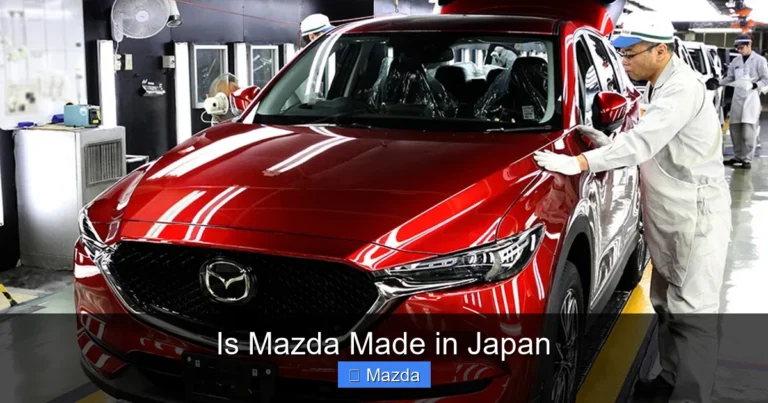
When you think of Mazda, you think of Hiroshima. This is hallowed ground. The Hofu plant, located in Yamaguchi Prefecture near Mazda’s global headquarters, is the spiritual and technical home of the Mazda 3. It was here that the very first generation (the BK series, launched as the Axela in Japan) was born in 2003. For the 2026 model year, the Hofu plant continues to play a vital, though sometimes less publicly visible, role.
Typically, the Hofu plant is tasked with producing the first examples of an all-new generation of the Mazda 3. This allows Mazda’s most experienced engineers and quality control teams to oversee the initial production run, work out any teething problems, and establish the gold standard for build quality. These early Japanese-built models are often reserved for the Japanese domestic market and for export to other regions with stringent quality perceptions, like Europe and parts of Australasia. It also produces certain high-specification models, such as the Mazda 3 with the turbocharged 2.5L engine, which may be prioritized for this facility due to its complex assembly requirements. If you’re a purist seeking the “original” engineering pedigree, a Japanese-assembled VIN (Vehicle Identification Number) starting with “JM” is the one to look for.
The North American Hub: Salamanca, Mexico
For customers in the United States and Canada, the answer to “Where is my Mazda 3 made?” is almost always: Salamanca, Mexico. This plant, which began Mazda 3 production for North America with the 2014 model year (third generation), has become absolutely critical to Mazda’s success in the region. The decision to build here was a masterstroke, allowing Mazda to price the 3 competitively against rivals like the Honda Civic and Toyota Corolla while maintaining healthy margins.
The Salamanca plant is a state-of-the-art facility that embodies Mazda’s “Monotsukuri” (art of making things) philosophy. It features extensive robotic welding and painting systems, but also relies heavily on skilled human technicians for final assembly and quality inspection. Every Mexican-built Mazda 3 for North America comes from here. The VIN for these vehicles will start with “3M” (for Mexico). This plant also produces the Mazda CX-30 and, historically, the Mazda CX-5 for the region. The consistency and quality from Salamanca have been so high that most North American buyers cannot tell the difference from a Japanese-built car, a testament to Mazda’s successful global quality transfer. When you’re shopping for a used 2008 Mazda 3, understanding its origin is key, as models before the Mexico plant opened were all from Japan—this historical context influences how much is a 2008 Mazda 3 worth today, with Japanese-built examples often commanding a small premium.
The Asian Production Centers: Thailand, China, and Vietnam
To serve the massive and diverse Asian markets, Mazda operates three major production centers. Each serves a distinct regional cluster.
Rayong, Thailand – The ASEAN Powerhouse
The Mazda plant in Rayong, Thailand, is the primary source for Mazda 3 models sold throughout the Association of Southeast Asian Nations (ASEAN) and Oceania (Australia, New Zealand). It began operations in 2014. Thailand was a logical choice: it’s a major automotive hub with a strong supplier base and favorable trade agreements within ASEAN. Vehicles from Thailand carry a VIN starting with “MM.” For Australian buyers, a Thai-built Mazda 3 is the standard. This plant is also a key export hub for right-hand-drive markets. Its production is finely tuned to regional preferences, which can include different standard equipment packages or engine calibrations compared to North American or European models.
Nanjing, China – A Joint Venture Venture
China is the world’s largest auto market, and Mazda cannot ignore it. However, foreign automakers cannot wholly own a manufacturing plant in China; they must operate through a joint venture with a local partner. Mazda’s partner is Changan Mazda. Their major production base is in Nanjing. Mazda 3 models sold within China are built here (VINs start with “LVS” or similar JV codes). This plant is fascinating because it produces vehicles specifically for the Chinese market, which often have unique features, longer wheelbases, and different infotainment systems to cater to local consumer tastes. It’s a clear example of “glocalization”—global platform with local customization. These China-built Mazda 3s are not typically exported to other major markets like the US or Europe.
Truong Son, Vietnam – The Emerging Player
Mazda’s newest major production site is the Truong Son plant in Vietnam, which started Mazda 3 production in 2018. This facility serves the fast-growing Vietnamese domestic market and also exports to other Southeast Asian countries. It represents Mazda’s long-term bet on Vietnam as an emerging manufacturing and consumer hub. For buyers in Vietnam, their Mazda 3 is proudly local, with VINs starting with “XUG.” This plant is smaller and more flexible than its Thai or Mexican counterparts, allowing it to adapt quickly to regional demand.
The Evolution: A Historical Look at Mazda 3 Production
The global spread wasn’t always the case. Understanding the history helps decode older VINs and explains why production location matters for used cars. The first two generations of the Mazda 3 (2003-2013) were produced exclusively in Japan at the Hofu plant. If you own or are looking at a first or second-gen Mazda 3 from any market, it is Japanese-made. This exclusivity contributes to their perceived durability and sometimes higher value in enthusiast circles.
The third generation (2013-2018) marked the turning point. Production began in Mexico for North America and in Thailand for ASEAN/Australasia. Japan continued to produce for other global markets. The current fourth generation (2019-present) solidified this network: Mexico for the Americas, Thailand for Asia-Pacific, Japan for select markets and initial production, and Vietnam joining later for Southeast Asia. China’s production has always been for its domestic market via the joint venture. This history means that for a 2008 Mazda 3, you are guaranteed a Japanese VIN, a fact that is a key data point in any valuation.
Does “Made In…” Matter? Quality, Pricing, and Resale Value
This is the million-dollar question. Does the country of origin affect the car you drive every day? Mazda’s official stance is a resounding “no.” They invest billions in training and technology to ensure a Mazda 3 from Mexico is indistinguishable in fit, finish, and reliability from one from Hiroshima. And for the vast majority of owners, this is true. The driving experience is engineered in Japan, and that core DNA is replicated globally.
However, on a deeper level, the production location can have subtle impacts:
- Initial Pricing: Cars built in Mexico for the US market benefit from lower production costs and no import tariff, contributing to Mazda’s ability to offer a relatively affordable base price with premium features. A hypothetical Mazda 3 built entirely in Japan for the US market would likely cost significantly more.
- Parts Supply & Service: For common wear-and-tear items, parts are globally distributed. But for unique, early-production, or region-specific components (like certain trim pieces or engine calibrations), knowing the plant of origin can help a mechanic or parts specialist pinpoint the exact part needed. This is rarely an issue but can be for specific repairs.
- Resale Value Narrative: In the used car market, perception matters. Some buyers, particularly enthusiasts, still hold a slight preference for “JDM” (Japanese Domestic Market) or Japanese-assembled vehicles, believing them to be more authentic or meticulously built. This can translate to a 1-3% premium in private-party sales for a Japanese-built Mazda 3 versus a Mexican-built one of the same year and mileage. It’s not a huge difference, but it exists. Tools that estimate how much is a 2006 Mazda 6 worth will factor in its Japanese origin as a positive.
- Feature & Option Availability: Sometimes, the plant dictates what’s available. For example, the turbocharged engine might only be built in Japan or Mexico, limiting its availability in certain markets. Your local dealer’s inventory reflects what that specific regional plant produces.
The Road Ahead: Mazda 3 Production in 2026 and Beyond
Looking toward the 2026 model year and beyond, Mazda’s manufacturing strategy is not static. The global push toward electrification is the biggest disruptor. Mazda has announced plans for battery-electric vehicles (BEVs) and has already introduced the MX-30 EV. It is highly likely that future generations of the Mazda 3 will have hybrid or fully electric variants. This will force a re-evaluation of plant capabilities.
Plants like Salamanca and Rayong are being prepared for EV production, with Mazda investing in new battery assembly lines and training. It’s possible that by the late 2020s, we could see different powertrains (gas vs. EV) being produced at different plants based on regional EV adoption rates and local government incentives. Furthermore, trade tensions and supply chain reshoring could prompt Mazda to adjust volumes. For instance, if North American demand for EVs surges, we might see more EV-focused production shift to Mexico to avoid tariffs on Asian-made EVs. The core principle—build where you sell—will remain, but the “how” will evolve with technology and politics. For now, in 2026, the five-plant system is stable and efficient, but the blueprint for the 2030s is already being drawn.
How to Find Your Mazda 3’s Birthplace
So, you have a Mazda 3 or are about to buy one. How do you definitively know where it was made? The answer is in the Vehicle Identification Number (VIN). This 17-character code is the car’s fingerprint. The first three characters are the World Manufacturer Identifier (WMI).
- JM1: Japan (Hiroshima/Hofu)
- 3M1: Mexico (Salamanca)
- MM1: Thailand (Rayong)
- LVS: China (Nanjing – Changan Mazda JV)
- XUG: Vietnam (Truong Son)
You can find the VIN on the dashboard near the windshield, on the driver’s side door jamb, or on your registration and insurance documents. Simply look up the first three characters online or use a VIN decoder service to confirm the assembly plant. This is the only foolproof method. Dealers and Mazda themselves can also look this up in their systems. When buying used, asking for the VIN and checking it is a smart move that tells you more than just the car’s origin—it reveals its exact model year, engine type, and production sequence.
Conclusion: The question “Where Is Mazda 3 Made?” reveals a sophisticated, globally-integrated manufacturing story. In 2026, your Mazda 3 likely comes from Mexico if you’re in the Americas, Thailand if you’re in Australia or Southeast Asia, Japan if you’re in Europe or Japan itself, or Vietnam for the local market. China produces its own unique version. While the pride of Japanese engineering is universal, the practical realities of global trade mean your specific car’s origin is a direct result of where you live. This global network allows Mazda to deliver a consistently excellent driving experience at a competitive price, which is ultimately what matters most to the driver. The next time you see a Mazda 3, you’ll know it’s not just a car—it’s a well-traveled citizen of the world, built with “Mazda Quality” on multiple continents.
Frequently Asked Questions
Does the manufacturing location affect the Mazda 3’s reliability?
No. Mazda enforces identical rigorous quality control and manufacturing standards at all its global plants. Long-term reliability studies show no significant difference between Mazda 3s from different assembly plants when maintenance histories are similar.
Can I choose which plant my new Mazda 3 comes from?
>No. For new cars, the manufacturing plant is determined solely by your geographic region and the dealer’s allocation from Mazda’s regional distribution centers. A US buyer will receive a Mexico-built vehicle; there is no option to request a Japanese-built one.
Are Japanese-built Mazda 3s better than others?
“Better” is subjective. They are not inherently more reliable or better built. However, some enthusiasts perceive them as having a slight edge in initial fit-and-finish or as more “pure” examples of the design. This perception can create a small resale value premium in some used markets.
What does the VIN tell me about my Mazda 3?
The VIN is a comprehensive code. The first three characters (WMI) tell you the country and specific plant of assembly. Characters 4-8 describe the vehicle’s model, body style, engine, and restraint system. The 10th character is the model year, and the 11th indicates the assembly plant’s specific sequence. You can decode it using free online tools.
Will future electric Mazda 3s be made in the same plants?
Likely, but with adaptations. Mazda is upgrading its existing global plants, including Salamanca (Mexico) and Rayong (Thailand), to produce battery-electric vehicles. The same core plants will probably build future EV versions of the Mazda 3, but dedicated production lines and battery assembly areas will be added.
Is a used Mazda 3 from Mexico a good buy?
Absolutely. The vast majority of used Mazda 3s in the US and Canada are from the Salamanca plant and are known for excellent build quality and reliability. Focus on the vehicle’s maintenance history, condition, and mileage rather than its plant of origin when evaluating a used purchase. The differences are minimal in real-world ownership.