What Year Does the Toyota Camry Have Oil Burning Problems

Contents
- 1 Key Takeaways
- 2 📑 Table of Contents
- 3 The Problem Years: A Timeline of the Oil Burning Issue
- 4 Why Does It Happen? The Technical Deep Dive
- 5 Symptoms: How to Know If Your Camry Is Burning Oil
- 6 Fixes and Solutions: From Temporary to Permanent
- 7 Prevention and Smart Ownership for At-Risk Models
- 8 Conclusion: Knowledge is Power
- 9 Frequently Asked Questions



Oil burning problems are most prevalent in Toyota Camry models from the 2007 to 2011 model years, primarily affecting those equipped with the 2.4L 2AZ-FE engine. Some 2012-2017 models with the 2.5L 2AR-FE engine also report issues, though less frequently. The root cause is typically faulty piston rings that allow oil to enter the combustion chamber. Symptoms include blue exhaust smoke and frequent low oil warnings. While costly repairs like piston ring replacement are often necessary, using the correct oil and vigilant maintenance can help manage the issue in affected vehicles.
Let’s talk about a topic that causes a lot of worry for Toyota Camry owners: oil burning. The Toyota Camry has an almost legendary reputation for reliability and longevity. For decades, it’s been the sensible, go-to sedan that you can count on to start every morning and get you where you need to go. So when people start talking about a Camry “burning oil,” it sounds like a contradiction. How can a car known for being so bulletproof have such a significant problem?
The truth is a little more nuanced. Yes, the Camry is one of the most reliable cars ever made. But like any complex machine with millions of parts produced over many years, certain batches of specific engines developed a well-documented weakness. This weakness manifests as excessive oil consumption—what we commonly call “oil burning.” It doesn’t mean every single Camry from a certain year is a lemon. It means there’s a higher probability for this issue in specific model years and engine types. Knowing exactly which years and engines are involved is the first and most critical step for any current or prospective owner. It separates the worry from the reality and helps you make an informed decision about maintenance, repair, or purchase. This guide will dive deep into the exact years, the “why” behind the problem, how to spot it, and what you can do about it.
Key Takeaways
- Affected Years & Engines: The primary issue targets 2007-2011 Camrys with the 2.4L 2AZ-FE engine. A smaller number of 2012-2017 models with the 2.5L 2AR-FE engine are also known to consume excess oil.
- Root Cause: The problem is almost always caused by defective or poorly seating piston rings, which allow engine oil to leak past into the combustion chamber where it burns.
- Key Symptoms: Look for blueish-gray smoke from the exhaust, a consistent drop in oil level between services (more than 1 quart per 1,000 miles), and illuminated oil pressure or level warnings.
- Repair Complexity: Fixing it correctly requires a major engine repair, often a piston ring replacement or even an engine rebuild, which is expensive. Less effective “fixes” like using thicker oil are only temporary bandaids.
- Prevention is Key: For at-risk models, using the exact manufacturer-recommended oil viscosity, adhering to strict service intervals, and regularly checking oil levels are the best defenses against catastrophic failure.
- Not All Camrys Are Affected: This is a specific design flaw in certain engine families. Many Camrys from the same years with different engines (like the 3.5L V6) are completely reliable and not prone to this issue.
- Check Your Specific Vehicle: Always verify your engine code (found on a sticker under the hood) and consult with a trusted mechanic for a diagnosis, as other issues like leaky valve seals can mimic similar symptoms.
📑 Table of Contents
The Problem Years: A Timeline of the Oil Burning Issue
When pinpointing the oil burning problem in Camrys, we have to talk in terms of engine codes, not just model years. Toyota uses different engines throughout a generation. The infamous oil consumption issue is tied directly to two specific four-cylinder engine families. Understanding this distinction is crucial because you could have a 2010 Camry that will never burn a drop of oil, and a 2009 Camry that eats a quart every 800 miles. The difference is likely under the hood.
The 2AZ-FE Engine (2002-2014): The Primary Culprit
The epicenter of the Toyota Camry oil burning controversy is the 2.4-liter 2AZ-FE engine. This engine powered hundreds of thousands of Camrys, Corollas, RAV4s, and other vehicles. While generally robust, a significant design flaw in the piston rings for certain production periods led to them not seating properly against the cylinder walls. This allowed oil to seep from the crankcase into the combustion chamber, where it was burned along with the fuel.
The highest concentration of problematic 2AZ-FE engines in Camrys falls within the 2007 through 2011 model years. These were the fifth-generation (XV40) Camrys. If you own or are looking at a Camry from this period with a 2.4L four-cylinder engine, you must be acutely aware of this issue. The problem was so widespread that Toyota issued a extended warranty program (often called a “goodwill” or “customer support” program) for certain VINs to cover piston ring replacement. However, that warranty has long since expired for these models. Engines from the 2002-2006 Camry (fourth generation) also use the 2AZ-FE and can be affected, but the failure rate is generally considered lower than in the 2007-2011 batch. It’s still a known risk factor for any vehicle with this engine code.
The 2AR-FE Engine (2013-Present): A Lesser, But Present, Concern
For the 2012 model year, Toyota introduced the sixth-generation Camry (XV70) with a new engine family: the 2.5-liter 2AR-FE. This engine was supposed to be an improvement, and for the most part, it is. However, a smaller but still notable number of early 2AR-FE engines, particularly from the 2013 through 2015 model years, have been reported to consume excessive oil. The suspected cause is similar—piston ring design and material issues—but the prevalence is much lower than with the 2AZ-FE.
Later model 2AR-FE engines (from approximately 2016 onward) appear to have resolved the vast majority of these issues through engineering updates. So, while you shouldn’t panic about a 2020 Camry 2.5L, a 2014 model with the same engine code warrants a bit more caution and a diligent pre-purchase inspection that includes a check of the oil consumption history.
What about the V6? It’s worth noting that the 3.5L 2GR-FE V6 engine available in these same Camry years has an excellent reputation and is not associated with widespread oil burning problems. The issue is almost exclusively a four-cylinder engine concern.
Why Does It Happen? The Technical Deep Dive
To understand the fix, you need to understand the failure. An internal combustion engine is a closed system of moving parts that requires a fine balance. Oil lubricates everything, but it must stay where it’s needed. The piston rings are the critical component here. They are metal rings that sit in grooves on the piston and serve two main jobs: they seal the combustion chamber to keep compression in and power high, and they regulate the thin film of oil that lubricates the cylinder walls.
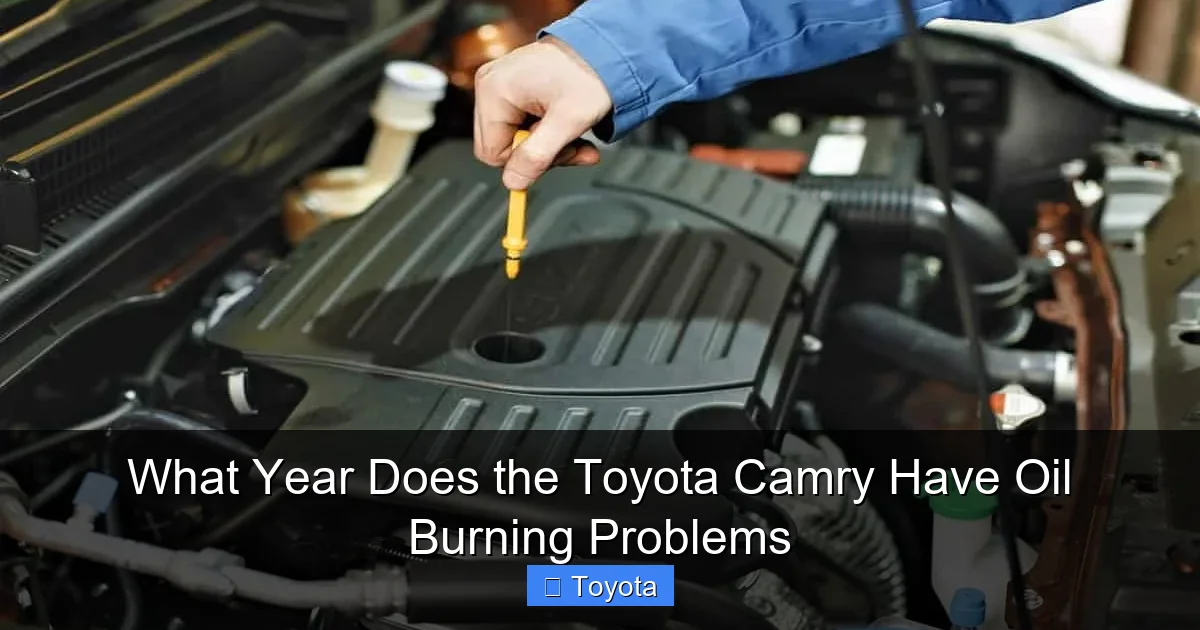
Visual guide about What Year Does the Toyota Camry Have Oil Burning Problems
Image source: blog.toyotaofmorristown.com
The Piston Ring Failure Mode
In the affected 2AZ-FE and early 2AR-FE engines, the piston rings—specifically the oil control rings—were not rigid enough or did not have the proper tension. During normal operation, as the piston moves up and down at high speed, these rings are supposed to flex slightly to maintain contact with the cylinder wall while scraping excess oil back down into the crankcase. In the faulty engines, the rings would “stick” or not spring back effectively, allowing a film of oil to remain on the cylinder wall. On the intake stroke, some of this oil is drawn past the rings into the combustion chamber. It’s then vaporized and burned during the power stroke.
This is a mechanical wear problem, not a “just add a quart” problem. It gets worse over time as the cylinder walls and rings themselves wear, increasing the gap. This is why a car with 60,000 miles might use a quart every 3,000 miles, and the same engine at 120,000 miles might use a quart every 500 miles. It’s a progressive failure.
Contributing Factors: PCV Valve and Driving Style
While the piston rings are the primary villain, other systems can accelerate oil consumption if they’re not functioning correctly. The Positive Crankcase Ventilation (PCV) valve is a key one. This valve manages pressure in the crankcase. If it gets clogged or stuck, it can create positive pressure that forces oil vapor past the seals and rings. A failing PCV valve can make an already bad ring problem much worse.
Driving style also plays a role. Frequent short trips where the engine doesn’t fully warm up can allow fuel and moisture to dilute the oil, reducing its viscosity and making it easier to slip past rings. Consistently high-RPM driving, especially when the engine is cold, can also exacerbate ring wear. However, these are secondary factors; the core design flaw in the rings is the main event.
Symptoms: How to Know If Your Camry Is Burning Oil
How do you move from suspicion to confirmation? The symptoms of excessive oil consumption are often subtle at first and can be mistaken for other issues. Here’s what you need to look and listen for.
Visual guide about What Year Does the Toyota Camry Have Oil Burning Problems
Image source: i.ebayimg.com
The Classic Sign: Blue Exhaust Smoke
The most obvious symptom is smoke from the tailpipe. But we need to be precise here. Blue or blue-gray smoke, especially during acceleration after the engine has been running for a while, is a classic sign of oil burning. White smoke is usually coolant (a head gasket issue), and black smoke is a rich fuel mixture. A thin, intermittent blue haze at startup that clears after a minute or two can sometimes be worn valve seals, which is a different, less severe issue. The tell-tale sign for piston ring failure is persistent blue smoke that appears under load—when you accelerate or go uphill—and may continue as long as the engine is running under demand. You might also see it at idle if the problem is severe.
The Silent Symptom: Dropping Oil Level
This is the most important and earliest diagnostic tool. You must check your oil level regularly—at least once a month or every 1,000 miles. The dipstick has marks for “Low” and “Full.” The rule of thumb is that if your engine is using more than one quart of oil per 1,000 miles, it is considered excessive consumption by most manufacturers’ standards. Many affected Camrys will use a quart every 500-800 miles. If you find yourself adding oil between scheduled changes (which are typically every 5,000-7,500 miles), you have a problem. Keep a log of oil additions and mileage. This data is invaluable for a mechanic.
Other Clues: Spark Plugs and Performance
Burning oil fouls spark plugs. If a mechanic pulls your plugs and finds them coated in a dry, black, sooty or oily residue (instead of a light tan or gray), it’s a strong indicator of oil entering the combustion chamber. You might also notice a slight loss of power or a rougher idle as the engine’s compression decreases due to the worn rings not sealing properly. The check engine light may eventually come on with codes related to misfires (P0300-P0304) because the oil-fouled plugs aren’t sparking efficiently.
Fixes and Solutions: From Temporary to Permanent
So you’ve confirmed your Camry is burning oil. What now? The path forward depends on your budget, the car’s value, and the severity of the consumption. There are no cheap, magical fixes for the core piston ring problem.
Visual guide about What Year Does the Toyota Camry Have Oil Burning Problems
Image source: d1l9oib0dboqqi.cloudfront.net
The “Temporary” Band-Aids (Use with Extreme Caution)
You’ll hear suggestions online: “Switch to a thicker oil!” or “Use this oil additive!” These are, at best, temporary measures to buy time and, at worst, they can cause more damage. Using a 10W-40 instead of the recommended 0W-20 or 5W-20 can sometimes reduce consumption because the thicker oil is harder to slip past the rings. However, it also increases drag on the engine, reduces fuel efficiency, and can cause faster wear on components like the variable valve timing (VVT) system that are designed for a specific oil viscosity. Oil additives that claim to “recondition seals” are generally ineffective for this mechanical ring gap issue and can clog oil passages. These are not solutions; they are very short-term mitigation strategies for a car you plan to sell or junk soon.
The Correct Mechanical Fixes
The only permanent fix is to address the piston rings and cylinder walls. There are two main levels of repair:
- Piston Ring Replacement (Engine “Overhaul” or “Refresh”): This is the standard repair. The engine is removed from the car or the cylinder head is removed, the pistons are pulled, the cylinder walls are inspected (and often lightly honed), and new piston rings are installed. This is a major labor-intensive job. A quality shop will also replace related seals, gaskets, and the PCV valve. Cost typically ranges from $2,500 to $4,000 or more.
- Used or Remanufactured Engine Replacement: If the cylinder walls are scored beyond a simple honing, or if the cost of a ring job approaches the value of the car, swapping the entire engine might be more economical. A used engine from a donor car carries risk (what’s its history?). A remanufactured engine from a reputable rebuilder is the most reliable but also the most expensive option, often $4,000-$6,000+ installed.
For the early 2AR-FE engines, Toyota did issue a Technical Service Bulletin (TSB) that sometimes led to warranty extensions for specific VINs, but those are long expired. Any repair today is an owner expense.
Prevention and Smart Ownership for At-Risk Models
If you own a Camry from the risk years (2007-2011 2AZ-FE, early 2013-2015 2AR-FE), your goal is to prolong the engine’s healthy life and catch any developing issue before it destroys the engine. Proactive maintenance is your greatest weapon.
Strict Adherence to Oil and Filter Service
Do not extend your oil change intervals. The recommended 5,000-7,500 miles is a maximum. For an at-risk engine, changing the oil every 3,000-4,000 miles with high-quality oil is a wise policy. Fresh, clean oil maintains its viscosity and detergency longer, helping to manage minor sludge and keep the rings as clean as possible. Always use an oil filter from a reputable brand. A cheap filter can allow contaminants to circulate and accelerate wear. Speaking of oil, using the exact viscosity specified by Toyota is non-negotiable. For most of these engines, that’s 0W-20. Using a different weight can affect hydraulic systems and oil flow. You can find the precise specification for your model year and engine in the owner’s manual or on the oil cap. For specific guidance on older models, a resource like our article on what kind of oil a 2008 Toyota Camry takes can be a helpful reference point for that engine family’s requirements.
Become One with Your Dipstick
Check the oil level every two weeks, without fail. Do it when the engine is cold, on level ground, after waiting a few minutes after shutting off. Get to know what “full” looks like on your specific dipstick. The moment you notice a trend of the level dropping, start logging it. One quart low between changes is a red flag. Two quarts is a major problem. Catching a rising consumption rate early, while the engine still has good compression, can sometimes mean a simpler ring job is possible before cylinder wall damage occurs.
Address Ancillary Systems
Have the PCV valve inspected and replaced according to the maintenance schedule (or sooner if you suspect a problem). A clogged PCV valve pressurizes the crankcase and forces oil past the seals and rings. Ensure no other vacuum leaks exist in the intake system, as unmetered air can also affect crankcase pressure. A healthy PCV system is a crucial support system for your piston rings.
Conclusion: Knowledge is Power
The Toyota Camry’s reputation for reliability is well-earned. For the vast majority of owners, their Camry will provide years of trouble-free service. However, for a specific subset of models—namely the 2007-2011 2.4L and some early 2012-2017 2.5L models—the specter of oil burning is a real financial and mechanical concern. It stems from a known engineering issue with piston rings. The key takeaway is not to live in fear, but to live in awareness. If you own one of these cars, become meticulous about oil checks and changes. Know the symptoms. If you’re considering buying a used Camry from this era, a pre-purchase inspection by a mechanic that specifically checks for oil consumption history is absolutely essential. Ask for records of oil additions. A seller who says “it uses a little oil” is often downplaying a significant problem. Arm yourself with this knowledge. It will help you protect your investment, make a smart buying decision, and navigate any potential repairs with your eyes wide open.
Frequently Asked Questions
What Toyota Camry years have the worst oil burning problems?
The most severe and widespread oil burning issues are found in the 2007 through 2011 Toyota Camry models equipped with the 2.4-liter 2AZ-FE four-cylinder engine. A smaller but still notable number of 2012 through 2015 Camrys with the 2.5-liter 2AR-FE engine also exhibit this problem.
Is burning oil a sign my Camry’s engine is completely shot?
Not necessarily. While it indicates a serious internal problem (usually piston rings), the engine may still have good compression and run well for thousands of miles if you stay on top of oil additions. However, if left unchecked, it will eventually lead to catastrophic failure due to low oil or severe cylinder wear. The cost to fix it properly is often high.
Can I fix my Camry’s oil burning problem myself?
No. The root cause requires a major mechanical repair: removing the pistons to replace the rings or rebuilding the engine. This is not a DIY job for 99% of people. It requires specialized tools, engine knowledge, and machining capabilities. Attempting temporary fixes like thick oil or additives will not solve the problem long-term.
How much oil consumption is considered “normal” vs. a problem?
Modern engines are designed to use very little oil. As a general rule, using more than one quart of oil per 1,000 miles is considered excessive and indicates a problem. Many well-maintained engines go 5,000-10,000 miles without needing a top-off. If you’re adding oil between scheduled changes, have it diagnosed.
Will using a different oil viscosity stop my Camry from burning oil?
It might reduce the rate of consumption slightly, but it is not a fix. Using the manufacturer-recommended oil (typically 0W-20 for these engines) is critical for proper lubrication of all components, including variable valve timing systems. Switching to a thicker oil can cause other damage and poor performance. The rings need to be replaced to stop the leak.
Should I buy a used Camry from the problematic years?
You can, but only with extreme caution and a pre-purchase inspection by a trusted mechanic. The inspection must include a compression test, a check for oil on spark plugs, and a review of the vehicle’s oil change and oil addition history. A well-documented history of frequent oil changes and no major consumption is a good sign. A vague history or evidence of heavy consumption should be a deal-breaker unless the price is extremely low to account for the inevitable $3,000+ repair.