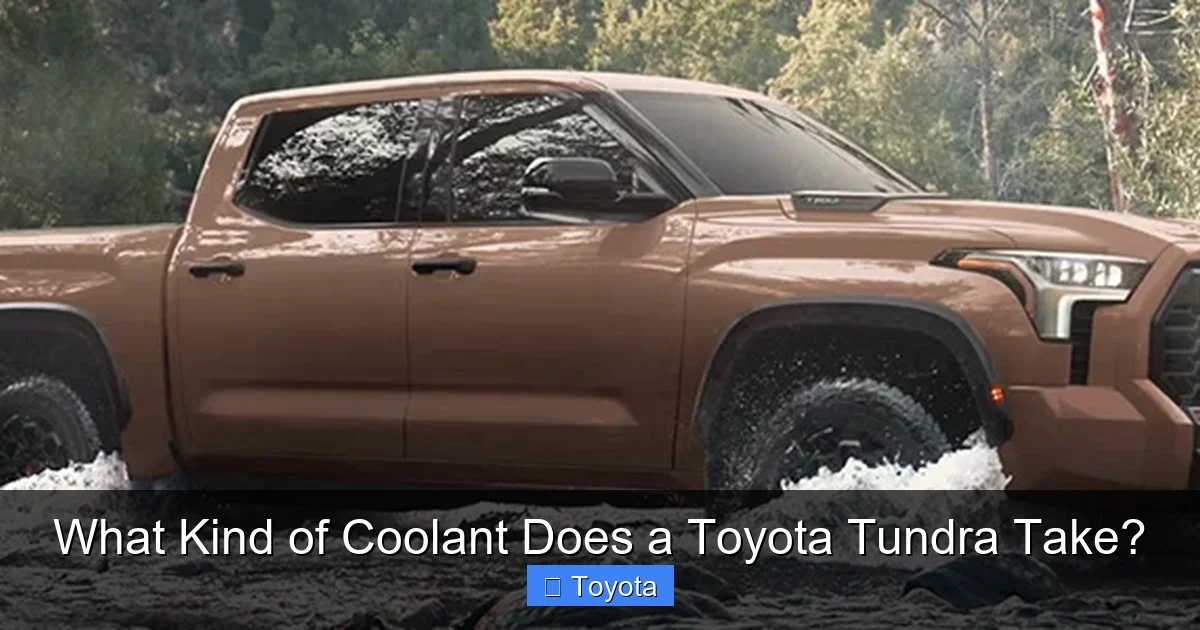
What Kind of Coolant Does a Toyota Tundra Take?

Contents
- 1 Key Takeaways
- 2 📑 Table of Contents
- 3 What Kind of Coolant Does a Toyota Tundra Take?
- 4 Why Coolant Matters in Your Toyota Tundra
- 5 Toyota Super Long Life Coolant (SLLC): The Right Choice
- 6 Coolant Requirements by Tundra Model Year
- 7 When and How to Change Your Tundra’s Coolant
- 8 Common Coolant Mistakes to Avoid
- 9 FAQs About Toyota Tundra Coolant
- 10 Frequently Asked Questions


Your Toyota Tundra requires Toyota Super Long Life Coolant (SLLC), a pink or red ethylene glycol-based formula designed for extended protection. Using the wrong coolant can lead to corrosion, overheating, and costly engine damage—so always check your owner’s manual and stick to manufacturer recommendations.
Key Takeaways
- Use Toyota Super Long Life Coolant (SLLC): This pink or red coolant is specifically formulated for Toyota engines and offers up to 10 years or 150,000 miles of protection.
- Never mix coolants unless specified: Mixing incompatible types—like conventional green coolant with SLLC—can cause sludge, corrosion, and cooling system failure.
- Check your owner’s manual: Always refer to your specific model year and engine type, as requirements may vary slightly between Tundra generations.
- Flush and replace every 5 years or 60,000–100,000 miles: Even long-life coolants degrade over time and lose their protective properties.
- Avoid “universal” or “global” coolants: These may not meet Toyota’s stringent specifications and could void your warranty.
- Use distilled water for top-offs: Tap water contains minerals that can build up and damage the cooling system over time.
- Watch for signs of coolant issues: Overheating, low coolant levels, or discolored fluid are red flags that need immediate attention.
📑 Table of Contents
What Kind of Coolant Does a Toyota Tundra Take?
If you own a Toyota Tundra—or you’re thinking about buying one—you probably already know it’s a beast of a truck. Built for towing, hauling, and conquering tough terrain, the Tundra is engineered to last. But like any high-performance vehicle, it needs proper maintenance to keep running strong. One of the most overlooked yet critical aspects of that maintenance? Coolant.
Coolant—also known as antifreeze—does way more than just prevent your engine from freezing in winter. It keeps your engine from overheating in summer, protects internal components from rust and corrosion, and helps maintain optimal operating temperatures year-round. Using the wrong kind of coolant in your Tundra isn’t just a minor mistake—it can lead to serious engine damage, expensive repairs, and even complete cooling system failure.
So, what kind of coolant does a Toyota Tundra take? The short answer: **Toyota Super Long Life Coolant (SLLC)**, typically pink or red in color. But there’s more to the story. In this guide, we’ll dive deep into why this specific coolant matters, how to identify the right type for your model year, when and how to change it, and what happens if you get it wrong. Whether you’re a DIY mechanic or just want to stay informed before your next service appointment, this article will give you everything you need to keep your Tundra’s engine cool, clean, and running like new.
Why Coolant Matters in Your Toyota Tundra

Visual guide about What Kind of Coolant Does a Toyota Tundra Take?
Image source: i.ytimg.com
Let’s start with the basics: why does coolant even matter? Your Tundra’s engine generates an enormous amount of heat—especially when you’re towing a trailer up a mountain pass or idling in stop-and-go traffic on a 100-degree day. Without a proper cooling system, that heat would quickly warp engine components, melt gaskets, and cause catastrophic failure.
Coolant circulates through the engine block, cylinder heads, radiator, and heater core, absorbing heat and transferring it away from critical parts. But modern coolants do more than just transfer heat. They contain additives that prevent rust, lubricate the water pump, and inhibit the growth of algae and bacteria inside the system.
Toyota engineers design their engines with very specific tolerances and materials—aluminum heads, composite intake manifolds, and precision-machined components—that require a coolant formulated to protect them. That’s why using the right coolant isn’t just a suggestion; it’s a necessity.
The Role of Ethylene Glycol
Most coolants, including Toyota’s SLLC, are based on ethylene glycol. This chemical lowers the freezing point of water (so your coolant won’t freeze in winter) and raises its boiling point (so it won’t boil over in summer). But ethylene glycol is also corrosive on its own—which is why coolants include corrosion inhibitors.
Toyota’s Super Long Life Coolant uses a special blend of organic acid technology (OAT) inhibitors that form a protective layer on metal surfaces. This prevents rust and scale buildup without the need for traditional silicate or phosphate additives, which can break down over time and cause sludge.
Why Generic Coolants Fall Short
You might be tempted to grab a bottle of “universal” coolant from the auto parts store because it’s cheaper or more convenient. But here’s the problem: universal coolants are often formulated to meet broad industry standards, not Toyota’s specific requirements.
For example, many universal coolants use silicates for fast-acting corrosion protection. While that sounds good, silicates can drop out of solution and form a gritty paste that clogs narrow coolant passages—especially in modern engines with tight tolerances. Toyota’s SLLC avoids this by using a slower-releasing OAT formula that provides long-term protection without the risk of clogging.
Using the wrong coolant can also void your warranty. Toyota explicitly states in the owner’s manual that only approved coolants should be used. If a coolant-related failure occurs and you’ve used an unapproved product, Toyota may deny coverage—even if the failure wasn’t directly caused by the coolant.
Toyota Super Long Life Coolant (SLLC): The Right Choice

Visual guide about What Kind of Coolant Does a Toyota Tundra Take?
Image source: i.ytimg.com
So, what exactly is Toyota Super Long Life Coolant, and why is it the only recommended choice for your Tundra?
SLLC is a premium, ethylene glycol-based coolant specifically engineered for Toyota, Lexus, and Scion vehicles. It’s dyed pink or red (depending on the region and formulation) to distinguish it from conventional green or orange coolants. The color isn’t just for show—it helps technicians quickly identify the type of coolant in your system during service.
Key Features of SLLC
– **Extended Service Life:** SLLC is designed to last up to 10 years or 150,000 miles—significantly longer than traditional coolants, which typically need changing every 2–5 years.
– **Organic Acid Technology (OAT):** This advanced inhibitor package provides long-lasting protection without the risk of silicate dropout or phosphate scaling.
– **Aluminum Protection:** SLLC is specially formulated to protect aluminum engine components, which are common in modern Toyota engines.
– **Compatibility:** It’s safe for use in all Toyota models, including the Tundra, Camry, RAV4, and more.
How to Identify Genuine Toyota SLLC
When shopping for coolant, look for the following on the label:
– “Toyota Super Long Life Coolant” or “Toyota Genuine Coolant”
– Part number 00295-1LLC2 (concentrate) or 00295-1LLCF (pre-mixed)
– “Meets Toyota Specification TSB-00295-1LLC2”
– Pink or red color (never green or blue)
Avoid knockoff brands or “compatible” coolants that claim to meet Toyota specs but aren’t officially licensed. These may not contain the right balance of inhibitors and could damage your engine over time.
Pre-Mixed vs. Concentrate: Which Should You Use?
Toyota SLLC is available in two forms: pre-mixed (50/50 coolant and distilled water) and concentrate (100% coolant that must be mixed with water).
For most Tundra owners, **pre-mixed coolant is the best choice**. It’s convenient, eliminates the risk of improper mixing, and ensures the correct dilution ratio right out of the bottle. Just pour it in and go.
Concentrate is typically used by professional mechanics or for large-volume top-offs. If you do choose concentrate, always mix it with **distilled water**—never tap water. Tap water contains minerals like calcium and magnesium that can form scale deposits and reduce cooling efficiency.
Coolant Requirements by Tundra Model Year

Visual guide about What Kind of Coolant Does a Toyota Tundra Take?
Image source: s.ecrater.com
While Toyota Super Long Life Coolant is the standard recommendation across most Tundra models, there are some nuances depending on the year and engine type. Let’s break it down by generation.
First Generation (2000–2006)
The first-gen Tundra came with either a 3.4L V6 or a 4.7L V8 engine. These models originally used Toyota Long Life Coolant (LLC), which was green or blue-green in color and had a 5-year/100,000-mile service life.
However, Toyota later transitioned to SLLC, and it’s now recommended to upgrade to the newer formula during your next coolant change. SLLC is backward-compatible with older Toyota systems, so you can safely switch without flushing—though a full flush is still recommended for optimal performance.
Second Generation (2007–2017)
This generation introduced the 5.7L V8 engine and continued using the 4.7L V8 in some trims. All second-gen Tundras were factory-filled with Toyota Super Long Life Coolant (pink or red).
If your 2007–2017 Tundra still has the original coolant, it’s likely due for a change. Even though SLLC lasts up to 10 years, most experts recommend changing it every 5 years or 60,000–100,000 miles to ensure peak performance.
Third Generation (2018–Present)
The current-generation Tundra (2018 and newer) continues to use SLLC. However, with the introduction of the twin-turbo 3.5L V6 engine in 2022, Toyota has emphasized even stricter coolant maintenance due to the higher operating temperatures and pressures in turbocharged engines.
For 2022+ Tundras, Toyota recommends inspecting the coolant every 15,000 miles and replacing it every 60,000 miles—even though the coolant is rated for 150,000 miles. This is because turbo engines generate more heat, which can accelerate coolant degradation.
Hybrid Models (2022+)
The 2022 Tundra i-FORCE MAX hybrid uses the same 3.5L twin-turbo V6 but adds an electric motor and battery system. While the internal combustion engine still uses SLLC, the hybrid system has its own separate cooling circuit for the battery and motor.
Always refer to your owner’s manual for hybrid-specific coolant requirements. Never assume the same coolant type applies to both systems.
When and How to Change Your Tundra’s Coolant
Even the best coolant doesn’t last forever. Over time, the additives break down, the pH level drops, and contaminants accumulate. That’s why regular coolant changes are essential—even if your Tundra seems to be running fine.
Recommended Coolant Change Intervals
– **2000–2006 Tundras:** Every 5 years or 60,000 miles (upgrade to SLLC if still using old LLC)
– **2007–2021 Tundras:** Every 5 years or 60,000–100,000 miles
– **2022+ Tundras (including hybrids):** Every 5 years or 60,000 miles (sooner if towing or driving in extreme conditions)
If you frequently tow, drive in hot climates, or use your Tundra for off-roading, consider changing the coolant every 4 years or 50,000 miles. High-stress conditions accelerate coolant breakdown.
Signs Your Coolant Needs Changing
Don’t wait for the service interval if you notice any of these warning signs:
– **Overheating:** If your temperature gauge climbs into the red, pull over immediately.
– **Low Coolant Level:** Frequent top-offs may indicate a leak or evaporation.
– **Discolored Coolant:** Pink or red coolant that turns brown, green, or murky is a sign of contamination or degradation.
– **Sweet Smell:** A sugary odor inside the cabin could mean a heater core leak.
– **Sludge in the Radiator:** A thick, oily residue in the coolant reservoir indicates additive failure.
DIY Coolant Change: Step-by-Step
Changing your Tundra’s coolant is a manageable DIY job if you have basic tools and a safe workspace. Here’s how to do it:
1. **Let the Engine Cool:** Never open the radiator cap when the engine is hot—pressurized coolant can cause severe burns.
2. **Locate the Drain Plug:** On most Tundras, the radiator drain plug is at the bottom passenger side of the radiator.
3. **Drain the Old Coolant:** Place a drain pan underneath, open the drain plug, and let the coolant flow out. Also, open the radiator cap to allow air in and speed up drainage.
4. **Flush the System (Optional but Recommended):** Use a radiator flush solution and distilled water to remove any remaining sludge or contaminants.
5. **Refill with New Coolant:** Close the drain plug and fill the radiator with pre-mixed Toyota SLLC. Fill slowly to avoid air pockets.
6. **Bleed the System:** Start the engine with the heater on high and let it run until the thermostat opens. Top off the coolant as needed and check for leaks.
7. **Dispose of Old Coolant Properly:** Coolant is toxic—take it to a recycling center or auto parts store that accepts used fluids.
Professional Service vs. DIY
If you’re not comfortable doing the job yourself, a Toyota dealership or trusted mechanic can perform a coolant flush and refill. They’ll use factory-approved equipment to ensure the system is properly bled and filled.
Expect to pay $150–$250 for a professional coolant service, depending on your location and shop rates. While it’s more expensive than DIY, it includes a full system inspection and ensures the job is done correctly.
Common Coolant Mistakes to Avoid
Even experienced drivers make coolant mistakes. Here are the most common ones—and how to avoid them.
Mixing Coolant Types
Never mix different coolant types. Combining SLLC with conventional green coolant (IAT) or orange Dexcool can cause a chemical reaction that forms sludge. This sludge can clog the radiator, water pump, and heater core, leading to overheating and costly repairs.
If you accidentally mix coolants, flush the entire system immediately and refill with the correct type.
Using Tap Water for Top-Offs
It’s tempting to top off low coolant with water from the hose—but don’t. Tap water contains minerals that can cause scale buildup and reduce cooling efficiency. Always use distilled water for top-offs, or better yet, use pre-mixed coolant.
Ignoring the Coolant Reservoir
The overflow reservoir (also called the coolant expansion tank) holds excess coolant and helps maintain system pressure. Check it regularly and keep it between the “MIN” and “MAX” lines. If it’s consistently low, you may have a leak.
Overfilling the System
Too much coolant can cause pressure buildup and lead to leaks or radiator damage. Fill only to the recommended level and allow room for expansion.
Skipping the Bleed Procedure
Air pockets in the cooling system can cause hot spots and overheating. Always bleed the system after a coolant change by running the engine with the heater on and topping off as needed.
FAQs About Toyota Tundra Coolant
Can I use any pink coolant in my Tundra?
No. Only use Toyota Super Long Life Coolant or a coolant that explicitly meets Toyota specification TSB-00295-1LLC2. Other pink coolants may not have the right additive package.
Is it okay to mix SLLC with water?
Yes, but only if you’re using concentrate and mixing it with distilled water. Pre-mixed SLLC is already diluted and ready to use.
How often should I check my coolant level?
Check the coolant reservoir every month or before long trips. Look for the level between the “MIN” and “MAX” marks when the engine is cold.
Can I use SLLC in an older Tundra?
Yes. SLLC is backward-compatible with older Toyota models. You can safely switch during your next coolant change.
What happens if I use the wrong coolant?
Using the wrong coolant can cause corrosion, sludge buildup, overheating, and damage to the water pump, radiator, and engine components.
Does the Tundra have more than one coolant system?
Yes, 2022+ hybrid models have a separate cooling circuit for the battery and electric motor. Always consult your owner’s manual for hybrid-specific maintenance.
Frequently Asked Questions
What is What Kind of Coolant Does a Toyota Tundra Take??
What Kind of Coolant Does a Toyota Tundra Take? is an important topic with many practical applications.