What Is Vdc in an Infiniti?

Contents
- 1 Key Takeaways
- 2 📑 Table of Contents
- 3 What Is VDC in an Infiniti?
- 4 How Does VDC Work in an Infiniti?
- 5 VDC vs. Other Stability Systems: What’s the Difference?
- 6 When Does VDC Activate? Real-World Scenarios
- 7 Can You Turn Off VDC in an Infiniti?
- 8 VDC Warning Light: What It Means and What to Do
- 9 Benefits of VDC: Why It Matters for Infiniti Drivers
- 10 Maintenance and Care for Your VDC System
- 11 Conclusion: VDC Is Your Infiniti’s Silent Guardian
- 12 Frequently Asked Questions

Windshield Cleaning Tool

Liquid Car Polish

Diesel Fuel Additive

Car Ambient Light Kit
VDC in an Infiniti stands for Vehicle Dynamic Control, an advanced electronic stability system designed to help drivers maintain control during slippery or emergency driving conditions. It works by automatically applying brakes and adjusting engine power to prevent skidding and loss of traction, enhancing overall safety and driving confidence.
Key Takeaways
- VDC stands for Vehicle Dynamic Control: It’s Infiniti’s proprietary name for electronic stability control (ESC), a critical safety feature in modern vehicles.
- Enhances vehicle stability: VDC monitors steering input, wheel speed, and vehicle direction to detect and correct skidding or loss of control.
- Works with other safety systems: It integrates with ABS, traction control, and brake assist to provide comprehensive driving support.
- Automatically activates when needed: The system operates in the background and only intervenes when it senses instability, such as during sharp turns or wet roads.
- Can be temporarily disabled: Some Infiniti models allow drivers to turn off VDC for specific situations like off-roading or snow driving, but it’s recommended to keep it on for daily use.
- Improves safety in adverse conditions: VDC significantly reduces the risk of accidents caused by oversteer, understeer, or hydroplaning.
- Standard on most Infiniti models: Nearly all Infiniti vehicles produced since the mid-2000s come equipped with VDC as a standard safety feature.
📑 Table of Contents
- What Is VDC in an Infiniti?
- How Does VDC Work in an Infiniti?
- VDC vs. Other Stability Systems: What’s the Difference?
- When Does VDC Activate? Real-World Scenarios
- Can You Turn Off VDC in an Infiniti?
- VDC Warning Light: What It Means and What to Do
- Benefits of VDC: Why It Matters for Infiniti Drivers
- Maintenance and Care for Your VDC System
- Conclusion: VDC Is Your Infiniti’s Silent Guardian
What Is VDC in an Infiniti?
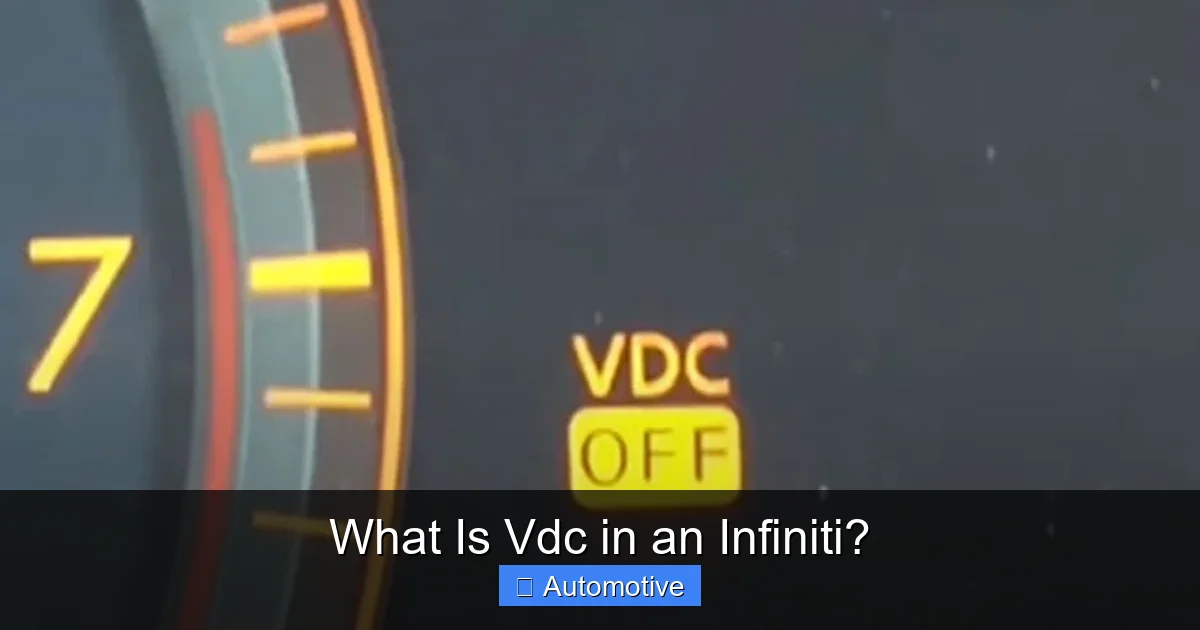
If you’ve ever driven an Infiniti—whether it’s a sleek Q50 sedan, a powerful QX60 SUV, or a sporty Q60 coupe—you’ve likely noticed a dashboard light that occasionally flashes or stays on briefly. That light often reads “VDC OFF” or simply “VDC.” But what exactly does that mean? Is it something to worry about? Should you be concerned if it’s on or off?
The short answer: VDC stands for Vehicle Dynamic Control, and it’s one of the most important safety systems in your Infiniti. Think of it as your car’s electronic co-pilot—constantly watching, analyzing, and stepping in when things get tricky on the road. Whether you’re driving on a rain-slicked highway, navigating a sharp curve, or braking suddenly to avoid an obstacle, VDC is working behind the scenes to keep your vehicle stable and under control.
Unlike older mechanical systems that relied solely on driver skill, modern vehicles like Infinitis use advanced electronics to assist in maintaining traction and directional stability. VDC is Infiniti’s version of what many other automakers call Electronic Stability Control (ESC). While the name varies—some brands use ESP (Electronic Stability Program) or DSC (Dynamic Stability Control)—the function is essentially the same: to prevent skidding and loss of control.
This system isn’t just a luxury add-on. It’s a critical safety feature that has been proven to reduce the risk of single-vehicle crashes, especially in adverse weather or emergency maneuvers. In fact, the National Highway Traffic Safety Administration (NHTSA) estimates that electronic stability control can reduce fatal single-vehicle crashes by up to 50%. That’s a huge number—and it’s one reason why VDC is now standard on nearly all new vehicles, including every Infiniti model.
How Does VDC Work in an Infiniti?

Visual guide about What Is Vdc in an Infiniti?
Image source: bryansgarage.com
So, how does VDC actually do its job? It’s not magic—it’s a sophisticated network of sensors, computers, and actuators working together in real time. Let’s break it down in simple terms.
At the heart of the VDC system is a central control unit, often referred to as the Electronic Control Module (ECM) or Stability Control Module. This “brain” constantly receives data from a variety of sensors placed around the vehicle. These include:
– Wheel speed sensors (one at each wheel)
– Steering angle sensor (measures how far and how fast you’re turning the wheel)
– Yaw rate sensor (detects rotation around the vertical axis—like when the car starts to spin)
– Lateral acceleration sensor (measures side-to-side movement)
– Brake pressure sensors
All this data is processed dozens of times per second. The system compares what the driver is trying to do (based on steering input) with what the car is actually doing (based on sensor feedback). If there’s a mismatch—say, you turn the wheel sharply but the car begins to slide outward—the VDC system springs into action.
Here’s how it responds:
1. Selective Braking: The system can apply the brakes to individual wheels. For example, if the rear of the car starts to slide out (oversteer), VDC might brake the front outer wheel to help bring the rear back in line. If the front wheels lose grip and the car pushes straight ahead (understeer), it might brake the inner rear wheel to help the car turn.
2. Engine Power Reduction: VDC can also reduce engine power by adjusting throttle input or delaying ignition timing. This helps prevent wheel spin and gives the tires a better chance to regain traction.
3. Coordination with Other Systems: VDC doesn’t work alone. It communicates with the Anti-lock Braking System (ABS) to prevent wheel lockup during hard braking, and with Traction Control System (TCS) to limit wheel spin during acceleration. Together, these systems create a comprehensive safety net.
Let’s look at a real-world example. Imagine you’re driving on a wet road and suddenly swerve to avoid a pothole. Your front wheels lose grip for a split second, and the car starts to skid. Without VDC, you might overcorrect and spin out. But with VDC, the system detects the loss of traction and instantly applies the brake to the appropriate wheel while reducing engine power. The result? Your car stays on course, and you avoid a potential accident.
VDC vs. Other Stability Systems: What’s the Difference?

Visual guide about What Is Vdc in an Infiniti?
Image source: bryansgarage.com
You might be wondering: isn’t VDC just another name for traction control or ABS? Not exactly. While these systems are related and often work together, they each have distinct roles.
Let’s clarify the differences:
Traction Control System (TCS)
TCS focuses on preventing wheel spin during acceleration. If you floor the gas on a slippery surface and the drive wheels start to spin, TCS reduces engine power or applies the brakes to those wheels to regain grip. It’s primarily active when you’re speeding up.
Anti-lock Braking System (ABS)
ABS prevents the wheels from locking up during hard braking. Without ABS, locked wheels can cause the car to skid and lose steering control. ABS pulses the brakes rapidly, allowing the wheels to keep rotating and maintain traction. This helps you stop shorter and steer while braking.
Vehicle Dynamic Control (VDC)
VDC goes a step further. It monitors the overall stability of the vehicle—not just during acceleration or braking, but throughout the entire driving experience. It looks at steering input, vehicle direction, and body movement to determine if the car is following the driver’s intended path. If not, it intervenes to correct the trajectory.
Think of it this way: TCS helps you get going, ABS helps you stop safely, and VDC helps you stay on course. All three are essential, but VDC is the most comprehensive, acting as the “captain” of the vehicle’s stability team.
Other automakers use different names for similar systems:
– Mercedes-Benz: ESP (Electronic Stability Program)
– BMW: DSC (Dynamic Stability Control)
– Toyota/Lexus: VSC (Vehicle Stability Control)
– Honda/Acura: VSA (Vehicle Stability Assist)
Despite the branding differences, the core technology is very similar. Infiniti’s VDC is on par with these systems in terms of performance and reliability.
When Does VDC Activate? Real-World Scenarios

Visual guide about What Is Vdc in an Infiniti?
Image source: garagesee.com
VDC isn’t always active—it only kicks in when the system detects a potential loss of control. Here are some common situations where you might see VDC in action:
Driving on Wet or Icy Roads
Rain, snow, and ice reduce tire grip. If you accelerate too quickly or brake hard, your wheels can lose traction. VDC senses this and adjusts power and braking to keep the car stable. For example, if you’re driving through a puddle and one side of the car hydroplanes, VDC can apply brakes to the opposite wheels to counteract the imbalance.
Taking Sharp Turns at High Speed
If you enter a curve too fast, the tires may not be able to maintain grip, causing the car to understeer (pushing straight) or oversteer (spinning out). VDC detects this and applies corrective braking to help the car follow the intended path. This is especially helpful on winding mountain roads or during emergency lane changes.
Emergency Maneuvers
Imagine a child runs into the street, and you swerve to avoid them. Your car might skid or fishtail. VDC monitors the sudden change in direction and applies targeted braking to stabilize the vehicle, reducing the chance of a spin or rollover.
Off-Road or Loose Surface Driving
While VDC is designed for paved roads, it can also help on gravel, dirt, or snow-covered paths. However, in deep snow or mud, you might want to temporarily disable VDC (more on that later) to allow wheel spin for better traction.
High-Performance Driving
Even on dry pavement, aggressive driving can trigger VDC. If you’re pushing your Infiniti hard on a track or during spirited driving, the system may intervene to prevent oversteer or loss of control. Some performance models offer a “VDC Sport” mode that allows more driver freedom while still providing a safety net.
It’s important to note that VDC doesn’t make your car invincible. It can’t overcome the laws of physics—if you’re going too fast for the conditions, no system can guarantee safety. But it does give you a much better chance of staying in control.
Can You Turn Off VDC in an Infiniti?
Yes, in most Infiniti models, you can temporarily disable VDC. This is usually done by pressing a button labeled “VDC OFF” or “TCS OFF” on the dashboard or center console. When you do this, a warning light will appear on the instrument panel, indicating that the system is inactive.
But why would you want to turn it off?
There are a few legitimate reasons:
Driving in Deep Snow or Mud
In deep snow or thick mud, you may need your wheels to spin slightly to gain traction. VDC can interpret this wheel spin as a loss of control and reduce engine power, making it harder to get moving. Turning off VDC allows more wheel slip, which can help you power through.
Rock Crawling or Off-Roading
When navigating rough terrain, you might need to feather the throttle and allow controlled wheel spin. VDC can interfere with this, so disabling it gives you more direct control.
Performance Driving or Track Use
Enthusiasts who take their Infiniti to the track may prefer to disable VDC for more responsive handling and greater driver input. Some models even offer a “VDC Sport” mode that reduces intervention while still providing a safety backup.
However, it’s crucial to remember that turning off VDC removes a major layer of safety. The system is designed to protect you in unexpected situations, and disabling it increases the risk of skidding or losing control. Always reactivate VDC as soon as you’re back on normal roads.
Also, note that in some newer Infiniti models, VDC cannot be fully disabled—only partially reduced. This is a safety measure to ensure the system remains active in critical situations.
VDC Warning Light: What It Means and What to Do
If the VDC warning light comes on and stays illuminated, it doesn’t necessarily mean the system has failed—but it does mean something needs attention.
Here’s what the light could indicate:
Normal Operation (Flashing Light)
If the VDC light flashes briefly while driving, it means the system is actively working—applying brakes or reducing power to maintain stability. This is normal and nothing to worry about. It’s a sign the system is doing its job.
System Malfunction (Steady Light)
If the light stays on steadily, it could indicate a problem with the VDC system, such as a faulty sensor, low brake fluid, or an issue with the ABS. In this case, the system may be disabled or operating at reduced capacity.
VDC Manually Turned Off
If you pressed the VDC OFF button, the light will remain on to remind you that the system is inactive. Simply press the button again to reactivate it.
Low Tire Pressure
Some Infiniti models link VDC to the Tire Pressure Monitoring System (TPMS). If tire pressure is too low, it can affect vehicle stability and trigger the VDC light.
What to Do If the Light Stays On
– Check your tire pressure and inflate if necessary.
– Ensure the VDC hasn’t been accidentally turned off.
– If the light persists, have your vehicle inspected by a certified Infiniti technician. They can scan the system for error codes and diagnose any issues.
Ignoring a steady VDC light can compromise your safety. Even if the car seems to drive normally, the system may not be able to assist in an emergency.
Benefits of VDC: Why It Matters for Infiniti Drivers
So, why should you care about VDC? Beyond the technical details, this system offers real, tangible benefits that enhance your driving experience and safety.
Reduced Risk of Accidents
Studies show that vehicles with electronic stability control are significantly less likely to be involved in single-vehicle crashes. VDC helps prevent rollovers, skids, and spinouts—especially in adverse weather.
Improved Confidence in Emergency Situations
Knowing that your car has a system that can help you maintain control during a sudden maneuver gives you peace of mind. Whether you’re avoiding an animal on the road or navigating a sudden downpour, VDC acts as a safety net.
Better Handling and Performance
Even in normal driving, VDC contributes to smoother, more predictable handling. It helps the car respond more accurately to your inputs, making it feel more planted and responsive.
Enhanced Resale Value
Vehicles with advanced safety features like VDC tend to hold their value better. Buyers recognize the importance of stability control, and it can be a deciding factor in a used car purchase.
Compliance with Safety Standards
Since 2012, the U.S. government has required all new vehicles to have electronic stability control. Infiniti has been ahead of the curve, equipping most of its models with VDC long before it became mandatory.
Maintenance and Care for Your VDC System
Like any complex system, VDC requires proper maintenance to function correctly. Fortunately, most of the components are designed to last the life of the vehicle with minimal upkeep. However, there are a few things you can do to ensure it stays in top shape:
Regular Brake Inspections
Since VDC relies on the braking system, worn brake pads or low brake fluid can affect performance. Have your brakes checked during routine maintenance.
Tire Maintenance
Proper tire inflation and tread depth are critical for traction. Underinflated or worn tires reduce the effectiveness of VDC. Check tire pressure monthly and rotate tires as recommended.
Sensor Cleaning
Dirt, snow, or ice can block wheel speed sensors or the yaw sensor. Keep these areas clean, especially in winter. If you notice erratic behavior, a quick cleaning might resolve the issue.
Professional Diagnostics
If the VDC light comes on and won’t go off, don’t ignore it. Use an OBD2 scanner or visit an Infiniti service center to diagnose the problem. Many issues can be resolved with a simple reset or sensor replacement.
Conclusion: VDC Is Your Infiniti’s Silent Guardian
In the world of automotive safety, few systems are as underappreciated as VDC. It doesn’t make noise, it doesn’t require driver input, and it only shows itself when things go wrong. But when it does activate, it can mean the difference between a close call and a serious accident.
VDC in an Infiniti is more than just a dashboard light—it’s a sophisticated network of sensors and controls designed to keep you safe. Whether you’re driving through a thunderstorm, taking a sharp turn, or simply commuting to work, this system is working tirelessly to maintain stability and control.
Understanding how VDC works helps you appreciate your Infiniti even more. It’s not just a luxury vehicle—it’s a smart, safety-focused machine built with cutting-edge technology. So the next time you see that VDC light flash, don’t panic. Smile. It means your car is looking out for you.
Keep VDC active, maintain your vehicle properly, and drive with confidence. After all, the best safety feature is a system you don’t even notice—until you really need it.
Frequently Asked Questions
What does VDC stand for in an Infiniti?
VDC stands for Vehicle Dynamic Control. It’s Infiniti’s name for electronic stability control, a system that helps maintain vehicle stability by preventing skidding and loss of traction.
Is VDC the same as traction control?
No, VDC is more advanced than traction control. While traction control only prevents wheel spin during acceleration, VDC monitors the entire vehicle’s movement and corrects instability during turns, braking, or emergency maneuvers.
Can I drive my Infiniti if the VDC light is on?
Yes, you can drive, but it’s not recommended if the light stays on steadily. A flashing light means the system is working; a steady light indicates a possible malfunction that should be checked by a technician.
Should I turn off VDC when driving in snow?
You can temporarily disable VDC in deep snow or mud to allow wheel spin for better traction. However, always reactivate it once you’re back on clear roads for safety.
Does VDC affect fuel economy?
No, VDC does not directly impact fuel economy. It only activates when needed and doesn’t interfere with normal engine operation. In fact, by improving stability, it can help you drive more efficiently.
Is VDC standard on all Infiniti models?
Yes, VDC has been standard on nearly all Infiniti vehicles since the mid-2000s. It’s a core safety feature across sedans, SUVs, and coupes in the lineup.