What Is the Most Reliable Year for the Toyota Tundra?

Contents
- 1 Key Takeaways
- 2 📑 Table of Contents
- 3 Understanding Tundra Generations: The Foundation of Reliability
- 4 The Case for 2014-2017: The Reliability Sweet Spot
- 5 The Value Leader: 2008-2010 Second-Gen Models
- 6 The Newcomer: 2022-Present Third-Generation Tundra
- 7 Common Issues Across All Generations: What to Watch For
- 8 How to Choose the Most Reliable Used Tundra for YOU
- 9 Conclusion: The Verdict on the Most Reliable Year
- 10 Frequently Asked Questions


Finding the most reliable Toyota Tundra year means looking at each generation’s strengths and weaknesses. The 2014-2017 model years of the second-generation Tundra often emerge as top contenders for long-term dependability, thanks to a refined 5.7L V8 and proven mechanics. However, the 2008-2010 models also offer excellent value for budget buyers. Always check a specific vehicle’s service history, as maintenance is the ultimate key to reliability.
If you’re in the market for a full-size truck that can take a licking and keep on ticking, the Toyota Tundra is almost always on the list. Its reputation for longevity is legendary, often compared to the invincible Toyota Land Cruiser. But reputation is one thing; pinpointing the single most reliable year for the Toyota Tundra is another. It requires digging into decades of data, owner forums, repair trends, and understanding how each generation evolved. This article is your definitive guide. We’ll cut through the noise, examine each model year’s pros and cons, and give you a clear, actionable answer backed by real-world evidence. Forget guessing—let’s find the Tundra year that will truly give you peace of mind for the long haul.
Key Takeaways
- The 2014-2017 Tundra models are frequently cited as the most reliable overall. This period represents a “sweet spot” where the second-generation platform was mature, and the 5.7L V8 had overcome early teething issues from its 2007 debut.
- 2008-2010 models offer strong reliability at a lower purchase price. These are post-redesign trucks where most initial 2007 kinks were worked out, providing a more affordable entry into the capable second-gen Tundra.
- The 2022+ third-generation Tundra shows early promise but lacks long-term data. Its new twin-turbo V6 and hybrid i-FORCE MAX powertrain are innovative, but buyer beware: true long-term reliability is still unproven over a decade.
- The 5.7L V8 (2UR-FE) is the engine of record for proven reliability. Found in 2007-2021 models, this bulletproof engine is the primary reason many prefer older generations for sheer dependability.
- Every vehicle’s reliability hinges on its individual service history. A well-maintained 2007 can outlast a neglected 2016. Always prioritize a complete, verifiable maintenance record over model year alone.
- Watch for generation-specific issues. Second-gen Tundras (2007-2021) can have air pump and water pump failures, while early third-gen trucks (2022-2023) have reported infotainment glitches.
- Consider your primary use case. A heavy-duty work truck might prioritize the robust 2014-2021 models, while a family hauler might lean toward the newer, more refined third-gen with better ride quality.
📑 Table of Contents
- Understanding Tundra Generations: The Foundation of Reliability
- The Case for 2014-2017: The Reliability Sweet Spot
- The Value Leader: 2008-2010 Second-Gen Models
- The Newcomer: 2022-Present Third-Generation Tundra
- Common Issues Across All Generations: What to Watch For
- How to Choose the Most Reliable Used Tundra for YOU
- Conclusion: The Verdict on the Most Reliable Year
Understanding Tundra Generations: The Foundation of Reliability
Before we crown a specific model year, we must understand the truck’s architectural history. The Tundra has undergone three major generational shifts since its 1999 debut. Each generation brought new engines, transmissions, and chassis designs that significantly impact long-term dependability. Think of it like building a house: the foundation (the platform) and the core systems (powertrain) matter more than the paint color (trim level).
The First Generation (1999-2006): The Pioneer
The original Tundra was Toyota’s bold entry into the American full-size market, sharing some components with the Tacoma. It was available with a reliable 3.4L V6 or the legendary 4.7L V8. These trucks are simple, rugged, and have a cult following. However, they are now 20+ years old. While the 4.7L V8 is notoriously durable, age-related issues like aging wiring harnesses, worn suspensions, and parts scarcity for specific components become the primary concerns, not inherent design flaws. For this reason, they are rarely the top pick when discussing the most reliable year in a modern context, though a pristine example can be incredibly dependable.
The Second Generation (2007-2021): The Workhorse
This is the generation that cemented the Tundra’s “built-for-life” legend. Completely redesigned for 2007, it featured a massive, body-on-frame design, a powerful new 5.7L V8 (2UR-FE), and a sophisticated 6-speed automatic. This platform was produced for an astonishing 15 years with only minor refreshes. This longevity is a double-edged sword for reliability: it allowed Toyota to perfect the assembly process and work out early bugs, but it also means some components aged alongside the truck. The 2014 mid-cycle refresh introduced a new grille, interior, and some suspension tweaks, but the core mechanicals remained the same. This generation is the heart of our reliability discussion.
The Third Generation (2022-Present): The New Era
For 2022, Toyota finally gave the Tundra a clean-sheet design. It ditched the old V8 entirely for a twin-turbo 3.5L V6 (V35A-FTS) or the hybrid i-FORCE MAX system. It boasts a fully boxed frame, independent rear suspension, and a vastly more modern interior. Early reports are glowing for performance and refinement. However, when asking “what is the most reliable year?”, we must acknowledge that this generation is simply too new. There is no 15-year, 300,000-mile data set for the twin-turbo V6. While Toyota’s engineering is top-tier, introducing two entirely new powerplants (and a hybrid) means unknown long-term failure points. Time is the ultimate reliability tester, and this truck hasn’t passed that test yet.
The Case for 2014-2017: The Reliability Sweet Spot
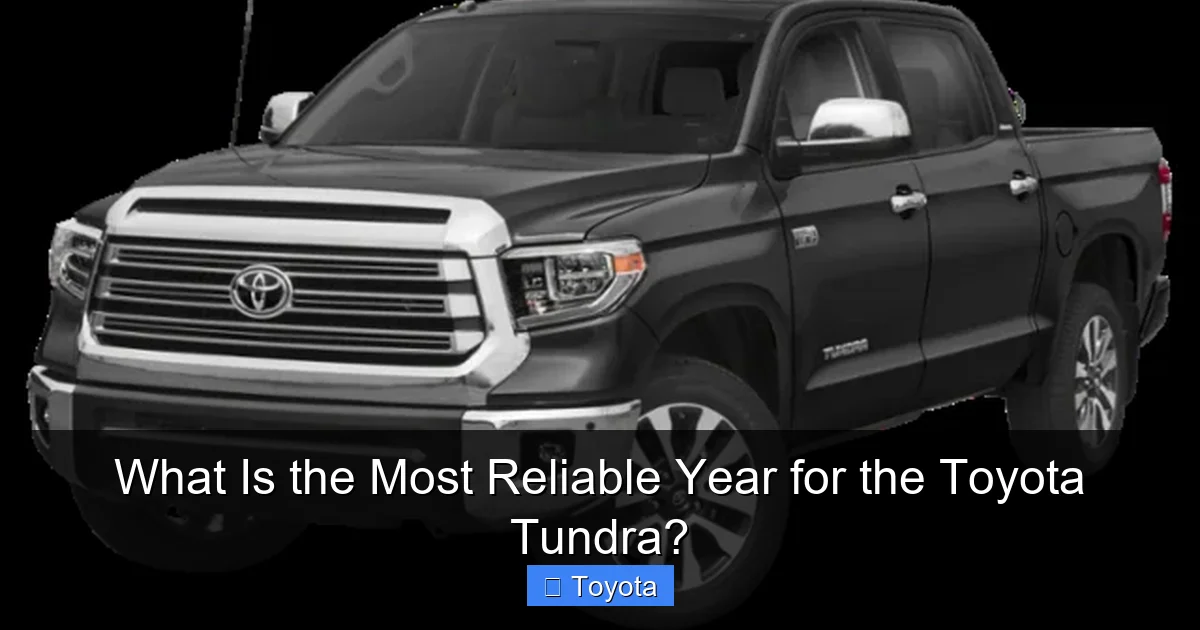
If you were to poll Tundra owners on forums like TundraTalk or Reddit, and ask for their top recommended used year, the 2014-2017 model years would dominate the responses. Why? Because they represent the perfect convergence of proven engineering, maturity, and modern features.
Visual guide about What Is the Most Reliable Year for the Toyota Tundra?
Image source: cdn.pixabay.com
A Mature, Perfected Platform
The 2007 redesign was a massive leap, but like any all-new vehicle, it had a few early adopter issues. The first few model years (2007-2010) saw some problems with the air injection pump (a smog-related component), water pumps, and occasional exhaust manifold cracks. By the 2011 model year, most of these were addressed. The 2014 refresh wasn’t a radical change, but it did bring minor engineering updates and, crucially, it shifted the entire production line into a period of maximum refinement. Factories had been building this same basic truck for seven years. The processes were optimized, supplier parts were vetted, and assembly tolerances were tight. A 2015 Tundra rolling off the line in San Antonio was built with the institutional knowledge gleaned from hundreds of thousands of predecessors.
The Legendary 5.7L V8 in Its Prime
The 5.7-liter 2UR-FE V8 is a masterpiece. It produces 381 horsepower and 401 lb.-ft. of torque. Its reputation for running well past 300,000 miles with basic maintenance is well-earned. In the 2014-2017 models, this engine was paired with the proven 6-speed automatic transmission. There were no major, widespread failure reports for this powertrain combo during this period. The engine’s timing chains are robust (a key point of reliability over timing belts), and the design is inherently overbuilt. For the most reliable Toyota Tundra year seeker, this proven, unstressed powertrain is the single biggest selling point. You get the power and torque of the V8 without the unknowns of the newer turbocharged engine.
Modern Amenities Without the “New Car” Price Tag
A 2016 Tundra is not a spartan work truck. By this year, Toyota had loaded it with features. You could get a premium audio system, ventilated seats, a large touchscreen with navigation, blind-spot monitoring, and a rearview camera. These are not just luxury items; they are safety and convenience features that make daily driving pleasant. A 2023 Tundra has more tech, but you pay a significant premium for it. The 2014-2017 models offer the best balance: you get a modern, comfortable, safe cabin with a powertrain whose long-term reliability is already being proven by high-mileage examples on the road today. You’re not betting on future performance; you’re buying a known quantity.
The Value Leader: 2008-2010 Second-Gen Models
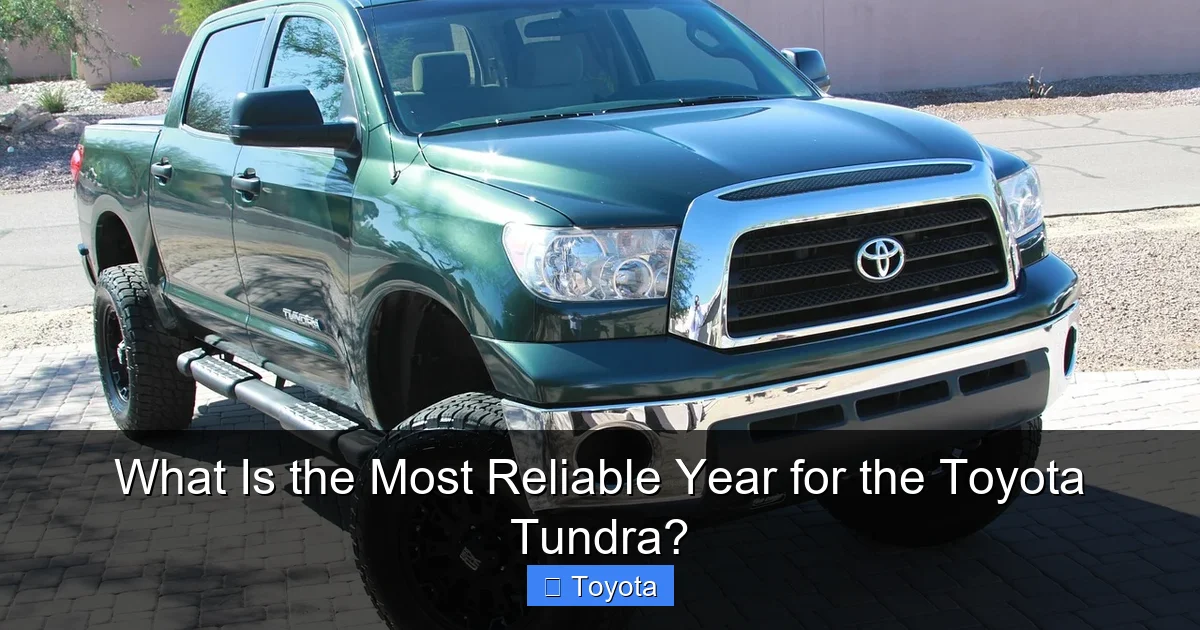
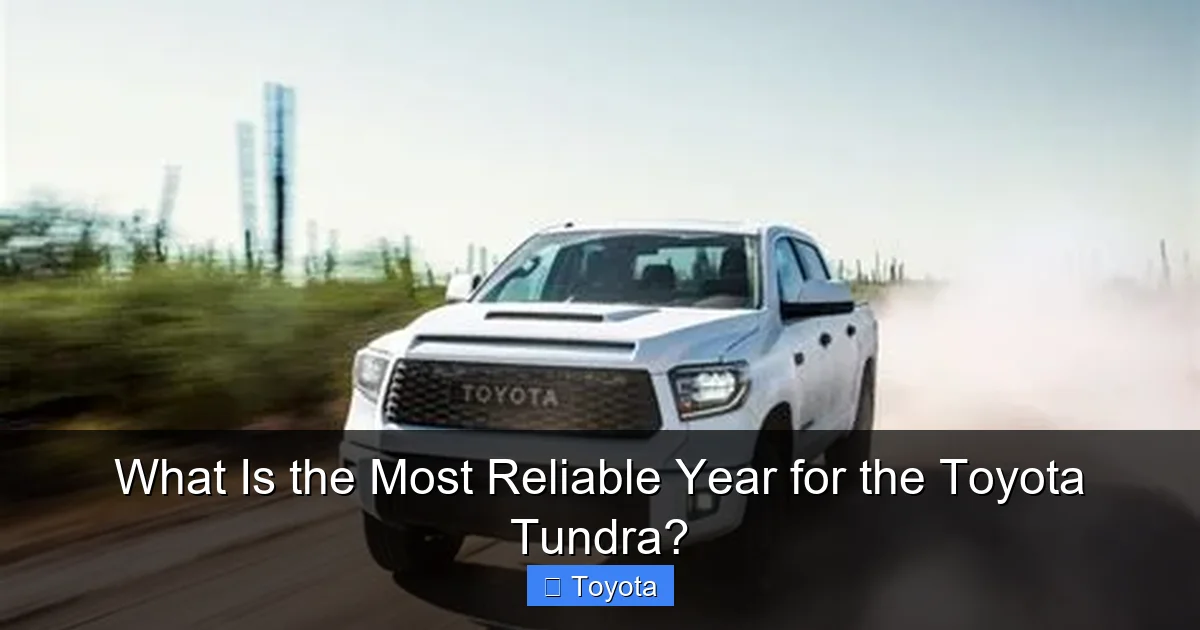
For the budget-conscious buyer who still wants a rock-solid full-size truck, the 2008-2010 Tundra is a fantastic and often overlooked choice. These are the models that truly benefited from the 2007 redesign’s initial fixes.
Visual guide about What Is the Most Reliable Year for the Toyota Tundra?
Image source: autozonic.com
The “Kinks” Were Worked Out
The absolute first-year 2007 models had a higher incidence of the aforementioned air pump and water pump issues. By 2008, Toyota had revised parts and procedures. Consumer Reports and owner data show a marked drop in reported problems for the 2008 model year and beyond. These trucks still have the same bulletproof 5.7L V8 and 6-speed automatic as the later models. The core mechanical DNA is identical to the 2017. You are essentially getting 90% of the long-term reliability potential for a significantly lower purchase price.
What You Sacrifice (And It’s Minimal)
Compared to a 2015, a 2009 Tundra will lack some of the latest driver aids. You might not have a standard backup camera (though many were added later), the infotainment system is more basic, and the interior materials are slightly less premium. However, the fundamental experience—the solid feel, the powerful engine, the towing capacity, the spacious cab—is virtually identical. For someone who wants a no-nonsense, capable truck to haul a boat, a job site trailer, or a family, and who plans to keep it for 10+ years with proper care, the 2008-2010 models are a smart financial play. The savings at purchase can be redirected into a comprehensive pre-purchase inspection and any preventative maintenance the vehicle needs, setting it up perfectly for the long term.
The Newcomer: 2022-Present Third-Generation Tundra
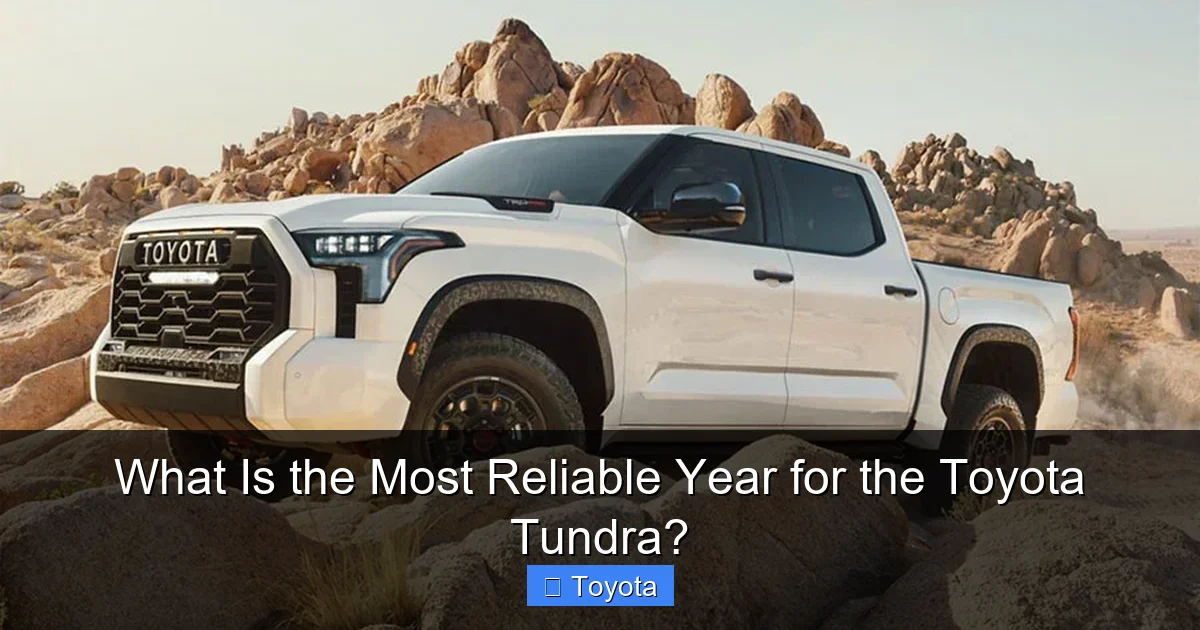
It’s impossible to talk about Tundra reliability without acknowledging the all-new model. It’s a spectacular truck, but it sits in a unique category for this discussion.
Visual guide about What Is the Most Reliable Year for the Toyota Tundra?
Image source: carsflow.com
Revolutionary Powertrain, Zero Long-Term Data
The switch from a naturally aspirated V8 to a twin-turbo V6 (and a hybrid) is the single biggest change in Tundra history. The V35A-FTS engine is a technological marvel, producing more power and torque than the old V8 while promising better fuel economy. Early reviews praise its smoothness and response. However, we have no data on how these engines will hold up at 250,000 miles. Will the turbochargers need replacement? How will the complex hybrid system’s battery pack age? These are unanswered questions. For a buyer whose primary metric is known, decades-proven reliability, this is a significant risk. You are an early adopter of a new platform.
Outstanding Initial Quality, But…
J.D. Power and other initial quality studies often rate new vehicles highly. The 2022 Tundra received good scores for its first 90 days. But initial quality is not long-term reliability. The most common complaints for the newest Tundras in forums are software glitches in the large central touchscreen, minor rattles, and some early reports of fuel system concerns. These are often fixable with software updates, but they highlight that any new vehicle has a teething period. The most reliable year for this generation won’t be known for another 5-7 years, when we see which components stand the test of time and which do not.
Common Issues Across All Generations: What to Watch For
No vehicle is perfect. Understanding the common pain points of the Tundra, regardless of year, is critical for making a smart purchase. This knowledge empowers you to inspect a used truck properly and negotiate a fair price based on its actual condition.
Second-Generation (2007-2021) Achilles’ Heels
The air injection pump (AIP) is the most famous issue. This emissions-related part can fail, triggering a check engine light. Replacement can be costly. While more common in 2007-2010 models, it’s not unheard of later. Water pump failures (external to the engine) have also been reported. The good news? Both are wear items with known replacement intervals and procedures. A truck with a documented history of these replacements is often a better buy than one with no history at all. Other items include: premature wear on lower control arm bushings, occasional exhaust manifold cracks (especially on early 5.7L V8s), and failures of the rear axle seals on some heavy-use trucks. What Is Auto LSD On a Toyota Tundra? is a common question related to drivetrain. The Auto LSD (Limited Slip Differential) system is a software-based traction aid for the rear differential, not a mechanical clutch-type LSD. It’s generally reliable but is part of the vehicle’s stability control system, which can have sensor or software faults.
Third-Generation (2022+) Early Reports
As mentioned, infotainment system bugs are the primary complaint. Some owners report screen freezes, slow response, or connectivity issues. These are often resolved with dealer software updates. There have also been isolated reports of fuel pump concerns and minor interior trim issues. The redesigned fuel filler door has a known mechanical latch that can fail, requiring a simple and inexpensive fix. The independent rear suspension (IRS) is a major change from the old solid axle. While generally praised for ride quality, any new suspension design carries a question mark about long-term durability under heavy loads. A thorough inspection for any unusual noises or leaks is paramount.
The Universal Rule: Maintenance Trumps Model Year
This is the most important takeaway. A 2007 Tundra with a stack of oil change receipts, a repaired AIP, and a replaced timing belt (if applicable to that specific engine variant) is a far better bet than a 2019 Tundra with spotty service records and a history of deferred maintenance. Always, always obtain a vehicle history report (like Carfax or AutoCheck) to check for accidents and verify service records. A pre-purchase inspection by a trusted, Toyota-specialist mechanic is non-negotiable. They can spot signs of neglect, previous damage, and impending failures that no report can show.
How to Choose the Most Reliable Used Tundra for YOU
With all this data, how do you make the final call? It comes down to your personal needs, budget, and risk tolerance.
Step 1: Define Your Budget and Use Case
Are you towing a 10,000 lb. trailer weekly? A 2015 TRD Pro with the 5.7L V8 and tow package is a known workhorse. Is this a family hauler with occasional Home Depot runs? A 2022 Limited with the smoother ride of the IRS and more refined cabin might be worth the new-car premium and unknown longevity. Are you a value hunter? A clean 2009 SR5 with 150,000 miles and full service records represents incredible bang for the buck. Be honest about how you’ll use the truck. That dictates which generation’s characteristics are most important to you.
Step 2: Prioritize the Powertrain
This is the core of the reliability question. If your top priority is a powertrain with 20+ years of proven track record, you must choose a truck with the 5.7L V8 (2007-2021). This means third-generation models from 2022 onward are off the table for the ultra-cautious. Within that, the 2014-2017 period offers the most refined version of this engine and transmission pairing, with the least number of known common issues.
Step 3: The Inspection is King
Never buy a used truck sight unseen. Your mechanic should check for: signs of accidents (poorly aligned panels, mismatched paint), fluid leaks (engine oil, transmission fluid, differential fluid), the condition and level of all fluids, compression test results for the engine, and any stored trouble codes. They should specifically look for the common issues we listed for that generation. For a second-gen Tundra, ask them to pay extra attention to the air injection pump area and the water pump. For a third-gen, ensure all software updates have been applied. The inspection report is worth every penny and can save you from a $5,000 mistake.
Step 4: Consider the 1794 and Other Special Editions
You might wonder about the popular 1794 Edition. It’s essentially a top-trim luxury model (named after the year Toyota’s Texas plant began operations). It comes with premium leather, a JBL audio system, and unique styling. Mechanically, it is identical to the equivalent Limited or Platinum trim. Therefore, its reliability is tied to its model year and engine, not its badge. A 2016 1794 has the same reliability profile as a 2016 Limited. The value is in the features, not the mechanics. You can learn more about the specifics of this trim by reading our detailed guide on What Is A 1794 Edition Toyota Tundra.
Conclusion: The Verdict on the Most Reliable Year
So, what is the final answer? After weighing decades of data, owner experiences, and engineering maturity, the title of most reliable year for the Toyota Tundra belongs to the model years spanning 2014 through 2017.
This cohort offers the ultimate blend: the bulletproof, time-tested 5.7L V8 engine mated to a proven transmission; a platform that had been in continuous production for 7-10 years, allowing for all early flaws to be ironed out; and a level of equipment, safety, and refinement that makes them feel thoroughly modern. They are old enough to have a proven track record (you can find many with 250,000+ miles still on the road) but young enough to still have plenty of life left and reasonable pricing in the used market.
The 2008-2010 models are a superb, more budget-friendly alternative with nearly identical core reliability. The 2022+ models are compelling as new vehicles with better ride and tech, but they carry the inherent uncertainty of a first-generation powertrain. Your best bet is to find a well-maintained 2014-2017 Tundra with a complete service history. Use the knowledge of common issues as your inspection checklist. And remember, the most reliable Tundra is the one that has been cared for. Start your search with these years, get a professional inspection, and you’ll likely be rewarded with a truck that will faithfully serve you and your family for another decade or more. For specific questions about features like the set button on your Toyota Tundra or other functions, our library of guides is a great resource to help you get the most out of your reliable machine.
Frequently Asked Questions
Is the Toyota Tundra 5.7L V8 engine really that reliable?
Yes, the 2UR-FE 5.7L V8 is widely regarded as one of the most reliable full-size truck engines ever made. With regular oil changes and basic maintenance, it is known to routinely surpass 300,000 miles. Its overhead cam design with timing chains (not a belt) is a key factor in its longevity.
Should I avoid the first model year of any Tundra generation?
Generally, yes, for maximum reliability. The first year of a new generation (2007 and 2022) often has the highest incidence of unforeseen issues as the factory works out production kinks. The 2007 had more air pump and water pump issues, while the 2022 had more software bugs. Waiting for the second or third model year is a prudent strategy.
What is the biggest problem with the second-generation Tundra (2007-2021)?
The most common and costly issue is the failure of the secondary air injection pump (AIP), particularly on 2007-2010 models. This emissions component can fail and trigger a check engine light. While not a showstopper, its replacement can be expensive. A thorough pre-purchase inspection should verify its condition or note if it has already been replaced.
Are the newer 2022+ Tundras with the twin-turbo V6 worth the risk?
They are exceptional trucks to drive and own *today*. If you plan to keep it for 5-7 years and then trade, the risk is low. If you want a true 20-year, 300,000-mile truck and want to bet on a known quantity, the older 5.7L V8 models are the safer play. The twin-turbo engine’s long-term durability simply hasn’t been proven yet over extreme mileage.
How important is a vehicle history report for a used Tundra?
Extremely important. It’s your first line of defense against buying a truck with a hidden past. The report will flag accidents, title issues (like salvage or flood damage), and sometimes even maintenance records. However, it’s not perfect. A clean report does not mean the truck is mechanically sound, which is why a mechanic’s inspection is still mandatory.
What trim level offers the best value for reliability?
Reliability is almost identical across trims (SR5, Limited, Platinum, 1794, TRD Pro). The differences are in features and off-road capability. The SR5 is the most basic but can be the best value if you find one with the 5.7L V8 and good maintenance. The 1794 and Limited offer more luxury features for comfort. The TRD Pro adds off-road suspension and skid plates. Choose the trim that fits your needs and budget; the mechanical reliability underneath is fundamentally the same for a given year and engine.