What Is the Most Common Problem with the Toyota Hilux

Contents
- 1 Key Takeaways
- 2 📑 Table of Contents
- 3 The Unbreakable Truck’s Achilles’ Heel: Setting the Stage
- 4 Understanding the Hilux’s Diesel Evolution and the Birth of the DPF
- 5 The Most Common Problem: Diagnosing DPF Failure Symptoms
- 6 Root Causes: Why Does the Hilux DPF Clog? (It’s Usually You… Sort Of)
- 7 Solutions and Fixes: From a Simple Drive to a Major Repair
- 8 Prevention: The Hilux Owner’s DPF Maintenance Bible
- 9 Beyond the DPF: Other Less Common Hilux Issues
- 10 The Verdict: Is the Hilux Still a Reliable Buy?
- 11 Frequently Asked Questions


The most common and significant problem with modern diesel Toyota Hilux models is a failing or clogged Diesel Particulate Filter (DPF). This emissions component, essential for meeting strict regulations, is prone to blockages from frequent short trips, stop-and-go driving, or neglected maintenance. Symptoms include warning lights, loss of power, poor fuel economy, and failed regens. While costly to replace, the issue is highly manageable with proper driving habits, regular high-speed runs, and timely servicing. Understanding your Hilux’s DPF system is key to avoiding expensive repairs and keeping your truck running strong.
Key Takeaways
- The DPF is the #1 Problem: The Diesel Particulate Filter is the most prevalent and costly issue in post-2015 diesel Hiluxes, not a fundamental engine flaw.
- Symptoms Are Clear: Watch for a DPF warning light, limp mode activation, excessive smoke, and a sudden drop in fuel efficiency.
- Driving Style is the Main Culprit: Short, urban trips prevent the DPF from reaching temperatures needed for passive regeneration, leading to blockages.
- Prevention is Simple & Free: Regular 20-30 minute highway drives at higher RPMs (above 2000) forces active regeneration and keeps the filter clear.
- Neglect Leads to Cost: Ignoring warnings can result in a blocked DPF requiring professional cleaning (~$500-$1000) or full replacement ($3000-$6000+).
- Petrol Models Are Unaffected: This is exclusively a diesel issue; petrol Hilux engines do not have a DPF system.
- Regular Servicing is Non-Negotiable: Using the correct low-ash engine oil and adhering to service intervals is critical for DPF longevity.
[FEATURED_IMAGE_PLACEHOLDER]
📑 Table of Contents
- The Unbreakable Truck’s Achilles’ Heel: Setting the Stage
- Understanding the Hilux’s Diesel Evolution and the Birth of the DPF
- The Most Common Problem: Diagnosing DPF Failure Symptoms
- Root Causes: Why Does the Hilux DPF Clog? (It’s Usually You… Sort Of)
- Solutions and Fixes: From a Simple Drive to a Major Repair
- Prevention: The Hilux Owner’s DPF Maintenance Bible
- Beyond the DPF: Other Less Common Hilux Issues
- The Verdict: Is the Hilux Still a Reliable Buy?
The Unbreakable Truck’s Achilles’ Heel: Setting the Stage
Let’s be honest. When you think of a Toyota Hilux, certain words come to mind: unbreakable, reliable, workhorse, go-anywhere. For decades, this reputation was forged in the harshest environments on Earth, from African savannas to Australian outbacks. It’s a legend built on mechanical simplicity and sheer toughness. But like any complex machine, especially one adapting to modern environmental standards, the Hilux has its vulnerabilities. And for the vast majority of diesel-powered Hilux owners from the 2015 model year onward, there is one issue that eclipses all others in frequency and potential cost: problems with the Diesel Particulate Filter, or DPF.
This isn’t about a design flaw that leaves you stranded on every journey. It’s a complex emissions system at war with real-world driving patterns. The Hilux’s core mechanicals—the engine block, transmission, drivetrain—remain as robust as ever. The problem lies in the sophisticated after-treatment system bolted to the exhaust, a system that demands a specific driving rhythm to function correctly. When that rhythm is disrupted, the DPF clogs, leading to a cascade of performance issues and warning lights that can culminate in a very expensive shop visit. This article will dive deep into the heart of the Hilux’s most common problem, explaining what the DPF is, why it fails, how to recognize the signs, and most importantly, what you can do to prevent it from becoming your costly reality.
Understanding the Hilux’s Diesel Evolution and the Birth of the DPF
To understand the problem, we must first understand the “why.” The Toyota Hilux, particularly in markets like Australia, Europe, and parts of Asia, has been synonymous with diesel power for years. The legendary 2.4L and 2.8L turbo-diesel engines (like the 1GD-FTV and 2GD-FTV) are torque monsters, perfect for towing and hauling. However, these engines produce soot (particulate matter) as a byproduct of combustion.

Visual guide about What Is the Most Common Problem with the Toyota Hilux
Image source: toyotahiluxparts.com
The Regulatory Hammer: Euro 5 and Beyond
Starting around 2015-2016, stringent emissions regulations (Euro 5 in Europe, equivalent standards elsewhere) mandated a drastic reduction in these harmful particulates. Automakers had two primary paths: hugely expensive engine redesigns or adding complex, expensive after-treatment systems. Toyota chose the latter for its Hilux. The centerpiece of this system is the DPF. It’s a ceramic filter housed in the exhaust that physically traps soot particles. Over time, this trapped soot must be burned off—a process called regeneration—to prevent the filter from becoming a solid blockage.
How the DPF is Supposed to Work
There are two types of regeneration:
- Passive Regeneration: Occurs automatically during steady-state, high-speed driving (like highway cruising). The exhaust gas temperature is naturally high enough (around 500°C+) to burn off the accumulated soot without driver intervention.
- Active Regeneration: Initiated by the engine control unit (ECU) when the soot load reaches a certain threshold (usually around 40-45%). The ECU manipulates engine timing and injects a small amount of diesel fuel into the exhaust stream (post-combustion) to raise the exhaust temperature and incinerate the soot. You might notice a change in engine sound, higher idle RPM, or a slight smell of burnt diesel during this process, which can last 10-20 minutes.
In a perfect world, a Hilux doing regular highway drives would handle both types seamlessly. The problem arises when the driving pattern doesn’t allow for either.
The Most Common Problem: Diagnosing DPF Failure Symptoms
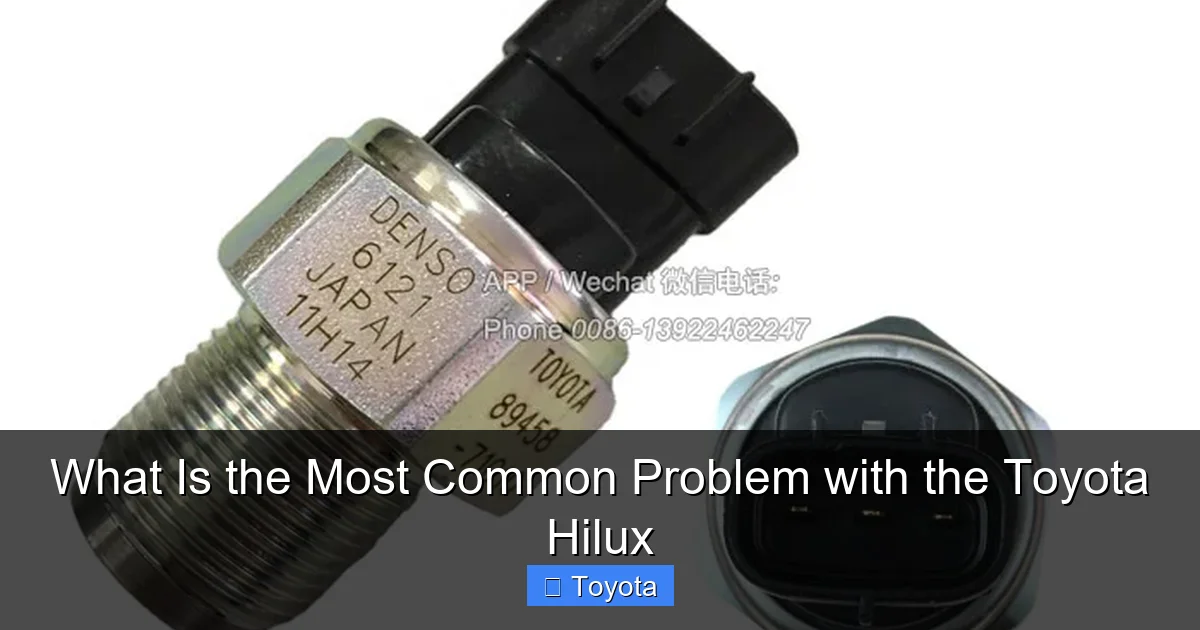
When the DPF can’t regenerate effectively, soot builds up. The ECU monitors back-pressure sensors. When the blockage becomes critical, it triggers warnings and, ultimately, protective measures to prevent engine damage. The symptoms progress from subtle to severe.
Visual guide about What Is the Most Common Problem with the Toyota Hilux
Image source: toyotahiluxparts.com
Stage 1: The Warning Light
The first and most obvious sign is the illumination of the DPF warning light on the instrument cluster (often a symbol of a filter with exhaust dots). This is your truck’s polite but firm request: “Please go for a drive that allows regeneration.” At this stage, the filter is likely 50-70% full. A continuous 20-30 minute drive at consistent highway speeds (above 80 km/h or 50 mph) should trigger and complete an active regeneration, clearing the warning.
Stage 2: The “Limp Mode” or Restricted Performance
If you ignore the warning light, the ECU will eventually enter a fail-safe mode, often called “limp mode.” You’ll experience:
- Severe Loss of Power: The engine’s power is drastically reduced to minimize soot production. Acceleration becomes sluggish, and climbing hills feels impossible.
- RPM Limiting: The engine may refuse to rev beyond a certain point (e.g., 3000 RPM).
- Persistent Warning: The DPF light may now be flashing or accompanied by a check engine light.
This mode is designed to get you to a workshop without destroying the engine. It is not sustainable for driving.
Stage 3: The Point of No Return (Complete Blockage)
If limp mode is also ignored, the soot load can reach 100%. The filter is essentially a solid plug. At this point:
- The vehicle may not start or will stall immediately after starting.
- All regeneration attempts will fail.
- The only solution is a forced, professional clean or a full replacement.
Other associated symptoms throughout the process can include a noticeable increase in fuel consumption (the engine works harder against exhaust back-pressure), a persistent smell of unburnt diesel, and sometimes visible black smoke from the exhaust during acceleration attempts.
Root Causes: Why Does the Hilux DPF Clog? (It’s Usually You… Sort Of)
Blaming the vehicle is easy. The truth is, the DPF’s health is a direct reflection of the owner’s driving style and maintenance regime. The Hilux’s DPF system is not designed for purely urban, short-trip use without intervention.

Visual guide about What Is the Most Common Problem with the Toyota Hilux
Image source: erwinsalarda.com
The Short-Trip City Slog
This is the #1 cause. If your Hilux is used primarily for:
- Daily school runs.
- Short commutes (under 20-30 minutes).
- Frequent stop-and-go delivery work.
- Idling for long periods (e.g., as a worksite vehicle).
The exhaust system never gets hot enough for passive regeneration. Active regenerations may be attempted but often fail because the journey ends before they complete. Soot accumulates cycle after cycle.
Poor Quality Fuel and Oil
Using low-quality diesel with high sulfur content or the wrong specification engine oil (non “Low SAPS” – Sulfated Ash, Phosphorus, Sulfur) accelerates ash buildup in the DPF. Ash cannot be burned off during regeneration and eventually fills the filter’s cells. Always use fuel from reputable stations and the oil grade specified in your owner’s manual (typically a low-ash oil like API CK-4 or specific Toyota specification).
Faulty Sensors or Components
While less common, a faulty DPF pressure sensor or temperature sensor can send incorrect data to the ECU, preventing it from initiating a regeneration. Similarly, issues with the EGR (Exhaust Gas Recirculation) valve can increase soot production, overloading the DPF. A diagnostic scan is needed to rule these out if symptoms appear despite good driving habits.
ECU Software Issues
In some early models of the new-gen Hilux, Toyota released ECU updates to refine regeneration logic and make it more effective in varied conditions. An outdated software map might not initiate regens frequently or aggressively enough. A dealer can check for and apply any outstanding updates.
Solutions and Fixes: From a Simple Drive to a Major Repair
Treatment depends entirely on the severity of the blockage. The golden rule: act at the first warning light.
For a Warning Light (Stage 1): Forced Regeneration
This is the simplest and cheapest fix. It often doesn’t require a mechanic. You need to perform a “forced” or “active” regeneration drive.
- The Drive: Find a long, safe stretch of road (highway). Ensure the vehicle is in “D” (automatic) or an appropriate gear (manual). Accelerate to around 80-100 km/h (50-60 mph), then maintain a steady speed. The engine should be at a constant, moderate load (around 2000-2500 RPM). Drive like this for 20-30 minutes without heavy acceleration or braking. You may hear the engine note change or see the idle revs increase slightly upon stopping—this is the regen completing.
- Alternative: Some workshops or mobile mechanics can perform a “static” forced regeneration using a diagnostic computer. This tells the ECU to initiate the regen process while the vehicle is stationary, but it requires the engine to be at full operating temperature and is less effective on severely clogged filters.
If the light goes out and stays out, you’ve likely solved it. Continue with regular highway runs.
For Limp Mode or Persistent Issues (Stage 2): Professional Cleaning
When a forced drive fails, the filter is too clogged. The standard repair is a DPF cleaning.
- Off-Vehicle Thermal Cleaning: The DPF is removed and placed in a specialized machine that burns off the soot at extremely high temperatures (600°C+) in a controlled environment. This is the most effective method, restoring up to 95% of capacity. Cost: $500 – $1,200.
- On-Vehicle Pressure/Pulse Cleaning: Less effective but cheaper. The filter is cleaned while still on the vehicle using compressed air and cleaning agents. May not clear a severe blockage. Cost: $200 – $500.
A reputable workshop will also scan for any underlying fault codes (sensors, EGR) that caused the problem in the first place.
For Complete Blockage (Stage 3): Replacement
If cleaning fails or the filter is damaged, replacement is the only option. This is the big-ticket item.
- OEM (Genuine Toyota) Part: $3,000 – $6,000+ for the filter alone, plus labor.
- Aftermarket/Remanufactured: Can be 30-50% cheaper, but quality varies. Ensure it meets emissions standards for your region.
In some extreme cases, owners explore DPF delete or tuning. This involves physically removing the filter and modifying the ECU software to ignore it. WARNING: This is illegal for road use in most countries with emissions testing (like Australia’s ADR, Europe’s MOT). It will cause a permanent check engine light, fail inspections, and void warranties. It is not a recommended solution for a road-going Hilux.
Prevention: The Hilux Owner’s DPF Maintenance Bible
An ounce of prevention is worth a pound of cure. Following these habits will make DPF problems a non-issue for most Hilux owners.
- Embrace the Highway: Once a week, if not more, take your Hilux on a dedicated 30-minute highway run. This is non-negotiable for city drivers. It ensures passive regeneration occurs.
- Don’t Ignore the Light: The moment the DPF warning appears, plan your drive. A 20-minute high-speed run is far cheaper than a $1000 clean.
- Use the Right Oil: This is critical. Only ever use the exact oil specification (e.g., Toyota Genuine Motor Oil or equivalent meeting the specified API/ACEA standard, usually a “Low SAPS” oil). The “SAPS” (Sulfated Ash, Phosphorus, Sulfur) content directly contributes to ash buildup in the DPF. Check your manual.
- Service On Time, Every Time: Stick to your service intervals. A clean air filter, healthy fuel system, and correct engine tune reduce soot production at the source.
- Quality Fuel: Use diesel from high-turnover, reputable stations. Add a diesel fuel additive (like those from Liqui Moly or Stanadyne) occasionally to help keep fuel system components clean.
- Mind the Idle: Avoid excessive idling. If you must idle for long periods (e.g., on a worksite), consider a monthly high-speed run to compensate.
- Listen to Your Truck: If you notice the engine sound change or a slight increase in idle RPM when you turn it off, that’s likely an active regeneration finishing. Let it cool down for a minute before shutting off if possible.
For fleet or commercial users whose Hiluxes never see highway miles, the DPF is a known operational cost. Strict schedules for forced regen drives or periodic professional cleaning must be built into the maintenance plan.
Beyond the DPF: Other Less Common Hilux Issues
While the DPF is the headline act, the Hilux is not without its other quirks, especially as it ages. These are far less frequent but worth noting for a complete picture.
EGR Cooler Failures
The Exhaust Gas Recirculation system, which reduces combustion temperatures to lower NOx emissions, has a cooler that can fail, leading to coolant loss, overheating, and white smoke. More common in earlier 2.4L diesel variants. A failing EGR can also increase soot load on the DPF.
Injector Problems
High-pressure common-rail injectors are complex. Symptoms include rough running, misfires, and black smoke. Failure is rare under normal use but can be caused by poor fuel quality. Replacement is expensive.
Transmission (Automatic) Hesitation/Jerking
Some owners of the 6-speed automatic transmission report occasional harsh shifts or hesitation, often due to software. A transmission control module (TCM) update from a dealer can resolve this. It’s not a widespread mechanical failure.
Suspension and Driveline Wear
As a work vehicle, Hiluxes used for heavy towing or off-road abuse will experience normal wear on CV joints, wheel bearings, and suspension bushes. This is wear-and-tear, not a defect, but it’s a common maintenance item for high-use examples.
It’s crucial to contextualize these. The DPF issue affects a specific, large subset of Hilux owners (modern diesel, urban use). The other issues are sporadic, age/mileage-dependent, and often pale in comparison to the potential financial impact of a neglected DPF.
The Verdict: Is the Hilux Still a Reliable Buy?
Absolutely, but with a major caveat. The modern diesel Toyota Hilux remains one of the most capable and well-built utes on the market. Its core mechanical integrity is unquestioned. The “most common problem” is not a ticking time bomb in the engine; it’s a predictable, manageable system requirement that clashes with a certain lifestyle.
If you are buying a used diesel Hilux (2016+), a full service history is paramount. Ask specifically about DPF cleaning or regeneration history. A vehicle that has been used for long-distance driving or has documented forced regens is a safe bet. Be wary of a city-car Hilux with low kilometers but no history of highway use—the DPF is likely a silent, clogging time bomb.
For new buyers, the advice is simple: understand your driving pattern. If your Hilux will never see a highway, you must be disciplined about weekly regen drives. Consider if a petrol Hilux (available in some markets) might better suit your needs, as it has no DPF. For the majority who use their Hilux as intended—for work, adventure, and long trips—the DPF will be a non-issue, and you’ll enjoy the legendary Toyota reliability for hundreds of thousands of kilometers. The problem isn’t the truck’s design; it’s the mismatch between an urban commute and a system built for the open road. Manage that mismatch, and your Hilux will remain the unstoppable force it’s always been.
Frequently Asked Questions
Is the DPF problem a deal-breaker for buying a used diesel Hilux?
No, it’s a manageable issue. A thorough service history showing regular maintenance and occasional highway driving is key. A full diagnostic scan for DPF-related fault codes is essential before purchase. If the current owner has only done city driving and ignored warnings, expect a costly repair.
How much does a DPF replacement actually cost on a Hilux?
For a genuine Toyota part, expect $3,000 to $6,000+ for the filter itself, plus $500-$1,000 in labor. Aftermarket or remanufactured units can reduce the parts cost by 30-50%, but ensure quality. A professional off-vehicle clean is a much cheaper alternative at $500-$1,200 if the filter isn’t damaged.
Can I permanently remove the DPF to avoid the problem?
Technically yes, but it is illegal for road use in most countries with emissions testing. It will cause a constant check engine light, fail mandatory inspections, and void any remaining warranty. It is not a legal or recommended solution for a daily-driven Hilux.
Will using a fuel or oil additive help my DPF?
Quality diesel fuel additives can help keep the entire fuel system clean, indirectly reducing soot production. However, they cannot replace the need for proper regeneration cycles. The single most important factor is using the manufacturer-specified low-ash engine oil during services.
Do petrol Toyota Hilux models have a DPF?
No. The DPF is exclusively a component of diesel engines to trap soot. Petrol engines use a different, less problematic three-way catalytic converter for emissions. If you want to avoid DPF concerns entirely and your usage is light, a petrol Hilux is a viable alternative, though it lacks the diesel’s low-end torque and fuel efficiency for heavy towing.
Is the DPF the only common problem with the Hilux?
It is by far the most common and costly for modern diesel models. Other issues like EGR cooler leaks, injector faults, or transmission software glitches exist but are far less frequent and often model-year or high-mileage specific. The Hilux’s core mechanical components (engine, gearbox, chassis) are renowned for durability when serviced correctly.