What Is the Maintenance Schedule for a Toyota Century

Contents
- 1 Key Takeaways
- 2 📑 Table of Contents
- 3 Introduction: Honoring a Legend’s Needs
- 4 Understanding the Toyota Century’s Unique Maintenance Profile
- 5 The Mileage-Based Maintenance Schedule: A Detailed Breakdown
- 6 Fluids, Filters, and Lubricants: The Lifeblood of Your Century
- 7 Tires, Brakes, and Suspension: The Road Connection
- 8 Professional vs. DIY: What Should You Do Yourself?
- 9 Conclusion: A Schedule for Serenity
- 10 Frequently Asked Questions


Keeping your Toyota Century on a strict maintenance schedule is non-negotiable for preserving its legendary reliability, comfort, and V8 power. Unlike standard models, the Century’s luxury engineering and potential for heavy use (often as a chauffeur-driven vehicle) demand meticulous, interval-based care. Adhering to Toyota’s recommended service milestones—from oil changes to complex system inspections—prevents costly repairs, ensures smooth operation, and protects your investment for the long haul. Think of it as essential healthcare for a premium automobile.
Key Takeaways
- Strict Adherence is Critical: The Century’s complex, high-performance V8 engine and luxury systems require maintenance at exact mileage intervals, not “when you get around to it.”
- Genuine Parts & Fluids Matter: Always use Toyota Genuine or manufacturer-approved parts and fluids (like specific oil weights) to match the Century’s precise engineering tolerances.
- Professional Servicing is Highly Recommended: While some basic tasks are DIY-friendly, the Century’s age (often used models) and advanced features benefit immensely from a technician familiar with its unique history.
- Maintain Meticulous Records: Keep all service invoices and a log. A complete, verifiable service history significantly boosts the Century’s value and proves its legendary care.
- Focus on Prevention, Not Just Repair: The schedule is designed to catch wear items (belts, hoses, brakes) before they fail, saving you from major, expensive breakdowns and downtime.
- Climate and Usage Affect Schedules: If your Century is used for frequent short trips, extreme temperatures, or heavy towing (though rare), you may need to perform some services more often.
📑 Table of Contents
- Introduction: Honoring a Legend’s Needs
- Understanding the Toyota Century’s Unique Maintenance Profile
- The Mileage-Based Maintenance Schedule: A Detailed Breakdown
- Fluids, Filters, and Lubricants: The Lifeblood of Your Century
- Tires, Brakes, and Suspension: The Road Connection
- Professional vs. DIY: What Should You Do Yourself?
- Conclusion: A Schedule for Serenity
Introduction: Honoring a Legend’s Needs
Let’s talk about the Toyota Century. It’s not just a car; it’s a statement. A rolling testament to Japanese engineering, quiet luxury, and bulletproof reliability. For decades, it has served as the official car for Japanese dignitaries and a cherished vessel for those who prioritize serene, effortless cruising over flashy performance. But this legendary status comes with a responsibility. That silky-smooth 5.0-liter V8 (or earlier iterations) and the plush, isolated cabin didn’t happen by accident. They are the result of obsessive engineering and, just as importantly, obsessive maintenance.
If you’re reading this, you likely own or are considering a Century. You understand it’s a different kind of Toyota. The maintenance schedule isn’t a vague suggestion; it’s a detailed roadmap to preserving the very essence of the vehicle—its unparalleled smoothness, its whisper-quiet cabin, and its ability to swallow miles without breaking a sweat. Ignoring it doesn’t just risk a breakdown; it erodes the core experience that makes the Century special. This guide will walk you through that schedule in plain language, explaining the “why” behind every task so you can make informed decisions and keep your Century performing at its absolute best for another 200,000 miles.
Understanding the Toyota Century’s Unique Maintenance Profile
Before we dive into mileage intervals, we need to adjust our mindset. A standard Camry or RAV4 maintenance schedule is a good baseline, but the Century operates on a different plane. Its primary roles—as a chauffeur-driven executive transport or a long-distance grand tourer—mean it often experiences consistent, high-speed highway cruising mixed with periods of idle waiting. This usage pattern places unique stresses on systems.
Visual guide about What Is the Maintenance Schedule for a Toyota Century
Image source: img.yumpu.com
The “Semi-Luxury” Workhorse Reality
Many Toyota Centuries, especially the G50 and G60 generations, have second lives as high-end taxis or private hire vehicles in markets like Southeast Asia. This means they are driven hard, constantly, but also maintained with fastidious care. The schedule you follow should reflect this dual nature: the precision of a luxury sedan with the durability needs of a workhorse. Components like the transmission fluid and engine oil are worked harder than in a偶尔 weekend-driven car, making timely changes even more vital.
Age vs. Mileage: The Classic Dilemma
For a car often purchased used, this is the big question. Does the 30,000-mile service come first, or the 3-year interval? The answer is: whichever comes first. Rubber components (hoses, seals, belts) degrade with time and temperature, not just mileage. A Century that sits mostly in a garage but is 15 years old still needs its coolant changed and belts inspected. Toyota’s schedules are “whichever occurs first” for a reason. We’ll break down both metrics.
The Mileage-Based Maintenance Schedule: A Detailed Breakdown
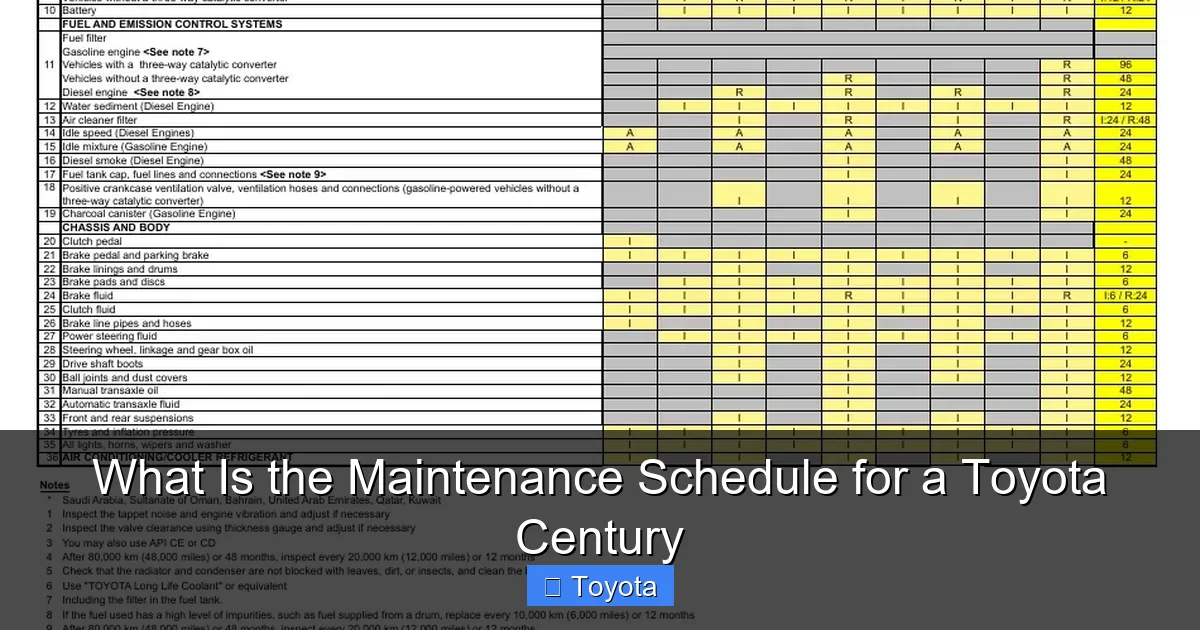
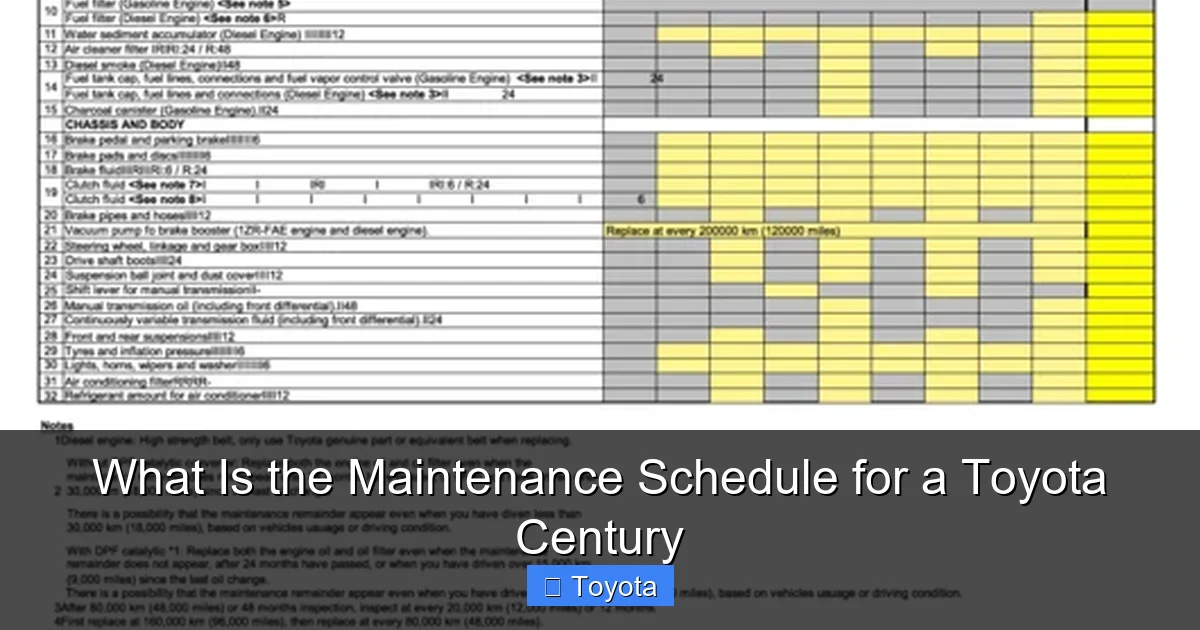
Toyota provides a very clear, interval-driven schedule for the Century. Let’s walk through it step-by-step, from the frequent to the periodic. Think of this as your master checklist.
Visual guide about What Is the Maintenance Schedule for a Toyota Century
Image source: data.formsbank.com
Every 5,000 Miles / 6 Months: The Foundation
This is the bedrock of your maintenance program. It’s more than just an oil change.
- Engine Oil & Filter Change: This is the single most important regular service. The Century’s V8 is a high-output, high-compression unit that runs best on clean oil. Always use the oil viscosity specified in your owner’s manual (typically 0W-20 or 5W-30 for newer models, but verify for your specific year). This interval prevents sludge buildup and ensures proper lubrication of the camshafts and bearings.
- Tire Rotation: Promotes even tire wear, which is crucial for the Century’s ride quality and handling. A well-maintained tire contact patch is part of what gives the car its “magic carpet” ride. Check your correct tire pressure at every service—it’s often listed on a sticker inside the driver’s door jamb. Improper pressure ruins ride quality and fuel economy.
- Multi-Point Visual Inspection: A good technician will check fluid levels, battery condition, lights, wipers, and look for any leaks. This is your early warning system.
Every 10,000 Miles / 12 Months: Stepping It Up
Building on the 5,000-mile service, this adds critical inspections and replacements.
- All items from the 5,000-mile service.
- Inspect Brake Pads, Rotors, and Fluid: The Century is a heavy car. Brakes wear faster than on a lighter vehicle. Inspecting pads for thickness and rotors for scoring is mandatory. Brake fluid is hygroscopic (absorbs water), which lowers its boiling point and can lead to a spongy pedal or even failure. It should be tested and replaced roughly every 2 years.
- Inspect Air Filter: A clogged air filter starves the engine of air, reducing power and fuel efficiency. In dusty environments, check it more often.
- Inspect Cabin Air Filter: This is your first line of defense against pollen, dust, and pollutants entering the serene cabin. A clogged one strains the HVAC blower motor and reduces airflow. Replacing it regularly is a cheap way to maintain that new-car smell and air quality.
Every 20,000 Miles / 24 Months: The Major Check-Up
This is where we start getting into more involved, time-sensitive component replacements.
- All items from the 10,000-mile service.
- Replace Engine Oil & Filter (again).
- Inspect Drive Belts: The serpentine belt that drives the alternator, power steering, and air conditioning is a critical wear item. Look for cracks, glazing, or fraying. A broken belt on the road leaves you stranded. For older Centuries, consider replacing it at this interval as a precaution.
- Inspect Fuel Lines and Connections: A visual check for any signs of leakage or damage.
- Inspect Suspension Components: Check ball joints, tie rod ends, and bushings for wear. Worn components lead to poor handling, uneven tire wear, and a compromised ride.
Every 30,000 Miles / 36 Months: The Core Service
This is a major milestone service. If you’ve kept up to this point, your Century is in good hands.
- All items from the 20,000-mile service.
- Replace Spark Plugs: For the V8, this means eight plugs. Worn plugs cause misfires, poor fuel economy, and rough running. Use the specified plug (often platinum or iridium). This is a great DIY job if you’re mechanically inclined, but on a V8, it can be labor-intensive.
- Replace Fuel Filter: Protects your expensive fuel injectors from debris in the tank. Clogging leads to poor performance and hard starting.
- Inspect/Replace PCV Valve: A simple, cheap part that regulates crankcase pressure. A stuck valve can cause oil leaks and sludge.
- Inspect All Hoses and Clamps: Radiator, heater, vacuum—look for swelling, cracks, or leaks.
- Check and Adjust Valve Clearance (if applicable):strong> Some older Century models (like the 1G-GZEU engine) have mechanically adjusted valves. If your manual calls for it, this is a precise, critical adjustment for performance and noise. A professional is best for this.
Every 60,000 Miles / 60 Months: The Major Overhaul Interval
This is where significant fluid and component life-ends are addressed. Don’t skip these.
- All items from the 30,000-mile service.
- Replace Engine Coolant: Coolant degrades over time, losing its anti-corrosive and anti-freeze properties. Old coolant can cause overheating, corrosion in the radiator and water pump, and even cylinder head damage. This is a must-do.
- Replace Transmission Fluid & Filter (if automatic): This is arguably the most important fluid change for longevity. Transmission fluid breaks down under heat and shear. For a car often driven on highways, this heat is constant. Fresh fluid ensures smooth shifts and prevents wear on clutch packs and valves. Some manuals say “lifetime,” but changing it at 60k is a smart, widely accepted practice for long-term health.
- Replace Differential Fluid (if RWD): The Century is rear-wheel drive. The differential fluid lubricates the ring and pinion gears. It’s often overlooked but is simple and cheap insurance against a noisy, worn differential.
- Replace Brake Fluid: As mentioned, brake fluid absorbs moisture. At 60k/5 years, it’s definitely due. This affects braking performance and safety.
- Inspect/Replace Timing Belt (if equipped): CRITICAL. Many Century engines use a timing belt, not a chain. A belt failure on an interference engine means catastrophic engine damage—pistons hitting valves. The belt should be replaced at the specified interval (often 60k or 90k miles, check your manual!) along with tensioners and water pump (since they’re in the same area). This is not a service to delay.
Every 100,000 Miles / 100 Months: The Long Haul
At this point, you’re dealing with items that have a very long service life.
- All items from the 60,000-mile service.
- Replace Spark Plugs (again).
- Inspect Fuel Injectors: They can get clogged. A professional cleaning may be needed if performance dips.
- Inspect Engine mounts: Worn mounts cause vibration and harshness, ruining the Century’s famed smoothness.
- Comprehensive System Diagnostic: A full computer scan to check for any stored or pending trouble codes. Catching a minor sensor issue early can prevent larger problems.
Fluids, Filters, and Lubricants: The Lifeblood of Your Century
Let’s zoom in on the substances that keep everything running. Using the wrong type or letting them degrade is a primary cause of Century issues.
Visual guide about What Is the Maintenance Schedule for a Toyota Century
Image source: i.ytimg.com
Engine Oil: The Non-Negotiable
The Century’s V8, especially in later models with VVT-i (variable valve timing), has tight tolerances. Using the exact oil weight and specification (API, ILSAC) is mandatory. 0W-20 synthetic is common for post-2000 models for better cold-start flow and fuel economy. For older models, 5W-30 might be specified. Never use conventional oil in a modern Century. The change interval depends on your driving: severe service (lots of short trips, extreme temps) means stick to 5,000 miles. Mostly highway? 7,500-10,000 might be okay, but 5,000 is the safest bet for longevity.
Transmission Fluid: The Silent Guardian
Automatic transmission fluid (ATF) does more than lubricate; it transmits hydraulic pressure and cools the transmission. For the Century’s A340E or similar robust transmission, the fluid must be changed. Draining the pan only gets about 40% of the old fluid. A proper “flush-and-fill” or multiple drain-and-fill procedures are needed to replace nearly all the fluid. Use only Toyota Genuine ATF Type T-IV or the exact equivalent specified. This is the key to avoiding a $4,000+ transmission rebuild.
Coolant: More Than Just Antifreeze
Modern coolants are complex chemical cocktails. They prevent corrosion, cavitation, and boiling. Toyota typically uses a specific, often pink or red, long-life coolant (LLC). Mixing different types can create sludge. A complete drain-and-refill of the radiator and engine block is necessary at the 60k/5-year mark. This is also a good time to inspect the radiator core for clogs and the water pump for leaks.
Other Critical Fluids
- Brake Fluid: DOT 3 or DOT 4, as specified. Must be changed every 2 years regardless of mileage.
- Power Steering Fluid: If your Century has hydraulic power steering (not all do), check level and condition. It can degrade and cause noise or stiffness.
- Differential Fluid: Hypoid gear oil, specific to your model. Often 75W-90. Change at 60k intervals.
- Windshield Washer Fluid: Use a solution with antifreeze in winter to prevent system damage.
Tires, Brakes, and Suspension: The Road Connection
This is where the Century’s magic meets the road. A perfectly maintained engine is useless if the tires are bald or the brakes are fading.
Tire Care: Preservation of Comfort
The Century rides on tall, soft sidewalls. This is great for comfort but makes them susceptible to uneven wear if alignment is off.
- Rotation: Every 5,000-8,000 miles. This is simple and free with most oil changes.
- Pressure: Check monthly. Under-inflation causes shoulder wear, overheating, and poor fuel economy. Over-inflation causes center wear and a harsh ride. Use the door jamb sticker pressure, not the max on the tire sidewall.
- Alignment: Get an alignment check at least once a year or if you notice pulling or uneven wear. Hitting a pothole can knock it out.
- Replacement: Don’t wait until the tread wear bars. For a car of this caliber, replace tires when they still have 3/32″ of tread for optimal wet weather safety and ride quality.
Brake System: Safety is Paramount
The Century’s weight means brakes work hard.
- Pads and Rotors: Inspect at every service. Replace pads in pairs (axle sets). Rotors can often be resurfaced (“turned”) if above minimum thickness, but on a heavy car, replacement is frequently more cost-effective long-term.
- Brake Fluid Flush: Every 2 years. Moisture in the fluid lowers boiling point, leading to brake fade or failure under hard use. It’s a simple, crucial service.
- Calipers and Hardware: Inspect for sticking, leaks, and rust. Replace slider pins and hardware with pad changes for smooth operation.
Suspension: The Key to the “Floating” Feel
The Century’s air suspension system (if equipped on certain models) or its sophisticated coil springs and shock absorbers need attention.
- Air Suspension (if applicable): Listen for the air compressor running excessively. Check for air leaks from the bags or lines. These components can fail and are expensive. Early detection is key.
- Standard Suspension: Inspect shocks/struts for leaks or failure (a “nosedive” under braking is a sign). Check all bushings and ball joints for play. Worn bushings lead to clunks and poor handling.
Professional vs. DIY: What Should You Do Yourself?
The Century is a straightforward, well-built car, but its age and complexity require honest assessment of your skills.
Excellent DIY Projects
- Oil & Filter Change: Simple, clean, and gives you a direct connection to the car. Use a quality filter and the correct oil.
- Air Filter & Cabin Air Filter: Usually just clips or screws. Very easy.
- Spark Plugs: Accessible on most V8s. Just be gentle with the coils and use the correct socket with a rubber insert to avoid cracking the ceramic plugs.
- Wiper Blades, Bulbs, and Basic Fluid Top-Ups.
Leave It to the Professionals
- Timing Belt/Water Pump Replacement: This is an interference engine. One wrong tooth and you’re rebuilding the head. Requires specialty tools and precision.
- Transmission Fluid Service: Getting a true fluid exchange requires specialized equipment to avoid damaging the valve body.
- Brake Fluid Flush: Requires a pressure bleeder or a two-person procedure to get all air out. Improper bleeding is dangerous.
- Major Diagnostic Work: Electrical gremlins, sensor issues, or check engine lights often need advanced scan tools and knowledge.
- Suspension Work: Especially on air-suspended models or when pressing out bushings.
Pro Tip: Even if you DIY, use a reputable independent mechanic familiar with Japanese luxury cars or a Toyota specialist for the major services and inspections. They know the common failure points of the Century.
Conclusion: A Schedule for Serenity
The Toyota Century’s maintenance schedule is more than a list of tasks; it’s a covenant with the car’s original design philosophy. It was built to provide decades of silent, faultless service to its occupants. That promise can only be kept through disciplined, timely care. By following the mileage and time intervals outlined here, using genuine fluids and parts, and partnering with skilled technicians for the complex jobs, you are not just preventing breakdowns. You are actively preserving the soul of the machine—that profound quietness, that effortless surge of V8 power, that sensation of being completely isolated from the rough edges of the world outside. A well-maintained Century is a joy to drive and a testament to your ownership. A neglected one, no matter how robust, will slowly surrender its magic. Invest in the schedule, and your Century will reward you with a driving experience few cars can ever match.
Frequently Asked Questions
What is the single most important maintenance item for a Toyota Century?
While all items matter, the most critical are timely timing belt replacement (if your engine uses one) and transmission fluid changes. A failed timing belt causes instant, catastrophic engine damage. Neglected transmission fluid leads to a slow, expensive death of the transmission. Both are non-negotiable for long-term survival.
How much should I expect to pay for a major 60,000-mile service on a Century?
Costs vary by region and shop, but for a full service including coolant, transmission fluid, differential fluid, brake fluid, spark plugs, and a thorough inspection, you’re looking at $800 to $1,500 at a reputable independent shop. Dealerships will be higher. This is an investment that prevents $3,000-$5,000+ repairs down the line.
Can I use regular motor oil in my Toyota Century?
Absolutely not. The Century’s high-compression V8 engine requires specific synthetic oil with the exact viscosity (e.g., 0W-20) and API/ILSAC certification listed in your owner’s manual. Using the wrong oil can cause increased wear, sludge formation, and even trigger check engine lights related to variable valve timing systems.
Is it okay to extend the maintenance intervals if I mostly drive on the highway?
While highway driving is easier on a car than stop-and-go traffic, you should not arbitrarily extend Toyota’s recommended intervals. The “whichever comes first” rule (miles or time) exists for a reason. Fluids degrade with time and heat, and seals dry out. Stick to the schedule for maximum reliability and to maintain a flawless service history.
Where is the best place to get my Toyota Century serviced?
Your best bets are 1) A Toyota dealership for factory-trained technicians and full warranty compliance (if applicable), 2) A highly-rated independent Japanese or Toyota specialist who understands these cars’ nuances, or 3) A trusted general mechanic with proven experience on older Japanese luxury vehicles. Avoid quick-lube chains for anything beyond an oil change.
How does proper maintenance affect the resale value of a Toyota Century?
Enormously. A complete, verifiable service history from reputable shops is the #1 factor in commanding a premium price for a used Century. It proves the car has been cared for and predicts future reliability. A car with spotty or missing records will sell for significantly less and sit on the market longer, as buyers are wary of hidden problems.