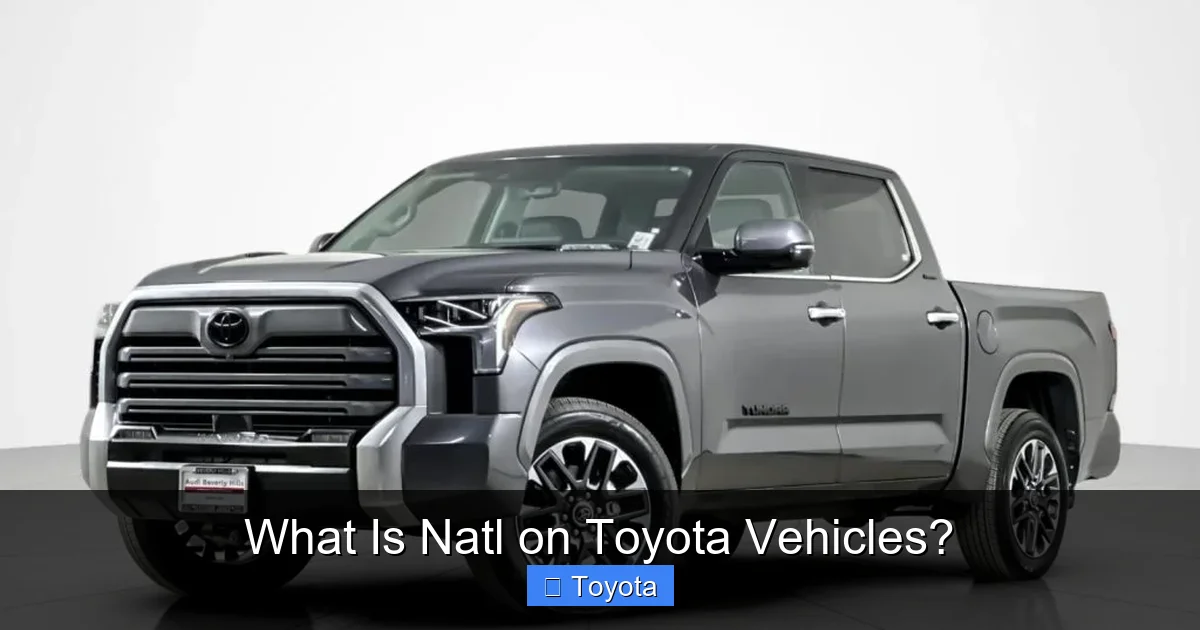
What Is Natl on Toyota Vehicles?

Contents
- 1 Key Takeaways
- 2 📑 Table of Contents
- 3 What Is NATL on Toyota Vehicles?
- 4 Understanding the Basics: What Does NATL Stand For?
- 5 Why Did Toyota Include NATL in Its Vehicles?
- 6 Which Toyota Models Use NATL?
- 7 How NATL Affects Your Driving Experience
- 8 Common Misconceptions About NATL
- 9 Maintaining Your Toyota with NATL
- 10 Conclusion: NATL Is Your Toyota’s Silent Guardian
- 11 Frequently Asked Questions



If you’ve ever seen “NALT” or “NATL” on your Toyota dashboard or owner’s manual, you’re not alone—many drivers are confused by this acronym. In this article, we’ll break down exactly what NATL means, how it works, and why it matters for your Toyota vehicle’s performance and safety.
Key Takeaways
- NATL stands for Non-Adjustable Torque Limiter: It’s a safety feature designed to prevent excessive torque from damaging your Toyota’s transmission or drivetrain.
- It protects critical components: NATL helps safeguard the transmission, differential, and axles from sudden stress during hard acceleration or towing.
- Common in older Toyota models: You’ll most often find NATL in trucks and SUVs from the late 1990s to early 2010s, especially in models like the Tacoma, 4Runner, and Tundra.
- Not a warning light or error code: Unlike check engine lights, NATL isn’t a diagnostic alert—it’s a mechanical or software-based limiter built into the vehicle.
- Affects performance under load: When activated, NATL may reduce engine power temporarily to prevent damage, especially during towing or off-roading.
- Maintenance can help prevent issues: Regular servicing of the transmission and drivetrain reduces the chances of NATL-related performance drops.
- Understanding NATL improves driving habits: Knowing how it works helps you drive more efficiently and avoid unnecessary strain on your vehicle.
📑 Table of Contents
- What Is NATL on Toyota Vehicles?
- Understanding the Basics: What Does NATL Stand For?
- Why Did Toyota Include NATL in Its Vehicles?
- Which Toyota Models Use NATL?
- How NATL Affects Your Driving Experience
- Common Misconceptions About NATL
- Maintaining Your Toyota with NATL
- Conclusion: NATL Is Your Toyota’s Silent Guardian
What Is NATL on Toyota Vehicles?
If you’re a Toyota owner—especially of a truck or SUV—you might have come across the term “NATL” in your owner’s manual, on a service report, or even in a forum discussion. But what exactly does it mean? Is it a warning? A feature? A defect?
NATL stands for **Non-Adjustable Torque Limiter**. It’s not a warning light, not a diagnostic trouble code, and not something that appears on your dashboard. Instead, it’s a built-in safety mechanism designed to protect your vehicle’s drivetrain from excessive stress. Think of it as a mechanical or electronic “circuit breaker” that kicks in when your Toyota is under heavy load—like when you’re towing a trailer, climbing a steep hill, or accelerating quickly from a stop.
This feature is most commonly found in older Toyota trucks and SUVs, particularly models from the late 1990s through the early 2010s. While newer Toyotas have more advanced electronic control systems that manage torque more seamlessly, NATL was an early solution to a very real problem: protecting expensive components from damage due to sudden or excessive force.
In this article, we’ll dive deep into what NATL is, how it works, why Toyota included it, and what it means for your driving experience. Whether you’re a weekend warrior hauling gear, a daily commuter, or a weekend off-roader, understanding NATL can help you get the most out of your Toyota while keeping it running smoothly for years to come.
Understanding the Basics: What Does NATL Stand For?
Visual guide about What Is Natl on Toyota Vehicles?
Image source: thecarhow.com
Let’s start with the basics. NATL is an acronym that stands for **Non-Adjustable Torque Limiter**. To understand what that means, let’s break it down:
– **Non-Adjustable:** This means the limiter is set at the factory and cannot be changed or tuned by the driver or even most mechanics. It’s a fixed threshold designed to protect the vehicle.
– **Torque:** Torque is the rotational force produced by the engine. It’s what gets your vehicle moving, especially from a standstill or when climbing hills.
– **Limiter:** A limiter is a device or system that restricts or controls a certain function—in this case, how much torque can be delivered to the transmission and drivetrain.
So, a Non-Adjustable Torque Limiter is a built-in safeguard that prevents the engine from sending too much torque to the transmission, differential, and axles all at once. This is especially important in vehicles that are designed for heavy-duty use, like the Toyota Tacoma, 4Runner, or Tundra.
How Does NATL Work?
NATL doesn’t work like a typical sensor or warning system. Instead, it’s often integrated into the vehicle’s engine control unit (ECU) or transmission control module (TCM). When the system detects that torque demand is approaching a level that could damage the drivetrain, it intervenes.
For example, if you’re towing a heavy trailer up a steep incline and suddenly press the accelerator hard, the engine wants to send a surge of power. But the NATL system recognizes that this sudden spike could stress the transmission or axles beyond their safe limits. In response, it may:
– Reduce engine power temporarily
– Delay upshifts or downshifts
– Limit throttle response
This doesn’t mean your vehicle is broken—it means the system is doing its job to protect your investment.
Is NATL the Same as a Torque Converter Lock-Up?
No, NATL is not the same as a torque converter lock-up, though both relate to torque management. The torque converter is part of an automatic transmission and helps transfer engine power to the transmission. Lock-up occurs when the converter “locks” to improve fuel efficiency and reduce heat.
NATL, on the other hand, is a broader safety system that can affect multiple components. While the torque converter may be involved, NATL operates at a higher level, often coordinating between the engine, transmission, and drivetrain to prevent overload.
Why Did Toyota Include NATL in Its Vehicles?
Visual guide about What Is Natl on Toyota Vehicles?
Image source: i.ebayimg.com
Toyota is known for building durable, long-lasting vehicles—especially trucks and SUVs. But even the toughest vehicles have limits. The drivetrain—including the transmission, transfer case, differentials, and axles—can only handle so much stress before components begin to wear out or fail.
In the late 1990s and early 2000s, Toyota began equipping many of its 4×4 and heavy-duty models with NATL as a way to prevent catastrophic failures. This was especially important for vehicles marketed toward off-roading, towing, and work use.
Protecting the Drivetrain from Sudden Stress
Imagine you’re driving a Toyota Tacoma up a rocky trail. You hit a steep section and floor the gas to get over a ledge. Without a torque limiter, the sudden surge of power could twist an axle, damage the differential, or even crack the transmission case.
NATL helps prevent this by smoothing out power delivery. It doesn’t eliminate torque—it just ensures it’s applied gradually and safely. This is especially important in older vehicles that don’t have modern electronic stability control or advanced traction management systems.
Extending Vehicle Lifespan
By reducing the risk of drivetrain damage, NATL helps extend the lifespan of your Toyota. A transmission rebuild can cost thousands of dollars. Replacing axles or differentials is even more expensive. NATL acts as a first line of defense, helping owners avoid costly repairs.
This is one reason why many older Toyotas are still on the road today—even with high mileage. The NATL system, along with Toyota’s reputation for reliability, helps these vehicles endure tough conditions year after year.
Meeting Safety and Durability Standards
Toyota engineers designed NATL not just for performance, but for safety. Sudden drivetrain failure can lead to loss of control, especially in off-road or towing situations. By limiting torque under extreme conditions, NATL helps maintain vehicle stability and driver control.
It also aligns with Toyota’s broader philosophy of “kaizen”—continuous improvement and reliability. NATL is a practical example of how engineering decisions are made with long-term durability in mind.
Which Toyota Models Use NATL?
Visual guide about What Is Natl on Toyota Vehicles?
Image source: images.hgmsites.net
NATL is not found in every Toyota vehicle. It’s primarily used in models that are designed for heavy-duty use, particularly those with part-time or full-time four-wheel drive systems. You’re most likely to find NATL in:
– Toyota Tacoma (especially 1995–2015 models)
– Toyota 4Runner (1996–2013, particularly V6 and V8 versions)
– Toyota Tundra (2000–2013, especially with the 4.7L V8)
– Toyota Land Cruiser (certain model years)
– Toyota Sequoia (early 2000s models)
These vehicles were often used for towing, off-roading, or work purposes, making torque management a critical feature.
How to Know If Your Toyota Has NATL
There’s no dashboard light or menu option that says “NATL Active.” However, you can often tell if your vehicle has this feature by:
– Checking the owner’s manual: Look for terms like “torque management,” “drivetrain protection,” or “non-adjustable limiter.”
– Consulting a Toyota service technician: They can confirm if your model year and trim include NATL.
– Observing driving behavior: If your vehicle feels like it’s “holding back” under heavy load—especially during acceleration or towing—it could be NATL at work.
Keep in mind that newer Toyotas (2015 and later) use more advanced electronic systems like Dynamic Torque Control or Integrated Dynamics Control, which serve similar purposes but are more refined and adjustable.
NATL vs. Modern Torque Management Systems
Modern Toyotas use sophisticated software and sensors to manage torque in real time. These systems can adjust power delivery based on traction, load, terrain, and driver input. They’re more responsive and less noticeable to the driver.
NATL, by contrast, is a simpler, fixed system. It’s effective but less flexible. That’s why it’s mostly found in older models. As technology advanced, Toyota phased out NATL in favor of smarter, more adaptive systems.
How NATL Affects Your Driving Experience
So, what does it feel like when NATL is active? Most drivers won’t notice it under normal conditions. But under heavy load, you might experience:
– A slight delay in acceleration when flooring the gas
– The engine feeling “muted” or less responsive during towing
– The transmission holding gears longer than expected
These aren’t signs of a problem—they’re signs that NATL is protecting your vehicle.
Driving with NATL: Tips and Best Practices
If your Toyota has NATL, here are some tips to get the best performance while keeping your drivetrain safe:
1. **Avoid sudden acceleration under load:** When towing or climbing hills, ease into the throttle instead of slamming it. This reduces stress on the drivetrain and helps NATL do its job smoothly.
2. **Use lower gears when towing:** Downshifting manually (if your vehicle has a manual mode) can help manage torque and reduce strain.
3. **Maintain your transmission:** Regular fluid changes and inspections help ensure the system works properly. Dirty or low transmission fluid can make NATL less effective.
4. **Don’t ignore warning signs:** If your vehicle feels unusually sluggish or makes grinding noises, have it checked. NATL prevents damage, but it’s not a substitute for proper maintenance.
Can You Disable NATL?
Technically, NATL is “non-adjustable,” meaning it’s not meant to be turned off. Some aftermarket tuners or performance shops claim they can modify the ECU to bypass NATL, but this is not recommended.
Disabling NATL increases the risk of drivetrain damage, especially if you’re towing or off-roading. It also voids warranties and may violate emissions or safety regulations. Toyota designed NATL for a reason—removing it undermines the vehicle’s safety and durability.
Common Misconceptions About NATL
Because NATL isn’t widely discussed, there are several myths and misunderstandings about what it does and how it works.
“NATL Is a Warning Light”
No, NATL is not a dashboard warning. You won’t see a “NATL” light on your instrument cluster. It’s a background system that operates silently unless conditions trigger it.
“NATL Means My Transmission Is Failing”
Not true. NATL is a protective feature, not a symptom of failure. If your transmission is slipping, making noise, or overheating, that’s a separate issue that needs attention—but it’s not caused by NATL.
“All Toyotas Have NATL”
Only certain models and model years include NATL. Most passenger cars, hybrids, and newer SUVs do not have this system. It’s primarily found in older trucks and off-road-capable vehicles.
“NATL Reduces Performance Permanently”
NATL only activates under extreme conditions. During normal driving, it has no effect on performance. It’s like a seatbelt—you don’t notice it until you need it.
Maintaining Your Toyota with NATL
Even with NATL, your Toyota needs regular maintenance to stay in top shape. Here’s how to care for a vehicle with this system:
Transmission Service
The transmission is one of the most critical components protected by NATL. Follow Toyota’s recommended service schedule—typically every 30,000 to 60,000 miles—for fluid and filter changes. Use only Toyota-approved ATF (Automatic Transmission Fluid).
Differential and Transfer Case Maintenance
These components also benefit from NATL’s protection. Check and replace differential fluid every 30,000 to 50,000 miles, especially if you off-road or tow frequently.
Tire and Axle Inspection
Uneven tire wear or damaged CV axles can increase stress on the drivetrain. Regular inspections help catch issues early.
Battery and Electrical System
Since NATL relies on the ECU, a weak battery or faulty sensors can affect its performance. Keep your electrical system in good condition.
Conclusion: NATL Is Your Toyota’s Silent Guardian
NATL—Non-Adjustable Torque Limiter—may not be a term you hear every day, but it plays a vital role in protecting your Toyota’s drivetrain. Found primarily in older trucks and SUVs, this system acts as a mechanical safety net, preventing excessive torque from damaging critical components.
While it may cause a slight reduction in responsiveness under heavy load, that’s a small price to pay for the peace of mind that comes with knowing your vehicle is built to last. NATL is a testament to Toyota’s commitment to durability, safety, and long-term reliability.
If you own a Toyota from the late 1990s to early 2010s—especially a Tacoma, 4Runner, or Tundra—there’s a good chance NATL is working behind the scenes to keep your ride running strong. Understanding how it works helps you drive smarter, maintain your vehicle better, and get the most out of every mile.
So the next time you feel your Toyota “holding back” on a steep hill or while towing, don’t panic. It’s not a problem—it’s NATL doing its job.
Frequently Asked Questions
What does NATL stand for on Toyota vehicles?
NATL stands for Non-Adjustable Torque Limiter. It’s a built-in safety feature designed to protect the drivetrain from excessive torque, especially during towing or off-roading.
Is NATL a warning light or error code?
No, NATL is not a warning light or diagnostic code. It’s a mechanical or electronic limiter that operates in the background to protect your vehicle’s transmission and drivetrain.
Which Toyota models have NATL?
NATL is most commonly found in older Toyota trucks and SUVs, including the Tacoma, 4Runner, Tundra, Land Cruiser, and Sequoia from the late 1990s to early 2010s.
Can I disable NATL on my Toyota?
While some tuners claim they can disable NATL, it’s not recommended. Doing so increases the risk of drivetrain damage and may void your warranty or violate safety standards.
Does NATL affect fuel economy?
NATL has minimal impact on fuel economy. It only activates under heavy load and doesn’t change normal driving behavior or efficiency.
How do I know if NATL is active in my vehicle?
You won’t see a dashboard indicator, but you might notice reduced throttle response or delayed acceleration when towing or climbing hills. This is normal and indicates NATL is protecting your drivetrain.