What Is Liability Car Insurance?

Contents
- 1 Key Takeaways
- 2 📑 Table of Contents
- 3 What Is Liability Car Insurance?
- 4 Why Is Liability Insurance Required?
- 5 Types of Liability Coverage
- 6 What Does Liability Insurance Cover?
- 7 What Doesn’t Liability Insurance Cover?
- 8 How Much Liability Insurance Should You Carry?
- 9 How to Get Liability Car Insurance
- 10 Conclusion
- 11 Frequently Asked Questions
Car Wash Mitt

Trunk Organizer

Rear View Camera

OBD2 Scanner Tool
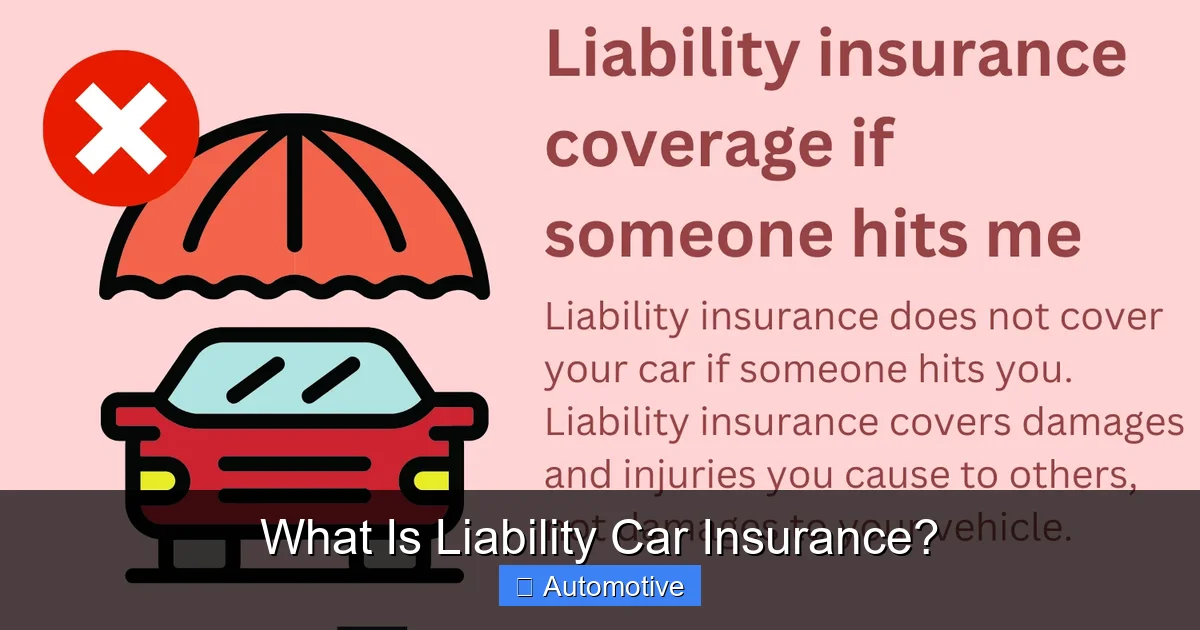
Liability car insurance covers damages or injuries you cause to others in an accident. It’s legally required in most states and protects you from costly lawsuits. Understanding your coverage limits and what’s excluded helps you drive with confidence and stay compliant.
Key Takeaways
- Legal Requirement: Most states mandate liability insurance to legally operate a vehicle.
- Covers Others, Not You: Pays for other people’s medical bills and property damage when you’re at fault.
- Two Main Types: Bodily injury liability and property damage liability are the core components.
- Limits Matter: Choose coverage limits wisely—low limits may leave you underinsured.
- Doesn’t Cover Your Vehicle: Your own car repairs and medical costs aren’t included unless you add other coverage.
- State Minimums Vary: Each state sets its own minimum requirements—know your local laws.
- Can Prevent Lawsuits: Adequate liability coverage reduces the risk of personal financial loss in major accidents.
📑 Table of Contents
What Is Liability Car Insurance?
So, you’ve got your driver’s license, your car is registered, and you’re ready to hit the road. But before you do, there’s one crucial thing you can’t skip: car insurance. And not just any insurance—liability car insurance. It might sound like just another piece of paperwork, but it’s actually one of the most important protections you can have as a driver.
Liability car insurance is a type of coverage that pays for the costs associated with injuries or property damage you cause to others in a car accident where you’re at fault. Think of it as your financial safety net when things go wrong. If you rear-end someone, run a red light and hit another car, or accidentally damage a mailbox while backing up, liability insurance steps in to cover the other party’s expenses—not yours. This includes medical bills, car repairs, and even lost wages for the injured person.
But here’s the kicker: in most states, you can’t legally drive without it. Every state except New Hampshire requires drivers to carry at least a minimum amount of liability insurance. Even in New Hampshire, you still need to prove financial responsibility if you cause an accident. So whether you like it or not, liability insurance is non-negotiable if you want to stay on the right side of the law—and protect your wallet.
Why Is Liability Insurance Required?

Visual guide about What Is Liability Car Insurance?
Image source: images.surferseo.art
You might be wondering, “Why does the government care if I have insurance?” The short answer: accountability. Driving a car comes with risks—not just to you, but to everyone else on the road. Accidents happen, and when they do, someone usually ends up hurt or with a damaged vehicle. Without liability insurance, that person could be left paying thousands—or even tens of thousands—of dollars out of pocket.
By requiring liability insurance, states ensure that drivers who cause accidents can cover the resulting costs. It’s about fairness and responsibility. Imagine causing a serious accident that leaves someone with broken bones and a totaled car. Without insurance, you might not have the money to pay for their medical treatment or vehicle replacement. That could lead to lawsuits, wage garnishment, or even bankruptcy. Liability insurance helps prevent that by shifting the financial burden from the victim to the at-fault driver’s insurance company.
But it’s not just about protecting others—it’s also about protecting you. If you’re found at fault in an accident and don’t have insurance, you could face hefty fines, license suspension, or even jail time in some cases. Plus, you’d be personally responsible for all damages, which could devastate your finances. Liability insurance acts as a buffer, giving you peace of mind knowing that if the worst happens, you won’t be left completely exposed.
State-by-State Requirements
Every state sets its own minimum liability insurance requirements, so what’s enough in one place might not cut it in another. These requirements are usually expressed as three numbers, like 25/50/25. Let’s break that down:
– The first number (25) refers to bodily injury liability per person, in thousands of dollars. So $25,000 is the max your insurance will pay for one person’s injuries.
– The second number (50) is the total bodily injury liability per accident. That means your policy will cover up to $50,000 total for all injured parties in a single crash.
– The third number (25) is property damage liability per accident—$25,000 to cover damage to other people’s vehicles or property.
For example, California requires 15/30/5, while Florida requires 10/20/10. Texas, on the other hand, mandates 30/60/25. These differences matter because a minimum policy in one state might leave you dangerously underinsured in another. If you move or frequently drive across state lines, it’s smart to check the requirements wherever you go.
What Happens If You Drive Without Liability Insurance?
Driving without liability insurance is a risky move—and not just because you’re breaking the law. If you’re caught driving uninsured, the penalties can be severe. In most states, your first offense might result in a fine, license suspension, and having to file an SR-22 form (a certificate of financial responsibility) to prove you’re now insured. Repeat offenses can lead to higher fines, longer license suspensions, and even vehicle impoundment.
But the real danger comes if you cause an accident. Without liability insurance, you’re personally liable for all damages. That means the other driver can sue you for medical bills, car repairs, pain and suffering, and more. If you can’t pay, your wages could be garnished, or your assets seized. In extreme cases, you could face bankruptcy.
Even if you’re not at fault, driving uninsured can still cause problems. Some states have “no-pay, no-play” laws that limit uninsured drivers’ ability to collect damages—even if the other driver was clearly at fault. So skipping insurance isn’t just illegal—it’s financially reckless.
Types of Liability Coverage
Visual guide about What Is Liability Car Insurance?
Image source: images.surferseo.art
Liability insurance isn’t a one-size-fits-all product. It’s actually made up of two distinct types of coverage, each designed to protect you in different ways. Understanding the difference between them is key to making smart insurance decisions.
Bodily Injury Liability
Bodily injury liability (BI) covers medical expenses, lost wages, and other costs related to injuries you cause to other people in an accident. This includes passengers in the other vehicle, pedestrians, cyclists, or even passengers in your own car (in some cases).
Let’s say you run a stop sign and hit another car, injuring the driver and two passengers. Their medical bills total $40,000. If your BI coverage is 25/50, your insurance will pay up to $25,000 per person and $50,000 total. So in this case, your policy would cover the full $40,000. But if the bills were $70,000, you’d be on the hook for the extra $20,000.
Bodily injury claims can be expensive. A broken leg might cost $10,000, but a traumatic brain injury could run into the hundreds of thousands. That’s why many experts recommend carrying more than the state minimum—especially if you have assets to protect.
Property Damage Liability
Property damage liability (PD) covers the cost of repairing or replacing other people’s property that you damage in an accident. This usually means the other driver’s vehicle, but it can also include fences, mailboxes, buildings, or even utility poles.
For example, if you back into someone’s garage door and cause $8,000 in damage, your PD coverage would pay for the repairs—up to your policy limit. If your limit is $10,000, you’re covered. But if the damage is $15,000, you’ll need to pay the extra $5,000 yourself.
While property damage claims are often smaller than bodily injury claims, they can still add up. High-end cars, luxury vehicles, or even minor damage to multiple vehicles in a multi-car pileup can quickly exceed low coverage limits.
Combined Single Limit (CSL) vs. Split Limit
Most liability policies use a “split limit” format—like 25/50/25—where each type of coverage has its own cap. But some drivers opt for a “combined single limit” (CSL) policy, which gives you one total amount that can be used for both bodily injury and property damage.
For example, a $100,000 CSL policy means your insurance will pay up to $100,000 total per accident, regardless of how it’s split between injuries and property damage. This offers more flexibility, especially in serious accidents where one type of damage far exceeds the other.
While CSL policies can be more expensive, they’re often worth it for drivers with significant assets or those who want maximum protection without worrying about hitting individual limits.
What Does Liability Insurance Cover?
Visual guide about What Is Liability Car Insurance?
Image source: agilerates.com
Now that we’ve covered the basics, let’s dive into what liability insurance actually pays for. It’s important to know exactly what’s included—and what’s not—so you can avoid surprises when you need your policy most.
Medical Expenses for Others
If you cause an accident that injures someone else, your bodily injury liability coverage will pay for their medical treatment. This includes ambulance rides, emergency room visits, surgeries, hospital stays, physical therapy, and prescription medications. It also covers long-term care if the injuries are severe.
For example, if you hit a cyclist and they suffer a spinal injury requiring surgery and months of rehab, your BI coverage would pay those bills—up to your policy limit. This can prevent the injured person from facing financial ruin and protect you from a lawsuit.
Lost Wages and Pain and Suffering
Liability insurance doesn’t just cover medical bills. It can also pay for lost income if the injured person can’t work due to their injuries. If someone misses three months of work after a crash, your policy may reimburse their lost wages.
In some cases, liability insurance also covers “pain and suffering”—a legal term for the physical and emotional distress caused by an injury. This is often included in settlements or court awards, and your insurance will pay up to your policy limit.
Property Damage to Vehicles and Other Property
Property damage liability covers repairs to the other driver’s car, but it doesn’t stop there. If you crash into a storefront, damage a fence, or knock over a utility pole, your PD coverage will pay for the repairs or replacement.
For instance, if you lose control on icy roads and plow into a neighbor’s mailbox and landscaping, your insurance will cover the cost of replacing the mailbox and restoring the yard—again, up to your limit.
Legal Defense Costs
If the other party sues you after an accident, your liability insurance may also cover your legal defense. This includes attorney fees, court costs, and settlements or judgments—up to your policy limit.
This is a huge benefit. Legal battles can cost tens of thousands of dollars, even if you win. Having insurance means you won’t have to pay out of pocket for a lawyer or risk losing your savings in a lawsuit.
What Doesn’t Liability Insurance Cover?
Here’s where many drivers get confused: liability insurance only covers others—not you. If you want protection for your own injuries or vehicle damage, you’ll need additional coverage.
Your Own Medical Bills
If you’re injured in an accident, even if it’s your fault, liability insurance won’t pay for your medical treatment. That’s where medical payments coverage (MedPay) or personal injury protection (PIP) comes in. These optional coverages pay for your healthcare costs, regardless of who caused the crash.
Damage to Your Vehicle
If your car is damaged in an accident, liability insurance won’t cover the repairs—even if the other driver is at fault. For that, you need collision coverage (if you’re at fault) or uninsured motorist property damage (if the other driver is uninsured).
Theft, Vandalism, or Natural Disasters
Liability insurance doesn’t protect your car from non-collision events like theft, hail, fire, or flooding. For that, you’ll need comprehensive coverage, which is separate from liability.
Personal Belongings
If your laptop, phone, or other personal items are damaged or stolen from your car, liability insurance won’t help. Comprehensive coverage may cover some of these losses, but often with limits.
Rental Car Reimbursement
If your car is in the shop after an accident, liability insurance won’t pay for a rental. You’ll need to add rental reimbursement coverage to your policy for that benefit.
How Much Liability Insurance Should You Carry?
State minimums are just that—minimums. They’re designed to meet legal requirements, not to fully protect you in a serious accident. In fact, many financial experts recommend carrying significantly more than the minimum.
The Risk of Being Underinsured
Let’s say your state requires 25/50/25, but you cause an accident that results in $100,000 in medical bills and $30,000 in property damage. Your insurance will only pay $50,000 for injuries and $25,000 for property damage—leaving you responsible for $55,000. That’s a huge financial hit.
If you own a home, have savings, or earn a good income, you’re at risk of being sued for the difference. And if you lose, your wages could be garnished or your assets seized.
Recommended Coverage Levels
Many insurance professionals suggest carrying at least 100/300/100—meaning $100,000 per person for bodily injury, $300,000 per accident, and $100,000 for property damage. This provides much better protection, especially in multi-vehicle or high-severity accidents.
If you have significant assets—like a home, investments, or a high income—you might even consider an umbrella policy. This adds extra liability coverage (often $1 million or more) on top of your auto and home insurance, giving you even more peace of mind.
Factors That Affect Your Decision
When deciding how much liability coverage to buy, consider:
– Your net worth (assets minus debts)
– Your income and earning potential
– The value of your car and other possessions
– How much you drive and where (urban areas have higher accident risks)
– Your risk tolerance
It’s also worth noting that increasing your liability limits usually doesn’t cost much more than the minimum. For example, upgrading from 25/50/25 to 100/300/100 might only add $20–$40 per month to your premium—but it could save you thousands in the long run.
How to Get Liability Car Insurance
Getting liability insurance is easier than you might think. Here’s a step-by-step guide to help you find the right policy at the right price.
Shop Around and Compare Quotes
Don’t just go with the first insurer you find. Prices can vary widely between companies, even for the same coverage. Get quotes from at least three different insurers—national brands like State Farm, Geico, and Progressive, as well as local or regional companies.
Use online comparison tools or work with an independent agent who can shop multiple carriers for you. Be sure to compare apples to apples: same coverage limits, deductibles, and discounts.
Understand Your Discounts
Many insurers offer discounts that can lower your premium. Common ones include:
– Safe driver discount (no accidents or tickets)
– Multi-car discount (insuring more than one vehicle)
– Bundling discount (combining auto and home insurance)
– Good student discount (for young drivers with good grades)
– Low mileage discount (driving fewer miles per year)
Ask your agent about all available discounts—you might be surprised how much you can save.
Choose the Right Deductible
While liability insurance doesn’t have a deductible (you don’t pay out of pocket when you file a claim), other parts of your policy might. If you add collision or comprehensive coverage, you’ll choose a deductible—the amount you pay before insurance kicks in.
A higher deductible means lower premiums, but more out-of-pocket costs if you file a claim. Choose a deductible you can afford to pay if needed.
Review Your Policy Annually
Your insurance needs can change over time. Maybe you’ve bought a new car, moved to a safer neighborhood, or improved your credit score. Review your policy once a year to make sure you’re still getting the best rate and the right coverage.
Also, check for any changes in your state’s minimum requirements. Some states update their laws, and you’ll want to stay compliant.
Conclusion
Liability car insurance is more than just a legal requirement—it’s a vital form of financial protection. It shields you from the potentially devastating costs of injuring someone or damaging their property in an accident. Without it, a single mistake on the road could lead to lawsuits, debt, or even bankruptcy.
But liability insurance isn’t just about meeting state minimums. It’s about making smart choices that protect your future. By understanding the two main types—bodily injury and property damage—and choosing appropriate coverage limits, you can drive with confidence knowing you’re prepared for the unexpected.
Remember, liability insurance covers others, not you. If you want protection for your own injuries or vehicle, you’ll need to add collision, comprehensive, or medical payments coverage. And if you have significant assets, consider an umbrella policy for extra peace of mind.
Ultimately, liability car insurance is one of the best investments you can make as a driver. It’s affordable, essential, and could save you from financial ruin. So don’t wait—review your policy today and make sure you’re fully protected.
Frequently Asked Questions
Is liability car insurance the same as full coverage?
No, liability insurance only covers damages or injuries you cause to others. Full coverage typically includes liability plus collision and comprehensive insurance, which protect your own vehicle.
Can I be sued even if I have liability insurance?
Yes, if damages exceed your policy limits, the injured party can sue you for the difference. That’s why it’s wise to carry higher limits or an umbrella policy.
Does liability insurance cover passengers in my car?
It depends. In most states, bodily injury liability covers passengers in other vehicles but not in your own. For passenger injuries, consider medical payments or PIP coverage.
What if the other driver doesn’t have insurance?
Liability insurance only covers your at-fault accidents. If an uninsured driver hits you, you’ll need uninsured motorist coverage to pay for your damages.
Can I drive without liability insurance if I own my car outright?
No. Even if you own your car and don’t have a loan, most states require liability insurance to legally drive. Ownership doesn’t exempt you from the law.
How do I know if my liability limits are high enough?
Consider your assets, income, and risk of accidents. If you own a home or have savings, experts recommend at least 100/300/100 coverage to avoid financial exposure.