

What Does Traction Control Sport Mean on a Dodge Charger?

Contents
- 1 Key Takeaways
- 2 📑 Table of Contents
- 3 Understanding Traction Control in the Dodge Charger
- 4 How Traction Control Sport Enhances Performance
- 5 Safety and Limitations of Traction Control Sport
- 6 How to Activate Traction Control Sport
- 7 Traction Control Sport vs. Other Performance Modes
- 8 Maintenance and Long-Term Considerations
- 9 Conclusion
- 10 Frequently Asked Questions

Car Windshield Wiper Blades

Car Wash Mitt

Battery Terminal Cleaner

Car Ambient Light Kit
Traction Control Sport on a Dodge Charger is a performance-oriented mode that reduces electronic intervention, allowing for more wheel slip and aggressive driving. It’s ideal for track days or spirited driving while still offering a safety net, giving drivers more control over the car’s powerful rear-wheel-drive dynamics.
If you’ve ever driven a Dodge Charger—especially one with a V8 under the hood—you know it’s not just a car. It’s a statement. A muscle car with modern tech, bold styling, and enough power to make your heart race. But with all that power comes the need for control. That’s where traction control comes in. And on the Charger, there’s not just one type—there’s a special mode called “Traction Control Sport.” So, what does traction control sport mean on a Dodge Charger? Let’s break it down in simple terms.
Traction Control Sport is a performance-oriented setting that modifies how the car’s electronic stability and traction systems behave. Unlike the standard traction control mode—which aggressively cuts power and applies brakes to prevent wheel slip—Traction Control Sport gives the driver more freedom. It allows for a controlled amount of wheel spin, especially during hard acceleration or cornering, while still keeping the car stable and safe. Think of it as a “sport mode” for your car’s safety systems: less interference, more fun.
This feature is particularly useful for drivers who enjoy spirited driving on dry roads or even occasional track days. It doesn’t turn off traction control completely—so you’re not left completely on your own—but it dials back the electronic nannies just enough to let the Charger’s rear-wheel-drive personality shine. Whether you’re launching from a stoplight or carving through a mountain road, Traction Control Sport helps you feel more connected to the car without sacrificing too much safety.
Key Takeaways
- Enhanced Performance Feel: Traction Control Sport reduces electronic limitations, letting the Charger’s engine deliver more power to the wheels for a sportier driving experience.
- Controlled Wheel Slip: Unlike full traction control off, this mode allows some wheel spin, improving acceleration and cornering dynamics without complete loss of stability.
- Ideal for Dry, Smooth Surfaces: Best used on dry pavement or tracks where grip is high, minimizing the risk of oversteer or loss of control.
- Driver Engagement: Offers a balance between safety and driver involvement, making it perfect for enthusiasts who want more feedback from their vehicle.
- Not for Wet or Icy Conditions: Should be avoided in rain, snow, or low-traction environments where full traction control is safer.
- Works with Other Systems: Integrates with Electronic Stability Control (ESC) and brake-based torque vectoring to maintain directional stability during aggressive maneuvers.
- Easy to Toggle: Activated via a button on the center console, allowing quick switching between normal and sport modes based on driving conditions.
📑 Table of Contents
Understanding Traction Control in the Dodge Charger
Before diving into what “Sport” mode does, it helps to understand how traction control works in the first place. Traction control is a safety system designed to prevent wheel spin when accelerating. It uses sensors to monitor wheel speed. If one wheel starts spinning faster than the others—indicating loss of grip—the system steps in. It might reduce engine power, apply the brakes to the spinning wheel, or both.
In the Dodge Charger, this system is part of a broader suite called Electronic Stability Control (ESC). ESC not only manages traction but also helps keep the car stable during sharp turns or sudden maneuvers. It can detect when the car is starting to understeer (pushing wide) or oversteer (fishtailing) and correct it automatically.
Now, in normal driving conditions—especially in rain, snow, or on rough roads—full traction control is your best friend. It keeps the car planted and predictable. But when you’re on a dry, smooth surface and want to push the Charger’s limits, that same system can feel restrictive. It might cut power too early during a hard launch or brake a wheel during aggressive cornering, robbing you of performance and driver feedback.
That’s where Traction Control Sport comes in. It’s a compromise—a middle ground between full safety mode and complete driver control. It’s designed for enthusiasts who want more involvement without going full “off-road” (literally and figuratively).
How Traction Control Sport Differs from Standard Mode
So, what exactly changes when you switch to Traction Control Sport? The biggest difference is in how much the system intervenes. In standard mode, the Charger’s computers are very proactive. They’ll cut power the moment they detect even slight wheel slip. This is great for safety, but it can feel like the car is “babying” you—especially if you’re trying to launch hard or drift through a corner.
In Traction Control Sport, the system is more lenient. It allows for more wheel spin before stepping in. This means you can get off the line faster, especially in a high-horsepower model like the Charger R/T or SRT Hellcat. You’ll feel the rear tires break loose slightly under hard acceleration, but the system will still monitor the situation and intervene if things get too wild.
Another key difference is in cornering. In standard mode, the system might brake the inside rear wheel during a turn to help rotate the car. In Sport mode, it still does this—but more subtly. The goal is to let the car rotate more naturally, giving you a better sense of how the chassis is behaving. This is especially noticeable on winding roads or during track sessions.
When to Use Traction Control Sport
Knowing when to use Traction Control Sport is just as important as understanding what it does. This mode isn’t meant for everyday driving—especially not in bad weather. Here are some ideal scenarios:
– **Dry, smooth pavement:** Whether you’re on a highway, backroad, or track, dry conditions give you the grip needed to take advantage of Sport mode.
– **Spirited driving:** If you enjoy pushing the Charger through corners or accelerating hard from stops, this mode enhances the experience.
– **Track days or autocross:** On a closed course, Traction Control Sport lets you explore the car’s limits while still having a safety net.
– **Performance testing:** Want to test your 0-60 time? Sport mode gives you more freedom to launch without the system cutting power too early.
Avoid using Traction Control Sport in rain, snow, ice, or on gravel roads. In low-traction conditions, the full traction control system is far safer. It can prevent skids and keep you from spinning out. Sport mode increases the risk of losing control when grip is already limited.
How Traction Control Sport Enhances Performance

Visual guide about What Does Traction Control Sport Mean on a Dodge Charger?
Image source: roadsumo.com
One of the main reasons Dodge includes Traction Control Sport is to enhance the driving experience for performance-minded owners. The Charger, especially in V8 or Hellcat form, is built for power. But raw horsepower is only part of the equation—how that power is delivered matters just as much.
Traction Control Sport helps by allowing more aggressive power delivery. In standard mode, the system might limit torque to the rear wheels to prevent spin. This can make launches feel sluggish, even in a 700+ horsepower machine. With Sport mode, the Charger can put more power down earlier, resulting in quicker acceleration and a more thrilling launch.
But it’s not just about straight-line speed. Handling improves too. By allowing slight wheel slip and reducing brake intervention during cornering, the car feels more responsive. You can feel the rear end rotate more naturally, which helps with placing the car precisely through turns. This is especially useful on twisty roads where you want to carry more speed.
Real-World Example: Launching from a Stoplight
Imagine you’re at a stoplight in your Charger R/T. The light turns green, and you floor it. In standard traction control mode, the system might detect wheel spin almost immediately and cut power. You’ll feel the car hesitate, then surge forward as the system allows more power. It’s safe, but not exciting.
Now, switch to Traction Control Sport. When you hit the gas, the rear tires might chirp or even spin slightly before the system gently intervenes. You get a more aggressive launch, with better acceleration and a more visceral feel. The car feels alive, not restrained.
This doesn’t mean you’ll be doing burnouts—unless you really want to. The system still prevents extreme wheel spin. But it gives you that extra bit of freedom that makes driving more engaging.
Cornering and Braking Dynamics
Traction Control Sport also affects how the Charger behaves in corners. In standard mode, the system might apply the brakes to the inside rear wheel to help the car rotate. This is called brake-based torque vectoring, and it’s great for stability. But it can also make the car feel artificial or over-assisted.
In Sport mode, this intervention is reduced. The car relies more on mechanical grip and driver input. This means you can feel the chassis working—how the weight transfers, how the tires grip, and how the car responds to steering inputs. It’s a more analog experience, even in a high-tech car.
Additionally, during hard braking, the system still works to prevent wheel lock-up (that’s ABS), but it allows for more dynamic weight transfer. This can improve braking performance and help you slow down faster before a corner.
Safety and Limitations of Traction Control Sport

Visual guide about What Does Traction Control Sport Mean on a Dodge Charger?
Image source: roadsumo.com
While Traction Control Sport enhances performance, it’s not a license to drive recklessly. The system still provides a layer of safety—just less than standard mode. It’s designed to give you more control, not to let you lose it.
One key limitation is that it doesn’t disable Electronic Stability Control (ESC) completely. ESC still monitors the car’s yaw rate (rotation around its vertical axis) and will intervene if it detects a potential spin or loss of directional control. This means you can’t fully drift or slide the car unless you manually turn off ESC (which requires holding the traction control button for several seconds).
Another limitation is tire wear. Allowing more wheel spin, even briefly, can increase wear on your rear tires—especially if you frequently launch hard. If you’re using high-performance summer tires, this might not be a big issue. But with all-season or touring tires, you may notice faster degradation.
When to Avoid Traction Control Sport
There are clear situations where Traction Control Sport should be avoided:
– **Wet or icy roads:** Reduced grip increases the risk of skidding or spinning out.
– **Gravel or dirt surfaces:** These surfaces already have low traction; allowing wheel spin can lead to loss of control.
– **Heavy traffic or city driving:** The added risk isn’t worth it when you’re mostly stopping and going.
– **New or inexperienced drivers:** If you’re not used to handling a powerful rear-wheel-drive car, the extra freedom could be dangerous.
Always use common sense. Just because you *can* push the car harder doesn’t mean you always *should*.
How to Activate Traction Control Sport
Visual guide about What Does Traction Control Sport Mean on a Dodge Charger?
Image source: roadsumo.com
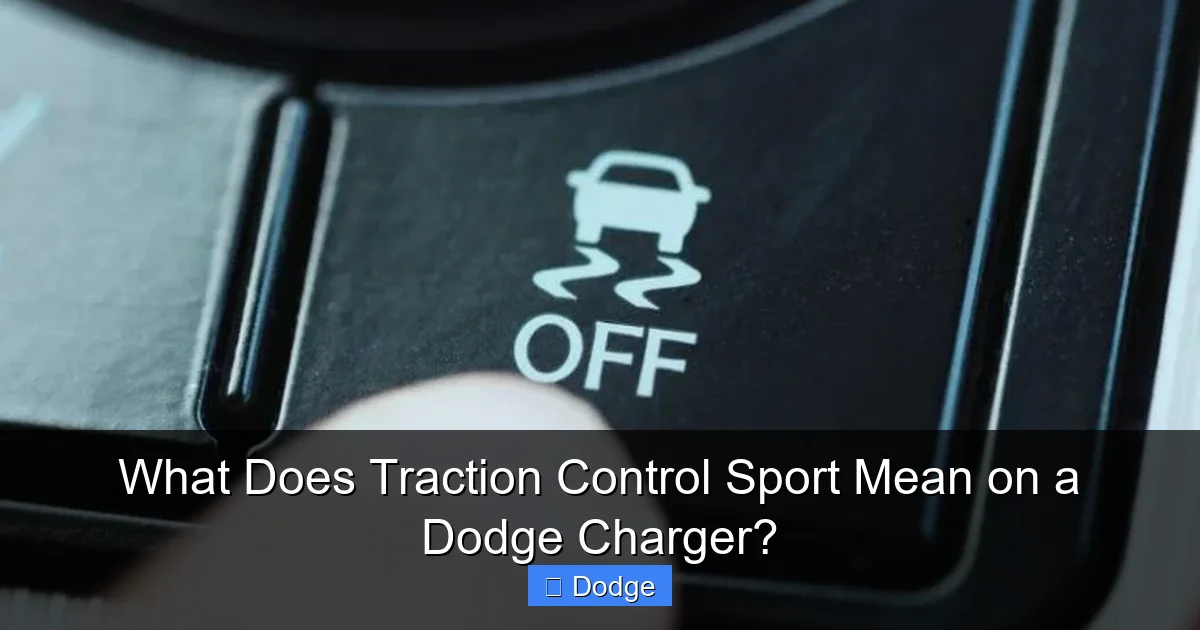
Activating Traction Control Sport on a Dodge Charger is simple. Most models have a dedicated button on the center console, usually labeled “ESC” or “Traction Control.” Here’s how it works:
1. **Press the button once:** This activates Traction Control Sport. You’ll usually see a message on the instrument cluster, like “Traction Control Sport” or “ESC Sport.”
2. **Press and hold the button (3-5 seconds):** This turns off ESC completely. You’ll see a warning light and message indicating that stability control is off. Only do this on a closed track or private road.
3. **Press the button again:** This returns the system to full traction and stability control.
Some higher-end models, like the Charger SRT or Hellcat, may have a drive mode selector (e.g., Sport, Track, or Custom modes). In these cases, selecting “Sport” or “Track” may automatically enable Traction Control Sport as part of the performance package.
Custom Mode and Personalization
On Charger models with customizable drive modes, you can often tailor Traction Control Sport to your preferences. For example, in “Custom” mode, you might be able to adjust:
– Throttle response
– Suspension stiffness (if equipped with adaptive dampers)
– Steering feel
– Traction control level
This lets you create a setup that balances performance and safety exactly how you like it. Want maximum power delivery with minimal intervention? Set traction control to “Sport” and throttle to “Sport+.” Prefer a slightly more conservative feel? Keep traction control in “Sport” but dial back the throttle sensitivity.
Traction Control Sport vs. Other Performance Modes
The Dodge Charger often comes with multiple drive modes: Normal, Sport, Track, and sometimes Custom. Each affects different systems, including the engine, transmission, suspension, and traction control. So how does Traction Control Sport fit in?
– **Normal Mode:** Full traction and stability control. Best for daily driving, especially in adverse weather.
– **Sport Mode:** Increases throttle response, firms up suspension (if equipped), and may activate Traction Control Sport. Great for spirited driving on dry roads.
– **Track Mode:** Found on SRT and Hellcat models. Optimizes all systems for maximum performance—engine, transmission, suspension, and traction control. Often includes launch control and reduced stability intervention.
– **Custom Mode:** Lets you mix and match settings. You could, for example, use Sport suspension with Normal traction control, or vice versa.
Traction Control Sport is often part of the Sport and Track modes, but it can also be activated independently. This gives you flexibility. You might want the sharper throttle of Sport mode but prefer full traction control for safety—no problem. Just activate Sport mode, then press the traction control button once to enable Sport-level intervention.
Performance Mode Synergy
When used together, these systems create a cohesive driving experience. For example, in Track mode on a Charger Hellcat:
– The engine delivers maximum power and torque.
– The transmission shifts faster and holds gears longer.
– The suspension stiffens to reduce body roll.
– Traction Control Sport allows aggressive launches and cornering.
This synergy turns the Charger from a comfortable cruiser into a track-ready machine—all at the push of a button.
Maintenance and Long-Term Considerations
Using Traction Control Sport regularly doesn’t require special maintenance, but it can affect wear and tear on certain components. Here’s what to keep in mind:
– **Tires:** More wheel spin means more heat and friction. Check tire pressure regularly and inspect for uneven wear. Consider upgrading to high-performance tires if you frequently use Sport mode.
– **Brakes:** Aggressive driving can increase brake wear. Listen for squealing or grinding, and have them inspected if you notice reduced performance.
– **Drivetrain:** The transmission and differential handle more stress during hard launches. Follow the manufacturer’s service schedule for fluid changes.
– **Suspension:** If your Charger has adaptive suspension, frequent hard cornering might affect the dampers over time. Pay attention to ride quality and handling changes.
Regular maintenance ensures your Charger stays reliable, even when you’re pushing it hard.
Conclusion
So, what does Traction Control Sport mean on a Dodge Charger? It’s a smart, performance-focused feature that gives drivers more freedom without sacrificing safety. By allowing controlled wheel slip and reducing electronic intervention, it enhances acceleration, cornering, and overall driving engagement. It’s perfect for dry roads, track days, or anytime you want to feel more connected to your Charger’s powerful rear-wheel-drive dynamics.
But remember—this mode is a tool, not a toy. Use it wisely. Avoid it in bad weather or low-traction conditions, and always prioritize safety. When used correctly, Traction Control Sport transforms the Charger from a comfortable muscle car into a thrilling performance machine.
Whether you’re a weekend warrior or just enjoy the occasional spirited drive, this feature adds a new dimension to the Charger experience. It’s one more reason why the Charger isn’t just a car—it’s a driving companion built for those who love the road.
Frequently Asked Questions
What is Traction Control Sport on a Dodge Charger?
Traction Control Sport is a performance mode that reduces electronic intervention, allowing more wheel slip during acceleration and cornering. It enhances driver engagement while maintaining a safety net for stability.
Is Traction Control Sport safe to use daily?
It’s not recommended for daily driving, especially in wet or icy conditions. It’s best used on dry, smooth roads or during spirited driving sessions where extra control is desired.
Does Traction Control Sport improve acceleration?
Yes, it allows more aggressive power delivery by permitting slight wheel spin during launches. This can result in quicker 0-60 times compared to standard traction control mode.
Can I turn off Traction Control Sport completely?
You can’t fully disable it with a single press, but holding the traction control button for 3-5 seconds turns off Electronic Stability Control entirely. This should only be done on closed tracks.
Does Traction Control Sport affect tire wear?
Yes, allowing more wheel spin can increase wear on rear tires, especially during hard launches. Regular tire inspections and proper inflation can help manage this.
Which Dodge Charger models have Traction Control Sport?
Most modern Charger models with V6 or V8 engines include this feature, especially those with Sport, SRT, or Hellcat trims. It’s often part of the performance or track drive modes.


